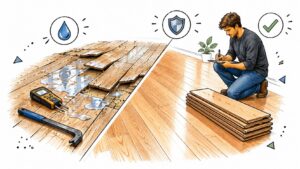
Minor water damage usually takes 3 to 5 days for full restoration, while major water losses can take several weeks to 2 to 3 months, and the most complex cases can stretch longer. That wide gap comes down to what kind of water entered the home, how far it spread, what materials got saturated, and whether hidden moisture is still trapped where you can't see it.
If you're reading this with wet carpet under your feet, a ceiling stain growing by the hour, or floodwater that just receded, the biggest question in your mind is probably simple: when does life go back to normal? The hard part is that water damage doesn't follow one tidy schedule. A clean-water supply line leak in one room behaves very differently from a sewage backup, and both are very different from a Central Texas slab home that looks dry on top but is still holding moisture below the floor.
Homeowners usually want one exact answer. In practice, the honest answer is a range, and a professional should be able to explain why your property falls where it does on that range. Fast action matters, especially in the first day. If you need context on why that first call changes the outcome, this guide on why fast action matters after water damage in Georgetown is worth reading.
The Short Answer and The Real Answer
The short answer is straightforward. A small, clean-water loss with a prompt response may dry and restore quickly, while a larger event with contamination, demolition, and rebuilding can become a much longer project.
The fact is that drying time and total project time are not the same thing. Homeowners often hear equipment will run for a few days and assume the whole job will be done at that point. Sometimes that's true. Sometimes it's not even close.
What a fast project looks like
For a minor incident, such as a single-room clean-water leak handled quickly, complete restoration typically takes 3 to 5 days according to this restoration timeline breakdown. In the smallest losses, if structural materials aren't compromised, the process from assessment to final repair can conclude in 24 to 48 hours according to that same industry timeline summary.
That kind of speed usually means the water source was stopped early, the moisture didn't migrate far, and there wasn't contamination or mold.
What a long project looks like
A severe loss is a different animal. When water affects multiple rooms, compromises structure, or requires major reconstruction, full completion typically takes 2 to 3 months, and reconstruction alone can account for 2 to 8 weeks according to this severe-loss restoration timeline guide.
Practical rule: If drywall, flooring, cabinets, baseboards, and subfloor all need attention, you're no longer asking only how long drying takes. You're asking how long drying, demolition, approvals, and rebuilding take together.
That distinction matters because most of the frustration homeowners feel comes after the visible water is gone. The floor may look dry. The house may smell better. But if moisture readings aren't back to dry standard, or if rebuilding materials haven't been approved yet, the project isn't ready to move forward.
The 5 Phases of Water Damage Restoration
A restoration job moves in a sequence. When that sequence is handled correctly, the house dries faster, the scope stays tighter, and the rebuild starts on a cleaner foundation.
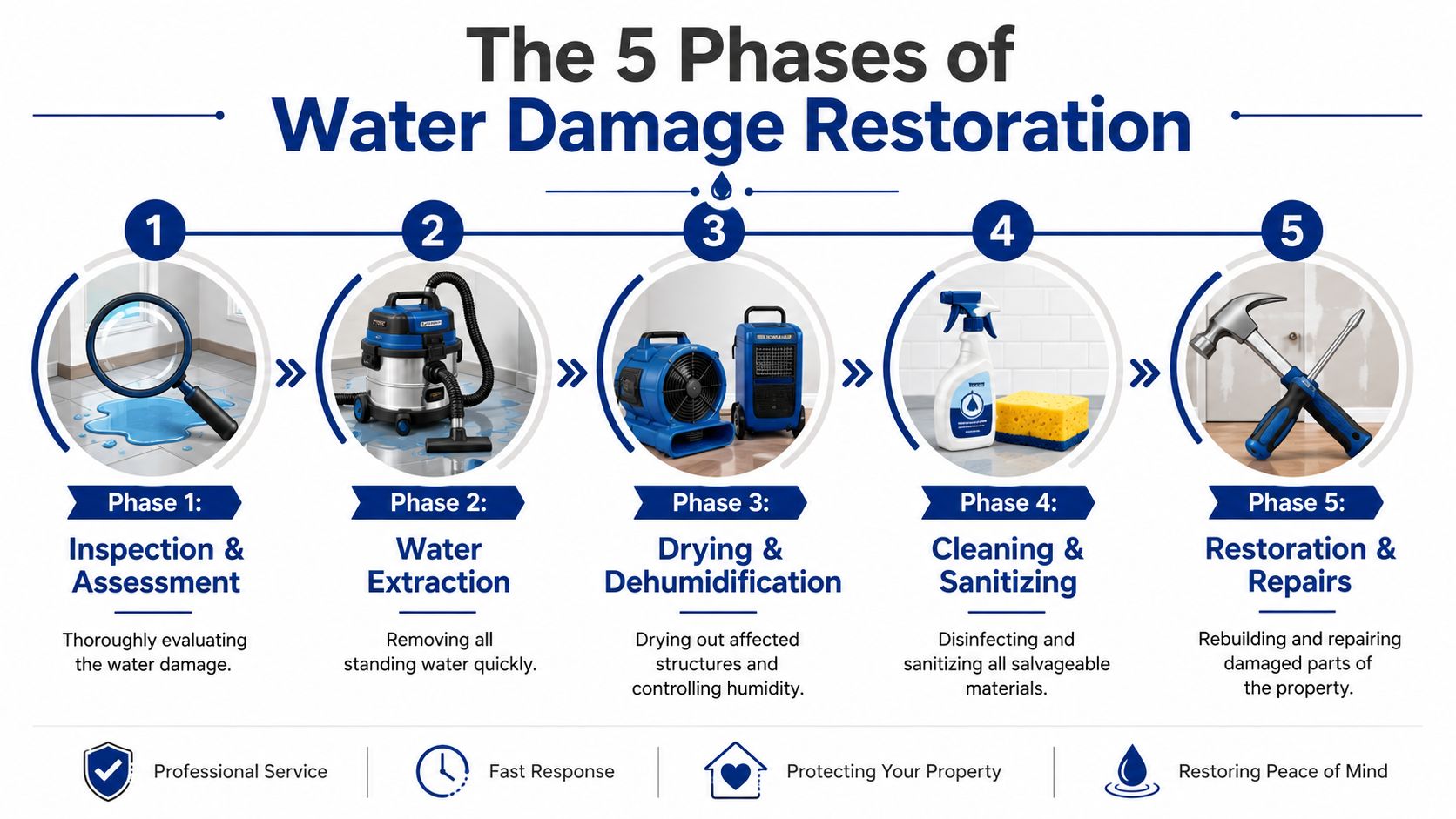
Phase 1 Inspection and assessment
This begins the moment the crew arrives. They identify the source, determine whether the water is clean, gray, or black, and map where moisture has traveled. That includes checking obvious surfaces and less obvious areas like wall cavities, under flooring, and behind cabinets.
The first emergency extraction stage usually happens within 1 to 6 hours, when professionals remove standing water and start moisture mapping, according to this restoration timing article.
A good assessment does two things at once. It protects the structure, and it prevents guesswork. Without moisture mapping, crews can miss wet insulation, damp sill plates, or a slab that's still releasing moisture under the floor covering.
Phase 2 Water removal and mitigation
This is the urgent part. Pumps, extractors, weighted wand tools, and truck-mounted or portable equipment remove as much liquid water as possible. The goal is simple. Get bulk water out before it migrates deeper.
This phase can be surprisingly fast in a small loss. But in a multi-room event, especially where water moved under flooring or into cabinetry, mitigation is more involved. Furniture may need to be blocked, baseboards may come off, and damaged materials may need to be opened up so trapped moisture can escape.
A delayed start makes this phase heavier. Water doesn't stay politely where it first landed.
Phase 3 Structural drying and dehumidification
This is usually the longest mitigation step. Air movers push evaporation. Commercial dehumidifiers pull moisture out of the air. Moisture meters, thermal imaging, and daily readings confirm whether materials are drying or just looking better on the surface.
For most residential projects, structural drying with dehumidifiers and air movers lasts 3 to 7 days before demolition or reconstruction begins, based on this drying timeline reference.
Here is where homeowners get tempted to rush. That's a mistake.
Dry isn't a visual judgment. Dry means the material has returned to an acceptable moisture condition, not that it feels less damp than yesterday.
If a crew pulls equipment too soon, moisture stays behind drywall paper, beneath plank flooring, or in framing members. That's how a "finished" job turns into odor, swelling, and microbial problems later.
Phase 4 Cleaning and sanitizing
Once the structure is drying or dry, the next step is cleaning salvageable materials and treating affected areas appropriately. This may include antimicrobial application where indicated, deodorization, and disposal of porous materials that can't be safely restored.
The timeline here varies because clean-water losses are much simpler than contaminated losses. A clean sink overflow and a sewage backup cannot be treated the same way, even if both affect the same square footage.
A practical difference homeowners notice is what stays and what goes. In a minor clean-water event, carpet and pad may be saved if conditions allow. In a contaminated event, demolition is usually more extensive.
Phase 5 Reconstruction and repair
This is the phase people often forget to count. Drywall replacement, texture, paint, trim, flooring, cabinets, and fixture resets all live here. If the loss was severe, this is the phase that stretches the calendar.
A severe water damage event involving structural compromise or extensive reconstruction typically requires 2 to 3 months to fully complete, with the drying and mitigation portion often resolving within 1 to 2 weeks, while the rebuild extends the total project duration, according to this reconstruction-focused timeline guide.
| Phase | What happens | Typical pace |
|---|---|---|
| Inspection | Source check, moisture mapping, safety review | Starts immediately |
| Water removal | Extraction, stabilization, initial tear-out if needed | Early emergency stage |
| Drying | Air movers, dehumidifiers, daily monitoring | Often the longest mitigation step |
| Cleaning | Sanitizing, deodorizing, selective disposal | Depends on water type |
| Reconstruction | Repairs and rebuild | Often the biggest schedule variable |
Key Factors That Extend or Shorten Your Timeline
Most homeowners ask, "Why is my neighbor's leak a three-day job and mine a three-week job?" The answer comes from the standard the industry uses to classify the loss.
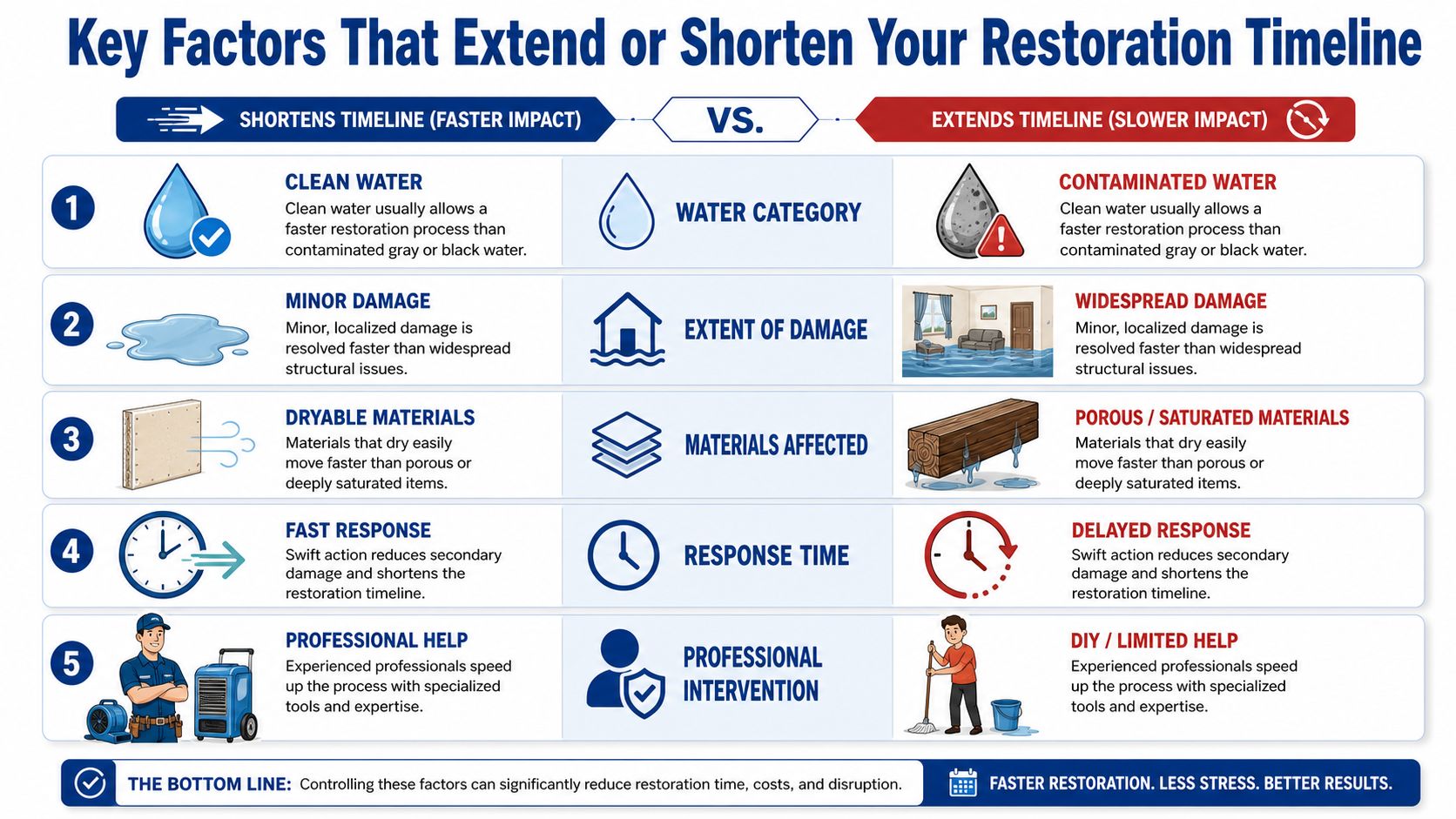
Water category changes the whole scope
The IICRC S500 framework looks at Water Category and Damage Class together. A Category 1, Class 1 loss may need 3 to 5 days of drying, while a Category 3, Class 4 loss can extend to 3 to 6 weeks including demolition and reconstruction, according to this IICRC-based restoration timeline explanation.
Think of category as the water's condition.
- Category 1 means clean water, such as a fresh supply line leak.
- Category 2 means water with a higher level of contamination, often from appliance discharge or similar sources.
- Category 3 means highly contaminated water, such as sewage or floodwater.
That difference isn't academic. It affects what can be cleaned, what must be removed, and how cautiously the crew has to work.
Damage class tells you how deeply the building got wet
Class is about absorption and penetration. A low-class loss affects less material and dries faster. A high-class loss means moisture has penetrated far into materials that are slow to give it back.
Materials matter a lot here:
- Drywall and insulation absorb quickly and often force selective demolition.
- Hardwood and dense materials can trap moisture below the surface.
- Concrete and slab systems can keep releasing moisture long after visible water is gone.
- Cabinet toe-kicks, wall bottoms, and subfloor layers often hold hidden wet zones that household cleanup misses.
A Class 4 condition is especially slow because low-permeability materials need longer monitoring and stronger vapor pressure control to reach equilibrium moisture content, as described in the same IICRC-based drying standard reference.
If someone promises a fixed timeline before they've checked category, class, and affected materials, they're guessing.
Response time helps or hurts
Speed changes everything. The longer water sits, the farther it moves and the more demolition may be needed later. Homeowners who want to understand that mold window in plain language can read this article on how long it takes for water damage to become mold.
What doesn't work is waiting to "see if it dries on its own." By the time a baseboard swells, flooring cups, or a musty odor shows up, the moisture has usually traveled beyond the original wet spot.
The Central Texas Factor Slab Homes and Flash Floods
National articles often miss the issue that shows up over and over in Austin and Georgetown homes. The floor looks dry, the air feels better, and the homeowner is ready for new flooring. But the slab below is still wet.
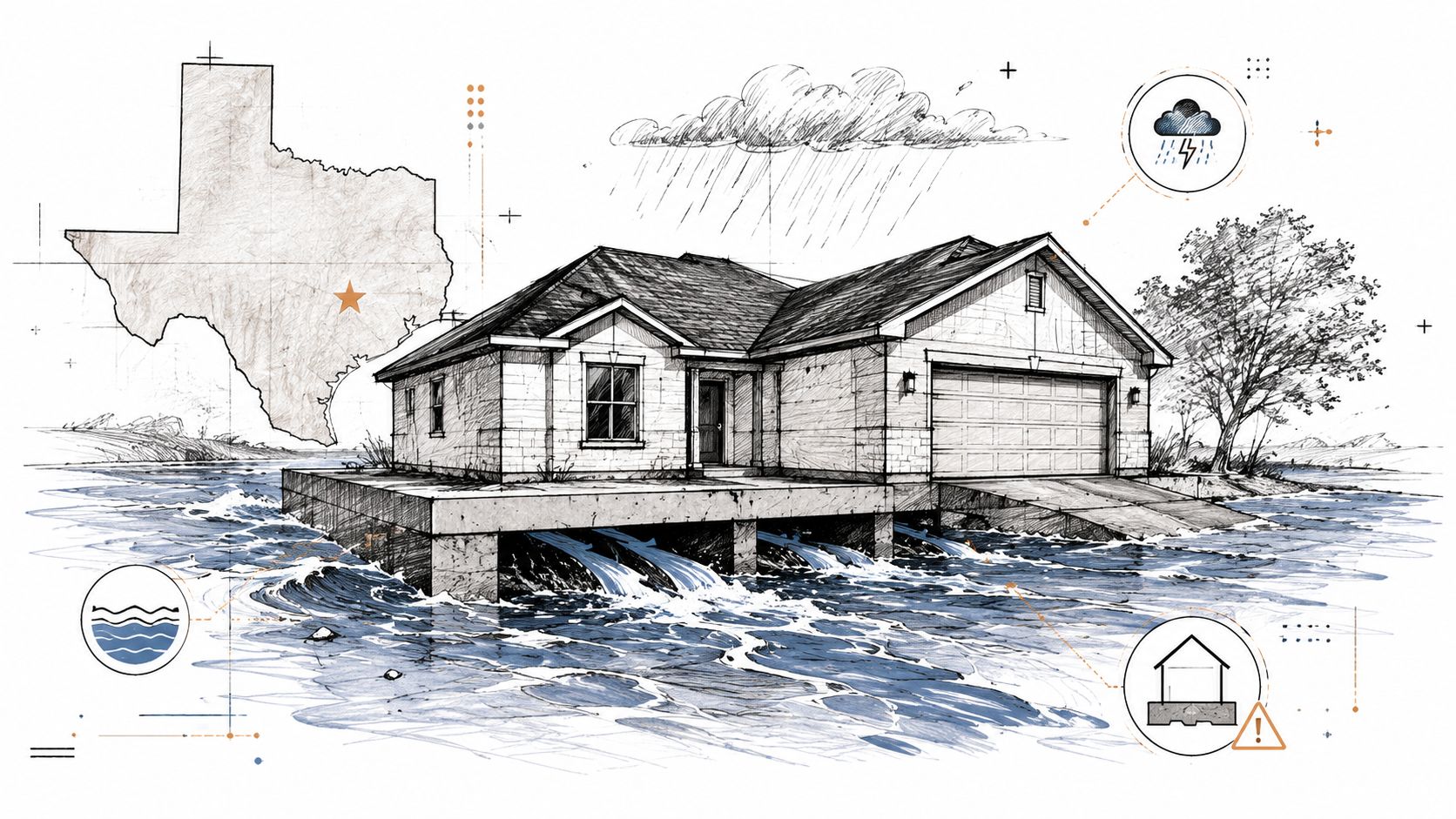
Hidden slab moisture is a real timeline driver
In concrete-slab homes common in Austin and Georgetown, concrete can retain moisture for 10 to 21 days beyond visible dryness, and if water sat for more than 48 hours, mitigation can take 7 to 14 days with drying equipment often needed for an additional 5 to 10 days before new flooring goes down, according to this Central Texas slab-drying article.
That's the hidden-slab moisture lag. It's one of the biggest reasons a floor replacement gets delayed after the home "looks fine."
What this looks like in real homes
A common Central Texas scenario is a first-floor leak in a slab-on-grade house after heavy rain, a plumbing failure, or water entering through a vulnerable opening. Surface water gets extracted fast. Baseboards come off. Air movers run. But moisture remains trapped in the slab and under flooring adhesives.
If new flooring is installed too early, the problem doesn't stay buried. The adhesive can fail, the flooring can warp, and moisture can support secondary microbial growth where no one sees it until odor or visible damage appears.
Floors don't get replaced because the top looks dry. They get replaced when the slab tests dry enough to support the new material.
Flash floods make this trickier. Water doesn't always enter neatly through one room. It can move across thresholds, soak perimeter walls, and load moisture into lower materials all at once. This local guide on how heavy rain and flash floods cause water damage in Georgetown reflects the kind of event that often turns a simple dry-out into a broader mitigation job.
Why local judgment matters
Crews who work slab homes regularly know where moisture lingers. They check under flooring transitions, exterior wall lines, and rooms that seem unaffected but share the same slab plane. That's the kind of detail that keeps a repair from failing after the house is put back together.
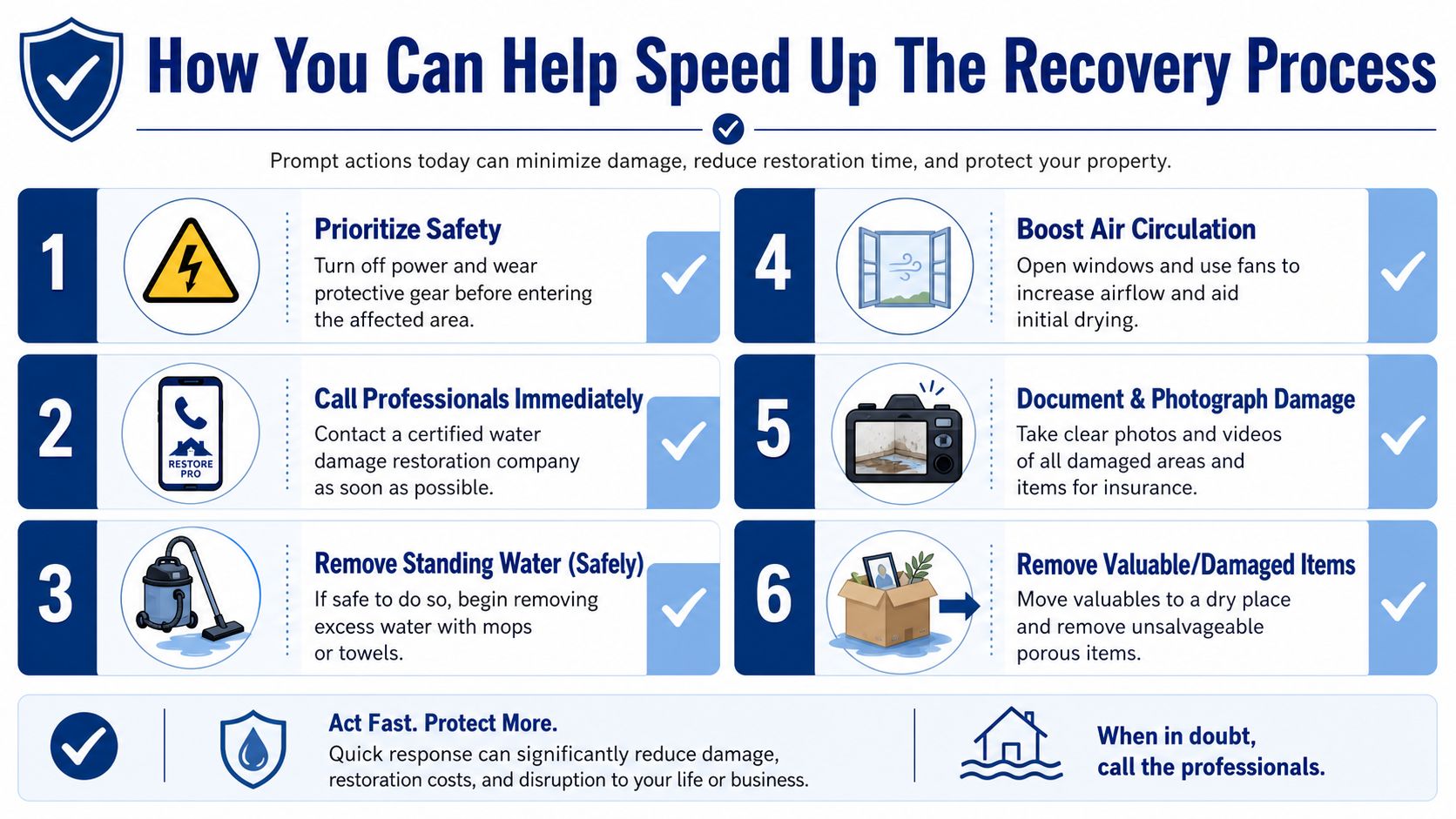
How You Can Help Speed Up The Recovery Process
Homeowners can't do professional drying on their own, but they absolutely can influence how smoothly the job goes. The biggest gains come from what happens in the first hours.
What helps
Rapid emergency mitigation, meaning extraction within 0 to 24 hours, can reduce total drying time and associated costs by up to 30%, and mold growth typically begins at 24 to 48 hours, according to this field-data analysis of rapid response and engineered drying.
That makes your first moves important:
- Shut off the source if you can do it safely. A supply line, appliance valve, or main shutoff can stop the damage from spreading.
- Protect people first. If water is near outlets, appliances, or sagging ceilings, don't wade in casually.
- Document the loss. Photos and video taken before cleanup help with the claim and with scope discussions later.
- Move contents out of the wet zone. Pick up rugs, boxes, electronics, and valuables if the area is safe to enter.
- Make access easy. Crews lose time when affected rooms are blocked by furniture or stored items.
What slows things down
Some well-meant homeowner actions create bigger restoration problems.
| Don't do this | Why it backfires |
|---|---|
| Wait a day or two | Water keeps migrating into walls, flooring, and cabinets |
| Assume surface dryness means structural dryness | Hidden moisture often remains in subfloors, framing, or slab |
| Use random household fans on contaminated water | Airflow can spread contaminants and odor through the home |
| Install new materials before dry standards are met | Repairs can fail and require reopening the area |
Open windows or use light airflow only if the environment and water type make that safe. The goal is to avoid trapping moisture, not to improvise a full drying plan with box fans from the garage.
A good restoration outcome is usually the result of two things working together. The homeowner acts fast and avoids making the situation worse. The mitigation crew verifies, instead of assuming, that the structure is dry.
Partnering with a Full-Service Restoration Expert
Water damage isn't one task. It's a chain of tasks that depend on each other. Source control affects extraction. Extraction affects drying. Drying affects what can be saved. Moisture readings affect when reconstruction can begin.
That is why projects bog down when too many handoffs happen between unrelated vendors. One company tears out materials. Another one sets equipment. A third one comes later for repairs and finds the area wasn't ready. The homeowner ends up reliving the same loss twice.
A full-service restoration partner solves a practical problem. One team documents the damage, manages mitigation, tracks drying, handles microbial prevention concerns, coordinates rebuild work, and keeps communication consistent from start to finish. That doesn't just feel better. It usually means fewer delays, fewer misunderstandings, and fewer surprises.
For a homeowner in Georgetown or Austin, local experience matters too. Central Texas homes, slab construction, storm patterns, and flash-flood conditions create issues that generic national advice often overlooks. A team that understands those local conditions is more likely to make the right calls the first time.
If you're dealing with a leak, overflow, backup, or flood in Georgetown or Austin, RestoTek TX can help you through the full process, from inspection and water extraction to structural drying, microbial prevention, and reconstruction. Joan and Josh Garza's team offers 24/7 response, clear guidance, and local Central Texas experience so you can move from emergency cleanup to a finished repair with one coordinated partner.