
Water is still dripping, the air smells wrong, and every room seems to raise a new question. Is the floor ruined? Can you touch that outlet? Should you start pulling up baseboards, or wait for insurance? Most Austin homeowners hit this moment with the same mix of panic and urgency. They want to act fast, but they don't want to make the damage worse.
That's a hard place to be, especially after a Central Texas storm or an indoor flood that got out of hand before anyone caught it. One room turns into three. A closet wall feels cool to the touch. Cabinets look fine from the front, but the toe-kick is swollen. You can see some of the damage, but you already know there's more you can't see.
Flood damage restoration in Austin, TX isn't just about removing visible water. The core job is getting a structure dry, clean, and stable before repairs close everything back up. That's where many projects go wrong. Homeowners get extraction from one crew, repairs from another, and hidden moisture gets missed in the handoff. Weeks later, the paint bubbles, the flooring cups, or mold shows up inside a wall cavity that looked “done.”
A good restoration plan gives you control again. It starts with safety, moves into documentation and mitigation, then follows through with structural drying, cleanup, and repair in the right order. If you know what to expect, you can make better calls under pressure and avoid the shortcuts that cost the most later.
After the Flood Waters Rise in Austin
The call often starts the same way. A homeowner walks into a room after a storm and hears the soft squish under a sock, or opens the front door and sees water lines on the sheetrock. In Austin, that can happen after heavy rain, flash flooding, a failed water heater, a supply line break, or a drain backup that turns one bad hour into a house-wide problem.
The first shock is real. People usually focus on what they can see first. Wet rugs. Swollen baseboards. Brown water marks. Furniture legs sitting in water. Then the second wave hits. What's behind the wall? Is the subfloor soaked? Did the water get under the cabinets? Is this safe for kids or pets?
What homeowners notice first
Visible damage gets attention because it's obvious. Hidden damage causes the longer headache.
A flooded room can look straightforward until you start tracing where water traveled. In Austin homes, water often moves farther than people expect. It can wick into drywall, migrate beneath plank flooring, settle under underlayment, and hang in wall cavities long after the standing water is gone. In a humid climate, that trapped moisture doesn't dry quickly on its own.
The house doesn't have to look disastrous for the damage to be serious. A small-looking loss can hide a large drying job.
That's why calm, ordered action matters more than frantic cleanup. Pulling out a few wet items helps. But if the structure stays wet, cosmetic cleanup only buys temporary relief.
What recovery should look like
The right approach is steady, not dramatic. Secure the property. Protect people first. Document everything before cleanup changes the scene. Then make sure the work moves in the right sequence: extraction, drying, sanitation where needed, and only then repair.
This is also where local experience matters. Austin homes deal with heavy rain, flash flood conditions, and the kind of humidity that keeps enclosed materials wet longer than owners expect. A contractor who understands that pattern will look beyond the puddle in the room and check the materials surrounding it.
Homeowners don't need to know every trade detail on day one. They do need to know one key truth: flood recovery is not a race to make the room look normal. It's a process of making the structure dry and safe before finishes go back on.
That distinction can save a lot of money, time, and frustration.
Your Immediate Flood Damage Checklist
The first day matters most. The priority isn't cleaning. It's preventing injury, preserving evidence, and stopping the loss from spreading.
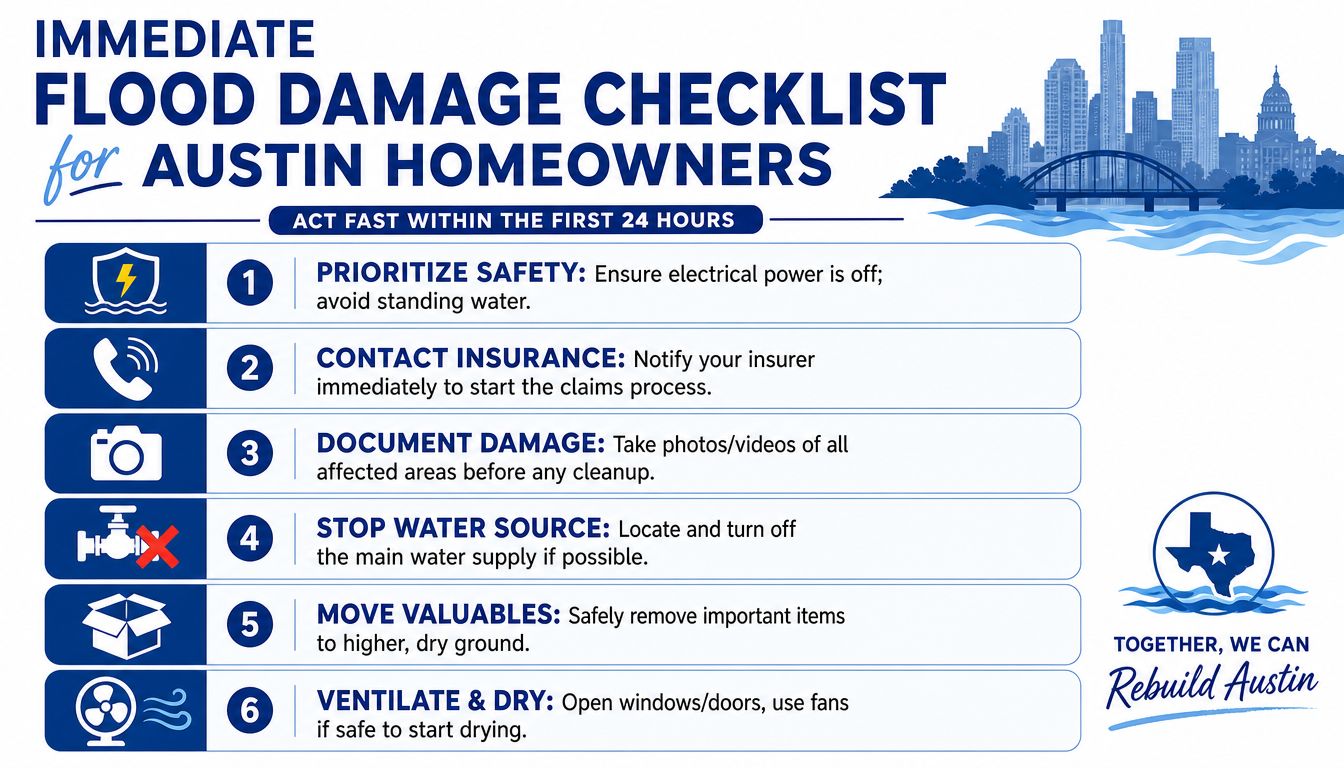
Start with safety
If water has reached outlets, appliances, extension cords, or electrical panels, stay out of the affected area until power is safely shut off. If you can't do that without entering standing water, call for help first.
Safety first: Don't walk into standing water where electricity may still be active, and don't assume clear water is clean.
If the source is a burst line or plumbing failure, shut off the main water supply as soon as you can. If the water came from outside flooding or a sewage-related backup, treat it as contaminated until a professional says otherwise.
Do these steps before cleanup changes anything
A lot of insurance trouble starts when homeowners throw things away too quickly or begin tearing out materials before documenting the loss.
Use this order:
- Take wide and close photos of every affected room.
- Record video while narrating what happened and what got wet.
- Capture contents such as furniture, rugs, electronics, boxes, and stored items.
- Photograph water lines on walls, cabinets, doors, and exterior surfaces.
- Keep damaged items until your carrier or adjuster tells you what can be discarded.
If you need a practical reference while you're moving through those first decisions, this guide on what to do immediately after water damage in your Central Texas home is useful to keep open on your phone.
Protect what you can without creating more risk
Once the scene is documented, move portable valuables to a dry area if it's safe to do so. That usually means:
- Important papers and photos moved to a dry table or upper floor
- Electronics unplugged only if the area is safe
- Textiles and soft goods separated so moisture doesn't spread
- Furniture legs lifted off wet flooring with blocks or foil if salvageable
Open interior doors and, if weather allows, open windows to promote airflow. Fans can help only if the power situation is safe and the water isn't contaminated. Homeowners often overestimate what a few box fans can do. They can support air movement, but they don't replace professional drying.
Make the first two calls
Call your insurance carrier early. Ask what they want documented, whether an adjuster will inspect in person, and what emergency mitigation they expect you to perform.
Call a restoration company next, especially if there is standing water, wet drywall, affected flooring, or any sign that water entered cavities or subfloors. The standard restoration methodology begins with emergency water extraction using truck-mounted pumps to remove standing water within 24 to 48 hours to help prevent structural compromise and mold colonization, as outlined by The Steam Team's Austin water damage restoration overview.
A good first-day response doesn't solve the whole loss. It buys time, protects health, and keeps the project from becoming larger than it already is.
The Restoration Process from Extraction to Drying
Homeowners usually picture restoration as pumps, fans, and torn-out carpet. That's part of it, but the actual work is more precise than many expect. Good flood damage restoration in Austin, TX follows a sequence. If that sequence breaks, the property may look repaired while moisture is still trapped inside.
Extraction is only the first layer
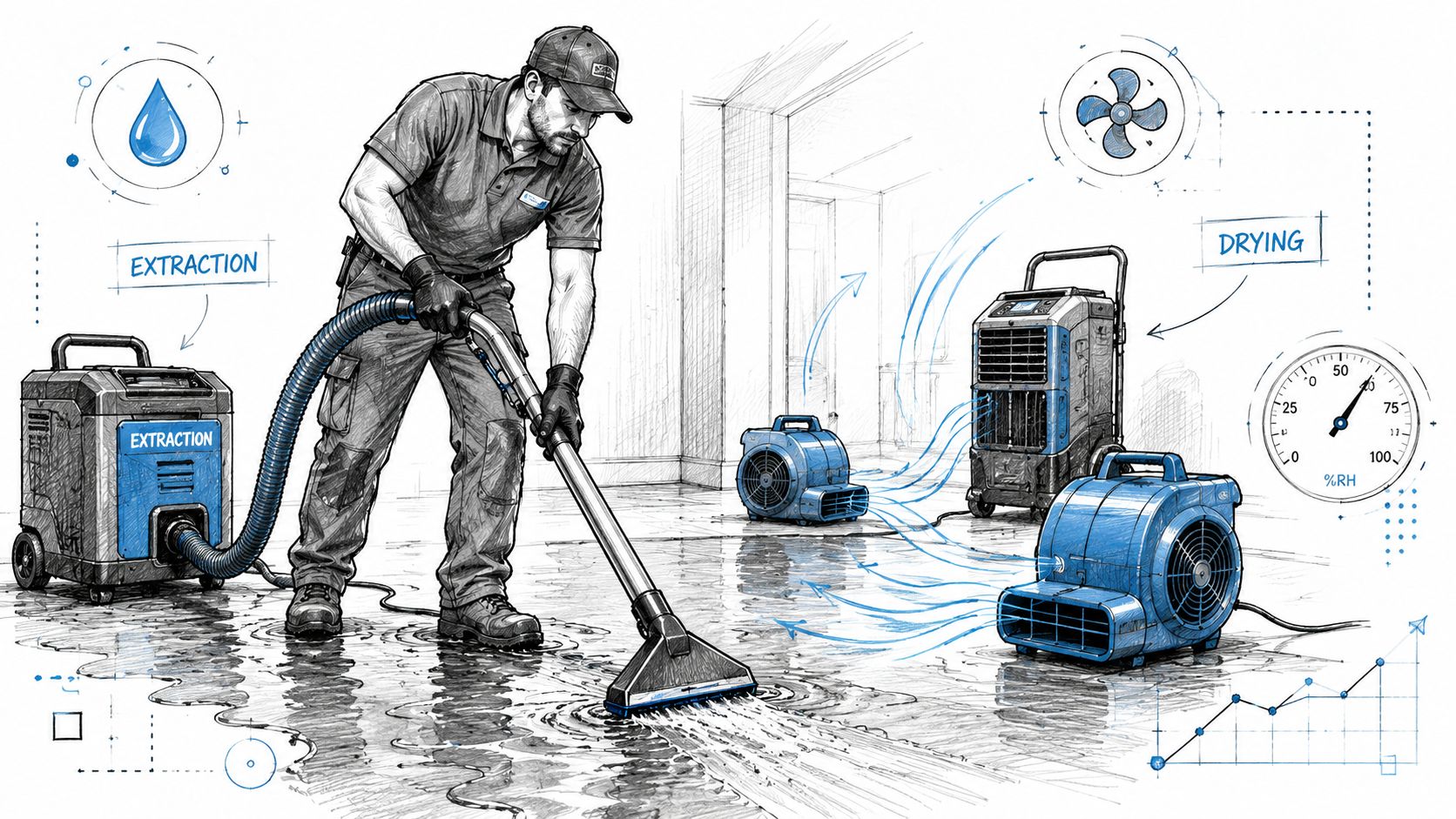
The first visible phase is water removal. Crews use truck-mounted extraction or other high-capacity equipment to pull standing water from floors and saturated materials. If certain finishes can't be saved, technicians remove them to expose the wet areas beneath.
That part is important, but it's also where many homeowners get a false sense of progress. Once the water is gone from the surface, the room looks dramatically better. The problem is that walls, insulation, framing, subfloors, and cabinetry components may still hold moisture.
A room can appear dry while the structure is still wet.
The drying-versus-repair gap
This is the issue often overlooked until it becomes expensive. One company may handle extraction. Another may handle reconstruction. Between those two steps, hidden moisture needs to be found, measured, and dried to an acceptable standard before anything gets closed back in.
That handoff is where projects fail.
According to local industry analysis citing IICRC studies, 80% of post-restoration mold claims stem from inadequate drying of hidden moisture, not the initial visible water, as noted in this discussion of why hidden structural drying matters.
If a contractor can't explain how they verify hidden areas are dry, they're talking about appearance, not restoration.
Austin's humidity makes that gap more risky. Materials don't always release moisture quickly, especially in enclosed assemblies. Drywall may feel normal at the painted surface while the backside stays wet. Flooring may seem stable until residual moisture starts pushing it upward.
What proper structural drying looks like
Professional drying is measured, not guessed. Technicians should inspect beyond the obvious wet zone and use tools to identify moisture that can't be seen.
That usually includes:
- Moisture mapping to trace where water traveled through connected materials
- Thermal imaging cameras to help locate cooler, moisture-affected areas behind finishes
- Moisture meters to check walls, trim, flooring, and subfloors
- Industrial air movers and dehumidifiers placed to dry materials, not just the room air
An end-to-end provider matters. Some firms can tear out and rebuild well. Others can extract water quickly. Fewer handle the full path from mitigation through structural drying and reconstruction under one scope. Structural drying in Central Texas is the point where a complete provider can keep the project from stalling between trades.
Cleaning, treatment, and rebuild
After drying reaches the target condition, the next phase depends on the category of water and the materials affected. Contaminated losses may require disposal of porous materials, antimicrobial treatment, and deeper cleaning of contents and structural surfaces. Odor treatment also belongs here, not at the very end as a cosmetic add-on.
Then repairs can begin. Drywall goes back. Trim gets replaced. Flooring decisions get made based on what can be salvaged. Paint and finish work come last.
Here's the practical trade-off homeowners should understand:
| Approach | What it looks like at first | What usually happens later |
|---|---|---|
| Fast cosmetic repair | Rooms look normal sooner | Hidden moisture can trigger odor, staining, swelling, or mold |
| Verified drying before rebuild | Progress feels slower early | Repairs are more likely to hold because materials were dry before closure |
That's why the middle phase matters so much. Extraction gets attention. Repairs get attention. Drying is quieter, less visible, and often the part that determines whether the whole project succeeds.
Managing Insurance Claims and Restoration Costs in Austin
At 7 a.m., the water is gone, but the financial mess is just starting. A carrier wants photos. A mitigation crew wants approval. You are trying to protect the house without agreeing to work you do not fully understand.
Understand what drives the price
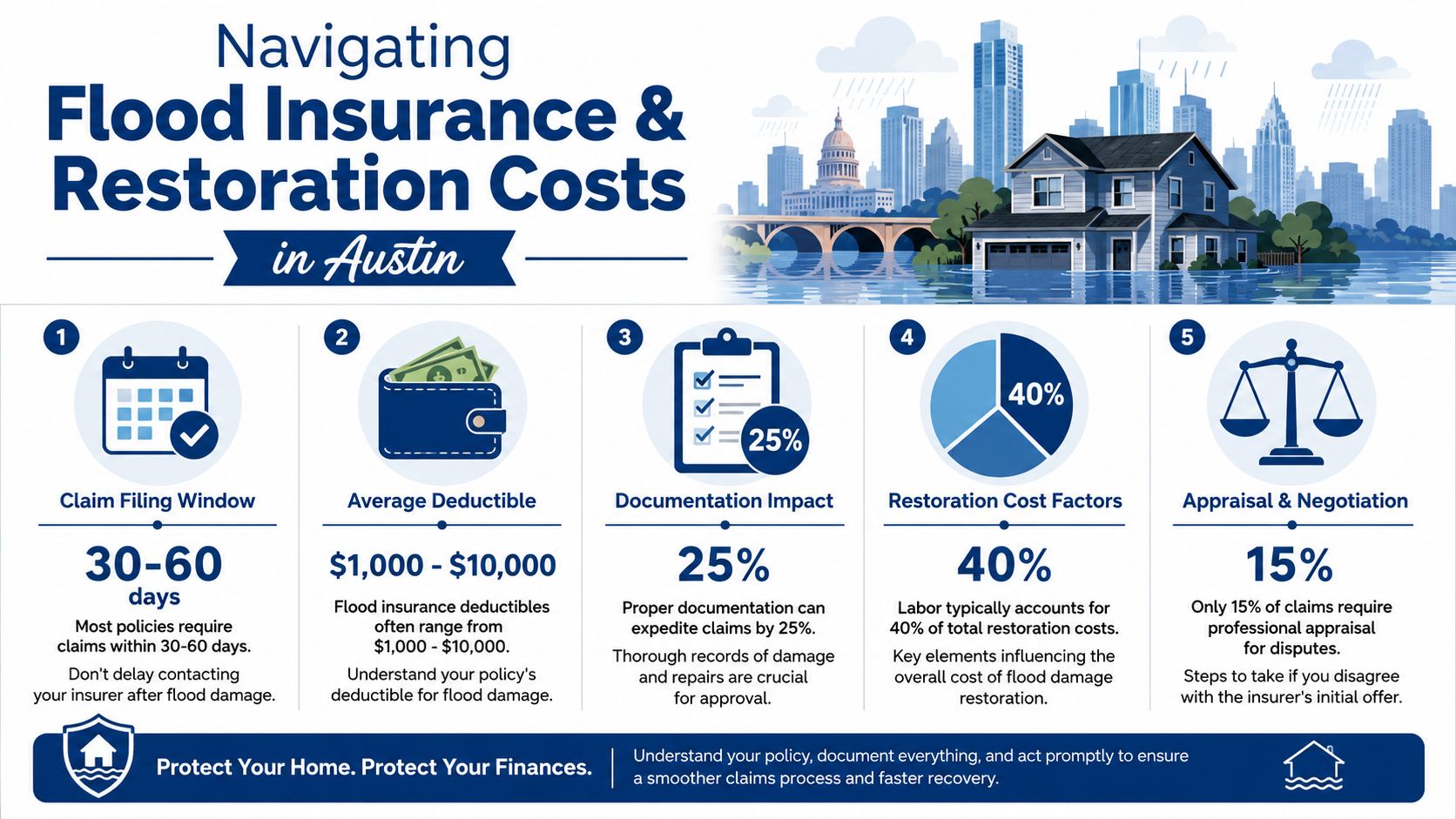
In Austin, the total bill usually turns on three things. The category of water, how far the moisture traveled, and whether the structure was dried correctly before repairs start.
Per Angi's Austin water damage cost guide, restoration costs in Austin range from $4.76 to $11.89 per square foot, with clean water averaging $5.55 per square foot, gray water costing $8.32 per square foot, and black water reaching $11.89 per square foot. The same source states that the average project cost is $6,101, and labor ranges from $111 to $317 per hour.
Those numbers help set expectations, but they do not show the whole risk. In this market, the expensive mistake is often the gap between water removal and final repairs. One company extracts water. Another bids the rebuild. Hidden moisture in wall cavities, subfloors, or framing sits in the middle, especially in Austin humidity. If that drying phase is rushed or poorly documented, the homeowner can end up paying twice. Once for the visible repair, then again when swelling, odor, or mold shows up later.
Black water losses also change the scope fast. More materials usually have to be removed, disposal rules are tighter, and cleaning standards are stricter.
Read the estimate line by line
A flood estimate should break the job into clear phases. Emergency extraction is one line. Demolition is another. Drying equipment, monitoring visits, moisture mapping, treatment, contents work, and repairs should each be identifiable.
That matters because plenty of disputes start with a vague scope. A homeowner thinks the approved amount covers the whole job. The carrier believes it only covers mitigation. The contractor finishes drying, then a second estimate appears for reconstruction.
If you are comparing proposals, this breakdown of home water damage repair cost shows how mitigation, drying, and repair are often separated on paper.
Some Austin-specific examples from Angi's cost guide can help you benchmark common repair items:
| Repair area | Austin cost range |
|---|---|
| Roof repairs for water damage | $634 to $3,170 |
| Drywall fixes | $476 to $1,347 |
| Basement repairs | $793 to $4,438 |
| Mold removal alone | $1,902 to $6,023 |
Use those numbers as a rough check, not a substitute for a proper scope.
Treat the claim like a documented project
Insurance files move better when the record is complete. Keep one folder for photos, video, room-by-room notes, contractor scopes, moisture readings if your contractor provides them, hotel or meal receipts, and every email with the carrier.
I tell homeowners to document the middle of the job, not just the beginning and end. The drying-versus-repair gap shows up here too. If insulation, cabinets, baseboards, or flooring are removed to expose wet materials, photograph that. If the contractor is monitoring moisture over several days, save those records. Adjusters do not watch the job unfold in real time. Your file has to show why the work was necessary.
Ask direct questions early:
- What emergency services can start before formal approval
- Do damaged materials need to be kept for inspection
- Will you review drying logs or moisture reports
- How should supplements be submitted if hidden damage appears after demolition
- Is reconstruction covered under this claim, or only mitigation and dry-out
A clean paper trail will not solve every disagreement. It does give you a stronger position if the carrier questions scope, timing, or cost.
How to Choose the Right Austin Restoration Contractor
You call one company at 2 a.m., another at 7, and by lunch three different crews have offered three different plans. One wants to pull wet drywall right away. Another says fans will handle it. A third is ready to talk about flooring before anyone has checked the wall cavities. That is how homeowners get pushed into the drying-versus-repair gap, and in Austin, that gap causes trouble fast.

The contractor matters because flood work is not one job. It is a chain of jobs that has to stay connected. Water extraction, demolition, structural drying, moisture verification, cleaning, and rebuild all affect each other. If one company removes wet material and another company repairs later without clear drying records in between, hidden moisture gets buried behind new finishes.
Ask how they dry the structure
Fast response still matters. So does a clear drying plan.
A reliable contractor should explain how they inspect for moisture you cannot see, what tools they use, what materials can stay, what has to come out, and how they verify dry conditions before reconstruction starts. If the conversation jumps from standing water straight to paint colors or cabinet replacement, slow the process down and ask harder questions.
Firms like RestoTek TX handle inspection, mitigation, structural drying, microbial prevention, and reconstruction under one scope. That reduces the chance that drying gets treated like a handoff between trades instead of a tracked phase of the same job.
Vet the contractor like this
Use a short checklist. After a major storm, out-of-area crews often show up with good sales scripts and very thin documentation.
- Ask about certification and insurance. They should explain their training, license requirements where applicable, and proof of coverage without dodging.
- Ask who is performing the rebuild. Some companies dry the house, then pass reconstruction to unrelated subs who did not see the original damage.
- Ask how moisture is documented. Look for moisture readings, affected-area mapping, daily monitoring, and a final drying target before repairs begin.
- Ask about Austin experience. Central Texas humidity changes how long materials hold moisture, especially inside wall cavities, under flooring, and around insulation.
- Ask for a written scope. You need line-of-sight into what is included now, what depends on demolition findings, and what may require a supplement.
One more test helps. Ask them to walk you through the project in order. A good contractor can explain the sequence room by room without talking in circles.
Judge the timeline honestly
Flood restoration takes as long as the materials take to dry, plus the time needed to rebuild correctly. Initial mitigation and drying often lasts several days. Full restoration usually runs longer once demolition, cleaning, inspections, and repairs are added.
The exact timeline changes with water category, how long the materials sat wet, what is trapped behind cabinets or under floors, and whether insurance approvals slow the rebuild. Austin homes can hold moisture longer than homeowners expect because humid outdoor air makes drying less forgiving.
A trustworthy contractor gives you a sequence, moisture checks, and clear stop points before repairs start.
Price and response time matter. The better hiring decision usually comes down to one thing. Choose the contractor who can show, in plain language, how your house goes from wet to verified dry to rebuilt without skipping the middle.
Long-Term Flood Prevention for Your Central Texas Home
Once the house is dry and repaired, most homeowners want one thing more than anything else. They want to avoid going through it again.
That starts with maintenance, but it shouldn't stop there. Central Texas homes benefit from both routine water management and smarter rebuilding choices after a loss.
Start outside the house
A lot of flood prevention is simple and unglamorous.
- Keep gutters and downspouts clear so roof runoff doesn't dump at the foundation.
- Check grading around the house and make sure water moves away, not back toward slab edges or crawl access points.
- Watch hardscape drainage near patios, walkways, and driveways where water may collect and redirect toward doors.
- Trim back problem landscaping if it traps water against exterior walls.
Inside the house, know where the main shutoff is, replace aging supply lines, and pay attention to small leaks before they become cabinet, wall, or flooring losses.
Rebuild with flood resistance in mind
Some prevention choices happen only when repairs are already underway. That's when homeowners can make upgrades that reduce future damage potential.
You may decide to raise vulnerable components, choose more water-tolerant finish materials in previously affected spaces, or improve drainage with permeable surfaces around the property. That lines up with the Flood Adaptation Hierarchy, which prioritizes restoring natural floodplains and relocating communities before building defenses. Homeowners can apply the same logic on a smaller scale by using passive adaptations such as raising structures or selecting permeable materials during restoration, as discussed in Ecology and Society's article on flood adaptation hierarchy.
Think in layers
The most resilient homes don't rely on one fix. They combine maintenance, drainage, material choice, and faster response when something goes wrong.
If your property has flooded before, don't just restore the same assembly and hope for a different result. Ask where the water entered, where it traveled, which materials failed first, and what can be changed now while the walls and floors are open. That's usually the cheapest moment to make the house harder to damage next time.
If you're dealing with an active loss or trying to make sense of the next step, RestoTek TX provides flood and water damage help in Austin and Central Texas, including inspection, extraction, structural drying, microbial prevention, and reconstruction. A clear scope and a drying-first process can make the recovery far less chaotic.