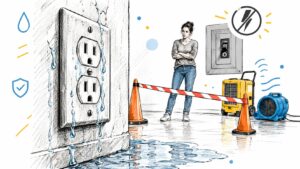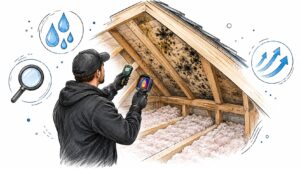
You're probably here for one of two reasons.
Either you found a damp baseboard, a musty laundry room, or a wall that still feels cool days after a leak, and now every company online says it's “certified” for mold remediation. Or you work in restoration, want to move beyond basic demo and drying, and need to know which credentials matter in Texas.
Both problems lead to the same question. What does qualified really look like in mold remediation?
That question matters more now because this isn't a side service anymore. The global mold remediation service market reached USD 1,234.6 million in 2023 and is projected to reach USD 1,516.8 million by 2030 according to Grand View Research's mold remediation market report. When an industry matures into a defined service category, credentials start separating trained operators from guys with a fogger and a business card.
In Texas, that distinction isn't academic. A humid structure after a plumbing leak can turn into a contamination problem fast. Homeowners need to know how to verify who they're hiring. Technicians need to know which training prepares them for real containment, drying, cleaning, documentation, and verification, not just sales language.
The Certified Expert vs The Weekend Warrior
A common Central Texas call starts the same way. A homeowner in Georgetown pulls the washing machine out, finds black spotting on the wall, and remembers the supply line dripped for who knows how long. The room smells stale. The baseboard is swollen. Someone online says, “Spray it with bleach.” Another says, “Any handyman can remove it.” Then three contractors show up, and all of them claim they're certified.
That's where people get burned.
A certified expert understands that mold remediation isn't just about killing visible growth. The job is to identify the moisture source, define the affected materials, isolate the work area, prevent cross-contamination, remove what can't be cleaned, clean what can be saved, and verify the structure is ready for rebuilding. A weekend warrior usually skips straight to wiping surfaces and spraying chemicals.
The difference shows up in the tools they reach for and the questions they ask. A trained crew talks about moisture mapping, containment, HEPA vacuuming, air filtration, and whether the HVAC needs protection. An unqualified operator talks mostly about “treatment.”
Practical rule: If the plan sounds like “spray and go,” it's not a remediation plan.
That's also why homeowners should learn what professionals use in the field, not just what appears in an estimate. This overview of what professionals use for mold remediation gives a useful baseline for the equipment and workflow a real contractor should be able to explain.
What the qualified pro does differently
- Finds the moisture source first. If the leak, humidity issue, or drainage problem isn't corrected, mold comes back.
- Builds containment before disturbing materials. Cutting drywall without containment can spread spores and debris into clean rooms.
- Treats the job as a building problem, not just a cleaning problem. Wet framing, insulation, subfloors, and duct runs all change the scope.
- Documents the process. Photos, moisture readings, and job logs protect the homeowner and the contractor.
Why this matters to both readers
If you're an aspiring technician, credentials aren't just resume padding. They prove you understand the sequence of work and the reasons behind it.
If you're a homeowner, credentials help you filter out risky operators before they open a wall in your house.
That's the fundamental divide. The expert follows a process because contamination control matters. The weekend warrior improvises because he doesn't know what he doesn't know.
Navigating the Alphabet Soup of Mold Certifications
It's common to see a badge on a website and assume all certifications mean the same thing. They don't.
Some credentials focus on restoration methods. Others focus on environmental and microbial specialties. Some apply to the company, while others belong to the individual technician standing in your hallway.
The names that come up most often
The IICRC is the credential family many restoration contractors know first. Its training tracks are tied closely to field procedures used in water damage and microbial remediation. That matters because effective remediation follows a structured seven-step workflow aligned with EPA and ASHRAE guidance, including assessment, containment, removal, HEPA vacuuming, and verification, as described in this overview of effective mold remediation practices.
The ACAC sits in a different lane. It's known for environmental certifications tied to assessment, investigation, and specialized microbial work. In practice, homeowners may encounter ACAC credentials on consultants, assessors, or supervisors, while restoration firms more often highlight IICRC training on the remediation side.
The first thing to ask is simple. Is the credential tied to the person, the company, or both?
Company certification vs individual certification
A company can advertise that it's IICRC-certified, but that doesn't automatically tell you what the crew in your home has studied. A technician with specific training in microbial remediation has a more relevant qualification than a generic logo placed on a homepage.
For homeowners, this is the useful distinction:
- Company-level recognition tells you the business participates in an industry framework.
- Individual credentials tell you the person on site has completed training for a defined body of work.
- Texas licensing, covered later, determines whether the company can legally perform regulated mold remediation work in this state.
A logo is not the same thing as competency on a contained job site.
Key Mold Remediation Certifications Compared
| Credential | Certifying Body | Focus Area | Typical Holder |
|---|---|---|---|
| WRT | IICRC | Water damage restoration fundamentals, drying principles, job documentation | Technician entering restoration work |
| AMRT | IICRC | Applied microbial remediation, containment, cleanup methods, worker protection | Technician or crew lead performing mold remediation |
| CMR | ACAC | Microbial remediation knowledge and field specialization | Environmental or remediation professional |
| CMRS | ACAC | Microbial remediation supervision and advanced oversight | Senior supervisor, consultant, or experienced specialist |
What each credential really signals
WRT means the technician understands water first
A lot of mold jobs begin as failed drying jobs. WRT training matters because mold remediation without moisture control is cleanup without correction. If a tech doesn't understand wet materials, psychrometry, drying goals, and hidden moisture, they'll struggle on real projects.
AMRT is closer to the work homeowners picture
This is the credential many restoration pros pursue when they want formal microbial remediation training. It lines up more directly with containment, removal procedures, cleaning protocols, and jobsite safety.
ACAC credentials often show a different specialty
ACAC designations can indicate stronger emphasis on the science, supervision, or environmental side of microbial work. That can be valuable on disputed scopes, sensitive occupant situations, or projects where a clearer separation between assessment and remediation is important.
For a homeowner, the right takeaway isn't “one acronym beats another.” It's this: the credential should match the work being proposed. If someone is opening walls, building containment, and cleaning a contamination zone, they need training that reflects those tasks.
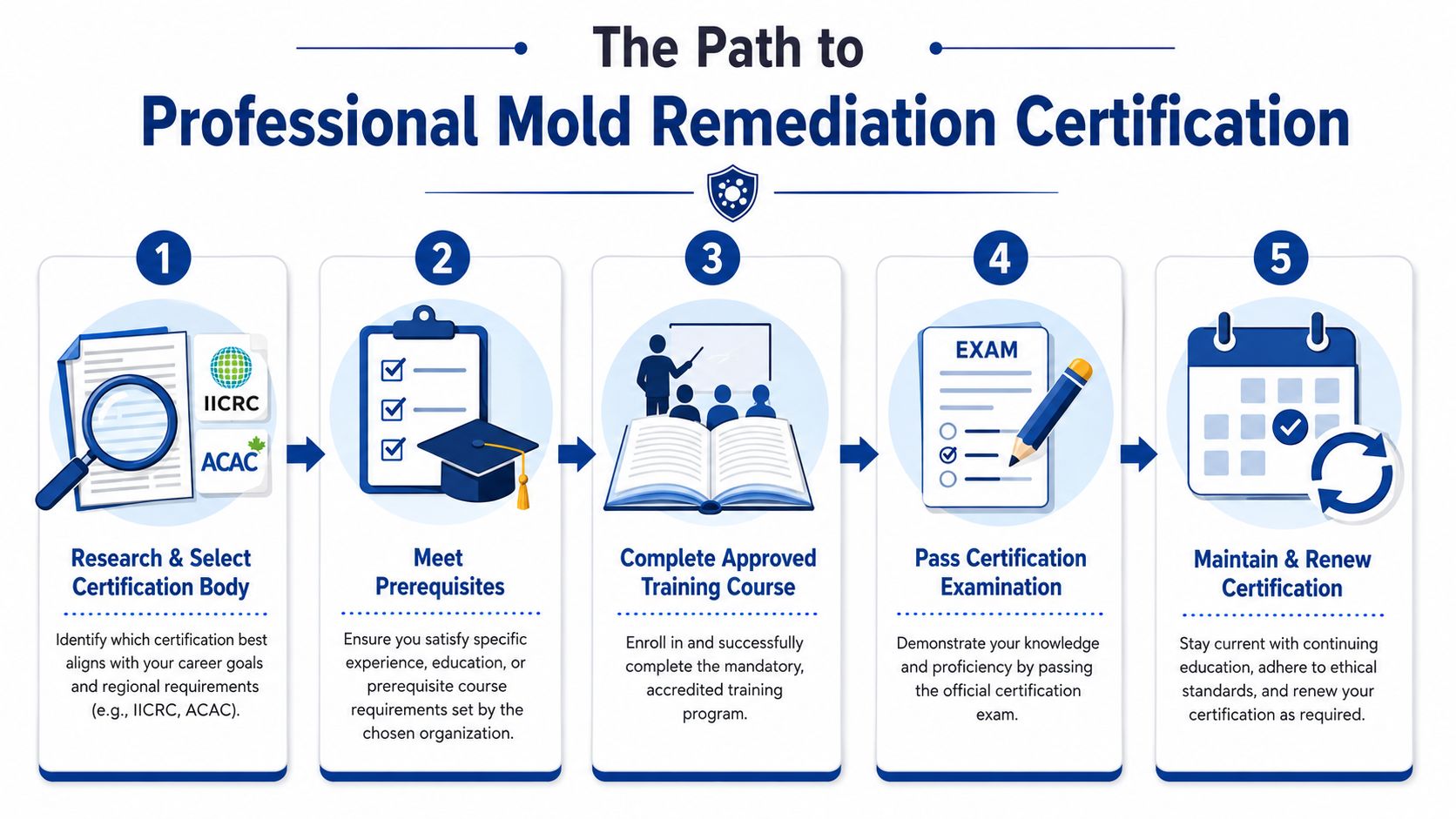
The Path to Professional Mold Remediation Certification
People enter mold remediation from different directions. Some start in water mitigation and realize the microbial side requires more discipline. Others come from construction or janitorial backgrounds and quickly learn that demolition experience isn't the same as remediation training.
The right path starts with foundations. If you don't understand how buildings get wet, how materials dry, and how contamination spreads during demolition, advanced mold training won't stick.
Start with the building, not the biology
A new technician often wants to jump straight to “mold certification.” That's backwards. In the field, the biggest failures don't usually come from not knowing Latin names for fungi. They come from poor containment, incomplete drying, weak documentation, or bad demolition decisions.
A practical progression usually looks like this:
- Learn water damage restoration fundamentals.
- Add microbial remediation training.
- Spend time on live jobs under a crew lead who explains why each control is in place.
- Learn to document, not just perform.
- Build the habit of verifying your work before calling a job clean.
What training should prepare you to do
A good course should make you competent in the sequence of work, not just familiar with terminology.
Scope the loss
You need to read a building. Where did the water go? Which materials are porous? What's salvageable? What needs removal? The answer changes between a bathroom vanity leak, an HVAC condensate issue, and storm-driven intrusion into exterior walls.
Set containment correctly
Inexperienced crews cause expensive secondary contamination. You should know when a small isolated area can be managed with limited controls and when a larger or riskier area needs full containment, negative air, and stricter entry procedures.
Clean with a reason
HEPA vacuuming, wiping, detail cleaning, bagging debris, and controlling worker traffic are all routine tasks. What separates a trained technician is knowing why each step happens in that order.
The best techs don't just follow a checklist. They know what failure looks like if they skip a step.
What the classroom won't teach by itself
Certification training gives you the framework. The jobsite teaches judgment.
In Central Texas, that judgment matters because our projects often involve fast-changing indoor conditions. A room may look dry on the surface while wall cavities, framing, or insulation still hold moisture. Summer humidity changes drying behavior. Occupied homes create pressure to move fast. Insurance timelines can push crews toward shortcuts. The technician has to resist all of that when the readings don't support closure.
How to build real field competence
- Shadow experienced crews. Watch how they isolate HVAC, stage tools, and move debris without contaminating clean areas.
- Practice using moisture meters and thermal imaging. Readings matter more than appearances.
- Study job documentation. Learn how photos, notes, and daily logs support the scope and protect everyone involved.
- Ask why materials were removed or saved. Scope judgment is where expensive mistakes happen.
- Observe post-cleaning verification habits. A neat-looking room isn't the same thing as a verified clean work area.
What separates a dependable technician
A dependable technician doesn't overpromise. They don't say every material can be saved, and they don't declare success because odor dropped after air scrubbing. They understand that remediation is a control process.
That mindset is what homeowners pay for. They're not buying a spray treatment. They're buying disciplined work under documented conditions.
Budgeting for Your Mold Remediation Career Investment
A lot of new techs ask the wrong budget question. They ask, “What does the class cost?” The better question is, “What am I paying to be trusted with higher-risk work inside occupied buildings?”
That changes how you look at the expense.
On the homeowner side, the same logic applies. Professional mold remediation isn't cheap because the contractor is carrying extra equipment. It costs more because correct work requires training, containment labor, cleaning time, documentation, and verification discipline.
According to SERVPRO's mold remediation cost guide, the national average cost for professional mold removal is about USD 2,368, with most projects falling between USD 1,223 and USD 3,753. The same guide notes common pricing of about USD 10 to USD 25 per square foot, with larger projects rising substantially based on area and complexity.
What that means for an aspiring technician
You're investing in the ability to work on jobs where mistakes are expensive.
If a crew misses moisture, cross-contaminates a home, or closes walls too early, the contractor can end up paying for rework, reconstruction delays, or dispute resolution. A technician who's trained to work cleanly and document decisions becomes more valuable fast.
Where the real investment sits
The financial hit isn't only the tuition line item. It's also:
- Time away from production while attending training
- Study time after hours so the material sticks
- Continuing education and renewals to keep credentials active
- Equipment familiarity so you can apply what you learned instead of freezing on site
For company owners, there's another layer. Once you train people properly, you also need to support them with the right setup in the field. That includes HEPA vacuums, air scrubbers, moisture meters, PPE, containment materials, and a workflow that doesn't reward rushing.
Why homeowners should care about that investment
Homeowners sometimes see a higher bid and assume it's markup. Sometimes it is. But often it's the cost of a company staffing trained crews and running the job the slow, controlled way that prevents another bill later.
Cheap mold remediation often becomes expensive reconstruction.
If one contractor's price is much lower, ask what was removed from the process. Fewer days on site? Less containment? No post-remediation verification? Minimal HVAC protection? Those cuts don't usually appear in bold on the estimate.
A serious company is charging for process discipline. In mold remediation, that's not fluff. That's the work.
Meeting Texas-Specific Mold Remediation Rules
National training matters. In Texas, it isn't the whole story.
A contractor can have staff with respected industry certifications and still miss the legal piece if they don't follow Texas requirements. That matters because mold remediation work can affect occupant health, reconstruction timing, insurance documentation, and liability when a job goes wrong.
Why Texas draws a harder line
In hot, humid climates like Central Texas, mold can begin to grow within 24 to 48 hours of water damage, as noted in Emergency Restoration Sciences' discussion of mold growth timing and response. That short window is exactly why Texas can't treat microbial work like ordinary cleanup.
In Georgetown, Austin, and surrounding areas, summer humidity, storm cycles, and intermittent heavy rain create the kind of conditions where hidden wetness lingers behind finishes. Delay the response, and the scope gets larger. Handle the response casually, and you can spread contamination into adjacent rooms or HVAC pathways.
That's why state rules matter. They exist because climate and building conditions in Texas punish sloppy work.
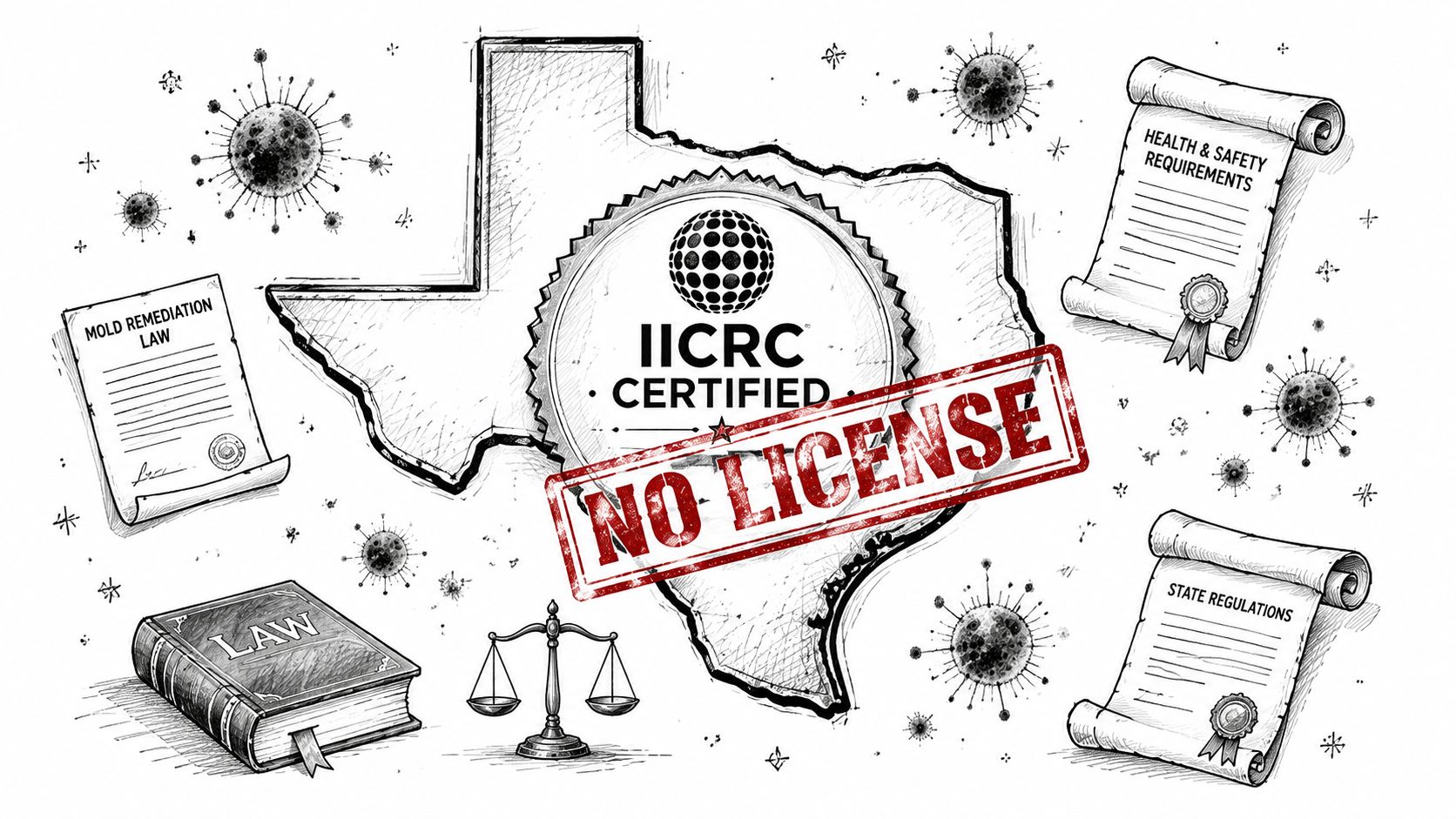
Certification is not the same as legal authority
This is the point many people miss.
An industry certification shows technical training. A Texas license or registration requirement governs whether the business is operating under the state's mold rules. Homeowners should care about both. Technicians should understand that one doesn't replace the other.
A company doing regulated mold remediation work in Texas needs to operate in line with state requirements, not just national trade education. If a contractor waves an industry card but can't explain the Texas side, that's a problem.
What the rules are trying to prevent
Texas oversight is aimed at the predictable failure points:
- Conflict in scope decisions when the same party benefits from enlarging the project
- Improper containment that allows contamination into occupied areas
- Weak documentation that makes disputes harder to resolve
- Inadequate insurance or business compliance when damage spreads beyond the original loss
- Fast cosmetic cleanup presented as proper remediation
That's why local experience matters too. A contractor who regularly handles Central Texas water losses understands that a “small leak” can become a multi-room microbial issue if indoor humidity stays high and drying stalls. That context is part of what homeowners should expect from a provider offering mold remediation services in Georgetown, TX that protect your home and health.
Texas doesn't care what a website headline says. It cares whether the work was done under the rules that apply here.
What technicians should take from this
If you're building a career in this trade, don't stop at national classes and assume you're done. Learn the Texas framework your employer operates under. Understand the difference between what you're trained to do, what your company is authorized to do, and what documentation must exist around the project.
That's what turns a trained worker into a dependable professional in this state.
How Homeowners Can Verify a Contractor's Credentials
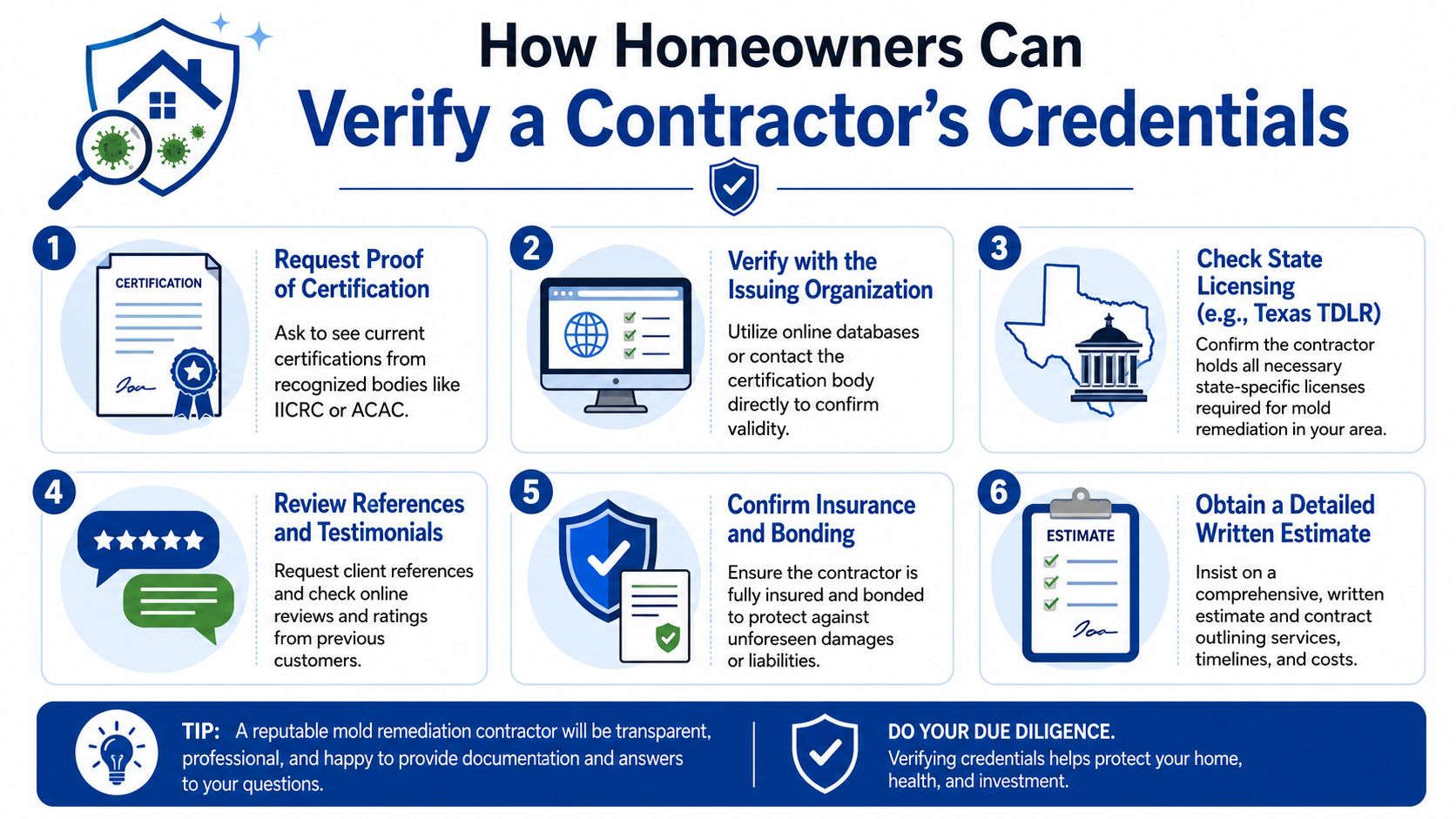
When a contractor says, “We're certified,” don't argue with them. Just verify it.
That one habit filters out a lot of risk. It also changes the conversation. Serious contractors won't be bothered by credential questions because they already keep the paperwork ready.
The homeowner checklist that actually matters
Start with the basics, then move into process questions.
- Ask who holds the credential. Is the certification tied to the company, the estimator, the project manager, or the crew on site?
- Request current documentation. A real contractor should be able to show active credentials, not just mention them.
- Verify Texas compliance. Check the business through the state's public license tools and ask how the company handles regulated mold work in Texas.
- Ask how containment will be built. If the answer is vague, keep looking.
- Ask how they'll confirm the area is dry and clean before rebuild. You want a process answer, not “we've done this for years.”
Ask process questions, not marketing questions
A homeowner doesn't need to know every acronym. You need to know whether the contractor follows a disciplined sequence.
The full remediation cycle typically takes 3 to 7 days for moderate infestations, and rushing or skipping verification increases the risk of residual contamination or regrowth, according to this mold remediation timing guide. The same source notes a roughly 35% chance of residual contamination or regrowth when moisture sources aren't fully addressed or protocols are relaxed.
That means your questions should sound like this:
- How will you isolate the affected area from the rest of the house?
- How will you determine what gets removed and what gets cleaned?
- How are you checking moisture before reconstruction starts?
- What happens if HVAC is connected to the affected zone?
- Who performs post-remediation verification, and when?
Red flags that should slow you down
“We don't need much containment”
That's often the sentence you hear before dust and debris move through the house.
“We'll spray everything and save the drywall”
Sometimes materials can be saved. Sometimes they can't. Anyone who promises the answer before inspecting moisture and contamination is selling, not diagnosing.
“It'll all be done in a day”
Maybe for a very limited issue. But if there's real contamination, selective demolition, cleaning, drying, and verification take time.
If a contractor is in a hurry to close the walls, they may be in a hurry to leave the problem behind.
One practical last step
Before signing anything, compare the remediation proposal with what you'd expect from a proper inspection workflow. This guide on how to test a house for mold helps homeowners understand what a thoughtful investigation should look like before work begins.
If you're dealing with water damage, musty odors, or visible growth in Georgetown or Austin, RestoTek TX handles inspection, drying, microbial prevention, remediation support, and reconstruction with a Central Texas focus. Reach out if you need a clear scope, a second opinion on a proposed mold remediation plan, or help responding quickly before moisture becomes a larger contamination problem.