Water has a way of making a house feel unfamiliar in minutes. A ceiling stain spreads while you're on hold with a plumber. The hallway carpet turns cold and soft under your shoes. A toilet backup that looked contained at first starts creeping toward baseboards, furniture legs, and door casings.
In Georgetown and Austin, that panic gets worse fast because our weather and buildings don't give you much slack. A hard storm can push water where it doesn't belong. Humid air slows natural drying. A small leak behind drywall can sit undetected until the smell, the swelling, or the staining finally shows up.
That's when people start searching for a water damage restoration business and trying to figure out who does what, what insurance will cover, and what they should do first. The good news is that this process is manageable when you know the order of operations and when the company on site knows how to dry a structure correctly, document the job, and keep the problem from turning into a much bigger one.
That Sinking Feeling When You Discover Water Damage
The call usually starts the same way. Something feels off, then suddenly it's obvious. You hear dripping in a room that should be quiet. You step out of bed and the floor is wet. You notice a brown ring on the ceiling that wasn't there yesterday, and now it's getting darker by the hour.
Most homeowners think first about cleanup. Towels. Fans. A shop vacuum. Maybe moving a rug outside. Those steps can help around the edges, but they don't answer the core question, which is how far the water traveled and what it touched before you found it.
Why the stress is justified
Water intrusion isn't rare, and it isn't something to shrug off. Water damage and freezing incidents represent 23% of all property damage claims, and the global water damage restoration segment is projected to account for 34% of the total disaster restoration market in 2026 according to industry benchmark data on restoration market share and claims trends.
Those numbers line up with what homeowners already feel in the moment. Water doesn't stay where you can see it. It wicks into drywall, trim, insulation, subflooring, and cabinetry. In Central Texas, ambient humidity can keep materials from drying the way people expect, even when the visible water seems gone.
When a homeowner says, “It doesn't look that bad,” that may be true on the surface. The hidden part is what changes the scope.
What a restoration company brings to the situation
A real water damage restoration business isn't just there to mop up and leave. The job is to stabilize the property, identify what kind of water entered the home, track where moisture migrated, dry the structure to a defensible standard, and document the process so the work holds up later.
That matters whether the loss came from a burst supply line, a washing machine overflow, a roof leak after a storm, or floodwater entering from outside.
If you're in Austin or Georgetown and looking at wet floors, swollen baseboards, or a stained ceiling, the first thing to remember is simple. You're not overreacting. You're dealing with a problem that gets more expensive and more disruptive when people guess instead of testing.
What a Water Damage Restoration Business Actually Does
A lot of homeowners hear “restoration” and think it means repairs only. New drywall. Fresh paint. Replaced flooring. That's only the back half of the job. The front half is where good companies separate themselves from crews that just remove obvious water and hope for the best.
The work starts with mitigation
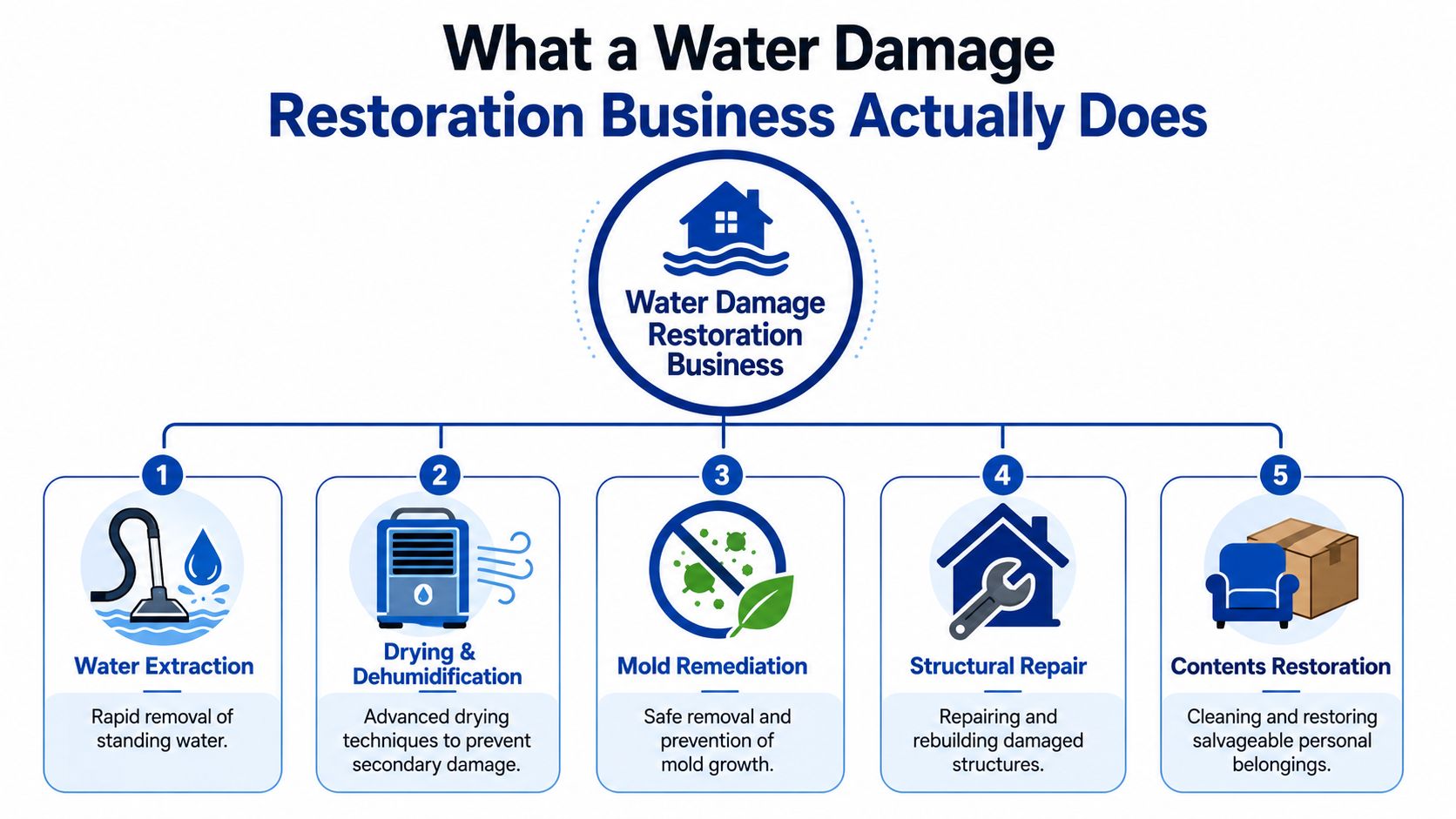
Mitigation means stopping the spread and preventing secondary damage. That includes extracting standing water, removing materials that can't be safely saved, setting drying equipment, and monitoring moisture over time instead of treating drying as a one-day event.
A proper water damage restoration business also has to classify the loss correctly under IICRC S500. Every job is categorized by contamination level and by evaporation load. That determines safety procedures, equipment needs, and whether certain materials can stay or need to be removed.
Here's the plain-English version:
| Classification | What it means for a homeowner |
|---|---|
| Category 1 | Water from a clean source, such as a broken supply line, if caught quickly |
| Category 2 | Water with meaningful contamination, such as some appliance overflows |
| Category 3 | Grossly unsanitary water, including sewage and certain flood conditions |
| Class 1 to 3 | How much water was absorbed and how aggressively the structure must be dried |
Misclassifying a job is a primary reason for business failure because it leads to the wrong equipment plan and raises the risk of mold and other secondary damage. That's one reason homeowners should understand the difference between cleanup and a fuller drying strategy. This breakdown of cleanup versus restoration for Georgetown and Austin property owners gives a useful local explanation of that distinction.
What good companies do that rushed crews don't
A rushed crew sees wet carpet and brings fans. A disciplined crew asks better questions.
- What kind of water is this. Clean, gray, or black water changes safety protocols and removal decisions.
- How much material was affected. A small visible spot can still involve wall cavities, underlayment, insulation, or subfloor.
- What's the dry standard. Technicians need unaffected readings to know when materials are dry.
- What must be documented. Moisture logs, temperature, and relative humidity readings help support billing and defend the scope of work.
Practical rule: If a contractor can't explain the water category and drying class in plain language, they probably don't have control of the job.
Restoration is broader than extraction
By the time a project is complete, the service may include:
- Water removal with extraction equipment to get bulk water out fast
- Structural drying using air movers, dehumidifiers, and monitored moisture reduction
- Microbial prevention when materials and conditions call for treatment
- Selective demolition of unsalvageable drywall, insulation, or flooring
- Reconstruction to put the property back into service
That's why a water damage restoration business should be judged on process, not just speed. Fast response matters. Correct classification and documented drying matter more.
The Step by Step Water Damage Restoration Process
Once a crew is dispatched, homeowners want two things right away. They want movement, and they want clarity. A professional process should give both.
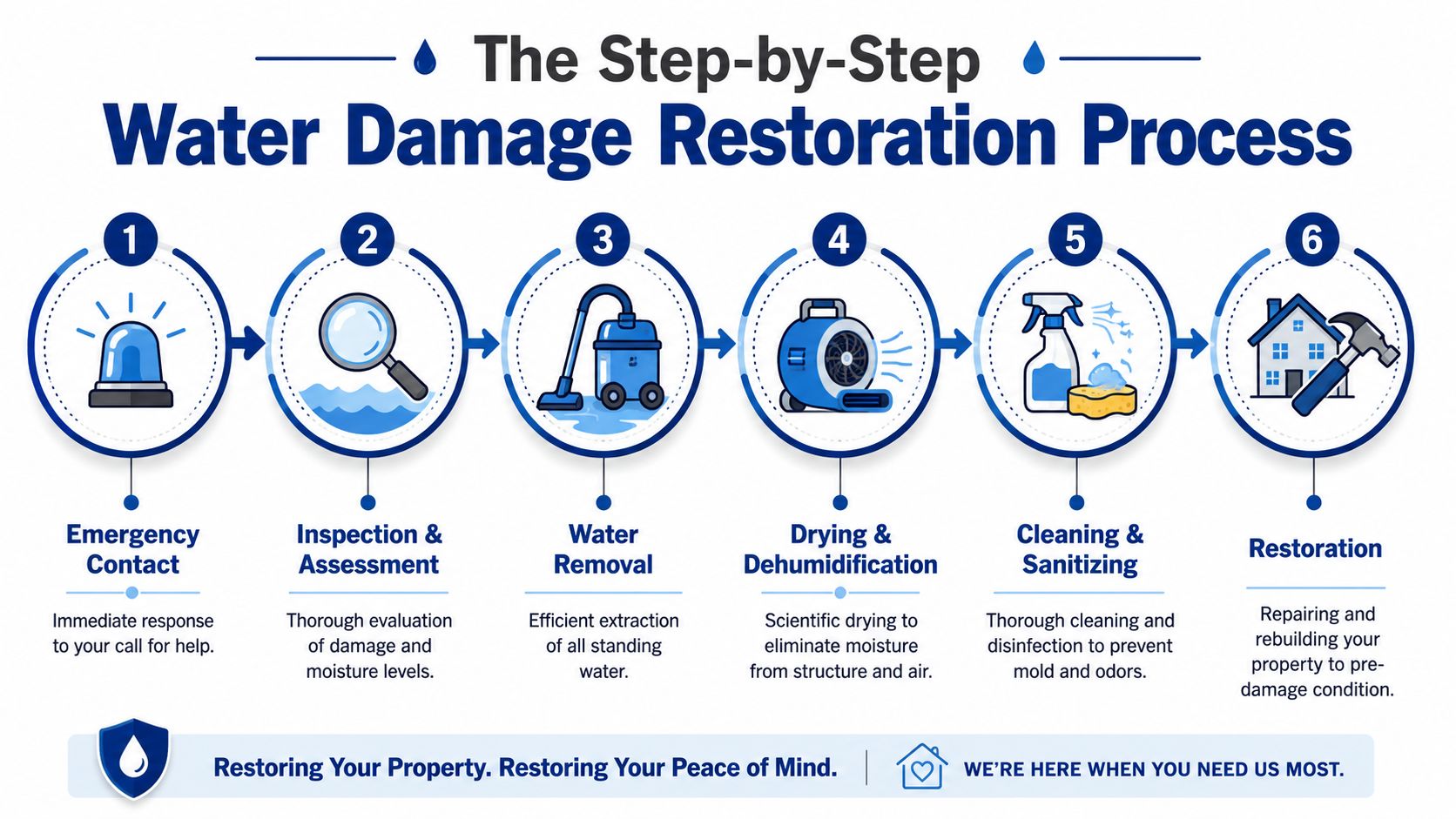
Step 1 and Step 2
The first stage is emergency contact, arrival, and inspection. Before anyone starts tearing out materials or placing equipment, the team should identify the source if it's still active, evaluate safety concerns, and map the affected areas.
Experienced technicians avoid one of the most common homeowner frustrations, which is treating the visible damage as the full damage. Water often moves sideways and downward. It follows framing, pools under flooring, and sits behind baseboards.
A strong inspection usually includes:
- Visual assessment of ceilings, walls, flooring, cabinetry, and contents
- Safety review for electrical hazards, contamination, and structural instability
- Instrument readings to locate moisture that isn't visible
- Initial scope decision on what can be dried and what likely needs removal
Step 3 and Step 4
After assessment comes extraction and drying. Standing water is removed first because bulk water removal gives the rest of the drying plan a chance to work.
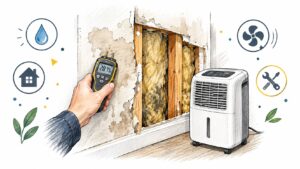
Then the drying system is built around the structure, not around guesswork. The industry benchmark is a confirm-and-verify workflow. Thermal imaging helps identify suspect cool areas, but thermal images alone don't prove moisture. Technicians need to confirm findings with non-penetrating and penetrating moisture meters, then track ambient conditions with a thermohygrometer. Relying on one tool can leave hidden moisture in place and lead to secondary damage later.
That means homeowners should expect to see several tools in use, not just fans dropped in the middle of a room.
Thermal cameras are scouts, not judges. They tell us where to test next, not whether a wall is dry.
One practical example helps here. A cooler patch on drywall might show up on camera. That could suggest moisture. It could also reflect another thermal difference. A technician then verifies the area with a moisture meter at multiple points to quantify what's happening. That's how drying decisions become defensible instead of intuitive.
Step 5
Cleaning and sanitizing happen after the water is removed and the drying environment is under control. The exact approach depends on the water category and what materials were affected.
Common actions include:
- Surface cleaning for affected structural areas and salvageable contents
- Odor control when damp materials leave behind persistent smells
- Removal of unsalvageable materials such as contaminated insulation or compromised drywall
- Microbial prevention where conditions support it
Not every job needs the same level of demolition or treatment. That's why category and class matter so much at the start.
Step 6
The last stage is restoration and rebuild. This can be as light as replacing a small drywall section and repainting, or it can involve flooring, cabinets, trim, insulation, and other finish materials.
For homeowners, the key question at this point is whether the structure reached dry standard before reconstruction starts. If rebuild begins too early, trapped moisture can create a second round of problems behind new materials.
A dependable process doesn't rush to make things look finished. It gets the hidden part right first, then closes the walls.
Navigating Costs Timelines and Insurance in Central Texas
Homeowners usually ask about cost and timing before the first equipment is even plugged in. That's understandable. Water damage disrupts routines, budgets, and often your sense of control.
The honest answer is that price and timeline depend on the water category, how long materials stayed wet, how far the water migrated, and whether reconstruction is minor or extensive. A clean water supply leak caught early is a different project from a sewage backup or storm-driven intrusion that soaked multiple materials.
The cost question most articles skip
There's also a practical issue many companies gloss over. Not every loss makes sense as an insurance claim.
The industry standard job cost is $3,000 to $8,000, and nearly 60% of residential water damage claims are under-insured or denied, which exposes a real billing gap for smaller losses according to analysis of water damage claim barriers and direct billing limitations. That matters for landlords with a minor leak, homeowners with a deductible that eats most of the claim, or anyone dealing with a slow leak that may fall into an exclusion.
A lot of marketing pushes “direct insurance billing” as if it solves everything. Sometimes it does help. Sometimes it doesn't fit the job at all.
When insurance helps and when it may not
A simple way to consider it:
| Situation | Practical concern |
|---|---|
| Large sudden loss | Insurance may be worth pursuing if the cause is covered and damage is substantial |
| Small contained leak | Filing may not make sense if your deductible is high |
| Gradual or long-term issue | Coverage disputes are more likely |
| Landlord turnover issue | Fast, documented mitigation may matter more than a formal claim |
That's why transparent estimates matter. A homeowner needs to know whether the right move is a claim, a limited out-of-pocket mitigation scope, or a full restoration plan.
For a more detailed local breakdown, this guide to home water damage repair cost in the Austin and Georgetown area is a useful starting point.
If the damage is small, the best service isn't always “we'll bill your insurance.” Sometimes it's “here's the narrowest responsible scope, and here's what it costs.”
What affects the timeline in Austin and Georgetown
Drying time isn't just about the amount of water. It also depends on material density, hidden cavities, airflow, and indoor humidity. Central Texas weather can work against you, especially when homes are closed up during humid conditions after rain.
A realistic company won't promise a neat timeline before inspection. They'll explain what they know now, what they need to verify, and what could change once moisture mapping and demolition reveal the full footprint.
Your First Moves During a Water Emergency
The first few minutes matter. The goal isn't to perform your own restoration. The goal is to protect people, prevent the loss from spreading, and avoid making the site more dangerous.
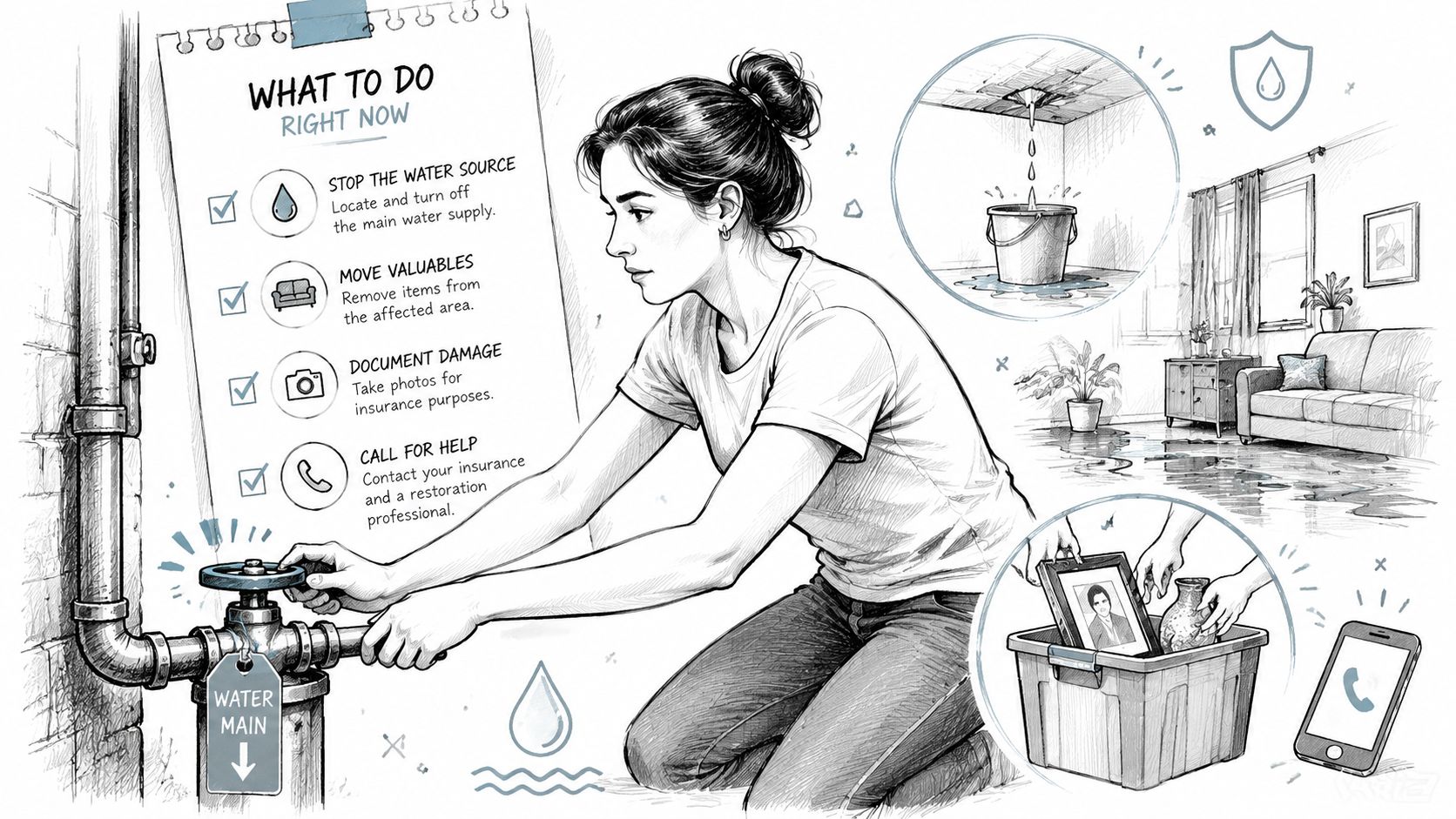
What to do first
Start with the source if you can reach it safely. A shutoff valve, fixture supply line, or appliance connection may stop the active leak before it affects another room.
Then move to basic protection:
- Shut off the water source if the intrusion is coming from plumbing or an appliance
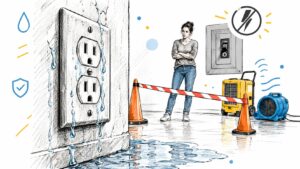
- Turn off power to the affected area if it can be done safely and without stepping into standing water
- Move rugs, loose contents, and small furniture to a dry area
- Place foil or blocks under furniture legs if heavier pieces must stay in place
- Take photos and short video before cleanup changes the visible condition
If you need a local checklist, this guide on what to do in the first 24 hours after water damage in Georgetown and Austin walks through the early decisions in more detail.
What not to do
Some of the most expensive mistakes happen because people try to help with the wrong equipment or enter unsafe areas.
Avoid these:
- Don't use a household vacuum on standing water
- Don't pull up materials blindly if the water source or contamination level isn't known
- Don't enter rooms with sagging ceilings or obvious structural movement
- Don't assume a dry surface means a dry structure
- Don't wait overnight if water is still active or materials are saturated
A calm order of operations
If you're overwhelmed, keep it simple.
- Protect people first
- Stop active water if possible
- Document the scene
- Call a qualified restoration company
- Stay out of unsafe areas
That order keeps a bad situation from becoming a dangerous one.
Why a Local Georgetown Austin Partner Matters
A water loss in Central Texas is rarely just a water loss. In Georgetown and Austin, the job often starts with storm runoff, fast-rising creek areas, older plumbing in established neighborhoods, or slab construction that hides moisture where homeowners cannot see it. Then the humidity keeps working against the drying plan long after the visible water is gone.
Stability counts more than branding
Water damage jobs do not end when the extraction stops. The same project can require moisture mapping, equipment setup, daily monitoring, selective tear-out, documentation for the carrier, and repairs that need to match the original home. Analysts at IBISWorld in its damage restoration industry report found that many restoration companies do not stay in business long term, and homeowners feel that instability when communication breaks down or phases get handed off.
Stable ownership matters because someone has to stay responsible for the whole file. A local company with a consistent process usually gives you a clearer point of contact, clearer documentation, and fewer surprises once the walls are open.
Local knowledge changes the plan
Crews who work this area every week know the difference between a hill-country storm loss, a slab leak in a Georgetown subdivision, and a second-floor overflow in an older Austin home. That changes how the drying chamber is built, how aggressively materials need to be detached or saved, and how long humidity control needs to stay in place.
It also affects scheduling and rebuild decisions. A contractor who already understands local housing stock can spot the common trouble areas faster, from trapped moisture under laminate on slab foundations to wet insulation inside exterior walls that still feel normal from the room side.
The billing gap is where homeowners get frustrated
Smaller claims are often the most confusing. The loss is large enough to disrupt your home, but not always large enough for the insurance process to feel organized. That is where homeowners run into the billing gap. The carrier may pay part of the work, question line items, or apply depreciation and deductible in ways that still leave a meaningful balance.
That does not automatically mean the invoice is wrong or the carrier is acting in bad faith. It means someone needs to explain the scope, document the readings, and tell you what is insurance-driven versus what is a direct homeowner cost. Local, family-run companies like RestoTek TX tend to handle those conversations more plainly because their reputation lives in the same communities they serve.
What that looks like in practice
A good local partner should offer more than fast arrival.
- Area-specific drying judgment for flash floods, high outdoor humidity, and slab construction
- Clear scope explanations so you know what is being dried, removed, saved, and rebuilt
- Consistent accountability from mitigation through repairs, instead of passing the job between unrelated vendors
- Straight talk on insurance gaps for smaller claims that do not fit neatly into a carrier's preferred workflow
Homeowners usually remember one thing most. They want to know who is in charge, what happens next, and whether the numbers are being explained transparently. A local Georgetown or Austin team is often better positioned to answer those questions because they know the houses, the weather, and the insurance friction that shows up on Central Texas losses.
Frequently Asked Questions About Water Damage Restoration
Will my homeowners insurance cover water damage
Sometimes yes, sometimes no. Coverage often depends on the cause and whether the event was sudden or tied to a longer-term issue. A burst line and a slow leak behind a wall can be treated very differently. The safest move is to document everything immediately, protect the property from further damage, and ask both your carrier and your restoration contractor to explain the scope in plain language before assumptions harden into disputes.
How do I know the house is actually dry
You know it's dry when the company can show you readings, not when the room looks normal again. A proper drying process uses moisture meters, thermal imaging as a scouting tool, and ambient readings to compare affected materials against dry standards from unaffected areas. If a contractor says it's dry but can't back that up with instrumented documentation, that's a problem.
Can I stay in the house during restoration
Sometimes. It depends on which rooms were affected, what kind of water entered the home, whether power needs to stay off in part of the house, and how much equipment is running. A clean-water laundry room loss is different from a sewage backup affecting multiple living areas. Ask specifically whether the environment is safe for children, pets, and anyone with respiratory concerns.
Should I throw away wet items right away
Not automatically. Some contents can be cleaned, dried, or documented before disposal. Throwing things out too early can also make insurance conversations harder if you need proof of loss. Take photos first, then ask what should be isolated, discarded, or evaluated for restoration.
Is a small leak really worth calling a professional for
Often yes, especially in Austin and Georgetown where humidity can slow natural drying and hidden moisture can linger in walls or flooring systems. Small visible damage doesn't always mean small structural impact. A brief professional inspection can help you decide whether you're dealing with a simple repair or the start of a bigger drying problem.
What should I expect from the first visit
Expect questions, testing, and a scope discussion. A solid company should identify the likely source, explain the water category in homeowner terms, check moisture beyond the obvious wet area, and tell you what happens next. You shouldn't be pressured into a vague demolition plan without a clear explanation of why it's necessary.
If you need clear answers and a measured response after a leak, overflow, backup, or indoor flood, contact RestoTek TX for help in Georgetown or Austin. They handle inspection, mitigation, structural drying, microbial prevention, and reconstruction, with guidance that's especially useful when you're dealing with a smaller loss that may not fit the usual insurance-billing script.