Water damage restoration usually falls between $1,383 and $6,378, with a mean cost of $3,864. That range is useful, but it's also where many homeowners get misled, because the final number changes fast once you factor in contamination, saturation, hidden moisture, and whether you're pricing cleanup only or the full rebuild.
If you're reading this after a pipe break, appliance overflow, roof leak, or storm intrusion, you probably want a straight answer: what is this going to cost, and can an online water damage repair cost calculator tell you the truth? Sometimes it can get you in the ballpark. Most of the time, it can't.
The biggest problem is that simple calculators act like water damage is one job. It isn't. A real estimate has at least two different phases, often handled on different timelines and priced very differently. First comes the emergency work to stop loss and dry the structure. Then comes the repair work to put the property back together.
For Central Texas homeowners, that distinction matters even more. Heavy rain, flash flooding, plumbing failures in slab homes, and long drying cycles in humid conditions can all push a project out of the “small cleanup” category and into something much broader. If you only plug square footage into a generic tool, you'll usually get a number that feels reassuring right up until demolition starts.
Why Online Water Damage Calculators Are Often Wrong
A lot of homeowners open a calculator, enter room size, pick “water damage,” and expect a reliable estimate. That's understandable. You're trying to make decisions fast, maybe while wet drywall is sagging or cabinets are swelling.
The problem is that most calculators only measure visible area. Water damage doesn't stay visible for long. It moves into drywall cavities, under flooring, behind baseboards, into insulation, and sometimes into adjacent rooms that don't look damaged yet.
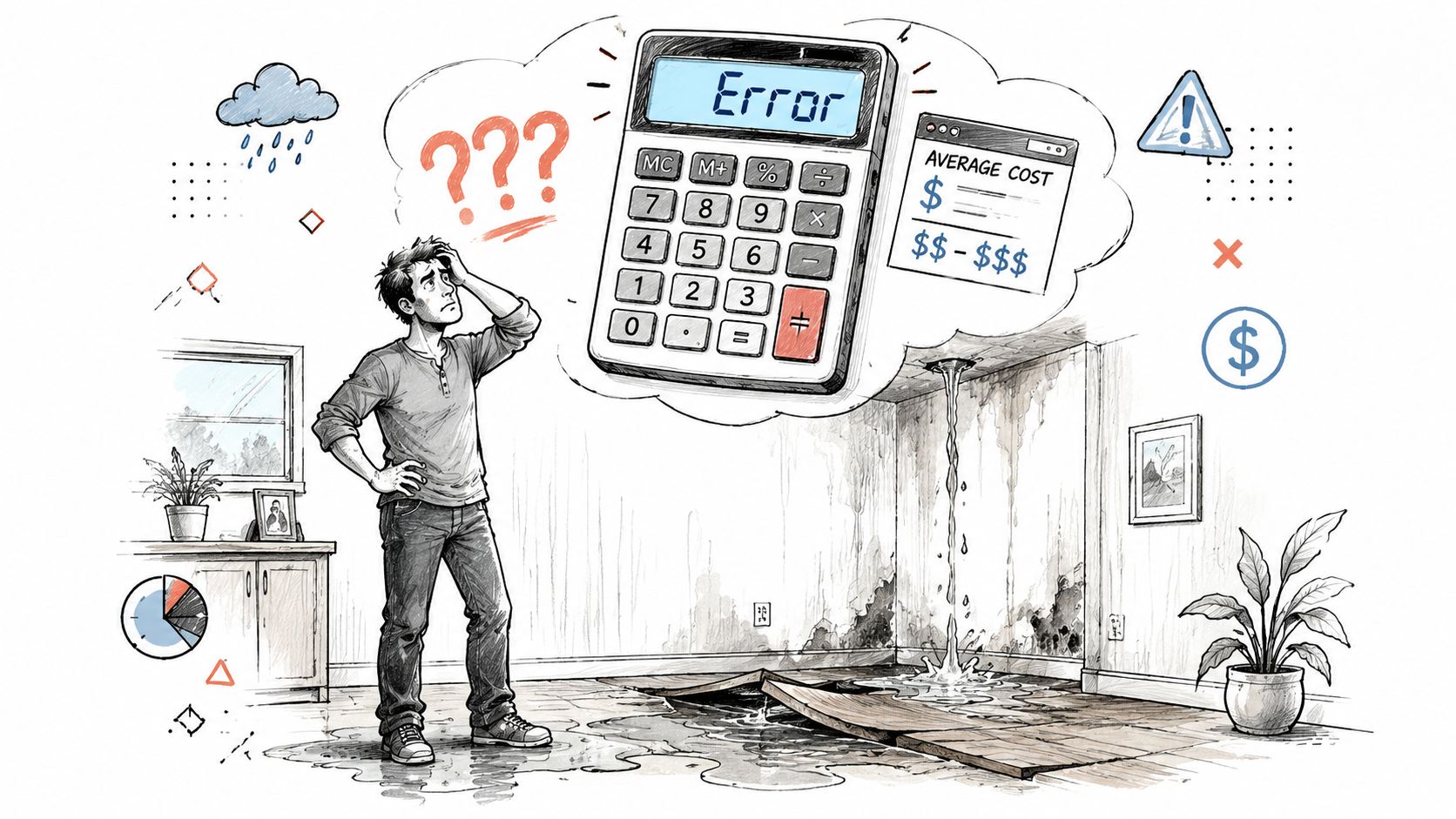
The national average is real, but it's not the estimate
Nationally, homeowners spend between $1,383 and $6,378 for professional water damage restoration, with a mean cost of $3,864, and severe events can climb to $20,000 to $100,000 according to HomeAdvisor's water damage restoration cost data. That tells you the category of expense. It does not tell you what your loss will cost.
A small clean-water supply line leak caught early might stay manageable. A storm-driven intrusion or sewage-related backup can turn into a major restoration and reconstruction job.
Practical rule: If a calculator gives you one neat total without asking what kind of water entered the building, it's guessing.
What cheap estimates usually leave out
The tools that miss hardest usually ignore the same issues:
- Water type: Clean water, gray water, and black water don't get handled the same way.
- Hidden spread: Moisture under flooring and inside walls changes labor, equipment, and demolition scope.
- Time elapsed: A leak that sat unnoticed overnight is different from one that sat for days.
- Material behavior: Hardwood, laminate, insulation, drywall, and cabinets all absorb and release moisture differently.
- Rebuild scope: Drying and tear-out is one invoice. Rebuilding finishes is another.
Why Central Texas homes get underestimated
In this part of Texas, water losses often don't behave like the tidy examples you see in national calculators. Storm water can bring contamination. Humidity slows drying. Slab construction and layered finish assemblies can trap moisture in places homeowners never see until flooring cups, trim separates, or odor shows up later.
That's why the “calculator number” and the “job cost” often split apart. The calculator assumes a direct path from wet to dry. Real projects involve moisture mapping, containment decisions, selective demolition, equipment placement, monitoring, and then reconstruction planning once materials are removed and the structure reaches dry standards.
A useful water damage repair cost calculator should help you ask better questions. It shouldn't trick you into thinking a water loss is simpler than it is.
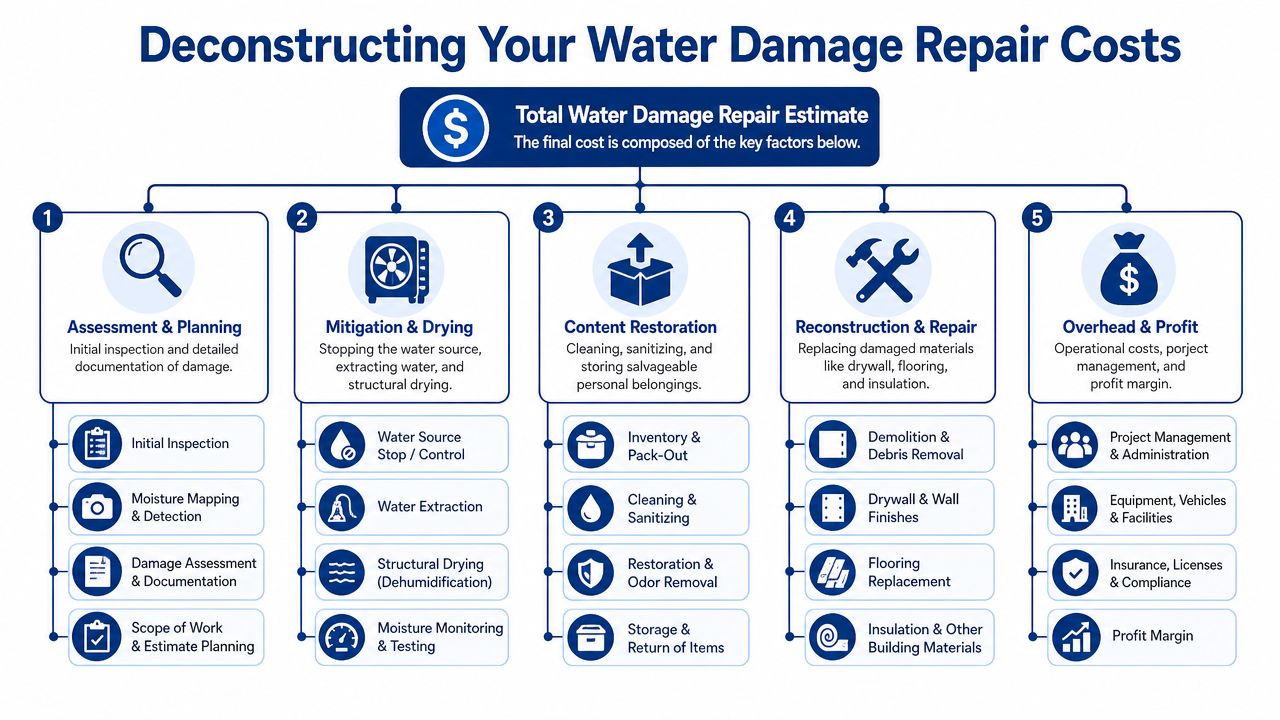
Deconstructing Your Water Damage Repair Costs
Professional estimators don't start with square footage alone. They start with classification. The two systems that matter most are water category and damage class.
That sounds technical, but it's the clearest way to understand your cost.
Water category decides the safety protocol
The first question is simple: what kind of water entered the property?
According to First and Last Restoration's calculator guide, professional cost calculation relies on a dual-classification method. Clean Water (Category 1) may run $3 to $10 per square foot, while Black Water (Category 3) can reach $7 to $37+ per square foot because sanitization requirements, disposal needs, and safety protocols are much heavier.
Here's what that means in plain terms:
- Category 1 clean water: Usually from a supply line or pipe break. The water starts sanitary.
- Category 2 gray water: Often from appliances or drains. It carries more contamination risk.
- Category 3 black water: Floodwater, sewage, or heavily contaminated water. This is the most expensive and the least forgiving.
A homeowner often focuses on where the water came from. The estimator also has to focus on what the water touched on the way through the structure.
Damage class decides labor and drying intensity
Now look at class, which is about the extent and broadness of water saturation within the structure.
A simple way to think about it:
| Damage class | What it usually feels like on site | Cost pressure |
|---|---|---|
| Class 1 | Limited area, low absorption, maybe hard surfaces | Lower equipment and labor demand |
| Class 2 | Water reached more of the room and affected porous material | More tear-out and longer drying |
| Class 3 | Ceilings, walls, insulation, and flooring are all involved | Heavy mitigation scope |
| Class 4 | Deep saturation in dense materials or long-standing water | Highest labor, specialty drying, major rebuild risk |
A Class 1 event is closer to a contained spill that got noticed quickly. A Class 4 event is the kind of loss where flooring, subfloor, wall cavities, and structural materials all hold moisture at once.
Water category tells you how carefully crews have to clean. Damage class tells you how hard they have to dry.
The five buckets on a real estimate
A professional estimate usually pulls from several cost buckets, not one blended line item:
- Assessment and documentation: Moisture readings, mapping, photos, and scope definition.
- Mitigation and drying: Extraction, dehumidifiers, air movers, containment, and monitoring.
- Contents work: Cleaning, pack-out, or storage of salvageable items when needed.
- Reconstruction: Drywall, insulation, trim, flooring, cabinets, paint, and finish carpentry.
- Project overhead: Scheduling, supervision, coordination, and disposal logistics.
That's why a water damage repair cost calculator becomes more useful when you treat it like a screening tool, not a contract price. If it doesn't separate the type of water from the depth of damage, it isn't building an estimate the way restoration professionals do.
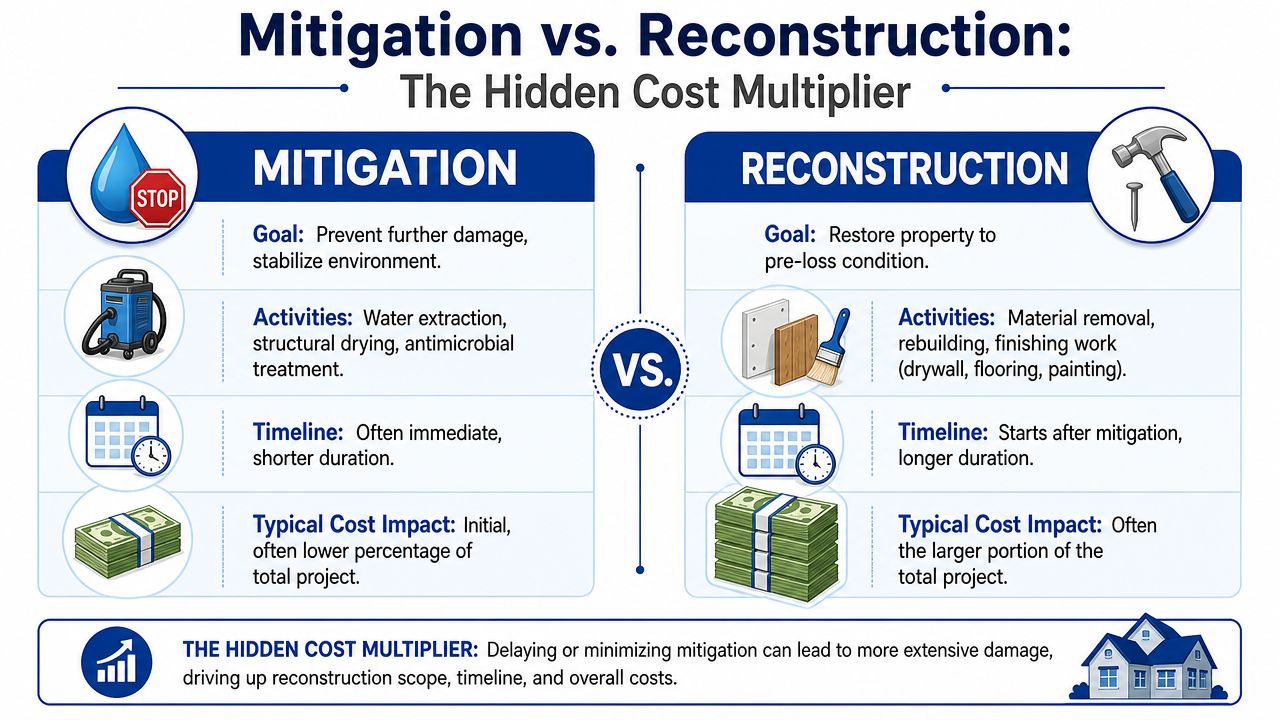
Mitigation vs Reconstruction The Hidden Cost Multiplier
Most homeowners find themselves blindsided. They receive a number for extraction and drying, assume that's the whole project, and then discover the larger bill arrives after the structure is dry.
Mitigation and reconstruction are connected, but they are not the same job.
What mitigation actually includes
Mitigation is the emergency and stabilization side of the loss. It usually covers:
- Stopping active damage: Isolating the water source or stabilizing the affected area.
- Removing water: Extraction from floors, cavities, or affected assemblies.
- Drying the structure: Air movers, dehumidifiers, moisture checks, and monitoring visits.
- Reducing microbial risk: Cleaning and antimicrobial treatment where appropriate.
This is the phase many calculators price, especially if they use a basic per-square-foot formula. It's important work, and on many losses it has to happen immediately.
If you want a good practical explanation of that process, this guide to structural drying in Central Texas is worth reviewing.
Reconstruction is where the real budget often shifts
Once crews remove wet drywall, swollen baseboards, ruined flooring, insulation, or damaged cabinetry, someone still has to put it all back. That's reconstruction.
According to BUK Restoration's breakdown of water damage repair costs, mitigation averages $3.75 to $7.00 per square foot, while reconstruction alone ranges from $10 to $30 per square foot. The same source notes that a 200 square foot room could cost $750 to dry but another $6,000 to rebuild.
That's the hidden multiplier most online calculators ignore.
Why blended pricing causes bad decisions
When calculators combine drying and rebuilding into one vague “repair” number, homeowners make decisions on incomplete information. They may think:
- the low number covers drywall replacement when it only covers drying
- the room can be used again as soon as the fans come out
- cabinets, trim, and paint are minor add-ons instead of separate trades
- demolition means the project is almost done, when it's just entering the rebuild phase
A low mitigation number is not a cheap project. It's often just the first phase of an expensive one.
The better way to budget
Ask for costs in two parts:
| Phase | What you should expect to see |
|---|---|
| Mitigation | Extraction, drying, treatment, monitoring, selective demolition |
| Reconstruction | Drywall, insulation, flooring, cabinetry, paint, trim, finish work |
That split gives you a clearer path for budgeting, insurance conversations, and scheduling. It also keeps you from comparing one contractor's mitigation-only estimate to another contractor's full-cycle estimate and thinking the cheaper one is automatically better.
Factoring in Central Texas Storm Risks and Costs
Central Texas changes the math. The same square footage can price very differently here depending on how the water entered the building and how fast drying starts.
Storm events are the obvious example. Flash flooding doesn't behave like a clean pipe leak. Water can enter through doorways, garages, thresholds, wall systems, and low openings, carrying soil, debris, and contamination with it. That pushes jobs toward a higher-contamination response and a broader demolition scope.
The 48-hour window matters more here
One of the biggest estimating mistakes is acting like all gray water stays gray water. It doesn't. According to Palm Building's water damage cost calculator analysis, failing to account for the 48-hour microbial incubation window can escalate contamination from Category 2 to Category 3, increasing costs by 150 to 300%. That source specifically notes this is a bigger problem in humid climates like Texas.
That's not just a pricing detail. It changes how crews approach safety, disposal, cleaning, and rebuild planning.
Why Central Texas jobs often grow after inspection
In Georgetown, Austin, and nearby communities, a water loss often starts with one visible complaint and expands during inspection. A homeowner sees buckled flooring in one room. The meter shows moisture in the shared wall, under adjacent flooring, and behind vanity toe-kicks. A business owner sees water at a storefront entry. The loss has already moved under finish materials farther back than expected.
That's why local conditions matter more than a national average. Drying strategy in Central Texas has to account for weather, ambient humidity, and how quickly materials stop releasing moisture.
A more complete local overview is covered in this guide to water damage restoration in Central Texas.
Trade-offs homeowners should understand
A faster response usually protects more material. A delayed response often leads to broader removal.
Here's what tends to work and what doesn't:
- What works: Quick extraction, moisture mapping, targeted demolition, and active drying before odor or microbial issues take hold.
- What doesn't: Waiting for materials to “air out” on their own when moisture is trapped behind walls or under floors.
- What works: Treating storm water as a contamination problem until proven otherwise.
- What doesn't: Pricing a flood as if it were the same as a clean appliance leak.
In Central Texas, time and contamination are usually the two variables that move a water loss from manageable to expensive.
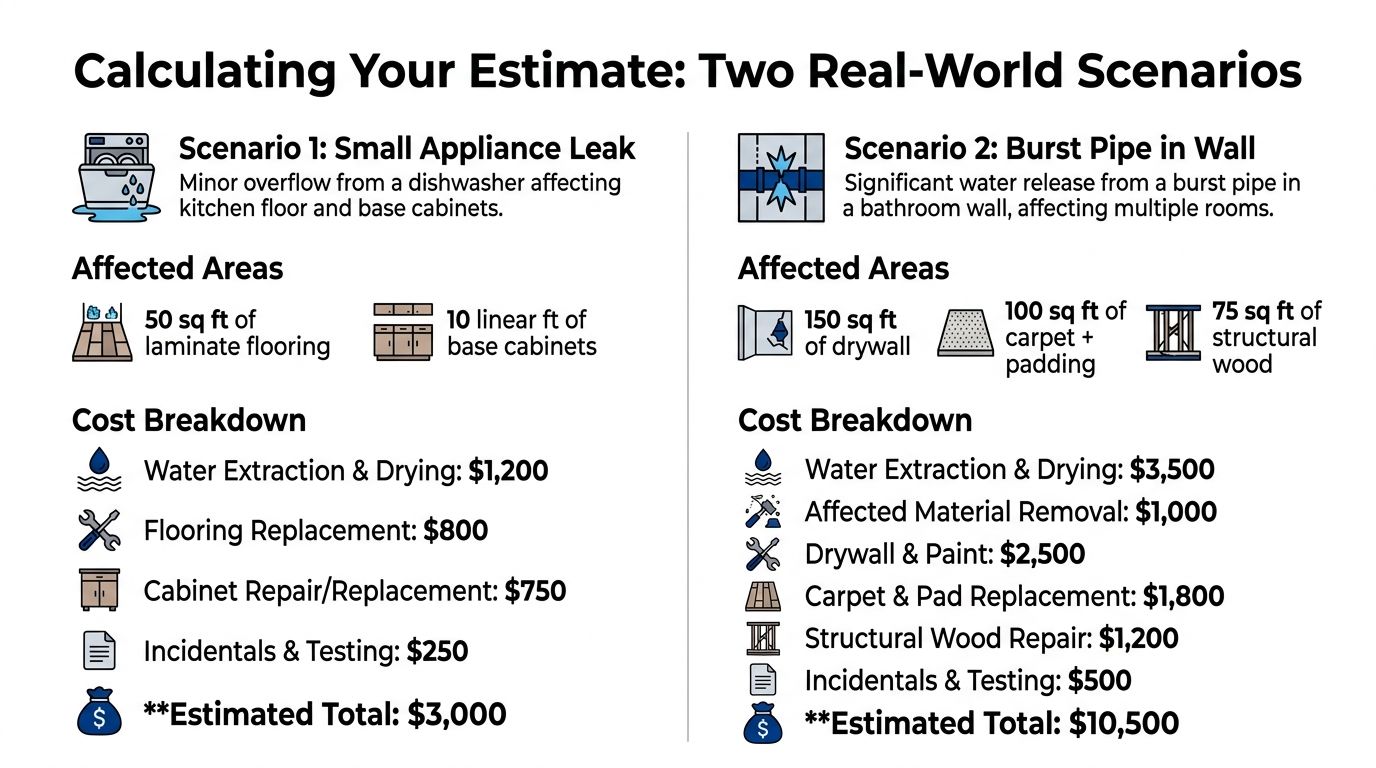
Calculating Your Estimate Two Real-World Scenarios
A water damage repair cost calculator is most useful when you run a realistic scenario through it. Not just room size. Actual water type, actual material impact, and actual scope split between mitigation and reconstruction.
The examples below use the verified national pricing ranges for extraction, drying, mitigation, and reconstruction. They are not promises of fixed pricing. They are a practical way to think like an estimator.
Scenario one gray water in a laundry area
A washing machine hose lets go in a Georgetown home. Water reaches the laundry room and spreads into the hallway. This is typically treated as Category 2 gray water because appliance discharge carries more contamination risk than a fresh supply-line release.
For extraction and drying alone, Americon Restoration's national remediation cost data places Category 2 water extraction and drying at $6 to $9 per square foot.
If the affected area is modest, a homeowner might run the square footage and think that's the project. But a real estimate asks more questions:
- Did water wick into drywall?
- Did baseboards need removal?
- Did laminate flooring trap moisture underneath?
- Are lower cabinets swollen or delaminated?
- Is insulation in the shared wall wet?
A practical estimate format would look like this:
| Estimate component | What's being priced |
|---|---|
| Mitigation | Extraction, drying setup, monitoring, minor removal of wet materials |
| Selective demo | Baseboards, lower drywall cuts, affected trim, maybe cabinet toe-kick access |
| Reconstruction | Drywall patching, texture, paint, trim replacement, possible flooring reset or replacement |
If the drying phase stays limited and materials are salvageable, the total stays closer to the lower end of what homeowners expect. If flooring has to come out and cabinets are compromised, reconstruction becomes the dominant number.
Scenario two flash flood intrusion in a commercial ground floor
Now take a small Austin business after a heavy storm. Water enters through the front and rear access points, crosses multiple rooms, and sits long enough to soak drywall, flooring, and lower wall cavities. This is a much more serious loss.
The contamination issue comes first. Floodwater often gets treated as Category 3 black water, and the same Americon source places Category 3 extraction and drying at $9 to $12 per square foot for the initial mitigation phase. That still does not include the full rebuild.
For more severe losses, category pricing can widen dramatically. As noted earlier, First and Last Restoration's classification guide shows Category 3 events can run $7 to $37+ per square foot depending on the scenario and damage class. On a storm-related commercial loss with deep saturation, that wider band becomes relevant fast.
A project like this usually involves:
- Containment and safety controls
- Removal of unsalvageable porous material
- Extended equipment use
- Sanitization protocols
- Rebuild of drywall, flooring, trim, and finish surfaces
The square footage may look straightforward on paper. The contamination level and damage class are what usually move the estimate.
How to use these examples without fooling yourself
When you use any water damage repair cost calculator, do three things:
- Price mitigation first. Use the extraction and drying range that matches the water category.
- List what got removed. Drywall, trim, insulation, flooring, cabinets, and finishes all need separate rebuild pricing.
- Assume hidden moisture until inspection proves otherwise. Water rarely stops exactly where the stain stops.
That approach won't replace a professional estimate, but it will keep you from anchoring to a number that only covers the first stage of the job.
When to Call a Pro and How to Handle Insurance
Some water problems are small enough for cleanup and monitoring. Many aren't. The right move depends less on how dramatic the leak looks and more on what materials got wet, how long the water sat, and whether contamination is involved.
When DIY stops making sense
Call a professional if any of these are true:
- Water touched porous building materials: Drywall, insulation, carpet pad, engineered flooring, or cabinetry can hold hidden moisture.
- The source wasn't clean: Appliance discharge, drain backup, storm intrusion, or sewage-related water needs a different response.
- You can't verify drying: Fans alone don't tell you what's happening inside walls, under flooring, or behind trim.
- The affected area is spreading: Stains, odor, swelling, or soft materials usually mean moisture moved farther than expected.
If you're not sure what to do in the first few hours, this checklist on what to do immediately after water damage in your Central Texas home gives a solid starting point.
How to protect your insurance claim
The first mistake many owners make is cleaning up too much before they document anything. The second is assuming the insurer and the restoration contractor are solving the same problem. They overlap, but they're not the same role.
Use this sequence:
- Document before moving items if it's safe to wait. Take photos and video of the source, wet materials, and affected rooms.
- Prevent further damage if you can do it safely. Shut off water, move contents out of harm's way, and avoid contaminated contact.
- Notify your carrier early. Start the claim and ask what documentation they want.
- Get a detailed scope, not just a one-line number. You want mitigation separated from reconstruction.
- Keep records. Moisture logs, photos, demolition notes, and rebuild scope all help when questions come up later.
What a good estimate should tell you
A credible estimate should answer these questions clearly:
- What category of water are we dealing with?
- How far did moisture spread?
- What's salvageable and what must be removed?
- What belongs to mitigation?
- What belongs to reconstruction?
That level of detail gives homeowners an advantage. It helps with planning, insurance review, and comparing bids on equal terms.
If you need help now, RestoTek TX handles the full water-loss cycle for Central Texas properties, from inspection and emergency mitigation through structural drying, microbial prevention, and reconstruction. Joan and Josh Garza's team offers 24/7 response in Georgetown, Austin, and surrounding communities, and they can provide a no-cost professional estimate that separates cleanup from rebuild so you can see the actual scope before the project moves forward.