Water in your home feels chaotic fast. A supply line bursts under the sink, the water heater lets go overnight, or a storm pushes water where it doesn't belong. In Austin and Georgetown, that first hour matters more than most homeowners realize. The wrong response, or a slow one, can turn a cleanup job into drywall removal, flooring replacement, and a much harder insurance claim.
The good news is that you don't need a perfect plan. You need a clear one. Quick action and proper maintenance can prevent about 93% of water damage, according to data cited by the National Flood Insurance Program at Noble Public Adjusting Group's write-up. That same guidance stresses the first 24 to 48 hours, which is the window when drying and stabilization can still stop a lot of secondary damage.
If you're dealing with a fresh loss right now, start with three moves. Shut off the water source if you can. Take photos and videos before anything gets moved. Then call a restoration company that can handle extraction, drying, documentation, and the next phase after mitigation.
Below are seven strong options in the Austin area. I'm looking at them the way a property manager would. Response discipline, drying verification, insurance communication, and whether you'll be coordinating three vendors or one.
1. RestoTek TX
If you want one local company to take a water loss from first inspection through rebuild, RestoTek TX is the one I'd put at the top of the list for Austin and Georgetown. They're family-owned, led by Joan and Josh Garza, and that ownership visibility matters during a stressful claim. You know who's responsible, and you're not getting passed around a huge network when the job gets messy.
What stands out is how much of the cycle they keep under one roof. They handle inspection, leak detection, water extraction, structural drying, microbial prevention, testing needs, plumbing-related issues tied to the loss, and reconstruction. For homeowners and property managers, that cuts down the handoff problem that often slows restoration more than the actual drying.
Why RestoTek TX fits Central Texas homes
In this market, water damage isn't always dramatic flooding. It's also slab-adjacent moisture, appliance failures, line backups, and storm-driven intrusion that gets into walls and flooring before anyone sees standing water. RestoTek's local content reflects that reality, and their Central Texas water damage recovery guide is useful because it focuses on the actual decisions owners make here.
Practical rule: The best water damage restoration company isn't just the crew that removes visible water first. It's the one that can prove the structure is actually dry before rebuild starts.
That's where local oversight helps. Reviews and site messaging consistently point to daily drying checks, communication, and quality rebuild work. Those aren't flashy selling points, but they're the things that keep a claim from drifting or a project from stalling.
A few trade-offs are worth stating plainly:
- Best for local service: RestoTek is focused on Georgetown, Austin, and nearby Central Texas communities. That's excellent if you want regional expertise. It's not a national option.
- Best for fewer handoffs: One provider handling mitigation and rebuild usually means fewer scheduling gaps and fewer scope disputes.
- Ask for credentials directly: The website offers free estimates, but if you want licensing or certification paperwork for your file, ask during the estimate and keep copies.
If I were choosing for a single-family home, a small portfolio, or a commercial property that needs tight communication, RestoTek TX checks the right boxes.
Visit RestoTek TX.
2. SERVPRO
SERVPRO is the practical pick when you want a large network with recognizable process language and multiple Austin-area touchpoints. In a regional weather event, that footprint can matter. A bigger network often has better surge capacity than a smaller operator, especially when many homes are affected at once.
Their core advantage is standardization. Homeowners usually get a clearer idea of what happens next, from emergency contact through extraction, drying, cleaning, and reconstruction support where available. That consistency is helpful when you're trying to make decisions quickly and keep a tenant, owner, or insurer updated.
Where SERVPRO works well
SERVPRO makes sense when speed of dispatch and broad staffing depth are the top priorities. It also helps if you're managing multiple units or need contents cleaning in addition to structure drying.
One thing I'd flag for any franchise system is variation. The brand is national, but your experience comes down to the local office. Scheduling, documentation style, and rebuild coordination can feel different from one franchise to another.
During a widespread storm, the strongest national brands often have the best intake systems. That doesn't automatically mean they'll have the best project communication once the drying equipment is in place.
The financial side of water damage also explains why many owners default to large brands. The average National Flood Insurance Program payout for water damage was $66,000 from 2016 to 2023, as reported by FEMA and summarized at RubyHome's water damage statistics overview. On larger losses, a company with national infrastructure can feel safer to some owners and adjusters.
Before you sign, ask three direct questions:
- Who is my local project lead: Get the name and contact method.
- What documentation will I receive during drying: Daily logs matter.
- Will your office handle rebuild, or will I need a separate contractor: Don't assume.
If you're comparing local versus franchise options, this breakdown of home water damage repair cost factors helps frame what often drives the final scope.
Visit SERVPRO.
3. ServiceMaster Restore
ServiceMaster Restore sits in a similar lane as SERVPRO, but I usually think of it as a good fit for homeowners who want a familiar national name and insurer-friendly workflows. In Austin, the local franchise model can still give you relatively quick arrival times while offering the comfort of a large established brand.
Their value is less about marketing polish and more about predictable process. They offer emergency response, mitigation, drying, and rebuild support in many markets. That can be especially useful if you don't want to separate the drying contractor from the repair contractor later.
Best use case
ServiceMaster Restore works well when the owner wants structure and timeline guidance from day one. That matters because a lot of claims don't become difficult during extraction. They become difficult when nobody can explain what happens after the equipment comes out.
The insurance side is where I'd look closely. One of the biggest blind spots in this industry is what I think of as the claims facilitation gap. Companies often say they'll “work with insurance,” but the real test is whether they use a standardized, independent damage assessment process and milestone-based documentation that keeps disputes from expanding. That issue is discussed in Continuity Insights' guidance on selecting a water damage restoration partner.
- Strong fit for insurance-heavy jobs: Larger brands are often familiar to carriers and adjusters.
- Less ideal if you want owner-level oversight: As with any franchise, local execution matters more than the national name.
- Important question to ask: Who handles supplements if hidden damage shows up after demo starts?
If you're in the first hours of a loss and need a grounded starting point, what to do immediately after water damage in your Central Texas home is the kind of checklist I wish more owners followed before crews arrive.
Visit ServiceMaster Restore.
4. Paul Davis Restoration
Paul Davis Restoration is a strong option for owners who care a lot about insurance coordination and keeping mitigation tied to reconstruction. That combination matters. Too many projects move smoothly during emergency drying, then bog down when a separate contractor has to relearn the file and negotiate scope from scratch.
Their residential water program and national network make them a sensible middle ground. You get a known process, but the local office still determines how responsive and detail-oriented the experience feels.
Where Paul Davis stands out
If you've ever managed a claim where the adjuster, mitigation vendor, and rebuild contractor all had different documentation, you know why a one-umbrella approach helps. Paul Davis tends to appeal to owners who want fewer parties involved and a clearer line from emergency response to finished repairs.
I also like this fit for people who want a restoration company to be active in insurer communication rather than passive. That doesn't mean promising coverage outcomes. It means documenting cause, scope, and drying progress cleanly enough that the adjuster isn't left guessing.
Good restoration companies don't just send photos. They create a file that tells the story of the loss in the same order the insurer reviews it.
The trade-off is familiar: franchise variation. One office may be excellent at communication and scheduling, while another may be more stretched during regional demand spikes. Ask whether the local branch performs reconstruction with its own teams or relies more heavily on outside trades.
Visit Paul Davis Restoration.
5. PuroClean
PuroClean is a good choice when you want a national brand but still value local familiarity with Austin weather patterns, humidity swings, and storm-related moisture issues. Their Austin-area teams cover emergency water extraction, drying, microbial prevention, mold-related services, and reconstruction on applicable jobs.
In practice, PuroClean often fits homeowners who need more than a basic pump-out and fan setup. If the loss has odor concerns, microbial treatment needs, or likely hidden moisture, that broader service range is useful.
The hidden-moisture question
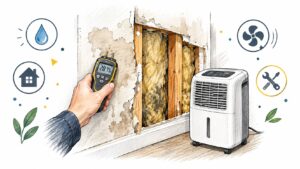
I'd separate average providers from the best water damage restoration teams by recognizing that visible water removal is only the first part. The bigger risk is what remains inside wall cavities, under flooring, or around cabinetry after surfaces look dry.
That blind spot is discussed well in UWRG Services' note on post-extraction moisture mapping, which argues that hidden moisture verification and digital moisture logs matter more than most “top company” lists acknowledge. I agree with that. If a company can't explain how it checks concealed wet areas after extraction, I'd keep shopping.
Ask PuroClean, or any provider, about these points:
- How they verify drying: Moisture meter readings should guide decisions, not guesswork.
- How they document hidden areas: Thermal imaging and written logs are worth asking about.
- When they recommend material removal: You want reasons tied to moisture conditions, not habit.
PuroClean's main downside is the same franchise variability seen in other national brands. The local team matters more than the logo.
Visit PuroClean.
6. Blackmon Mooring & BMS CAT
Blackmon Mooring & BMS CAT has a profile that fits Texas owners well. It's Texas-rooted, has an Austin presence, and has the capacity to handle both routine residential losses and larger, more operationally complex events. If you're managing a commercial building, multifamily property, or a house with a lot of contents to protect, that matters.
Their service mix includes extraction, drying, contents handling, pack-out, and reconstruction. That pack-out capability can be a major practical advantage when the structure needs aggressive drying or selective demolition and the contents can't stay in place.
Best for larger or more layered losses
I'd move Blackmon Mooring higher on the list for jobs where logistics matter as much as drying. Think commercial suites, occupied units, or homes where high-value contents and scheduling complexity change the job.
There's also a broader industry reason water restoration has become such a large category. Water Damage Restoration is projected to hold the largest share of the global disaster restoration market through 2027, with a 38.56% market share in 2025 within a global market valued at $45.20 billion and projected to reach $58.46 billion by 2031, according to Mordor Intelligence's disaster restoration services market report. That scale reflects how common and operationally important these losses have become.
For an owner, the takeaway is simple. You want a firm that can keep the project moving when the loss is bigger than a standard residential cleanup.
- Great fit for commercial and complex residential jobs: Strong logistics and reconstruction capability.
- Useful for contents-heavy losses: Pack-out services can save a project.
- Possible downside for small jobs: Some larger operators may feel less nimble on very limited losses.
Visit Blackmon Mooring & BMS CAT.
7. Dry Force (Texas)
Dry Force is a solid regional choice if you want a Texas-focused company rather than a fully national chain. That can be a sweet spot for Austin owners. You get local storm and humidity familiarity, but often with more operational specialization than a general contractor-led cleanup outfit.
Their Austin coverage, emergency dispatch, free evaluations, insurance claim assistance, and emphasis on drying technology make them easy to shortlist. This is one of the better fits for owners who want the restoration company to speak clearly about moisture monitoring, not just extraction.
Why Dry Force earns a spot
Advanced assessment tools are becoming more important in both operations and claims. AI-driven tools are speeding damage assessment and resource deployment, and the Water Damage Assessment market is projected to grow from $2.69 billion in 2025 to $5.2 billion by 2035 at a 6.9% CAGR, according to Business Research Insights' market report on disaster restoration services. That same report highlights the importance of tools like thermo-hygrometers, moisture meters, and infrared cameras for documentation and claim success.
Dry Force's regional specialization lines up well with that trend. If I were screening them, I'd ask for specifics about daily monitoring, moisture logs, and how they decide when drying is complete.
Don't hire on response speed alone. Hire on response speed plus drying proof.
The limitation is geographic. If you need a provider with reach outside Texas for a portfolio spread across states, Dry Force won't be the match that a national franchise would be. But for Austin-area losses, that regional focus can be an advantage.
Visit Dry Force.
Top 7 Water Damage Restoration Companies Comparison
| Provider | Implementation complexity | Resource requirements | Expected outcomes | Ideal use cases | Key advantages |
|---|---|---|---|---|---|
| RestoTek TX | Low, single local provider for end-to-end work | Moderate local crew; limited surge capacity | Thorough restoration, fast local response, high customer satisfaction | Homeowners in Georgetown/Austin with small–medium losses needing rebuild and insurance help | Hands‑on family ownership, strong local reviews, 24/7 response, free estimates |
| SERVPRO | Moderate, standardized franchise process; some local variance | High, large national network and strong surge capacity | Predictable mitigation process; scalable for regional events but local quality varies | Large or multi‑property incidents and fast local dispatch needs | Broad coverage, staffing depth, published step‑by‑step process |
| ServiceMaster Restore | Moderate, national standards with local franchise delivery | High, nationwide resources and franchise network | Consistent processes and insurer‑familiar documentation | Homeowners/insurers needing reliable claim documentation and routine rebuilds | National standards, extensive insurance familiarity, 24/7 response |
| Paul Davis Restoration | Moderate, documented residential program, coordinate with insurers | High, national network with local offices | Full‑cycle mitigation to reconstruction with strong claims support | Residential claims requiring reconstruction and insurer coordination | Strong insurance coordination, full‑service provider under one brand |
| PuroClean | Moderate, IICRC‑guided practices with franchise variability | Moderate–High, national network, local teams | IICRC‑aligned mitigation and mold/odor services; local weather awareness | Water losses with mold/odor concerns or when IICRC practices are desired | IICRC guidance, local Austin/Hill Country knowledge, breadth of services |
| Blackmon Mooring & BMS CAT | Moderate–High, capable of complex, large‑loss projects | Very high, capacity for major/complex events and contents pack‑out | Effective management of large or complex losses with pack‑out options | Major commercial losses or complex residential events requiring surge resources | Deep Texas footprint, national large‑loss capability, contents handling |
| Dry Force (Texas) | Low–Moderate, regional specialist with clear processes | Moderate, Texas‑focused teams and advanced equipment | Precise structural drying with advanced monitoring and IICRC‑certified techs | Central Texas properties needing rapid, tech‑driven drying and claims help | Texas specialization, free evaluations, IICRC certification and monitoring tech |
Making Your Final Choice and Navigating Insurance
If you're standing in a wet kitchen, soaked hallway, or damp garage right now, the decision usually comes down to this. Do you want a national system with broad surge capacity, or a local company that's more likely to give you tighter communication and fewer handoffs? Both can work. The best choice depends on the size of the loss, how complex the claim looks, and how much coordination you want to do yourself.
For many Austin and Georgetown homeowners, the strongest companies aren't just fast. They're organized. They document the loss well, explain what can be dried versus what may need removal, and keep the insurer updated without making vague promises about coverage. That last part matters. Owners often hear “we work with insurance,” but what you really want is a company that produces a clean job file with photos, moisture readings, drying updates, and milestone-based notes.
Take your own documentation seriously too. Photograph the source area, affected rooms, damaged contents, and any visible staining or swelling before major work begins if it's safe to do so. Keep a simple timeline with dates, names, and what each person told you. That record helps if the claim slows down or the scope changes later.
A few practical decision rules help:
- Choose local if communication is your top concern: Family-owned and regional operators often shine here.
- Choose franchise if scale is your top concern: A larger network can help during area-wide events.
- Choose end-to-end service if you want fewer delays: Mitigation plus rebuild under one provider usually simplifies scheduling.
- Choose the company that explains drying verification clearly: Hidden moisture is where a lot of bad outcomes begin.
One more point is worth keeping in mind. The EPA and ACGIH guidance summarized earlier stresses drying porous materials within the first 24 to 48 hours and notes that materials not dried in time may need removal, including wallboard in some cases. That's why waiting for a call back, hoping the area will air-dry on its own, or hiring the cheapest available crew can get expensive fast.
Act quickly, keep records, and pick the company that can show you its process instead of just promising results. That's how you protect the property, the claim, and your sanity.
If you want a local team that can handle inspection, extraction, structural drying, documentation, and rebuild without sending you to multiple vendors, RestoTek TX is a strong place to start. They serve Georgetown, Austin, and nearby Central Texas communities with 24/7 response and a practical, hands-on approach that fits the way real water-loss projects unfold.