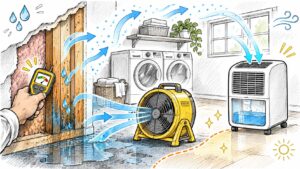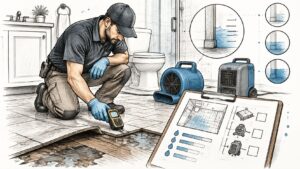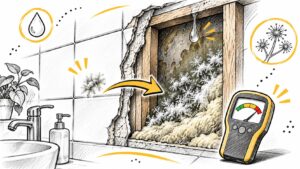
You shut the water off, mopped what you could see, and pointed a box fan at the baseboard. By afternoon the carpet looks almost normal, and someone says the room is dry enough to patch. That guess is where a lot of water losses go wrong.
Applied structural drying is the work of proving each material is dry, not hoping the room feels dry. A building is ready to rebuild when each material meets a goal set from its own unaffected baseline. Fan count and the number of days the machines have been running don't settle that question. Dated meter readings do.
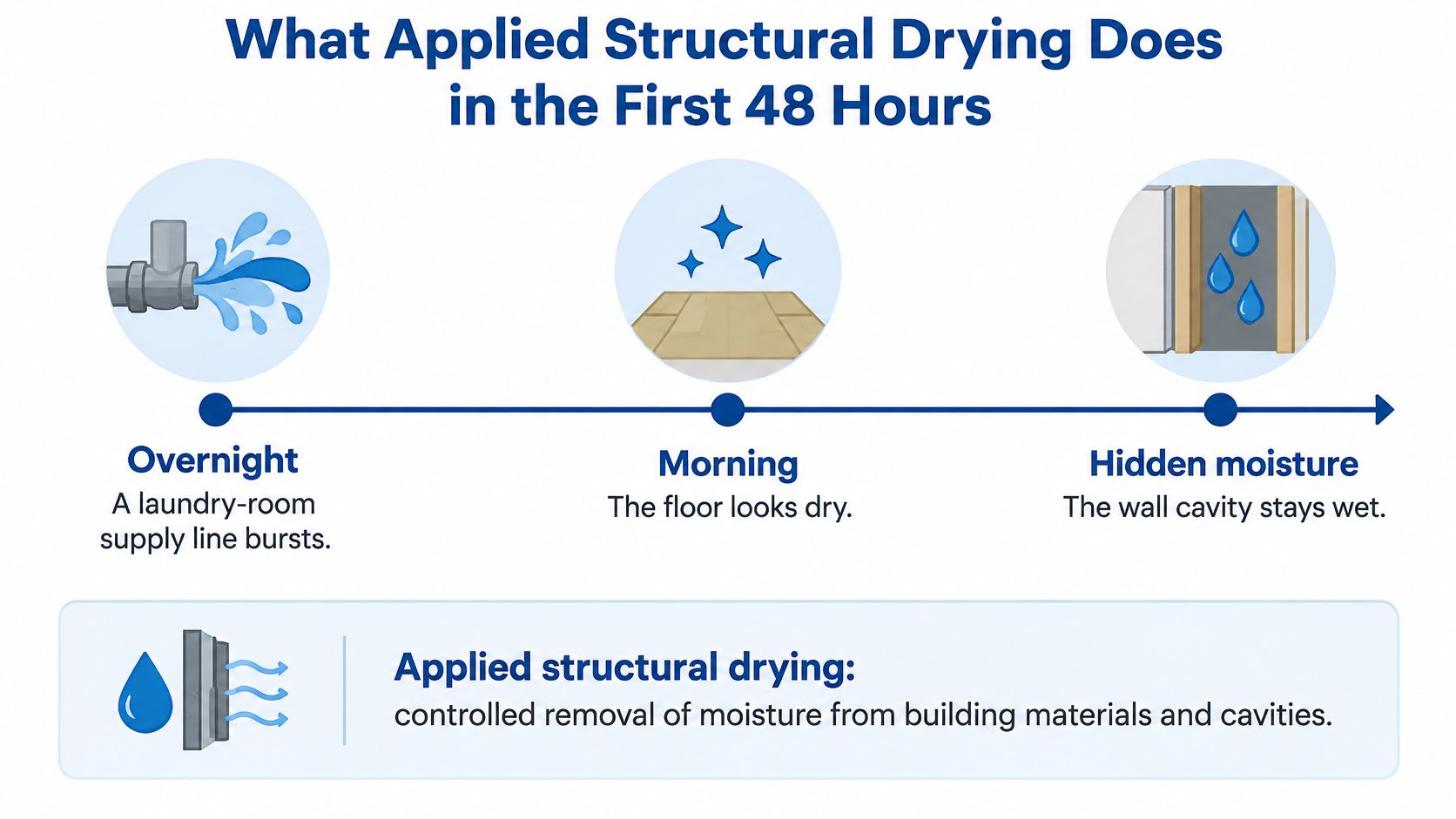
What Applied Structural Drying Does in the First 48 Hours
Say a laundry-room supply line bursts overnight. By morning the floor looks dry and the puddle is gone. Inside the wall, the cavity is still wet. The face of the drywall and the insulation behind it are not the same problem, and a dry-looking floor doesn't tell you which one you have.
Applied structural drying is controlled removal of moisture from porous and semi-porous materials. That includes carpet, carpet backing, drywall, wood, insulation, furnishings, and concrete. The crew uses extraction, air movement, and dehumidification together. Visible water is only the first problem. Water climbs drywall and sits in framing long after the surface looks clean.
The EPA brief guide on mold, moisture, and your home advises drying water-damaged areas and materials within 24 to 48 hours to help prevent mold growth. When wet or damp materials are dried inside that window, mold will not grow in most cases. The same guidance cautions that growth can still occur depending on conditions. Treat the window as a risk-reduction milestone, not a promise that mold cannot form.
Drying window by time since water loss
| Time since water loss | EPA status | Required action |
|---|---|---|
| Under 24 hours | Inside the drying window; mold growth unlikely in most cases if dried | Extract water and start drying immediately |
| 24 to 48 hours | Still inside the drying window for most materials | Finish extraction, run dehumidification and air movement, keep readings |
| Over 48 hours | Beyond routine drying; mold risk rises | Evaluate materials under mold-remediation procedures |
Under 24 hours, pull bulk water and start drying at once. From 24 to 48 hours, finish extraction, keep dehumidifiers and air movers running, and record readings. Past 48 hours, the job leaves routine drying. Wet materials get evaluated under mold-remediation procedures. On concrete and cinder block, extraction comes first, then dehumidifiers, fans, or heaters.
Write down the time since the loss before anything else. That clock decides whether drying stays routine or moves to remediation.
How to Set a Dry Standard and Read Moisture Against It
Applied structural drying is a monitored psychrometric process, not a pile of fans. The ANSI/IICRC S500 approach described by Restoration & Remediation separates a dry standard from a drying goal. The dry standard is the moisture condition measured in comparable, unaffected materials. The drying goal is the target for each affected material, and it may equal or closely approximate that standard. Wood framing should generally be below 16% moisture content before new drywall goes on. Above that, trapped moisture can drive movement, finish failure, or microbial growth behind the new board.
The FEMA fact sheet on cleaning flooded buildings identifies moisture content at or below 15% as a practical dry threshold for the materials covered by its table. Readings above 20% remain wet, and 15% to 20% require caution. Enclosed or poorly ventilated rooms can take four to six weeks or more to dry naturally, and wood framing should be checked before refinishing or covering. One percentage does not fit wood, drywall, concrete, engineered flooring, and masonry equally.
Five steps before the equipment runs
Take a baseline in an undamaged area of the same material. A hallway stud that never got wet tells you what "normal" is in this house, this season. The common mistake is skipping that reading and borrowing a number from another job.
Map the rooms and list each material by type and porosity. Carpet face, pad, drywall, framing, and slab each hold water differently. People often map the wet footprint on the floor and forget the wall the water climbed.
Record moisture content, temperature, and relative humidity in affected and unaffected zones. You need both the material and the air around it. Touching a baseboard and calling it dry is the mistake here.
Set the drying goal for each material from its own baseline. If unaffected drywall reads one way and unaffected wood another, the goals stay separate. Forcing every material toward a single percentage hides the one that's still wet.
Recheck at least daily. Log the meter reading by location, plus every equipment change, the ambient conditions, and progress toward the dry standard. A single end-of-job photo of the meters isn't a log.
Practical rule: Write each drying goal down before the first air mover is placed. If the goal isn't on paper, later readings have nothing honest to beat.
What the percentages actually prove
Moisture content thresholds for drying decisions
| Moisture content | Meaning | Action |
|---|---|---|
| At or below 15% | Dry by the FEMA practical threshold for the materials in its table | Move to the next stage if other checks also pass |
| 15% to 20% | Caution zone; material is not yet reliably dry | Keep drying and recheck at the same points |
| Above 20% | Still wet | Continue drying or evaluate further |
| Wood framing below 16% | Generally acceptable before new drywall is installed | Confirm the reading before installing drywall |
A 15% reading is a practical dry mark for the materials in FEMA's table, and only if the other checks pass. 15% to 20% is a caution zone, so drying continues at the same points. Above 20% is still wet. The 16% framing line is a reconstruction check, not a substitute for the baseline you took in this building.
Say the baseboard face reads in an acceptable range while a pin reading in the cavity behind it is still high. The surface dried first. The assembly didn't. Every point needs a record: material, location, baseline, affected reading, and date. A moisture meter reading only means something next to the unaffected baseline for that same material.
Fast equipment removal isn't success. The defensible endpoint is material-specific verification: which materials were tested, where the readings were taken, what baseline was used, and who approved reconstruction.
How Air Movement and Dehumidification Work Together
Think of a wet towel on a line. A fan across that towel speeds evaporation. Hang the same towel in a closed, humid bathroom and it stops drying once the air can't take more water. The towel is still wet. The air is just full.
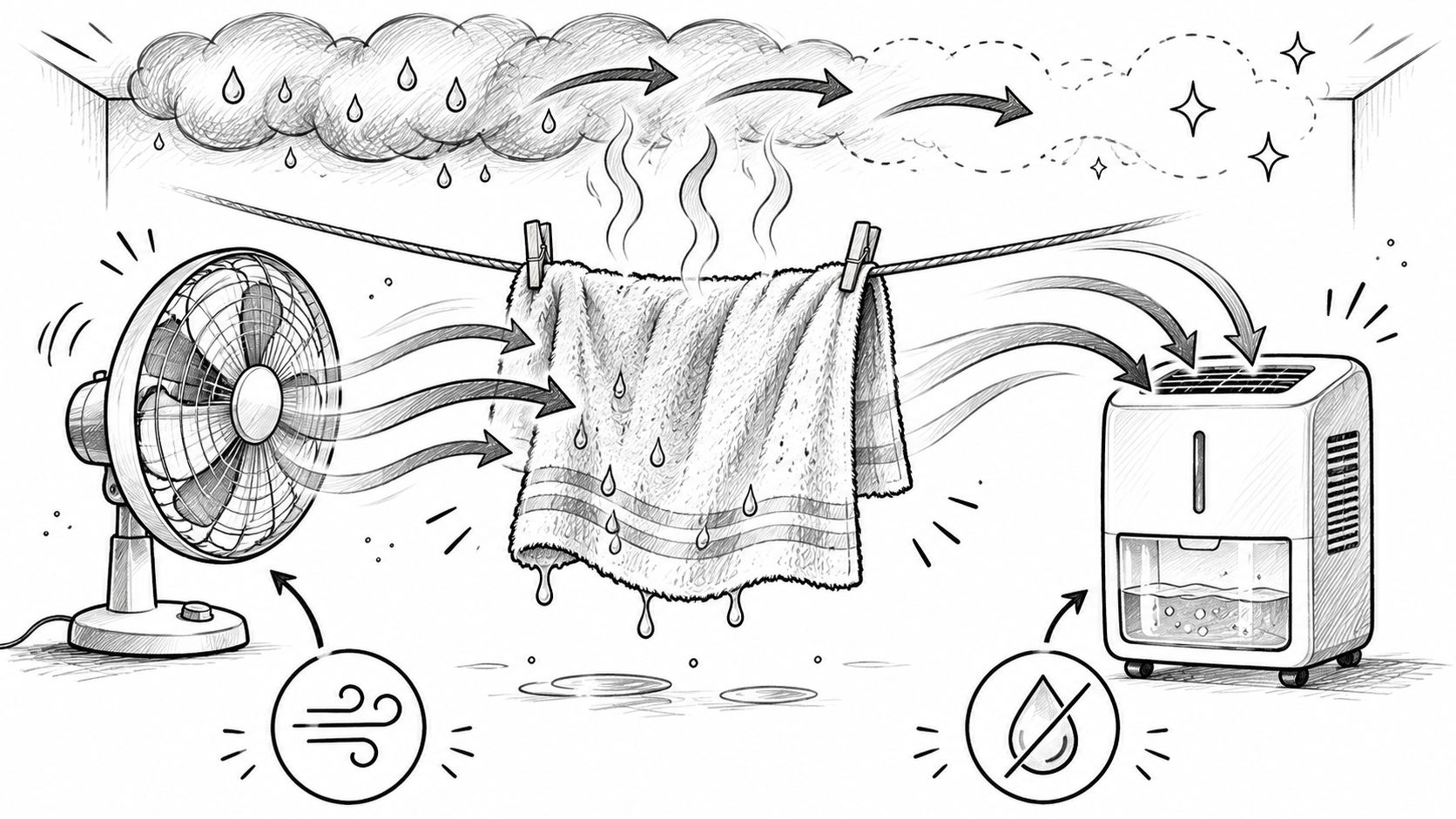
Air movement sweeps the thin layer of humid air off a wet surface so evaporation can keep going. Dehumidification lowers the water vapor in the room air so that evaporation doesn't stall. That's why a room can feel dry to your skin while the materials inside it are still releasing moisture. Heaters show up on some assemblies for the same reason: they change how much water the air can hold, and they only help when something is removing that water.
Three tools cover different jobs. Extraction takes bulk water you can still pull. Fans work the surfaces. Dehumidifiers, and sometimes heaters, treat the air and the assemblies that dry into that air. A dehumidifier for flood damage is sized for the wet air load, not chosen because it looks larger than a household unit.
Take carpet over a wet subfloor. Extraction pulls the water sitting in the carpet and pad. Air movers dry the carpet face. The subfloor still has to give up moisture into air that can accept it, which means the dehumidifier has to keep the vapor down or the underside stalls. Running fans alone in a closed room is the failure mode. Surfaces look finished. Humidity stays high. The materials underneath never get there.
Fans without dehumidification dry the air you can feel and leave the assembly you can't see.
When Drying Is Not Enough and Remediation Starts
Once materials have stayed wet past the routine drying window, the job is no longer "keep the fans running." It becomes an evaluation under mold-remediation procedures. Appearance is a weak signal. A wall can look ordinary and still be past that line.
The decision uses several checks together:
- Elapsed time since the loss, taken from the first record, not from when the equipment arrived.
- Visible microbial growth on a surface you can already see.
- Musty odor in a room that has no standing water left.
- Porous materials that cannot reach their goal, such as soaked insulation or particleboard that keeps holding water.
- Readings that stay in the still-wet range after the crew has re-mapped the setup.
Say the laundry-room wall cavity has been wet for three days. The crew opens the drywall, documents moisture and any growth inside the cavity, and the assessor decides which materials come out. That opening is inspection, not a cosmetic cut.
Once remediation starts, the sequence changes. Containment goes up. Affected porous materials come out. Cleaning follows. Drying is verified under that evaluation before anyone rebuilds. The drying log is the evidence for that decision, because it shows how long materials stayed wet and whether the readings ever moved.
Ask for the evaluation when the time window has passed. Don't wait for a smell or a stain to make the case.
Monitoring Drying Progress, Fixing Stalls, and Confirming Completion
Daily monitoring is a decision, not a courtesy visit. At each mapped location the crew reads material moisture, temperature, and relative humidity, then changes the setup or leaves it. Progress looks like steadily falling readings at every point, with relative humidity dropping as the drying chamber does its job. A room that smells fresher but holds the same meter numbers is not progressing.
Reading a stall
A stall is a signal to change the setup. It isn't a reason to wait another day and hope.
Drying stalls, causes and fixes
| Symptom | Likely cause | Fix |
|---|---|---|
| Readings flat for several days | Air movement too weak or aimed at the wrong surface | Reposition fans and recheck the same points |
| Relative humidity stays high | Dehumidifier undersized, or doors and windows left open | Seal the enclosure and add dehumidification capacity |
| Surface reads dry, cavity still wet | Surface dries faster than the wall or floor assembly behind it | Probe behind baseboards and under flooring, then adjust equipment |
| Enclosed room drying slowly | Poor ventilation | Use equipment instead of waiting for the room to dry on its own |
Flat readings usually mean the air is missing the wet face. Move the air mover so it washes that surface, then read the same points again. High relative humidity with the doors or windows open means outdoor air is undoing the dehumidifier. Close the enclosure and add capacity. A dry surface over a wet cavity means you measured the wrong layer. Probe behind the baseboard and under the flooring. An enclosed room that creeps along will not finish on its own. Equipment has to do the work.
Say a bedroom door stays shut and one fan blows across the center of the floor. The wall cavity never sees that air. Turn the fan onto the open cavity and add dehumidifier capacity. Drying starts again because the wet face and the room air are finally working together.
If readings don't change after one day of adjustment, ask the crew to re-map the points. Same numbers at the same spots mean the setup is still wrong.
A moisture map is what makes that recheck fair. It shows where each reading was taken so nobody "confirms dry" by moving the meter to an easier spot.
The evidence package before rebuild
Completion is a file, not a feeling. Before you approve rebuild work, the package should include:
- An unaffected-area baseline for each material type in this building.
- Material-specific readings for carpet, drywall, wood, masonry, and whatever else got wet.
- Mapped points, including cavities, the area behind baseboards, and the area under flooring.
- Temperature and relative humidity logs from affected and unaffected zones.
- Dated equipment changes, so a stall and its fix are visible.
- A final verification reading for each material against its own goal.
Don't close a cavity that was never checked. Don't hang new drywall until the framing reading meets the goal already written for that wood. Removing machines early is not the same thing as finishing.
A line backup or a sink overflow often needs the plumbing fixed before drying can hold. In Austin, we coordinate those repairs with licensed plumbers, make sure the source of the water is resolved, and start drying and restoration immediately after the repairs. You get a single point of contact for the plumbing work and the restoration, so the drying log isn't split across two crews who never compared notes.
Request that log and the final verification readings before you approve any rebuild. If a number isn't on the page, it hasn't been proven.
How Drying Limits Secondary Damage in Hidden Cavities
Secondary damage is the harm that shows up after the puddle is gone. Wood swells and loosens fasteners. Finishes crack or stain. A musty odor settles in. Mold grows on surfaces you already painted over. Most of that starts in a place the first cleanup never opened.
A wall that looks finished
Go back to that laundry-room wall. The drywall face can look dry while the insulation and the framing behind it stay wet for days. Your hand on the paint won't catch moisture under the flooring or inside the cavity. A meter at a mapped point will. Instrument checks matter more than touch because the damage you pay for later is the damage you couldn't feel.
Three mechanisms turn that hidden wet cavity into lasting damage. Bulk water left in place keeps feeding the materials around it. Humid room air stops those materials from releasing what they still hold, so they stay wet even with a fan in the doorway. Closing the cavity before a reading seals that moisture behind new finishes, where swelling, odor, and growth continue out of sight.
Drying limits that chain when bulk water comes out quickly, humidity is held low enough that materials can keep giving up moisture, and cavities are verified before anyone closes them. Each day those materials stay wet is another day odors and microbial growth can start. Once they sit wet beyond the routine window, the path shifts to remediation rather than another day of fans.
The places that limit secondary damage are the places that are hardest to see. If those points aren't on the log, the rebuild is a guess.
If your home in Georgetown or Austin still has wet walls, floors, or cavities after a leak, we can inspect the loss, extract the water, and dry the structure to material-specific goals with logged readings. RestoTek TX handles structural drying, microbial prevention, and the path through reconstruction, including coordination when a plumber has to stop the source first. Visit RestoTek TX to request help, and ask for the drying log before any rebuild starts.