The supply line under the bathroom vanity let go sometime after midnight, and nobody noticed until the hallway floor squelched underfoot at six the next morning. By the time a crew arrives, the vinyl is lifting at the seams, the baseboard on the far wall takes a thumbprint, and the vanity toe kick has swollen past its trim. An hour later the homeowner is holding a multi-page document with dozens of numbered lines, most of them written in a vocabulary nobody outside the trade uses.
That document is the water mitigation estimate. It prices the work that stops further damage and dries the building, and it's written before anyone quotes a sheet of drywall or a new floor. Read correctly, it isn't a sales sheet. It's a priced, verified drying plan: every line should tie back to a measurement, a meter reading or a logged hour, which is why the same pages answer both what's covered and why the number moves when a job turns out larger than the first look suggested.
What a Water Mitigation Estimate Covers Line by Line
Water runs under a bathroom floor overnight, and by morning it has traveled past the visible puddle into the subfloor, the wall cavity and the hallway beyond the room where it started. The estimate prices what stops that spread and dries the assembly. It isn't the cost of putting the room back.
A complete one documents:
| Component | What It Documents | Why It Changes the Scope |
|---|---|---|
| Water source and category | Where the water came from and whether it is clean, gray or contaminated | The source determines how much material must be removed |
| Affected area in square feet | Measured floor, wall and ceiling areas by room | Sets equipment count and material quantities |
| Moisture map | Readings across affected and unaffected reference areas | Reveals hidden moisture behind finishes |
| Materials and assemblies | Drywall, flooring, cabinetry, subfloor and insulation | Porous materials often need removal while others may dry in place |
| Contents handling | Furniture, electronics, rugs and stored items | Salvage, cleaning or disposal adds separate line items |
| Extraction | Standing water removed and time to start | Speed limits secondary damage |
| Drying equipment | Air movers and dehumidifiers with days on site | Often billed by equipment-day against moisture readings |
| Demolition and removal | Cut-outs to reach cavities and unsalvageable materials | Adds labor and disposal cost |
| Microbial prevention and deodorization | Treatment of affected areas and persistent odors | Added when moisture or odor persists |
| Reconstruction | Replacement of finishes, fixtures and structure | Priced as a separate estimate, not part of mitigation |
Nine of those lines belong to mitigation. Reconstruction is priced separately, usually by a different estimator, and often reviewed by a different person at the insurer than the one who approved the drying.
Read the source line first. Clean water from a supply line, gray water from a dishwasher or washing machine, and contaminated water from a sewer backup or an outdoor flood produce three different scopes. The category decides how much material comes out and what cleaning the crew owes you.
A complete estimate lets you do three things. You can compare two bids line by line instead of comparing totals. You can spot a missing item, such as demolition with no disposal charge or drying equipment with no monitoring visits. And you can check that each measured quantity matches the room sizes and readings in the written report, because a hallway counted as one room in one bid and three in another explains most of the gap between two quotes that look far apart.
Mitigation and Reconstruction Are Separate Estimates
Triage explains the split better than any definition. Mitigation is the emergency room: stop the bleeding, stabilize the patient, keep the situation from getting worse. Reconstruction is the surgery and the rehabilitation that follow once the patient is stable.
Take a kitchen supply-line leak. The first two days are mitigation. Someone shuts the line, extracts the standing water, sets air movers and dehumidifiers, removes the wet cabinet backs and the swollen flooring that would otherwise trap moisture, and monitors readings until the framing and subfloor reach a dry standard. Weeks later, the cabinet installation, the new flooring, the paint and the baseboard are reconstruction. Same leak, two documents, two different trades on two different schedules.
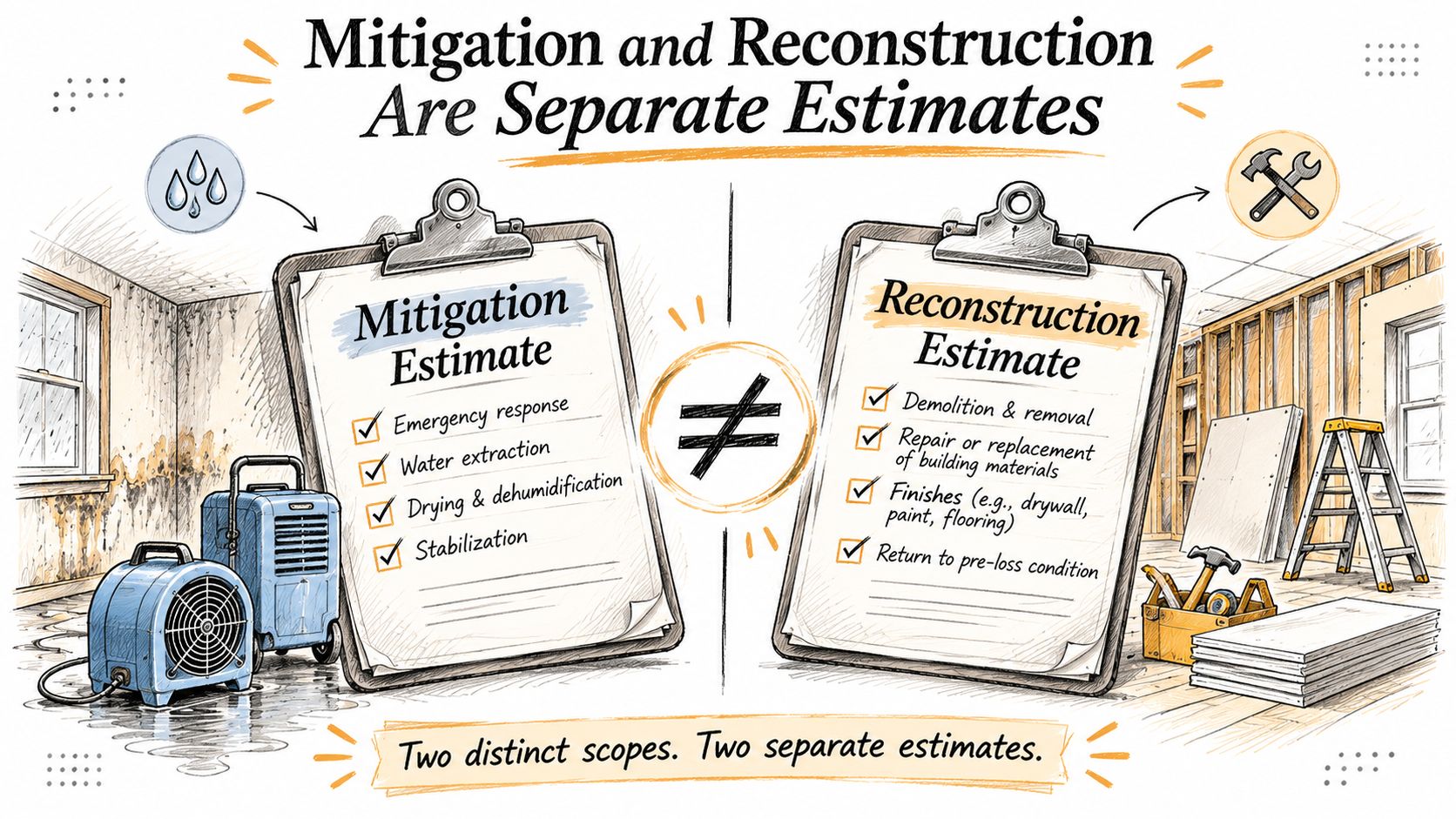
Insurers review the two at different points. Mitigation usually moves quickly because every day of delay adds scope, while reconstruction waits on the question of what drying proved. Combine them on one page and nobody can tell whether a dollar went toward stopping damage or toward repairing it. The distinction matters when you're reading a scope and can't work out where mitigation ends and water restoration begins.
Here's the test to apply to any line you don't understand. If the work stops or slows damage, it's mitigation. If it returns the room to its original finish, it's reconstruction. A detached cabinet base that gets dried and set aside for reuse is mitigation. The same cabinet reinstalled with new toe kick and caulk is reconstruction.
What Drives the Price and How Water Depth Changes It
Start with the national picture, because it explains why this paperwork exists at all. The Insurance Information Institute's table of average homeowners losses for 2019 to 2023 shows water damage and freezing at 1.50 claims per 100 insured homes annually, which works out to roughly one claim for every 67 insured homes, at a weighted-average severity of $15,400.
Compare that to fire and lightning. Fire claims cost far more each time, at an average severity of $88,170, but they arrive at only 0.23 claims per 100 insured homes. Water is the cheaper event that happens constantly; fire is the expensive event that happens rarely. The same dataset puts overall property damage at 5.53 claims per 100 insured homes with an average severity of $16,857.
Those are national benchmarks, not a price list for a house in Georgetown. Nobody can quote your job from a countrywide average, and an estimator who tries is guessing.
What the national average hides
That $15,400 figure averages two very different jobs. One is a contained plumbing event: a supply line to a single fixture, caught early, extracted in an hour, dried in three days. The other carries flooring, drywall, cabinetry, contents, drying equipment, microbial prevention and reconstruction, and it can run many times higher. The average sits between them because it includes both, which is exactly why an estimator documents the water source, affected square footage, material types, moisture readings, contents handling, demolition, drying duration and repair scope rather than applying one flat rate.
How depth turns into a dollar figure
Depth is the variable homeowners underestimate most. FEMA's flood-damage cost figures show how fast a few inches escalate:
| Water depth | Home size | Reported loss |
|---|---|---|
| About 1 inch of pooled water | 1,000 sq ft single-story | Close to $11,000 in damage |
| About 1 foot of water | 2,500 sq ft single-story | More than $29,000 in damage |
| About 3 inches of water | 1,000 sq ft single-story | About $12,000 out of pocket when flood insurance is unavailable; drywall, baseboards, carpets and furniture may need replacement |
| About 6 inches of water | 1,000 sq ft single-story | Approximately $21,000 in estimated loss |
Notice what the table implies: an inch of water in a small single-story home can cost about as much as three inches, because what matters isn't just depth but which materials the water reached and how long it sat. FEMA also reports that residents outside designated high-risk areas file more than 25% of flood claims nationwide, which is worth remembering if you've assumed your address rules out the problem.
On site, depth gets documented room by room rather than as one whole-house number. An estimator measures the water line at its highest mark, records standing time from the homeowner's account, lists which porous contents were submerged, and then meters the walls and floors for moisture the eye can't see. Water that reached a cabinet base or a wall cavity is a different scope from water that stayed on a sealed vinyl floor.
When two bids differ, compare them on eight things rather than on price alone: the named water source, the affected square footage per room, the material types being removed, the recorded moisture readings, contents handling, demolition and disposal, drying duration tied to readings, and the repair scope. A lower total usually means one of those lines got smaller, not that the work got cheaper.
How Timing and Moisture Readings Set the Drying Days
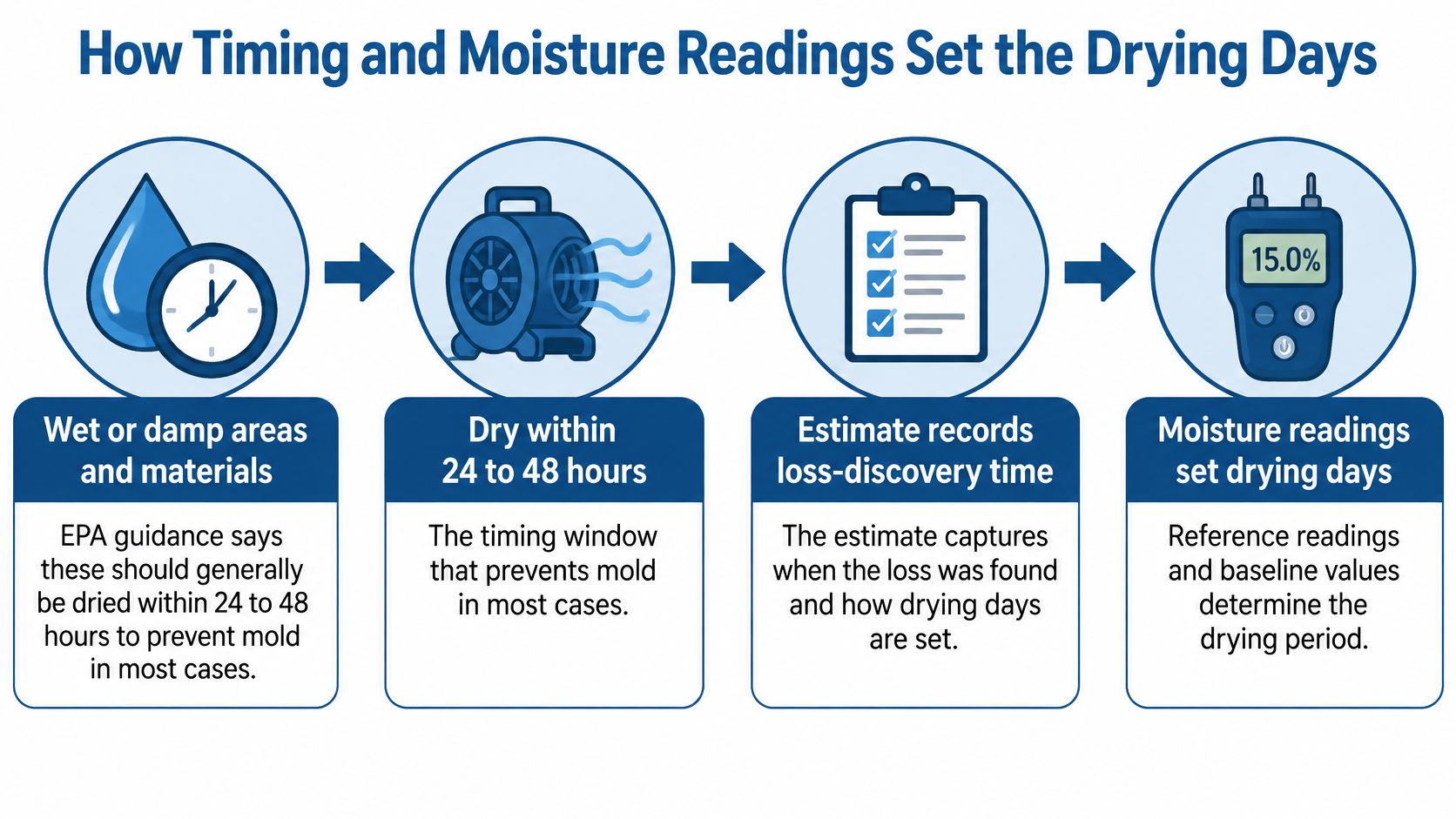
Time is a scope variable, not a footnote. EPA mold guidance states that wet or damp areas and materials should generally be dried within 24 to 48 hours to prevent mold growth in most cases. That window is why a good estimate records the loss-discovery time, the arrival time, the water category and source conditions, the affected material assemblies, and whether drying began inside those first two days.
The drying itself runs as connected stages, each with a reason:
- Stop the source. Extraction before repair means water returns the moment the line is pressurized.
- Extract standing water. Weighted extraction removes the bulk so air movement can reach the surface.
- Pull humidity down. Drying air with dehumidification makes the air able to accept moisture from materials.
- Move air. Air movers break the boundary layer at the surface so wet material evaporates faster than still air allows.
- Run dehumidifiers. Equipment keeps working until readings say the assembly has reached its dry standard, not until the floor looks matte.
- Monitor and adjust. Daily readings decide whether equipment stays, gets repositioned, or comes off site.
Each stage is a control on the same problem: reducing material moisture and indoor humidity rather than merely removing visible water. A loss that sat overnight, or one that happened during a humid Central Texas stretch, usually needs cavity access, more equipment days, odor treatment or a microbial assessment that a promptly extracted clean-water event never touches.
We coordinate plumbing repairs with licensed plumbers, confirm the source of the damage is resolved, and begin drying and restoration immediately after the repair is complete, because a drying plan written before the pipe is fixed is a plan with an open hole in it.
Readings decide what stays on site
Verification is a measured scope item, not a visual judgment. FEMA's guidance on cleaning flooded buildings recommends intrusive, pin-type moisture-meter readings, because touch and sight can't reliably establish whether building materials are dry. Wetted materials are presumed dry at 15% moisture content or less, readings above 20% remain wet, and 15% to 20% requires caution.
| Moisture Reading | Status | Effect on the Estimate |
|---|---|---|
| 15% or less | Dry; presumed dry | Equipment can be released and reconstruction can be scheduled |
| 15% to 20% | Caution; borderline | Recheck daily before deciding on removal or reducing equipment |
| Above 20% | Wet | Continue drying and extend equipment days |
FEMA also cautions that non-intrusive meters can be less accurate, so an estimate covering wood framing, subfloors or wall cavities should name the measurement method and the access it requires. That's why the moisture map matters as much as the equipment list. It sets reference readings in affected and unaffected areas so every later number has a baseline to be compared against.
Why the calendar isn't the plan
A fixed drying duration is a guess dressed as a promise. In Central Texas humidity, equipment days should be priced against readings, indoor conditions and comparison with dry reference materials, so the estimate can flex as the job dries. That's the difference between a document that holds up and one that has to be rewritten on day four.
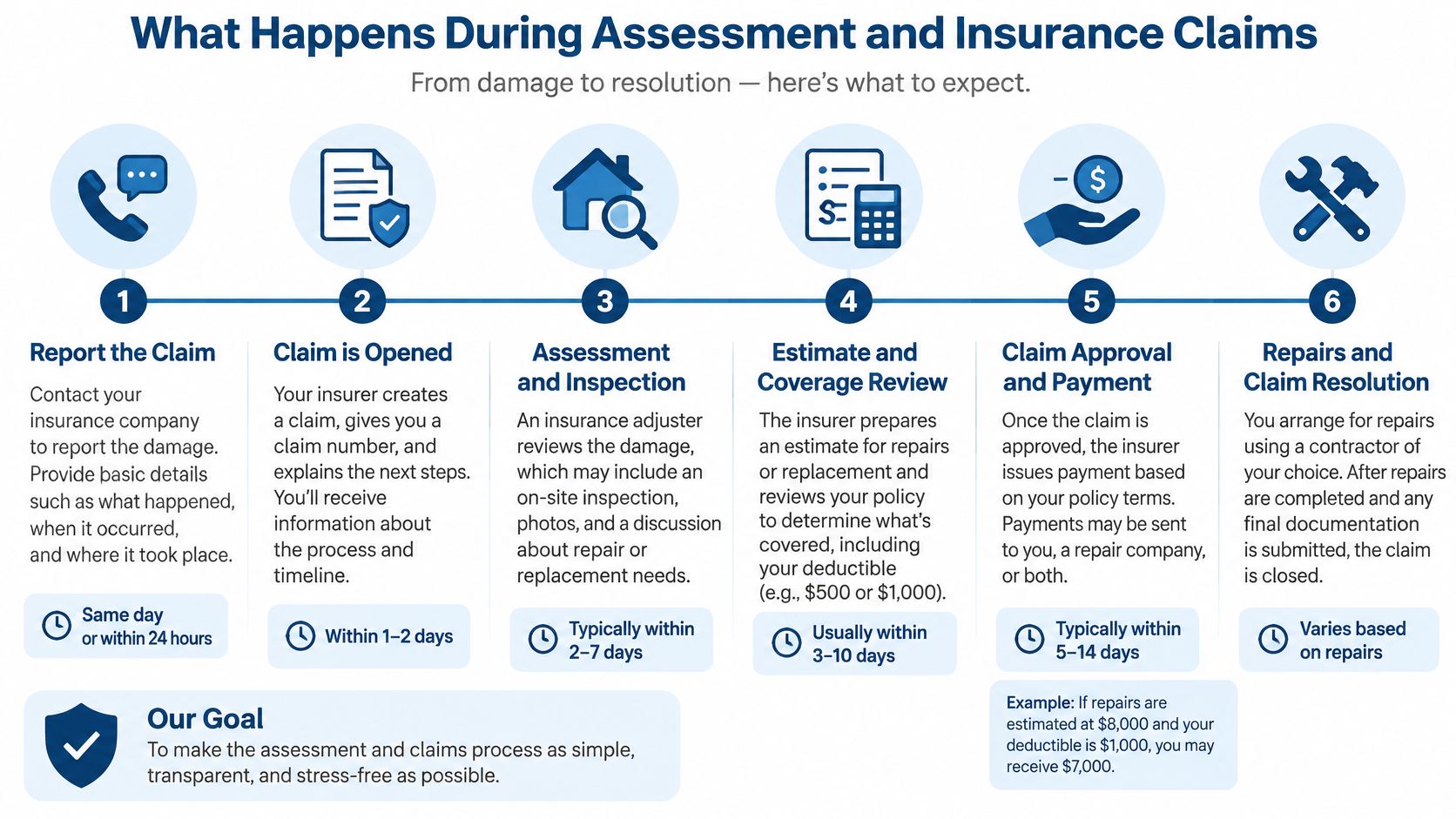
What Happens During Assessment and Insurance Claims
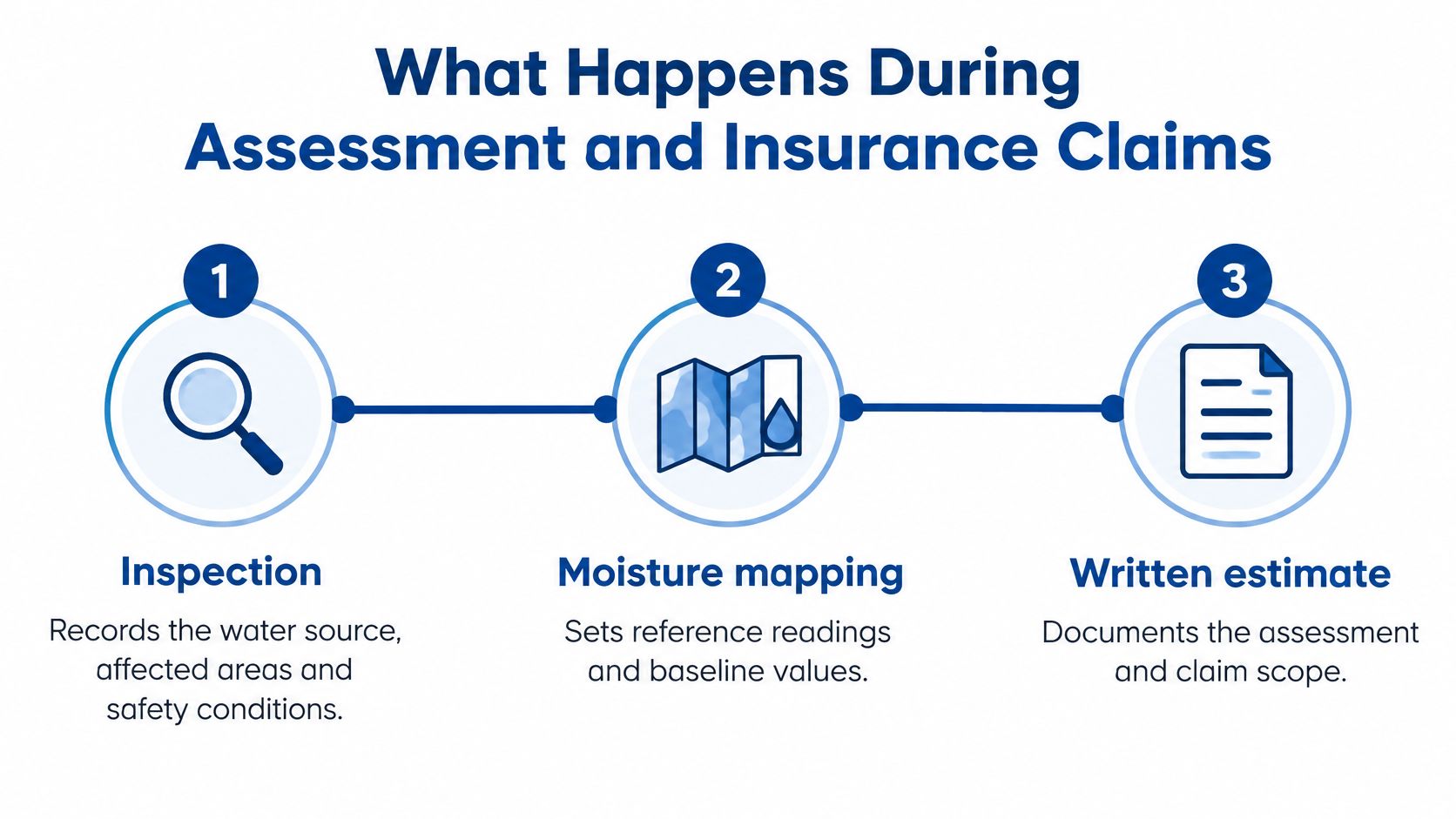
The process follows a fixed order, and each step produces a document you should end up holding.
- Inspection. The crew records the water source, affected areas and safety conditions, including anything electrical or structural that changes how work can proceed.
- Moisture mapping. Readings are taken in wet and dry reference areas to set baseline values and find moisture behind finishes.
- Written estimate. Each component is listed with quantities, plus the equipment plan and the days it's expected to run.
- Documentation. Photos, readings and daily drying logs are attached to the file as the job progresses.
- Adjuster review. The insurer's representative reviews scope and may ask for changes, additions or justification.
- Supplement. If demolition exposes damage beyond what the original moisture map showed, a supplement documents the new scope.
- Final dry verification. Readings confirm the assembly reached its dry standard before anyone closes a wall.
- Reconstruction estimate. The rebuild gets submitted as its own document, on its own timeline.
Mold testing sits alongside that sequence and answers a different question than drying does. It identifies whether mold is present and at what levels, and it doesn't remove anything; the insurance claim process runs on documentation, and testing after water damage helps document conditions for insurance purposes rather than serving as cleanup.
Ask three questions of an adjuster or a contractor, and the answers tell you whether the file is solid. How were the equipment days calculated, and against which readings? Which readings support the scope being paid for? Where are the daily logs kept, and can I get copies? A crew that can point to the meter values and the day-by-day log is a crew whose scope is defensible. A clear paper trail protects both the claim and the schedule, because a wall can't be closed until someone has proven it's dry.
What the Insurance Pays and What Stays Out of Pocket
Two documents decide this, and they answer different questions. The estimate prices the work. The policy decides payment. Keeping those separate stops the common confusion where a homeowner assumes a detailed estimate equals an approved claim.
Most sudden interior water damage from a plumbing failure falls under a homeowners policy. Loss driven by outdoor flooding depends on separate flood coverage, and without it the owner can be holding nearly the whole repair bill, which is the scenario behind FEMA's out-of-pocket figures for a few inches of floodwater in a small home.
Payment assembles in layers. Your deductible comes off the top of the total. The adjuster's approved scope sets what the carrier covers. When demolition uncovers damage the original moisture map didn't show, a supplement adds it, so a first approval isn't the final number.
Documentation decides how much of the estimate survives review. Photos, daily readings and logged equipment days are the argument. Without them, a line item is an assertion.
Keep and send the signed estimate, the moisture reading log, the equipment invoices and any mold-testing results. Each answers a question the adjuster will otherwise ask you to reconstruct from memory.
The gap between being covered and being paid in full usually comes down to which lines were approved, which are waiting on a supplement, and which are yours by policy terms. Ask for those three lists in writing before work starts.
Confirm the Estimate Before You Approve the Work
Check these before you sign:
- The source is named and the repair is scheduled. Drying a building while the supply line is still pressurized wastes everyone's money.
- Every room carries a measured square footage. Compare the numbers with the rooms you can walk through.
- The moisture map includes unaffected reference areas. Without a dry baseline, no reading means anything.
- The drying plan states how readings will set equipment days. A fixed day count with no verification step is a guess.
- Mitigation and reconstruction appear as separate documents. Approval of one says nothing about the other.
- Daily logs will be shared with you. Ask when and in what format.
Mold testing is worth requesting when there are persistent musty or earthy odors, recent water damage or leaks, past flooding or plumbing failures, visible discoloration on walls or ceilings, respiratory symptoms that improve when you leave the house, or a home purchase or sale in progress. If high levels show up, we walk you through the findings and next steps, including professional remediation where it's needed. RestoTek TX offers a free estimate and provides a single point of contact that coordinates plumbing repair, drying and reconstruction, so you aren't managing three trades on three schedules. The service area covers Georgetown, Austin and the surrounding Central Texas communities.
Water damage moves fast, and a vague estimate doesn't slow it down. RestoTek TX handles water damage restoration across Georgetown, Austin and the surrounding Central Texas area, offering a free estimate that documents inspection findings and moisture readings, then separates drying work from the rebuild that follows. If water has already reached a floor, a wall cavity or a cabinet base, request a free estimate at RestoTek TX and compare what comes back against the checklist above.