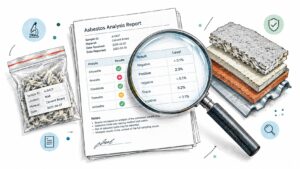
Can a negative asbestos result tell you that an entire room is clear, or only that asbestos wasn't identified in one particular sample? That distinction is central to reading asbestos testing results. Each result makes a limited claim about a sample, the method used to analyze it, and the benchmark applied. It doesn't automatically describe every material, layer, or air condition in a building.
For owners and contractors, that scope affects what can be disturbed, how work should be planned, and what a clearance report can establish. Start by identifying what was sampled and how. Then read the label and number in that context.
Asbestos Testing Result Categories at a Glance
A result label is a starting point, not a complete safety judgment. A positive bulk-material result can change work procedures, occupant protection, renovation planning, waste handling, and clearance decisions. An air result answers a different question: it must be compared with the exposure benchmark that applies to the sampling period and purpose. OSHA's asbestos standards show why a number needs context: its revised standard reduced the workplace limit from 2.0 to 0.2 fibers per cubic centimeter of air (f/cc) as an 8-hour time-weighted average, effective July 21, 1986. The agency's historical asbestos standard record documents that change and the importance of interpreting results against the relevant method and limit.
Use this table as a lookup tool. Find the wording on the report, read what it indicates, then check the caveat before deciding what to do.
Result labels and what they mean
| Result label | What it indicates | Typical lab wording | Key caveat |
|---|---|---|---|
| Positive | An asbestos type was identified above the method's detection threshold in the sampled material | “Chrysotile detected,” or a type listed with a percentage | Applies only to the sampled material; set the work scope before disturbance |
| Negative or none detected | Asbestos wasn't identified above the method's sensitivity in the tested subsample | “None detected,” “ND” | Doesn't clear unsampled or layered materials |
| Trace or below 1% | A low estimated asbestos content, below the 1% bulk benchmark or visually estimated below 10% | “Trace,” “less than 1%,” “present below 1%” | “Trace” isn't a federal category; visual estimates may differ from point counts |
| Above 1% | The bulk result exceeds the 1% benchmark used for asbestos-containing material | “Chrysotile, 2%” or “greater than 1%” | Requires controlled handling and planned disposal |
| Void or invalid | The sample couldn't be analyzed reliably | “Void,” “unable to analyze” | Requires resampling; it isn't a zero result |
| Air result below limit | The measured airborne concentration is below the stated benchmark under the sampling conditions | “Below reporting limit,” or an f/cc value below 0.1 | Applies only to the stated sampling duration, location, and method |
The caveat column often matters more than the headline label. A negative result might apply to one flooring layer, not the mastic beneath it; a low air reading might describe one location at one time, not exposure over a full shift. Before acting, check the sample description, method, reporting limit, and benchmark.
The distinction between bulk samples and air samples is the first step in deciding what a report can establish.
Sample Types and What Each One Answers
Bulk and air samples answer different questions. A bulk sample can identify asbestos type and estimate its proportion in the specific material collected. Air sampling measures airborne fibers under stated conditions. OSHA explains that airborne results assess exposure, not asbestos percentage in a building material, and describes the methods and occupational limits used for air monitoring in its asbestos air-sampling procedure.
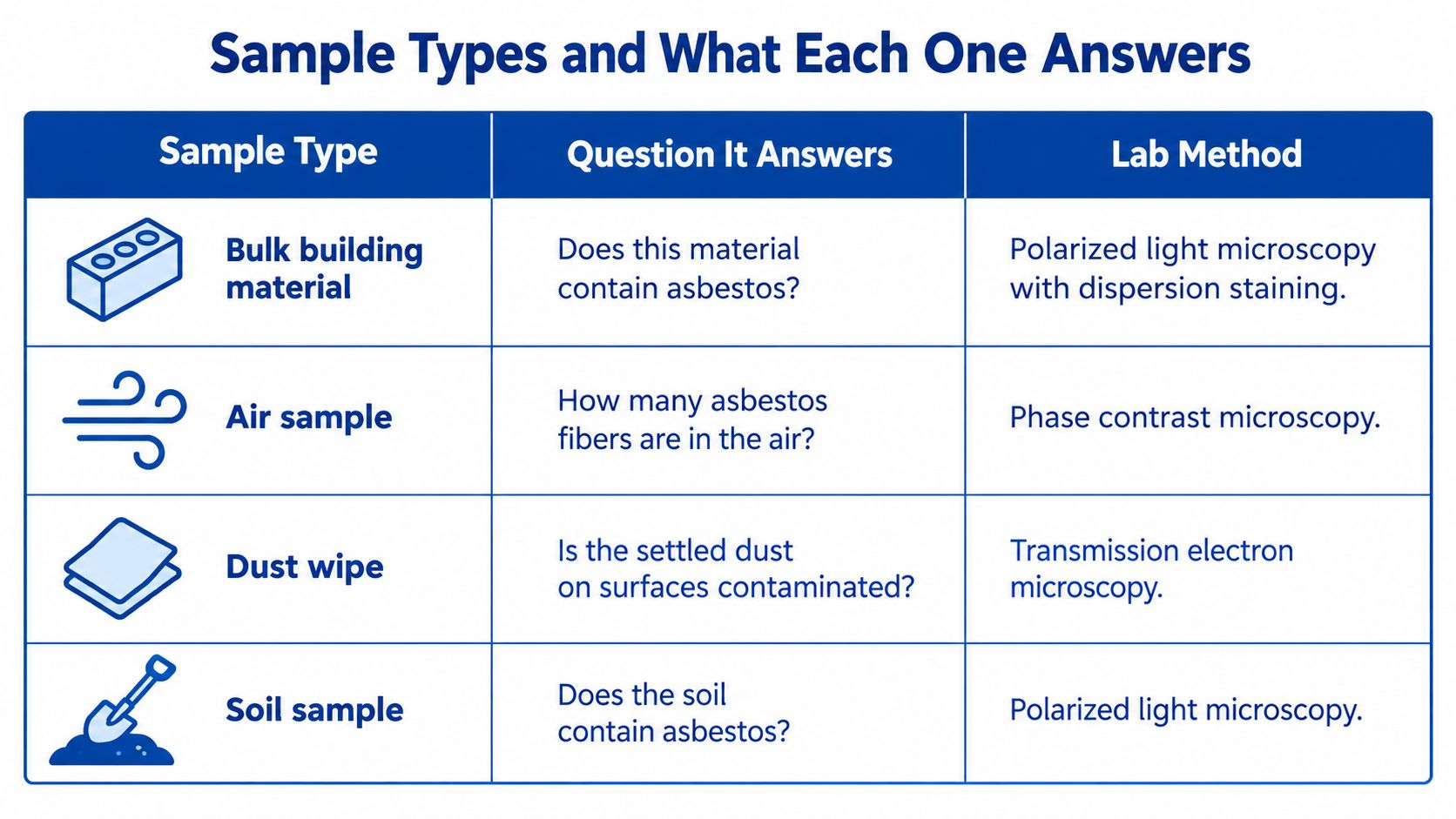
Sample types, methods and what each result answers
| Sample type | Method | Question it answers | Cannot establish |
|---|---|---|---|
| Bulk building material, single layer | PLM with dispersion staining | Which asbestos type and what percentage are in this layer? | Other layers, adjacent materials, or airborne levels |
| Bulk material with low visual estimate | PLM plus point counting | Is a visual estimate below 10% actually below 1%? | An exact percentage without a count |
| Personal air, 8-hour shift | Calibrated pump, mixed-cellulose-ester filter, PCM at 400× | What was the worker's average exposure against the 0.1 f/cc time-weighted average? | Whether counted fibers are asbestos, or conditions across the full room |
| Air, 30-minute excursion | Short-duration pump sampling, PCM | Was short-term exposure below the 1.0 f/cc excursion limit? | Full-shift average exposure |
| Area air after work | Room pump sampling, PCM, or electron microscopy for confirmation | What was the airborne concentration in this room when sampled? | Hidden debris outside the sampled zone, or whole-building condition |
| Surface wipe or dust | Wipe collection with laboratory analysis | Does settled debris on this surface contain asbestos? | Airborne concentration |
PLM, or polarized light microscopy, is used for bulk materials. PCM, or phase-contrast microscopy, counts airborne fibers, but it can't reliably identify whether those fibers are asbestos. A report using PCM should say whether it includes asbestos-specific confirmation by a method such as polarized-light or electron microscopy. The report should also state the air-sampling duration, volume, locations, and reporting limit.
If you're assessing airborne conditions during a restoration or construction project, air quality testing is one service category to discuss with a qualified provider. The test still needs to match the question: a short room sample isn't a substitute for a worker's breathing-zone measurement over a shift, and a material result can't tell you how much fiber is in the air.
Practical rule: A result is only as broad as the sample set behind it. More precise analysis of one sample won't answer questions about materials or locations that weren't sampled.
Lab Report Terms Decoded
A laboratory report can look definitive while leaving key questions unanswered. Terms such as “ND,” “point count,” and “void” describe how the result was produced and what its limits are. OSHA cautions that air samples must represent the relevant breathing-zone exposure period, and that overloaded or otherwise unusable samples should be reported as void, not recorded as zero. Its air-monitoring guidance for shipyard employment explains why a low value or an unusable sample needs careful interpretation.
Common report terms and how to read them
| Term | Meaning | Where it matters |
|---|---|---|
| f/cc | Fibers per cubic centimeter of air | Air results compared with the 0.1 f/cc or 1.0 f/cc occupational limit |
| TWA (8-hour) | Average exposure across a full work shift | Worker compliance and full-shift monitoring |
| Excursion limit (30-minute) | Short-term peak limit of 1.0 f/cc | Tasks that may disturb material |
| Reporting or detection limit | The lowest value the laboratory reports reliably | Results labelled “ND” or “below reporting limit” |
| ND (none detected) | Nothing was identified above the method's sensitivity in the tested subsample | Bulk or air results; it doesn't prove absence |
| Point count | A grain-by-grain count used to refine an estimated percentage | Bulk results with a low visual estimate |
| Homogeneous area | Material considered uniform in colour, texture, and age | Deciding which materials can be sampled as one unit |
| Nonhomogeneous or layered | A sample contains several materials or distinct layers | Reporting each relevant layer separately |
| Void | The sample couldn't be analyzed reliably | Resampling; it isn't zero |
A reporting limit gives you a boundary for interpreting a result, not a guarantee that no fibers exist below it. For example, “ND” means the method didn't identify asbestos above its sensitivity in the tested subsample. It doesn't prove that every particle in the building is asbestos-free.
A void sample raises a different problem: there is no usable result to compare with a limit. Treating it as zero can underestimate exposure, so ask the sampler to explain why the sample was unusable and how it will be recollected. A short room sample also can't stand in for a full-shift breathing-zone measurement if the question is whether a worker's exposure met the applicable time-weighted benchmark.
Exposure Limits and Action Thresholds
For occupational air monitoring, OSHA sets a permissible exposure limit (PEL) of 0.1 f/cc as an 8-hour time-weighted average and a 30-minute excursion limit of 1.0 f/cc. Those limits apply to worker exposure, not to the percentage of asbestos in a wall, floor, or other bulk material. A report that compares a sample against the wrong type of benchmark can create a misleading pass or fail.
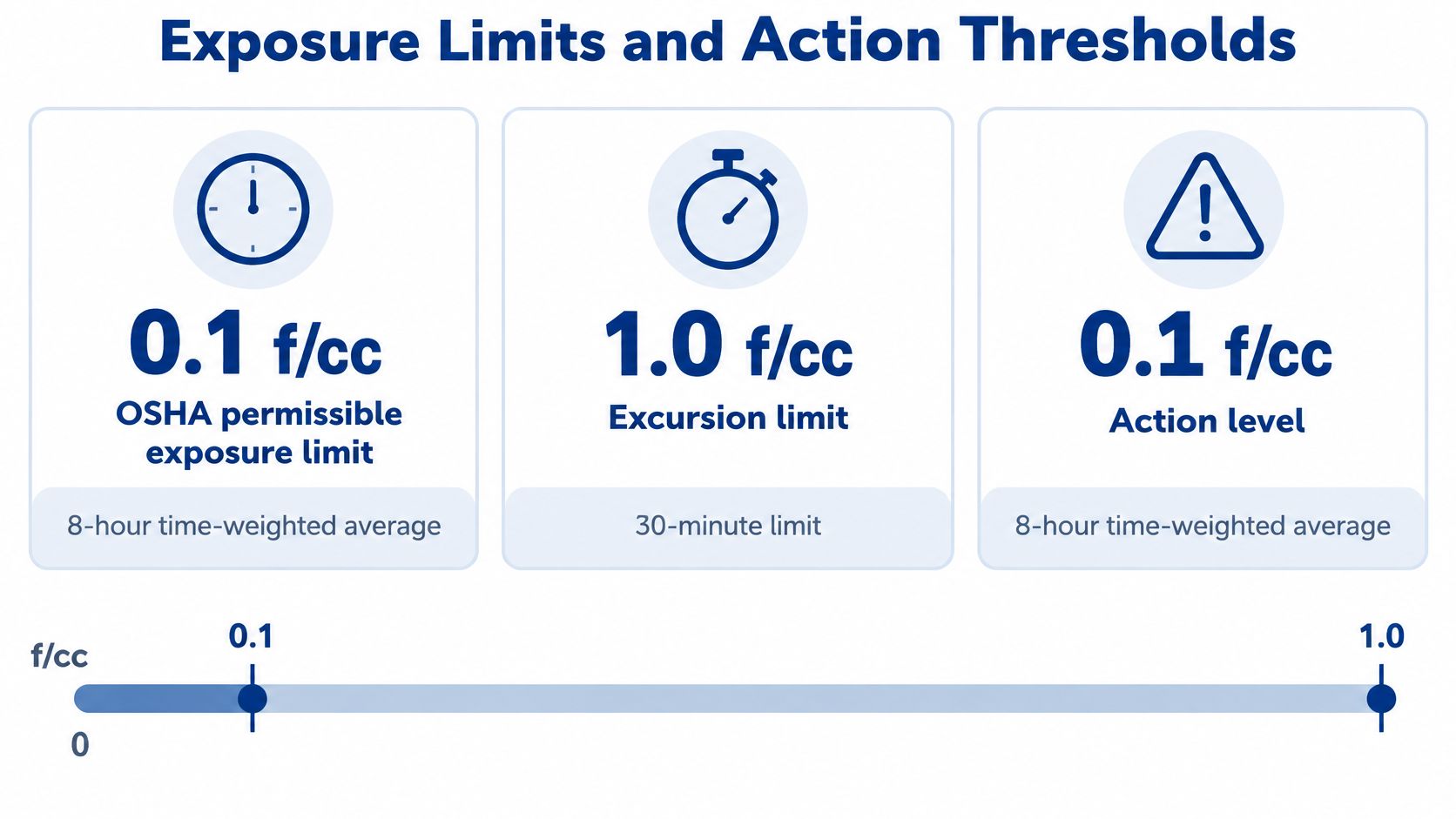
The values below come from different contexts. Some describe worker air exposure; others are reference points for bulk material. Don't treat them as interchangeable.
Benchmarks and where each applies
| Benchmark | Value | Applies to | Status |
|---|---|---|---|
| OSHA permissible exposure limit | 0.1 f/cc as an 8-hour time-weighted average | Worker breathing-zone air | Federal occupational limit |
| OSHA excursion limit | 1.0 f/cc over 30 minutes | Short-term peak air exposure | Federal occupational limit |
| OSHA revised standard | 0.2 f/cc as an 8-hour time-weighted average, down from 2.0 f/cc | Worker breathing-zone air | Superseded; effective July 21, 1986 |
| Asbestos-containing material threshold | More than 1% asbestos in bulk material | Building materials and renovation planning | EPA reference value |
| Visual-estimate rule | Visual estimate below 10% in PLM | Bulk material with low estimated content | Owner may assume above 1% or request point counting |
The historical record shows why an old report can't be compared with a current benchmark without checking which standard and analytical method applied at the time. The NIOSH-hosted record of the earlier OSHA revision also describes the 1976 NIOSH recommended exposure limit of 0.1 f/cc for fibers longer than 5 microns, when that level was described as the lowest detectable by phase-contrast microscopy.
A bulk-material benchmark isn't an air limit. The percentage in a building material describes the sample's composition; an air result describes airborne concentration during sampling. State and local rules may be stricter than federal values, and the relevant benchmark depends on whether the report is for worker protection, occupants, renovation planning, or another purpose.
Before deciding that a result is above or below the line, match the sample type, sampling duration, method, and benchmark. If one of those pieces is missing, ask the laboratory or qualified consultant to clarify the comparison before work proceeds.
Trace, Low-Percentage and Not-Detected Results
“Low” and “negative” can sound conclusive, but they don't close every question. For bulk materials, the EPA/NIOSH procedure uses PLM with dispersion staining and has a practical measurement range of approximately 1% to 100% asbestos, with an estimated lower detection limit below 1%. The EPA/NIOSH analytical procedure explains why “none detected” means asbestos wasn't identified above the method's effective sensitivity in the tested subsample, not that every material or particle in a building is asbestos-free.
Consider three common situations:
One vinyl floor tile is reported as none detected. That result applies to the tile sample, not the mastic or underlayment beneath it. If the work will remove the flooring system, sample the uncovered layer before disturbing it.
A material is visually estimated at 8%. Under the EPA approach, the owner may assume the material exceeds 1% and manage it as asbestos-containing, or request point-count verification. If the visual estimate and point-count result disagree, the point-count result controls. Don't treat “8%” as a reason to skip the scope decision.
A textured ceiling is reported at 0.5%. The low figure still needs to be evaluated before disturbance. Confirm what material and layer it describes, how the percentage was determined, and how the applicable rules govern the planned work.
A low number may answer a narrower question than you expected. Check whether the tested portion represents the material you're about to disturb.
Don't extend a negative or low result from one sample to unsampled drywall joint compound, texture, flooring, mastic, insulation, or fireproofing. These can be separate materials or layers, and each may need its own result. The report should identify the sample location, material, method, asbestos type, and estimated or point-count percentage.
For a low visual estimate, request point counting when it will help resolve the decision. For an uncovered layer, arrange a new sample. If the report indicates asbestos but the project scope is not settled, manage the material as asbestos-containing until a qualified professional establishes how it will be handled.
Reading One Full Report
Take a hypothetical report for a renovation involving a textured ceiling. Read it from the sample description through the final air and wipe results. The lines don't combine into a single all-purpose “safe” verdict; each answers a different question.
Sample ID and location: Check that the report names the exact ceiling coating, room, and sampled area. If it says only “ceiling,” ask whether joint compound, repairs, or other layers were included.
Method and reporting limit: Confirm that the bulk sample was analyzed by PLM with dispersion staining and note the laboratory's reporting limit. Without those details, it's harder to interpret the percentage or a “none detected” label.
Bulk result: Suppose the report lists 0.5% chrysotile in the textured ceiling coating and labels it “trace” or “below 1%.” That result applies to the tested coating. It doesn't automatically answer what's in other ceiling layers or nearby materials.
Personal air result: Suppose a worker's sample reports 0.04 f/cc as an 8-hour time-weighted average. Compare the result with the relevant occupational limit, then confirm the sampling duration and method. If the report uses PCM, ask whether asbestos-specific confirmation was included.
Wipe result: A wipe collected in the demolition zone describes settled debris on that surface. It doesn't establish an airborne concentration or clear other rooms.
The report supports a bounded conclusion: the sampled coating was analyzed at the listed locations, and the air and wipe samples describe their own sampling conditions. It leaves open what's in untested joint compound, concealed mastic, other ceiling layers, and areas outside the sample set.
Use this template when reviewing a report: “This result applies to [material and layer] at [location], analyzed by [method], with [result and reporting limit]. It compares with [benchmark] for [purpose]. It does not cover [unsampled materials or locations].”
What a Clearance Result Covers
After a clean result, ask: What exactly does this report clear? A negative asbestos result doesn't mean a building is safe for every purpose. Its meaning depends on what was sampled, where it was collected, and which method was used, as OSHA explains in its guidance on evaluating and controlling asbestos exposure.
Material-specific clearance covers the sampled material at the sampled location. It doesn't clear adjacent finishes, hidden layers, or similar-looking materials elsewhere unless the survey and sampling plan establish that they're represented.
Room clearance requires more than one negative material sample. The sample set must represent the suspect materials in the room, and any air sampling must have been conducted under the planned conditions. A single result can't automatically stand in for every surface or every work condition.
Building clearance requires a documented survey that addresses the areas and material types relevant to the decision. If areas weren't accessed or materials weren't represented, the report should state that limitation rather than implying whole-building clearance.
Consider a water-damage repair where a flooring tile sample is negative. Demolition then exposes mastic and drywall joint compound that weren't sampled. The original result doesn't clear those materials. It answers only the question asked of the original tile sample.
A new material type, newly exposed layer, changed work plan, or unexpected finding is a reason to revisit sampling before disturbance. Water-loss demolition can reveal concealed materials that the original sample set didn't include.
Ask for this in writing: “Which materials and areas do these results cover?”
That sentence turns a broad assurance into a scope that can be checked against the work area, sample locations, and materials actually represented.
Checking a Report for Defensible Data
A useful report lets you connect each conclusion to a specific sample, method, and purpose. Check the bulk and air sections separately. If key details are absent, request them before using the report to plan demolition, assess compliance, or make a clearance decision.
For bulk-material results
- Material and location: Confirm that each sample has a clear description and location.
- Sampling rationale: Check how the sampler grouped homogeneous areas and chose the number of samples.
- Result details: Look for the asbestos type and percentage, or a point-count figure when used.
- Method and reporting limit: Confirm that the report names the method, such as PLM with dispersion staining, and gives its reporting limit.
- Analyst and layers: Check the analyst qualifications and whether distinct or nonhomogeneous layers are listed separately.
For air results
- Sampling conditions: Look for duration, sampled air volume, sample location, and flow rate or pump-calibration information.
- Analysis details: Check the fiber-counting rules and whether the result is PCM-only or includes asbestos-specific confirmation.
- Benchmark: Confirm which limit the laboratory or project report applied and why it matches the sample's purpose.
For every result
- Documentation: Check the chain of custody, collection and analysis dates, and quality-control notes.
- Purpose: Confirm whether the report is intended for worker compliance, post-remediation clearance, property disclosure, or renovation planning.
When laboratories analyze the same bulk sample, their results can differ. If a result is unexpected or will drive a costly decision, ask the laboratory to explain its analysis and consider a second analysis by another qualified laboratory. A second opinion is most useful when you provide the full report and sample history, not just the result label.
Decision Branches and Steps
Start with the result category, then decide what information is still missing.
- Negative result for a specific material: Confirm the scope before demolition, sanding, or other disturbance.
- Positive result or material above 1%: Plan for controlled handling and disposal, with required licensing and work practices determined by the jurisdiction and project.
- Trace, low-percentage, or void result: Pause the decision, then consider point counting, a second laboratory, or resampling before work proceeds.
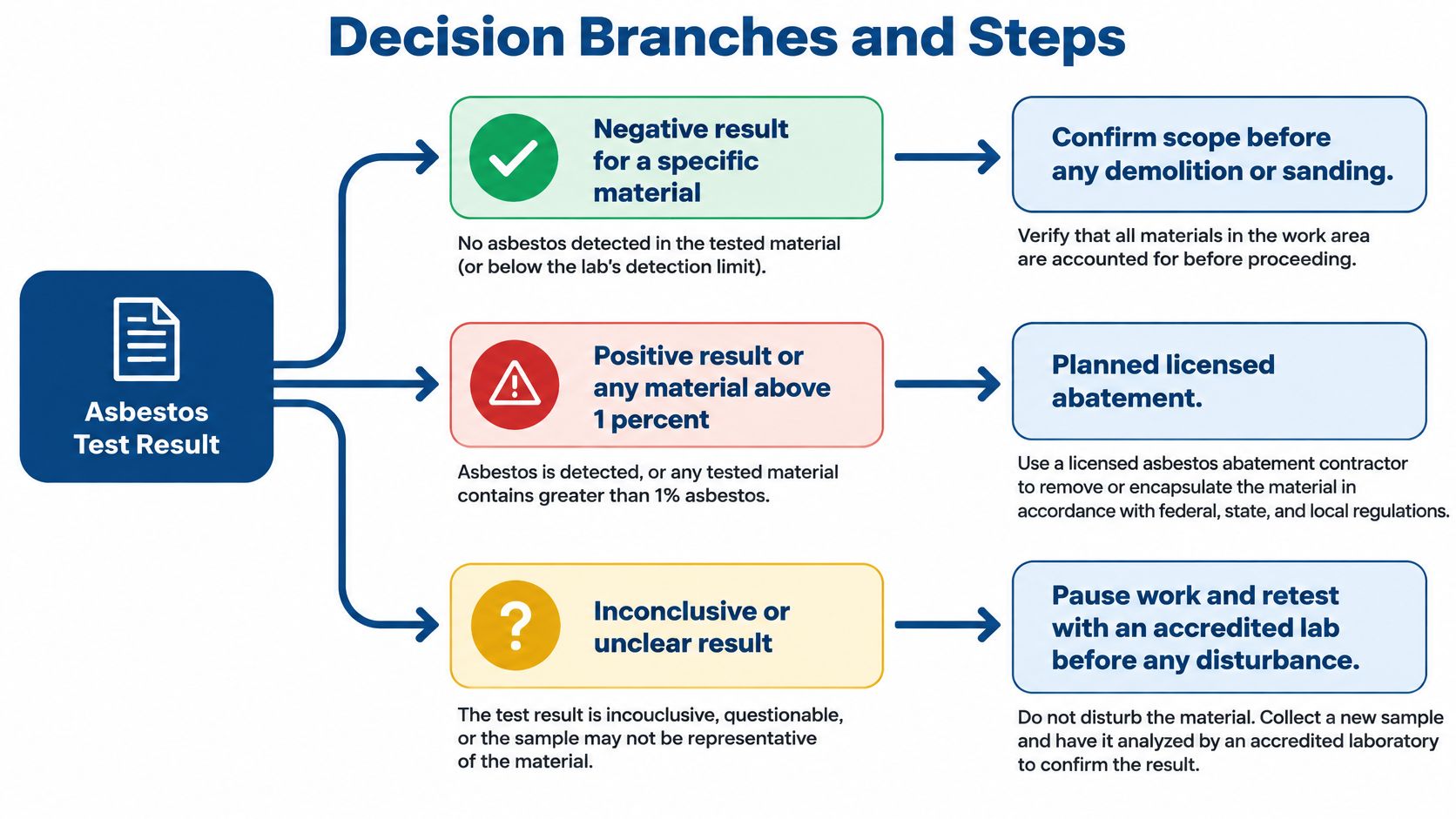
Follow these steps in order:
Stop disturbing suspect material. Set testing and work controls before sanding, scraping, or demolition. A common mistake is to start work before anyone has checked what the sample actually represented.
Confirm the sample scope. Match every result to the material, location, and layer it covers. Don't extend one flooring result to concealed mastic or adjacent joint compound.
Use the right benchmark. Compare like with like: bulk percentages against a bulk-material reference, and air concentrations against the appropriate air limit and sampling period.
Fill gaps in the report. Request missing method, location, duration, reporting-limit, and quality-control information. If a bulk result is unexpected or borderline, ask whether point counting or a second analysis is appropriate.
Set the work scope. Decide whether to manage the material as asbestos-containing or sample layers and materials the report leaves open.
Plan controls for disturbance. Confirm the licensing and work practices required by your jurisdiction, then arrange appropriate containment, wet methods, and air monitoring when needed. For a containment setup, a negative-pressure system may be relevant to the project plan.
Plan waste handling and clearance. Determine how the waste will be managed, then arrange post-work air sampling that matches the planned scope. A common mistake is treating one room's sample as proof of whole-building clearance.
Keep the record together. Retain the full laboratory reports, sampling records, work scope, and disposal documents for future occupants, buyers, contractors, or insurers.
Before calling a provider, gather the full report, a floor plan marked with sample locations, photos of the sampled materials, and a description of the planned work. Water-damage demolition can reveal layers that weren't visible during the first inspection, so coordinate testing with the inspection, mitigation, and drying plan. Ask for a written scope that maps each result to the material and area it covers.
If water damage has exposed building materials you're unsure about, RestoTek TX provides asbestos testing alongside water-damage inspection, mitigation, drying, and reconstruction services in the Georgetown and Austin area. Gather your laboratory report and mark the affected locations before requesting an assessment, so the provider can discuss what the existing results cover and what may need further testing.