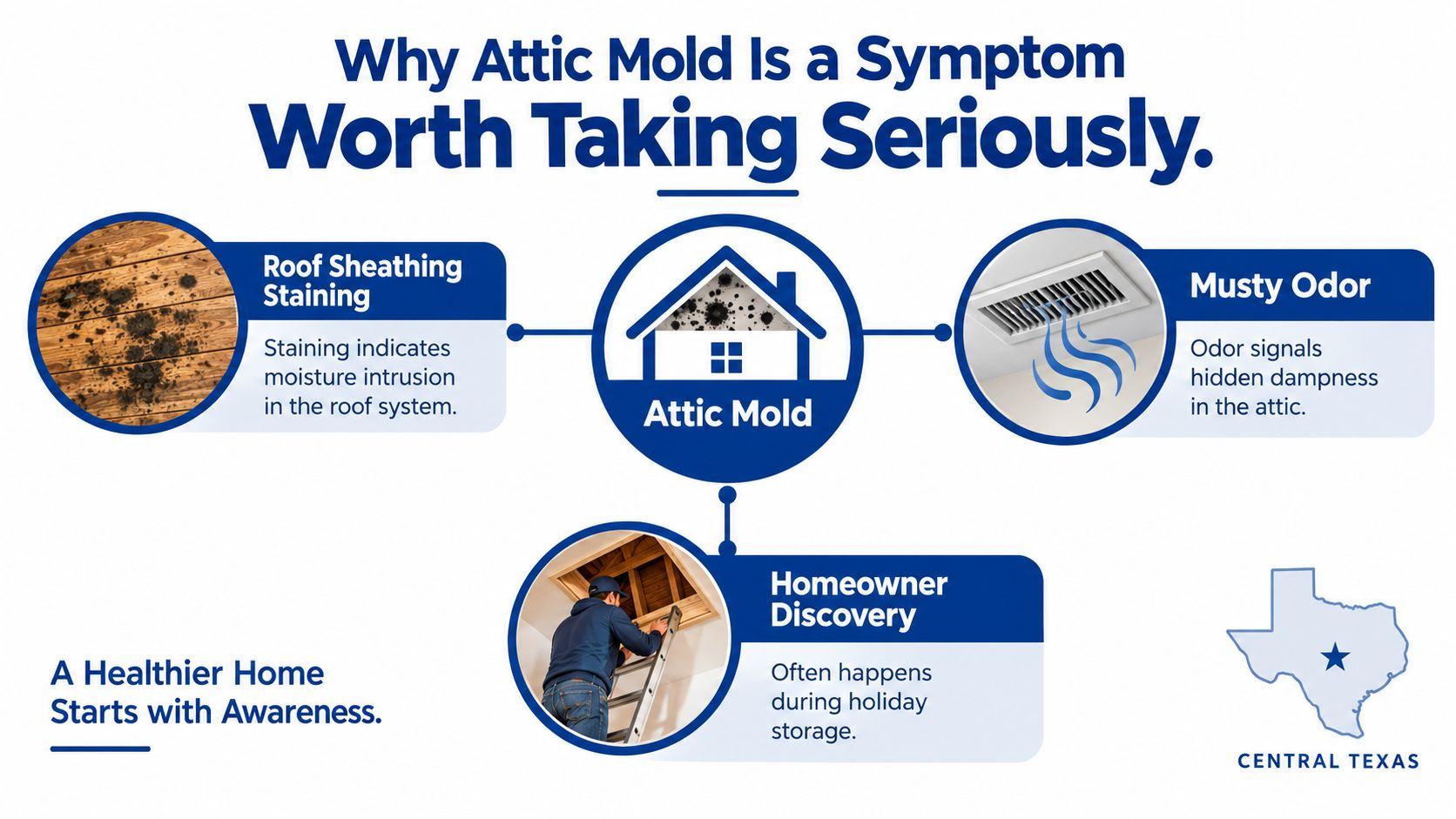
You pulled down the attic ladder to get holiday boxes and noticed it right away. Dark staining spreads across the roof sheathing, the insulation smells musty, and you don't know whether you're looking at a roof problem, a health problem, or both. That uncertainty is exactly what a good Attic mold inspection is meant to resolve, starting with moisture rather than mold itself.
Why Attic Mold Is a Symptom Worth Taking Seriously
A Georgetown homeowner finds that stain in November, after a wet fall. An Austin homeowner notices a musty smell only when the air handler starts. In both cases, the visible growth isn't the starting point. It's evidence that water has already found a path into materials that should stay dry.
Attics collect risks from several directions at once. Roof leaks and wind-driven rain enter from above, plumbing and HVAC condensation adds water from equipment, and humid indoor air leaking through the ceiling can condense on cooler surfaces. Summer heat, afternoon thunderstorms, and high outdoor humidity make Central Texas roof assemblies work hard, especially when ventilation is blocked.
Clues, not causes
Think of dark sheathing, damp insulation, and warped wood as clues to a moisture pathway. The World Health Organization identifies visible mold, moldy odors, condensation, and a history of water intrusion as practical indicators of dampness or microbial growth, and estimates indoor dampness affects approximately 10% to 50% of indoor environments across Europe, North America, Australia, India, and Japan in its WHO review of indoor dampness and health. That range is wide, but it makes a simple point. This isn't rare, and it isn't only a cosmetic issue.
A small visible patch can also mislead you. Moisture often spreads inside insulation or along framing before it shows on a surface you can see from the hatch. From the living space below, ceiling penetrations, recessed lights, duct leakage, and pressure differences can connect attic air to indoor air, so the location of airflow matters as much as the size of the stain.
Common Attic Moisture Sources and What They Leave Behind
| Moisture Source | Typical Sign in the Attic | Pattern |
|---|---|---|
| Roof or flashing leak | Staining on sheathing or rafters | Localized, often worse after rain |
| Exhaust vented into attic | Damp insulation near the termination | Recurring after showers or cooking |
| Blocked soffit intake | Broad dampness on roof decking | Widespread rather than one spot |
| Duct or air-handler condensation | Wet areas near platform or drain line | Seasonal, tied to cooling cycles |
Practical rule: Don't ask first how to clean the stain. Ask where the water came from, how long it's been there, and what materials stayed wet.
That shift changes the whole job. An attic mold inspection is a moisture investigation that happens to involve mold, and the findings should name a source you can fix.
What Happens During an Attic Mold Inspection
A competent inspection starts before anyone climbs the ladder. Your inspector should ask about roof age, recent storms, plumbing losses, HVAC changes, prior leaks, and when odors or symptoms appear. Those answers narrow where to look first, because a stain under a plumbing vent means something different from uniform staining across an entire roof slope.
The visual sweep
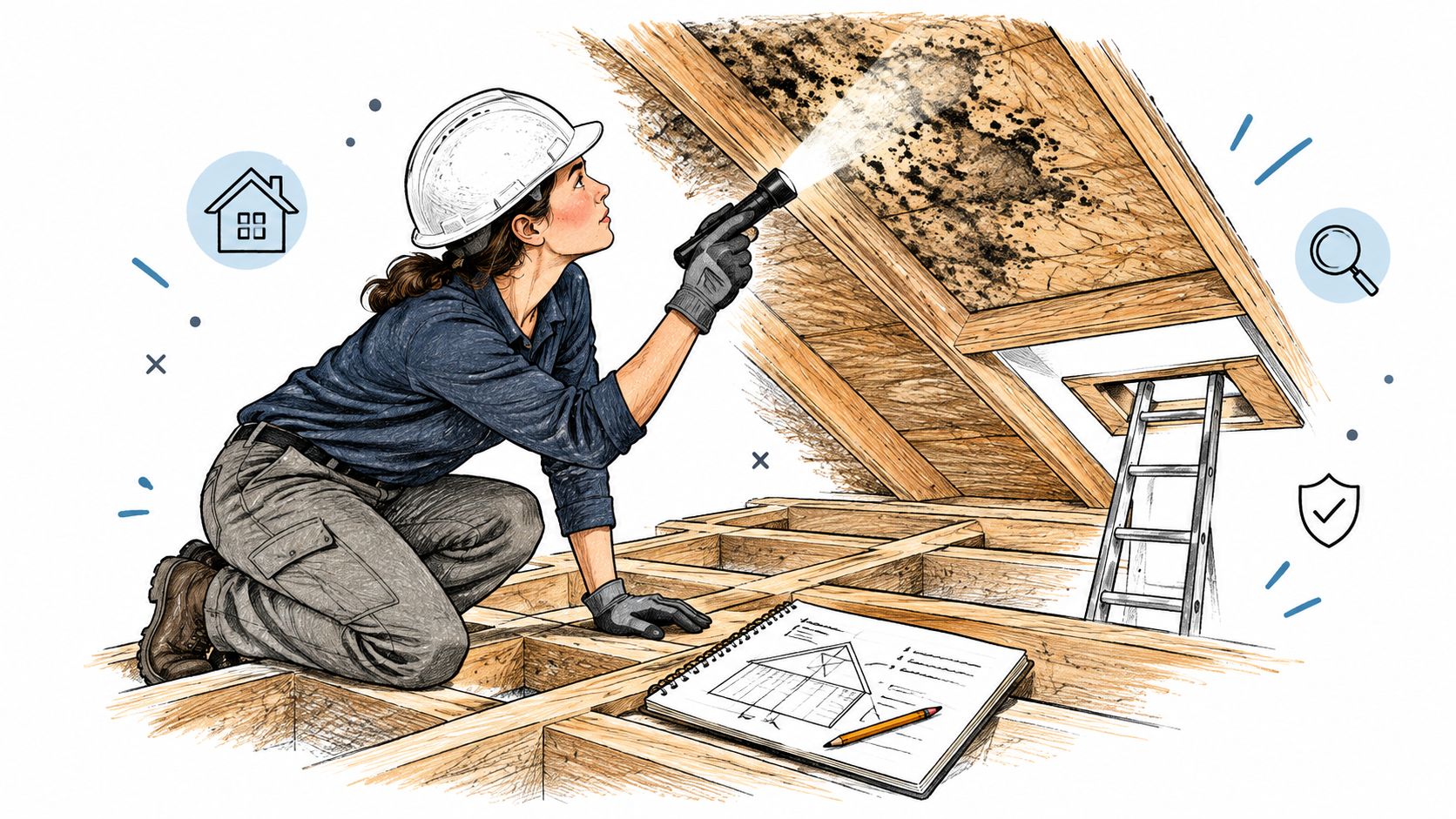
Next comes a structured look at the assembly itself. The inspector checks roof sheathing for staining, rafters and collar ties for growth, insulation for dampness or compression, soffits for blocked intake, and the ceiling plane for dark marks around penetrations where air leaks. DOE guidance identifies wet insulation, mold or mildew, warped or rotting attic wood, and deteriorated soffit or fascia components as signs of possible water intrusion in its DOE guide to durable attics.
Penetrations get special attention. Plumbing vents, exhaust ducts, chimneys, and roof-to-wall transitions interrupt the roof surface, so flashing failures tend to show up nearby. Your inspector should also trace bath and kitchen exhaust to confirm it discharges outdoors, not into the attic cavity or a soffit bay.
Moisture mapping and building systems
Visual findings then guide measurements. Pin and pinless moisture meters test sheathing and framing at stained areas and at dry comparison points, which helps separate old, dry staining from active wetting. Infrared imaging can flag temperature anomalies that suggest wet or missing insulation, but the inspector still confirms suspicious areas with a meter and direct inspection.
If HVAC equipment sits in the attic, that check matters just as much. Look for:
- Secondary drain pan problems: Standing water, rust, or overflow staining below the air handler
- Disconnected or damaged ducts: Gaps that dump cooled air into the attic and create condensation risks
- Condensate line issues: Blockages or poor routing that allow repeated dripping
- Air pathway concerns: Duct leakage or ceiling openings that could move attic contaminants indoors
Documentation ties these steps together. Expect location-specific photographs, moisture readings by material, notes on insulation condition, ventilation-path continuity from soffit intake to ridge or gable exhaust, and a stated source-to-damage relationship. If a report lists growth but says nothing about the roof, ventilation, exhaust routing, or ceiling air sealing, it's incomplete.
A useful report lets a roofer, HVAC technician, or remediation contractor act without starting the investigation over.
Ask which attic areas were accessible and which weren't. Limited access doesn't invalidate an inspection, but undisclosed limits should lower your confidence in broad conclusions.
Moisture Meters, Infrared Cameras, and Air Sampling
Homeowners often hear these tools described as if they're interchangeable. They're not. Each answers a different question, and confusing them leads to two common mistakes, spending money on a test that won't change the decision and trusting a reassuring result that never measured the attic materials at all.
What each tool actually measures
A moisture meter measures moisture in a material, using electrical resistance with pins or capacitance without pins. It tells you whether sheathing, framing, or drywall is wet, damp, or dry compared with a reference area. If you want the mechanics behind those numbers, a guide to interpreting a moisture meter reading explains how material and calibration affect what you see. What a meter can't do is identify mold or tell you whether growth is present.
An infrared camera measures surface temperature differences. Wet insulation, missing insulation, and air leakage can all create patterns worth investigating, especially when there's a temperature difference between indoors and the attic. It can't see through drywall, it doesn't detect mold, and a cool patch still needs confirmation because several conditions can look similar on screen.
Air sampling collects spores over a short period for laboratory analysis. It can describe what was airborne in that spot, at that moment, under those HVAC and activity conditions. CDC and NIOSH do not recommend routine mold air sampling, note there are no health-based indoor mold standards, and report that thorough visual inspection or identifying musty odors is generally more reliable than short-term air sampling in CDC and NIOSH guidance on mold testing and remediation.
Inspection Tools and Their Comparison
| Tool | What It Proves | What It Does Not Prove |
|---|---|---|
| Moisture meter | A tested material is wet, damp, or dry | Whether mold is present or which type it is |
| Infrared camera | A surface temperature pattern needs investigation | That moisture or mold is definitely present |
| Air sampling | What spores were captured during a short sample | That hidden attic materials are dry or clean |
| Surface or bulk sampling | What was on or in the sampled material | The moisture source or full extent of damage |
Surface or bulk sampling has a narrower role. It may help when a buyer and seller dispute what's on a material, when documentation needs to resolve a specific uncertainty, or when post-remediation comparison is required. Even then, the sample describes the material tested, not the entire attic.
Before you pay for any test, ask one question. What evidence is sufficient to define the problem, and what result would change the next action? If no answer changes the repair, the tool is adding cost, not clarity.
Reading the Attic Like a Detective
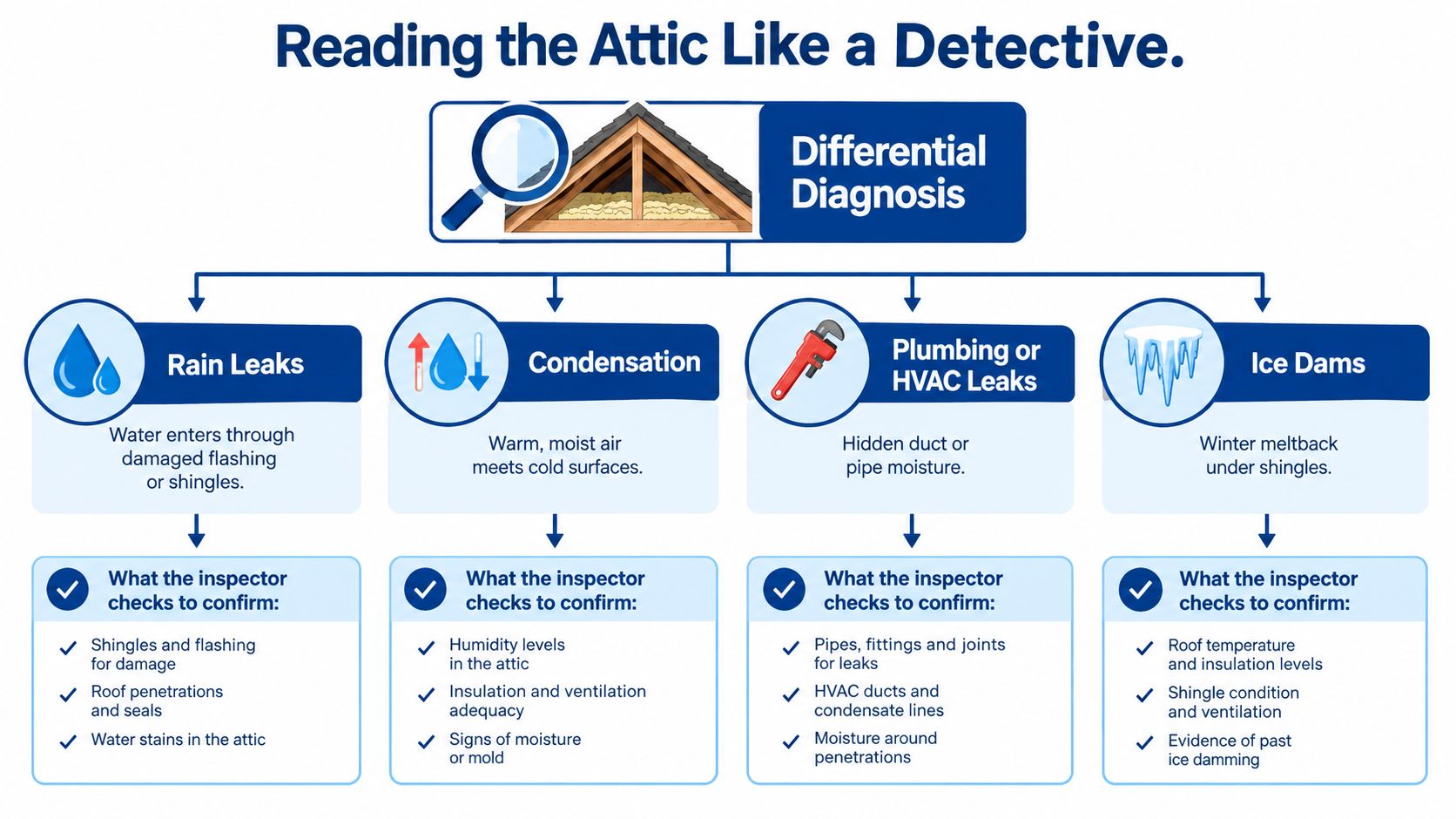
Four moisture mechanisms explain most attic findings, and each leaves a different fingerprint. Your inspector's real task is a differential diagnosis, matching pattern, timing, and location to the mechanism that fits best. Getting this wrong means you can clean thoroughly and still feed the same problem next month.
Four patterns, four different fixes
Roof or flashing leakage usually stays local. Staining follows rafters, seams, nail lines, valleys, or penetrations, and it often worsens after heavy or wind-driven rain. If active moisture lines up with a storm history, start with the roof, and a walkthrough on how to dry out a roof leak shows why source repair comes before drying decisions.
Exhaust terminating in the attic behaves differently. A bathroom fan that dumps warm, humid air near sheathing creates recurring moisture tied to showers, not rainfall. Insulation near the termination may stay damp, and nearby wood can support growth even when the roof itself is sound. Rerouting that exhaust outdoors fixes what cleaning never will.
Inadequate soffit-to-ridge airflow tends to look broad and uniform. Blocked soffit intake, missing rafter baffles, or insulation pushed into the eaves trap humid air and keep roof decking damp across a slope rather than in one spot. During a Central Texas summer, that trapped humidity has nowhere productive to go, so the pattern repeats across many bays.
Duct or air-handler condensation follows cooling cycles. Moisture appears near the air-handler platform, secondary drain line, poorly insulated ducts, or disconnected joints, often seasonally. It may vanish when cooling demand drops, which is exactly why timing notes belong in the report.
Don't overlook air leakage from below
Ceiling air leaks pull conditioned indoor air into the attic around recessed lights, hatches, plumbing and wiring penetrations, and top-plate gaps. Darkened insulation around those points is a useful signature because moving air leaves dirt and moisture clues behind. Humid indoor air reaching colder roof sheathing can condense there, blurring the line between a ventilation issue and an air-sealing issue.
Match the repair to the mechanism. Roof repair, exhaust rerouting, ventilation correction, duct sealing, and air sealing solve different problems, even when the stain looks similar.
Resist removing insulation across the attic before the source is confirmed. Targeted removal may be necessary where materials are wet or contaminated, but indiscriminate demolition destroys evidence, raises cost, and doesn't tell you which fix prevents recurrence.
Health Risks in Practical Terms
Population evidence gives you a reason to act, not a prediction about your family. The WHO review reports sufficient epidemiological evidence that occupants of damp or moldy homes and public buildings face increased risks of respiratory symptoms, respiratory infections, and asthma exacerbation. That's a building-health finding across many settings. It doesn't mean every attic stain causes illness, and it doesn't let an inspector diagnose anyone.
What the numbers do and don't say
A 2007 meta-analysis of 33 studies estimated exposure to home dampness and mold increased the risk of asthma development, ever-diagnosed asthma, and current asthma by roughly 30% to 50%, and estimated 21% of current asthma cases in the United States were attributable to dampness and mold, about 4.6 million of 21.8 million current cases, in the CDC hosted review of dampness, mold, and asthma. Use those figures correctly. They justify investigating moisture when occupants report respiratory symptoms or after roof or HVAC water intrusion. They don't convert a laboratory species name into a personal risk score.
That's where many homeowners get pulled off track. A frightening species label sounds precise, but it rarely changes the first decisions. CDC notes mold type doesn't determine whether removal is needed, and no accepted indoor quantity threshold exists. Extent, location, moisture pathway, and connection to occupied space give you more usable information.
Does attic mold mean contaminated indoor air
Not automatically. Risk depends partly on whether the attic connects to the conditioned space through ceiling penetrations, duct leakage, recessed lights, attic hatches, or pressure differences that draw air downward or through return pathways. A well-sealed ceiling and tight ducts reduce that connection. Leaky ducts in the attic or large ceiling openings increase it, even if visible growth looks modest.
Move faster and document carefully if your household includes:
- Infants or elderly occupants: People who may be less able to describe or tolerate worsening symptoms
- Asthma or allergy history: Occupants whose symptoms can flare with damp building exposures
- Immunocompromised occupants: Anyone whose clinician has advised extra caution with environmental exposures
- Unexplained, recurring symptoms at home: Patterns that improve away from the house and deserve medical and building review
Documentation matters even when nobody's symptomatic. Photographs, readings, dates, and repair records help with insurance questions, resale disclosures, and future comparisons after the next major storm. Treat symptoms as a reason to involve a medical professional, and treat the attic findings as a building problem to correct on building evidence.
When Testing Helps and When It Is a Distraction
More testing doesn't automatically produce a better decision. Sometimes it produces a number without a threshold, a species name without a repair, or false reassurance about materials nobody measured. The better question is whether visual and moisture evidence already defines the problem clearly enough to act.
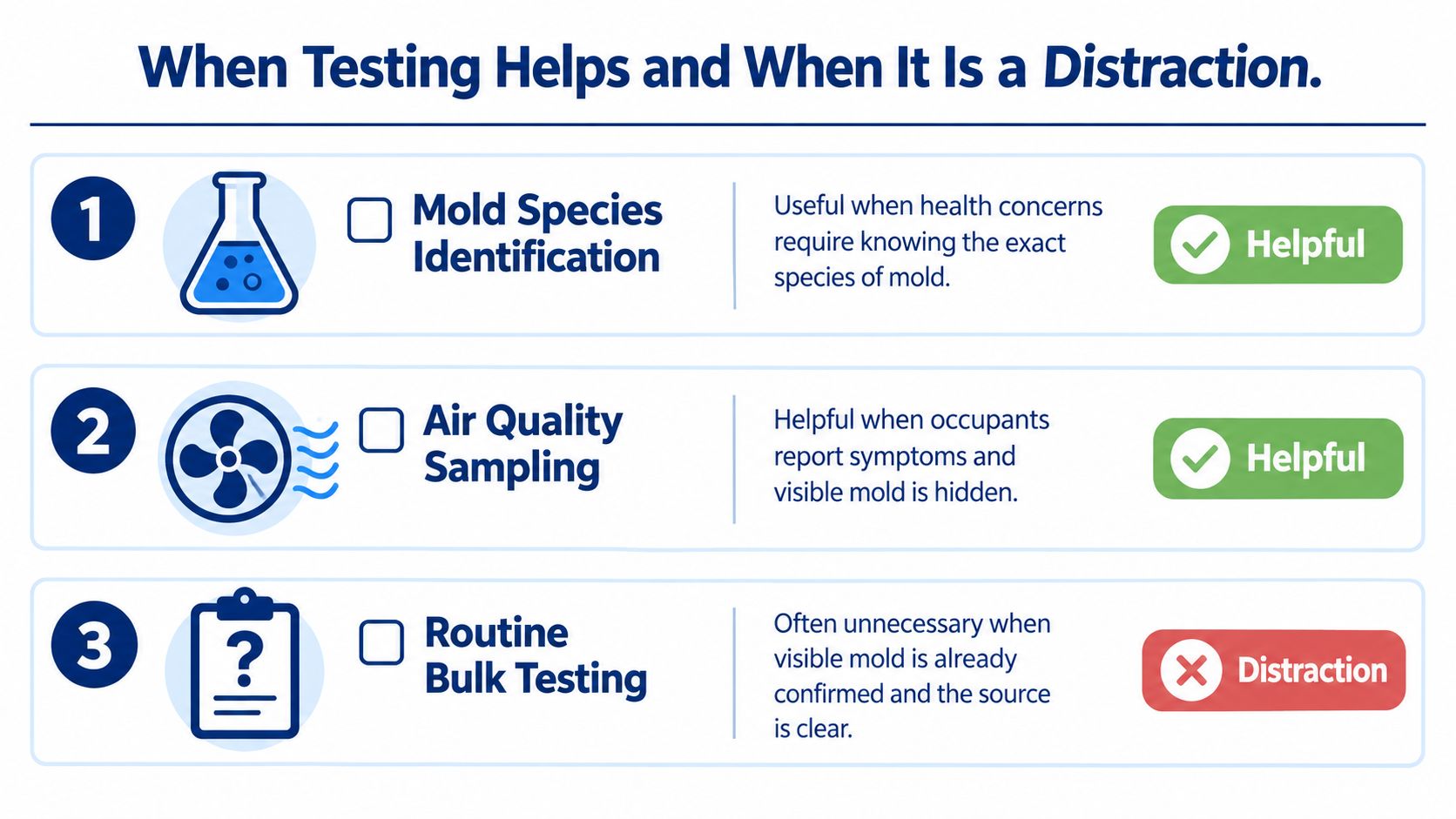
Three cases where targeted sampling can help
A real-estate dispute is the clearest case. If a buyer believes sheathing is contaminated and a seller believes it's harmless staining, a targeted surface or bulk sample from the disputed material can resolve that narrow disagreement. The sample doesn't replace moisture mapping, but it can settle what the parties are arguing about.
An insurance claim may also justify documentation of contamination type or extent when coverage decisions depend on it. Here, sampling supports a record that already includes photographs, moisture readings, and a source explanation. On its own, a lab report rarely tells an adjuster how water entered or what dried successfully.
Post-remediation clearance is the third case, because independent verification can matter after work is complete. Even then, sampling should follow a visual check and confirmation that materials are dry and the source is corrected. If you're weighing broader indoor questions after an attic finding, information on air quality testing can help you frame what a test should answer before you schedule one.
Why routine air samples often distract
An air sample is a brief snapshot. Results shift with HVAC operation, doors, activity, outdoor conditions, and sample location, and there's no health-based indoor standard to compare against. Localized attic growth can exist without producing a representative reading in a bedroom below, especially if the system is off or the ceiling is reasonably sealed.
Decision rule: If visible growth and moisture evidence already define the problem, correct the source and verify the fix. Reserve sampling for a genuine dispute where the result would change the next action.
A negative air sample can't prove concealed sheathing is dry or free of localized growth. A positive result usually doesn't change the response to confirmed moisture either, because you still repair the leak, fix ventilation or exhaust, dry or remove affected materials as warranted, and verify conditions afterward.
From Inspection Report to Action in a Central Texas Home
Your report should turn into a sequence, not a shopping list. Order matters because each step protects the next one, and skipping ahead is how homeowners pay twice for the same attic. EPA guidance emphasizes that wet areas should generally be dried within 48 hours and that roof leaks, condensation, and other moisture sources must be corrected, as explained in EPA guidance on mold prevention and moisture control. For an older, chronic condition, you can't rewind that clock, but you can still stop adding water first.
Fix in the right order
- Stop the moisture source: Repair roof or flashing leaks, correct plumbing or condensate problems, and confirm the fix under the conditions that caused wetting when possible.
- Correct exhaust and ventilation paths: Route bath and kitchen exhaust outdoors, clear soffit intake, install or repair baffles, and confirm airflow reaches ridge or gable exhaust.
- Address ducts and ceiling air sealing: Seal disconnected or leaky ducts, insulate where condensation forms, and seal major ceiling penetrations after exhaust routing is correct.
- Dry, clean, or remove materials as documented: Base insulation and wood decisions on moisture readings, material condition, and contamination extent, not on a blanket assumption.
- Verify and record: Repeat readings at previously wet locations, photograph corrected conditions, and keep dates with contractor invoices.
EPA also states sampling shouldn't replace visual inspection, while its remediation guidance notes musty odors can indicate continuing growth even when visible colonies are limited, in EPA guidance on mold inspection and remediation procedures. That's why verification includes your nose, a flashlight, and a meter, not only a lab result if one was used.
Who handles which part
A roofer addresses covering and flashing failures. An HVAC technician handles air-handler drainage, duct connections, and condensation tied to equipment. A restoration contractor can manage drying, stabilization, targeted material removal, and reconstruction, and RestoTek TX is one Central Texas option that provides water damage inspection, structural drying, and related repair services in Georgetown and Austin. Licensed mold remediation professionals may be warranted when contamination is extensive or when project requirements call for that scope.
After repairs, schedule a recheck after the next heavy rain or sustained cooling period, whichever matches your original mechanism. A roof-driven problem should stay dry through storms. A condensation problem should stay dry through August cooling cycles.
Your goal isn't a sterile attic. It's a dry, ventilated attic with a documented history, where the moisture mechanism is named, corrected, and checked. That's what makes an attic mold inspection worth paying for.
If you've found staining, damp insulation, or a musty odor you can't explain, RestoTek TX can inspect the attic, document moisture conditions, and help you prioritize source correction, drying, and repair for your Georgetown or Austin home. Visit RestoTek TX to request an assessment and get a clear next step before a hidden moisture problem spreads further.