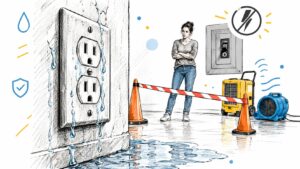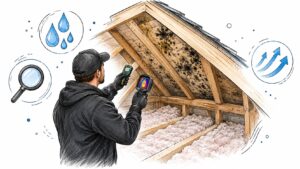
You walk into the kitchen and find water running down the wall beside an outlet. Or a supply line has leaked behind a cabinet, and now there's a puddle beneath a plugged-in appliance. Your first instinct might be to grab towels or unplug everything. Don't touch the outlet, the plug, or the water. Keep people away, and shut off power at the main breaker only if you can reach it without crossing water or touching wet equipment.
Why Water in an Electrical Outlet Is a Combined Hazard
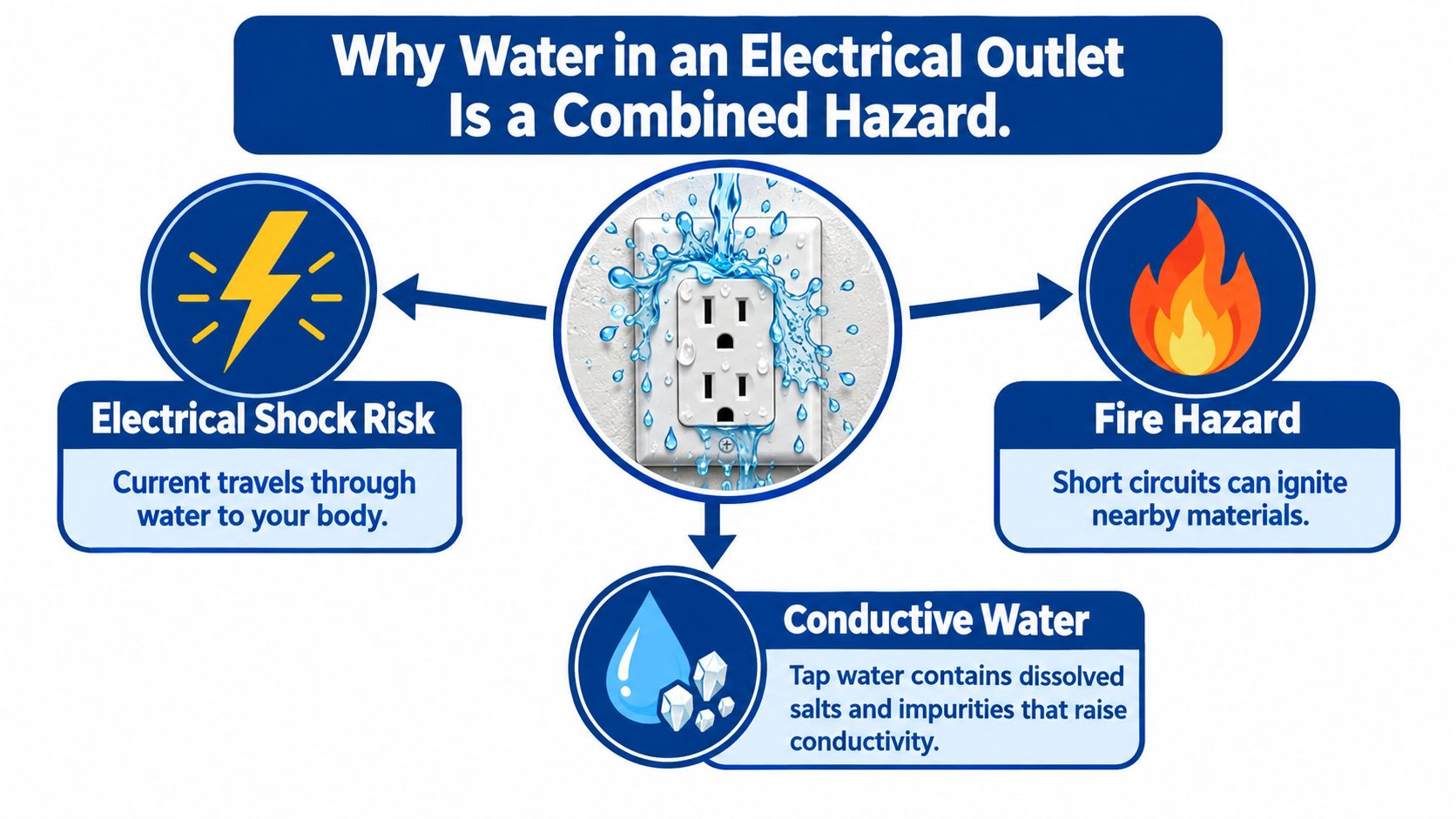
Water in an electrical outlet is a shock, fire, and property-damage hazard, not just a wet spot to clean. Ordinary water contains dissolved salts and impurities that increase conductivity. Wet skin also conducts electricity more effectively than dry skin, making contact with energized equipment especially dangerous.
OSHA's electrical-hazard guidance warns that serious or fatal shock can occur when someone contacts water while another part of their body touches a conductive surface. Its workplace requirements also call for proper grounding near water sources and removal of damaged receptacles and equipment from service until they're repaired and tested. For a homeowner, the practical lesson is straightforward: treat the affected area as energized until a qualified electrician establishes otherwise.
What you can't see behind the faceplate
The visible splash isn't necessarily the full exposure. Water may have reached terminals, wiring connections, the electrical box, or a connected device. After the surface dries, internal moisture, contamination, and corrosion can still create unsafe conditions.
- Shock exposure: Someone reaching for a plug or stepping into nearby water may contact an energized surface.
- Fire exposure: Damaged connections can produce arcing or heat when power is restored.
- Property damage: Moisture behind the wall needs assessment alongside the electrical damage, not after the outlet starts working again.
Practical rule: A dry faceplate is an observation, not electrical clearance.
Don't make the wall look better before making the area safe. Wiping the surface doesn't tell you whether the wiring or equipment behind it can safely carry current.
The first milestone is electrical isolation, followed by professional evaluation. Cleanup comes after that safety boundary is established, even when the amount of visible water seems small.
First Ten Minutes After You Notice the Water
Your immediate job is to prevent contact with the wet area and get qualified help. Don't start extracting water, removing covers, or experimenting with breakers to identify the problem.
OSHA's flood-response guidance directs people to turn off power at the main breaker when water may have reached electrical circuits or equipment, and not to enter flooded areas or touch electrical equipment while the ground is wet. That access condition matters as much as switching the breaker off.
Follow this order
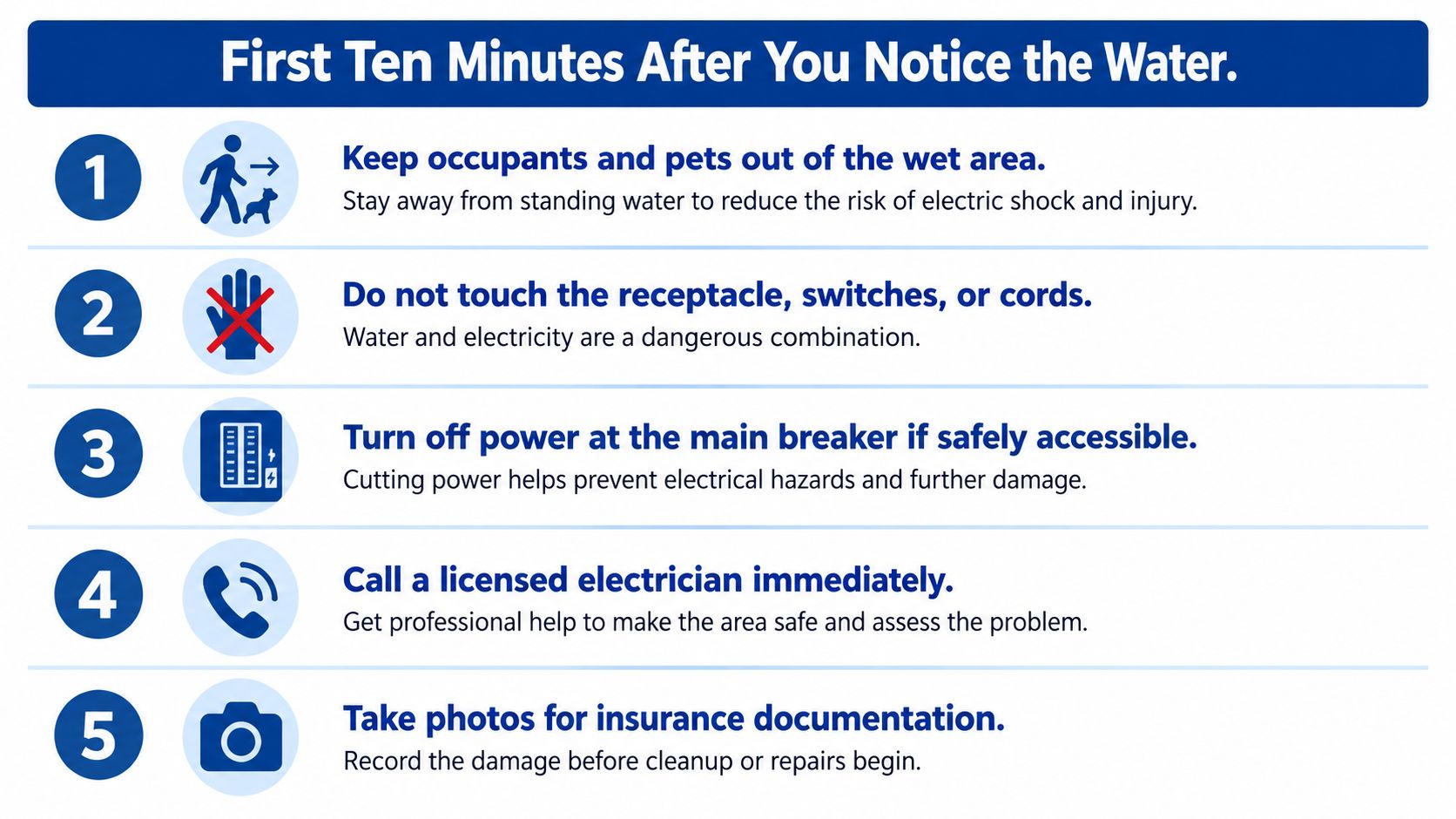
- Keep occupants and pets away. Block access from a dry location. Tell everyone which room or passage is off-limits.
- Leave electrical items alone. Don't touch receptacles, switches, cords, appliances, or standing water. Don't unplug something because you're worried it will get damaged.
- Use the main breaker only when safely accessible. If reaching it requires crossing water, entering a wet room, or touching wet equipment, stop. Ask the utility or a qualified electrician to de-energize the building.
- Arrange electrical evaluation. Tell the electrician that water has reached an outlet, not merely that an outlet has stopped working.
A tripped breaker or GFCI isn't proof that every conductor is de-energized. Leave verification to the qualified person using properly rated test equipment, with lockout/tagout before extraction, demolition, or drying begins.
Document without approaching
From a dry vantage point, photograph the affected room, outlet, visible water line, and panel status if safely observable. Don't move appliances or remove the faceplate to get a better picture. Note when you discovered the problem and where the water appears to be coming from.
Keep these emergency-response tips available while you arrange help. The immediate objective is a controlled, documented scene, not a room that looks dry before anyone has checked the electrical system.
Splash, Leak, or Submersion, Reading Your Situation
A brief kitchen splash and an outlet submerged during a sewage backup need different repair decisions. They don't need different rules about touching wet electrical equipment. Keep your hands off in either case.
The useful distinction is what happened inside the equipment. A homeowner can describe the event from a safe location; an electrician determines whether the exposure requires replacement, repair, or further testing.
Water Event Type and the Right First Response
| Water Event | Risk Level | Homeowner Action | Who to Call First |
|---|---|---|---|
| Brief splash near the faceplate | Potential internal exposure | Stop using the outlet; don't remove its cover to investigate | Qualified electrician |
| Condensation near a window or appliance | Uncertain or recurring exposure | Keep clear and document the apparent source | Electrician for outlet safety; restoration professional for moisture assessment |
| Supply-line leak into the wall | Hidden electrical and building-material exposure | Arrange isolation and source control without entering the wet area | Electrician and plumbing or restoration professional |
| Overflow that submerged the outlet | Submerged electrical equipment | Keep the area out of service | Electrician, then coordinated restoration |
| Floodwater or sewage backup | Submersion with contamination | Keep occupants away; don't attempt household cleanup | Electrical isolation provider and restoration crew |
Submersion changes the replacement decision. The Consumer Product Safety Commission's flood-damaged equipment warning says submerged receptacles, breakers, GFCIs, and fuses must be replaced even if they appear to work. Floodwater can leave silt and contamination inside equipment; restoring apparent operation doesn't establish safe reuse.
Describe the water pathway
Tell the responding professionals where the water originated, how high it reached, and how long the outlet may have been exposed. Include whether it entered from above, traveled through a wall, or rose from the floor. Report visible staining or swollen baseboards, but don't touch a potentially energized wall to check for dampness.
An outlet that stayed silent isn't cleared, and a tripped GFCI doesn't tell you how far water traveled. If the source is hidden, leak detection can help establish the water pathway so the repair addresses more than the visible outlet.
What a Qualified Electrician Actually Inspects
A proper evaluation doesn't end with swapping the receptacle. Ask the electrician to establish which circuit is affected, where water traveled, and which components can safely remain in service. Those findings also tell the restoration crew where it can work.
The electrician should verify de-energization with properly rated test equipment and establish controls against unintended re-energization. OSHA's electrical-safety guidance requires damaged equipment to stay out of service until repaired and tested, supporting a condition-based evaluation rather than a surface-dryness check.
Expect an evaluation beyond the outlet
- Circuit identification: Check the affected circuit and relevant upstream and downstream receptacles.
- Connections and enclosure: Inspect the box, wiring terminations, conductor insulation, and grounding and bonding.
- Protective devices: Evaluate the breaker and any GFCI device associated with the circuit.
- Damage documentation: Record moisture intrusion, corrosion, contamination, carbonization, insulation damage, and mechanical deterioration.
Submerged equipment follows the replacement guidance already described. Other reasons to reject a receptacle include contamination, corrosion, carbonization, or failure to meet applicable manufacturer or industry safety testing. Connected appliances and extension cords need evaluation too; a new outlet doesn't clear everything previously plugged into it.
Ask for the scope of the inspection, not just confirmation that the outlet works.
What must happen before return to service
Where replacement is appropriate, the electrician should verify conductor integrity and box condition before installing the device. Termination torque, polarity, grounding continuity, and required GFCI protection for the location also need checking. Operation and applicable trip/reset performance should be tested before the affected area returns to use.
Don't accept replacement of the visible device as an answer to unexplained moisture inside the wall. Equally, don't assume every wet component requires the same treatment; the electrician should document the disposition of each affected part.
Extraction and structural drying can proceed only after electrical isolation is established. Any permitted equipment used in a wet location needs appropriate GFCI protection, with its connections kept out of water.
Why a Tripped GFCI Does Not Mean You Are Safe
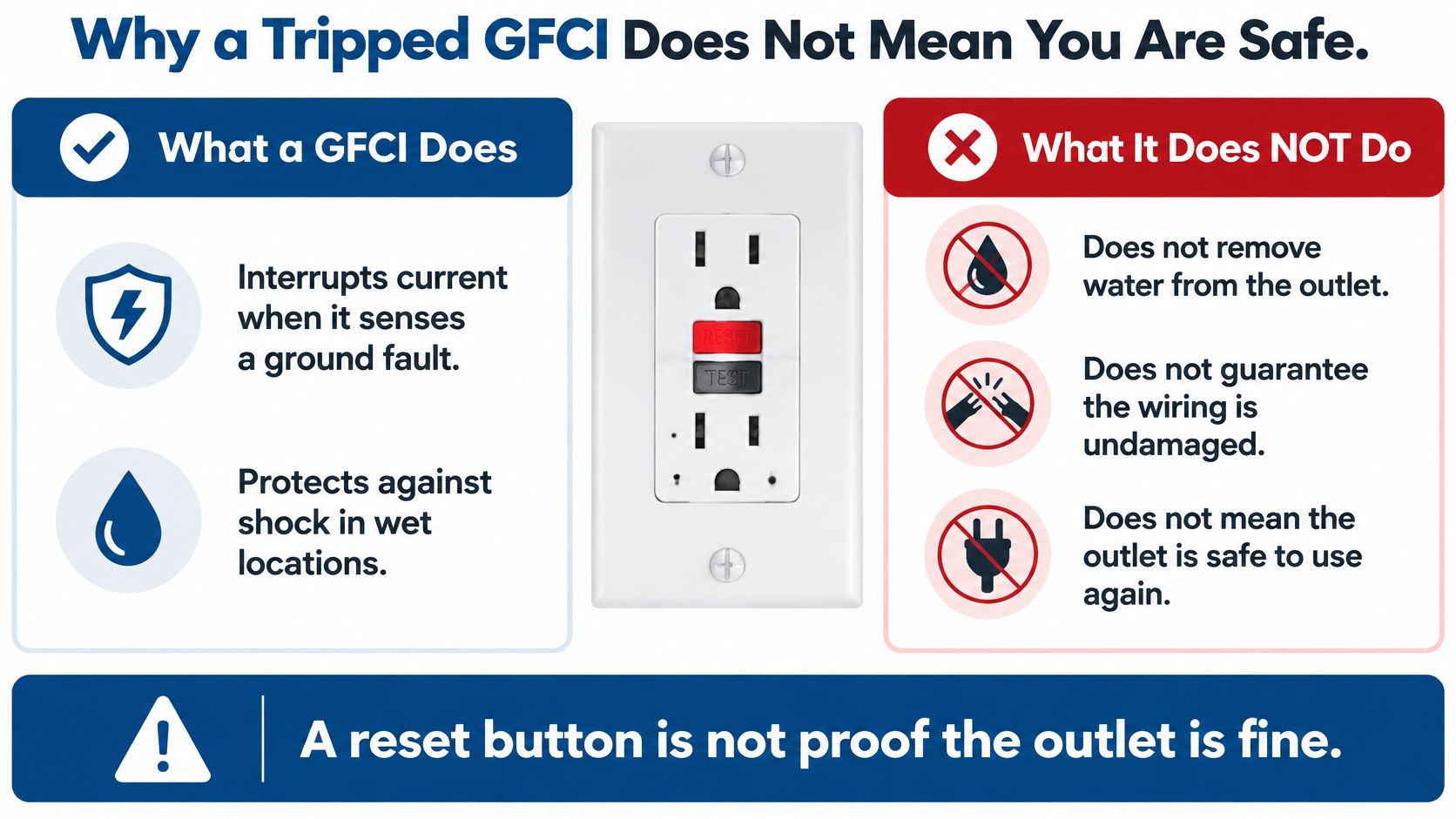
Don't keep pressing RESET on a wet GFCI. You're not solving the water exposure by getting the button to stay in.
A ground-fault circuit interrupter, or GFCI, reduces shock risk by interrupting current when it detects a ground fault. It doesn't remove moisture, reverse corrosion, clear contamination, or establish that a water-damaged outlet is reusable. Those are separate problems requiring inspection and, where necessary, replacement.
Protection isn't a repair
The CPSC's GFCI safety guidance explains that GFCIs are sensitive to moisture and need protection outdoors. Water can still enter despite covers when cords are plugged in. Protective equipment doesn't make water exposure harmless.
A nearby receptacle with TEST and RESET buttons also isn't enough to establish that the affected outlet has GFCI protection. Have the electrician identify the actual circuit arrangement rather than relying on proximity.
When it trips again or won't reset
Repeated trips mean the fault hasn't been resolved. The electrician needs to determine whether the affected receptacle, wiring, upstream device, or connected appliance is responsible. Don't move the appliance to another outlet to see whether it behaves differently.
- If it won't reset: Leave it alone and report the behavior to the electrician.
- If it resets but trips again: Don't repeat the cycle. Keep the affected circuit out of service.
- If it appears to operate after submersion: Apparent operation doesn't change the replacement requirement.
- If nothing trips: Don't interpret silence as permission to use the wet outlet.
A reset button is a control, not a safety certificate.
GFCI protection remains important when the electrician restores the installation. But its presence is preventive protection, not permission to skip inspection or reuse submerged hardware. The question isn't whether you can make the outlet deliver power again. It's whether the equipment and circuit are fit to return to service.
When to Call an Electrician Versus a Restoration Crew
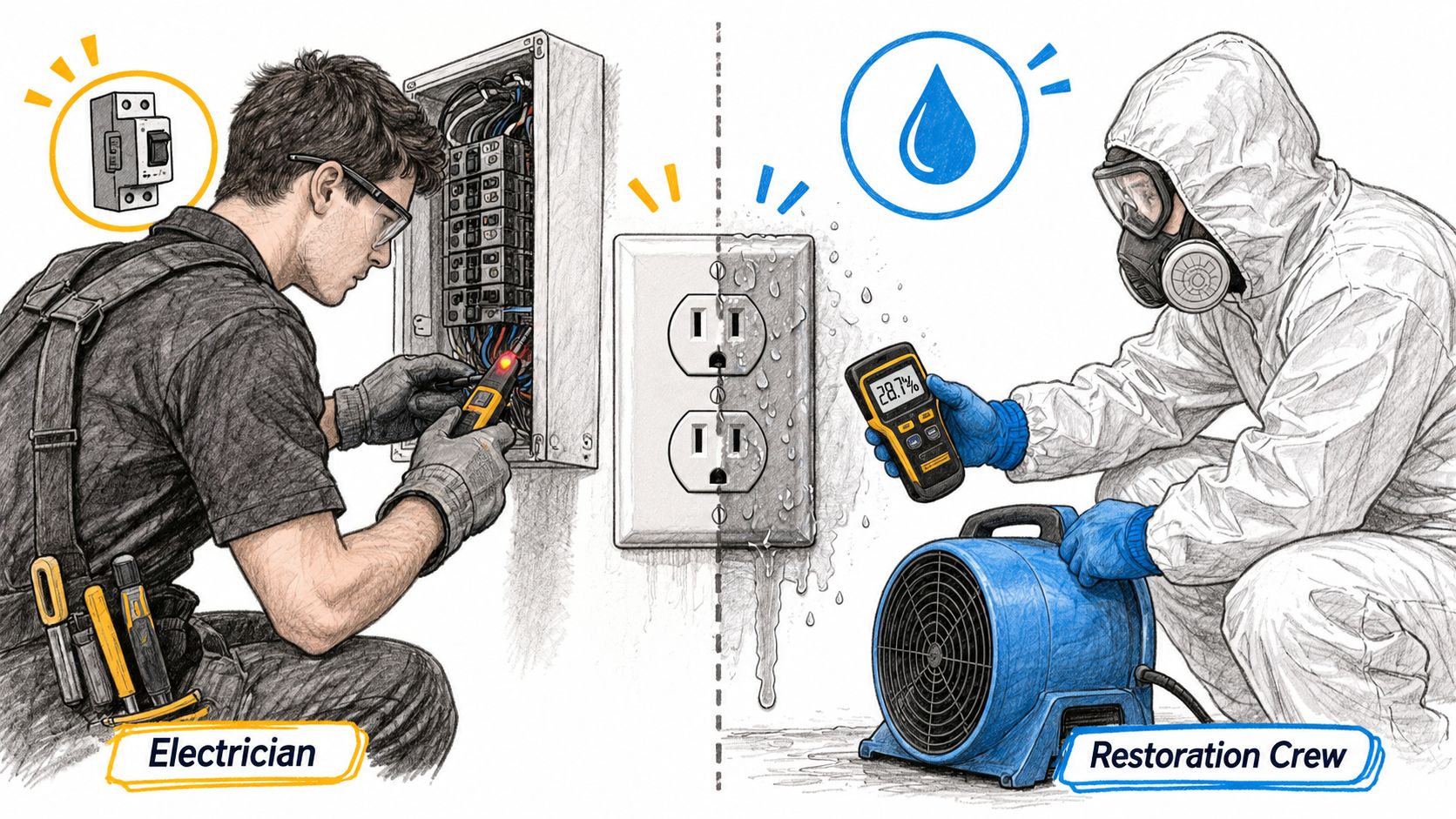
Call for electrical isolation first, and arrange restoration alongside it when water has reached building materials. You don't need to wait until every electrical repair is finished before requesting water-loss help. You do need a clear boundary between making the site electrically safe and starting wet-area work.
The electrician owns electrical inspection, replacement decisions, testing, and authorization to re-energize affected circuits. The restoration crew handles water-loss assessment, extraction, structural drying, hidden-moisture assessment, and the work needed to restore damaged materials.
Make the handoff explicit
| Responsibility | Electrical Professional | Restoration Crew |
|---|---|---|
| Establish electrical safety | Isolate, verify, and control affected circuits | Work within the established safe area |
| Assess damage | Evaluate electrical equipment and wiring | Assess moisture in materials and cavities |
| Perform corrective work | Repair or replace affected electrical components | Extract water, dry materials, and address microbial concerns |
| Complete the job | Test and authorize electrical return to service | Document drying and reconstruct damaged finishes |
The trade-off is straightforward: waiting for safe access can delay extraction, but powering drying equipment from an unsafe circuit creates another hazard. Coordinate both trades promptly instead of asking either to work around unresolved electrical exposure.
Agree on clearance before closing the wall
Ask who will document hidden moisture, who will confirm the leak source has been addressed, and who will authorize electrical re-energization. A replacement receptacle shouldn't become the excuse to close an unassessed wall cavity. Drying a room also doesn't authorize a restoration worker to clear electrical equipment.
The distinction between water-damage cleanup and restoration matters here. Removing visible water is only part of the work; drying, moisture verification, and reconstruction require their own decisions.
For Georgetown and Austin property owners, an active leak, standing water, sewage backup, or water entering electrical equipment warrants an immediate call. Don't postpone coordination until business hours just because the visible flow has stopped.
Your Safety Checklist and Next Call
Use this checklist while arranging help. You don't need to diagnose the electrical fault or prove how much water entered the box. Give the responding professionals clear observations and keep everyone away from the affected area.
Keep the priorities in order
- Restrict access: Keep occupants and pets out of the wet room or affected passage.
- Avoid contact: Leave wet outlets, cords, plugs, switches, appliances, and standing water alone.
- Disconnect only from safe access: Use the main breaker only when the approach and equipment are dry. Otherwise, request utility or electrician assistance.
- Record what's visible: Photograph the room and water line from a dry position. Note the apparent source and discovery time.
- Arrange qualified inspection: Don't begin extraction, drying, or demolition before electrical isolation and verification.
- Confirm the handoff: Make sure the electrician and restoration crew know who controls the circuit and what work is cleared.
Don't wait for another warning
Water in an outlet, sewage contamination, or standing water near the electrical panel is enough reason to seek help now. Repeated GFCI trips, visible scorching, or a smell of overheating also call for immediate professional attention, not another attempt to restore power.
Keep photographs, inspection findings, replacement records, and drying documentation together for the insurance claim. Ask each trade to record its own findings rather than assuming the other contractor will document everything.
There's no responsible fixed timeline without knowing the extent of electrical damage, hidden moisture, and material contamination. What you can control is the sequence: safe access, documented evaluation, coordinated drying, and authorized return to service. That's how you avoid finishing the room while leaving the underlying problem unresolved.
RestoTek TX offers water-damage inspection, extraction, structural drying, microbial prevention, and reconstruction, with 24/7 response across Georgetown, Austin, and surrounding Central Texas communities. If water has reached an outlet, arrange electrical isolation and ask the team to coordinate the water-loss assessment around the electrician's clearance. Visit the site to request a no-cost estimate and explain where the water entered and which areas are affected.