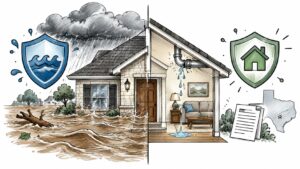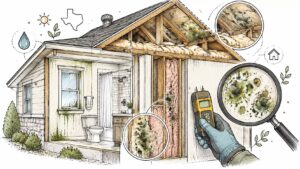
A standard homeowners policy generally excludes flooding, meaning water that rises from a creek, a street or the ground outside your home, while a sudden burst pipe or a failed appliance inside it is often covered, subject to the policy wording and any endorsements. That single distinction, where the water came from, settles more water claims than any other clause, and it explains why fewer than 4% of U.S. households carry federal flood coverage while floods turn up in almost every part of the country.
People who ask does home insurance cover flooding are really holding three questions at once. What does my homeowners policy say, is there a separate flood policy somewhere in my closing paperwork, and which one answers the water currently sitting in my drywall. The answer changes with the source of the water, how fast it arrived, and which endorsements were attached at your last renewal.
Here's the honest version, without the sales pitch. Your policy is not silent on water. It's very specific about water, just not in the way most homeowners expect.
Which Water Losses Homeowners Insurance Covers at a Glance
Standard homeowners and renters policies in the United States generally exclude flood damage, which is why a homeowner typically needs separate flood insurance for water entering from outside the building, whether that's an overflowing river, storm surge or widespread surface flooding (FEMA). Inside the building, a burst supply line or a leaking appliance is treated as a different event with a different answer.
Sort the loss by source before you call anyone.
| Water source | Typical standard policy outcome | Where coverage usually comes from |
|---|---|---|
| Rising river, creek or lake overflow | Excluded | Separate flood insurance (NFIP or private) |
| Storm surge or coastal flooding | Excluded | Separate flood insurance |
| Surface runoff across the yard or street | Excluded | Separate flood insurance |
| Burst or failed interior pipe | Usually covered, subject to policy wording | Homeowners policy |
| Appliance leak, such as a water heater or washing machine | Usually covered | Homeowners policy |
| Sewer or drain backup | Often excluded without an endorsement | Sewer backup endorsement |
| Rain entering through a storm-damaged roof | Covered if the storm damage itself is a covered peril | Homeowners policy, wind or hail coverage |
| Gradual seepage or long-term leak | Often limited or excluded | Policy wording and maintenance history |
Four questions decide every row. Where did the water originate: inside the plumbing, or outside the wall? How did it get in: through a supply line, a drain, a roof, a door sill, or up through the slab? How fast did it arrive: minutes, or months of slow seep? And which endorsements did you buy at renewal, since sewer backup is an add-on, not a default?
The scale of the exposure is worth sitting with. FEMA reports that 98% of U.S. counties have experienced a flood, yet fewer than 4% of U.S. households carry a policy through the National Flood Insurance Program, and roughly 40% of NFIP claims originate outside officially designated high-risk zones. For a house in Austin or Georgetown, the flood zone line on a closing document is not a safety certificate. Floods caused more than $8.8 billion in damage to homes and businesses across the United States in 2024, while most standard homeowners policies did not cover the water (FloodSmart).
Find the row that matches your loss. Note whether the water came from outside the building or inside it. If it came from outside, the next section is the one that matters.
Flood Insurance Options Compared for NFIP and Private Policies
Flooding is the one water loss a standard homeowners policy was never built to pay. Private insurers spent decades refusing to sell flood as a standard peril, and repeated losses were more than the market could spread broadly. Congress answered with the National Flood Insurance Act of 1968, and the National Flood Insurance Program it created is still the main public source of dedicated residential flood coverage in the United States.
An NFIP Standard Flood Insurance Policy splits the risk into two buckets. Building coverage runs to $250,000 for a residential building, and contents coverage runs to $100,000 for personal property, each with its own deductible, eligibility rules and exclusions, according to the Congressional Research Service. One flood can therefore produce two separate claims and two separate deductibles.
| Feature | NFIP policy | Private flood policy | Standard homeowners policy |
|---|---|---|---|
| Flood coverage | Yes, separate building and contents | Yes, terms set by the insurer | No, generally excluded |
| Building limit | Up to $250,000 | Set by the policy, can exceed NFIP limits | Not applicable for flood |
| Contents limit | Up to $100,000 | Set by the policy | Not applicable for flood |
| Waiting period before coverage starts | Yes, a waiting period applies | Set by the insurer | Not applicable for flood |
| Lender acceptance in a Special Flood Hazard Area | Accepted | Accepted if it meets lender rules | Not accepted as flood coverage |
The waiting period is the trap. A flood policy has to be in force before the water arrives, so buying during a storm watch answers nothing. In Central Texas the sequence is predictable: days of warnings building over the Edwards Plateau, then the rain, then the scramble. I tell homeowners to buy in the dry month, because once a storm is inbound the window to bind coverage has usually closed.
Private flood is its own calculation. Private carriers write their own forms, so limits, deductibles, exclusions and contents valuation are whatever that form says. The detail that matters most is whether contents pay at full replacement cost or at a depreciated value, since that single clause decides what a flooded downstairs is worth. The only honest comparison is quote against quote, side by side, against your own rebuild cost.
Rebuild cost decides the limits question. A house that would cost more than the NFIP building cap to reconstruct leaves the difference uncovered unless a private policy picks it up. Lender rules still drive most purchases: a federally regulated or insured lender financing property inside a Special Flood Hazard Area generally requires flood coverage, and meeting that requirement does not guarantee every loss is reimbursed in full. Take-up stays low among owners who face no lender requirement, which is how so many flooded homes end up with no flood coverage at all.
Before you sign, put your building limit next to a real rebuild estimate and your contents limit next to an actual inventory of what is in the house. Then confirm the effective date, because coverage that starts after the storm covers none of it.
Texas and Central Texas Flood Risk for Georgetown and Austin Homeowners
A single Central Texas storm rarely produces one water loss. It produces four at once: rain forced through a storm-damaged roof, creek water at the back door, a supply line that lets go while the power is out, and a sewer backing up under the slab. Each one lands on a different coverage question, which is why the Texas Department of Insurance's guidance that ordinary home policies don't cover flood damage is only half the answer (Texas Department of Insurance).
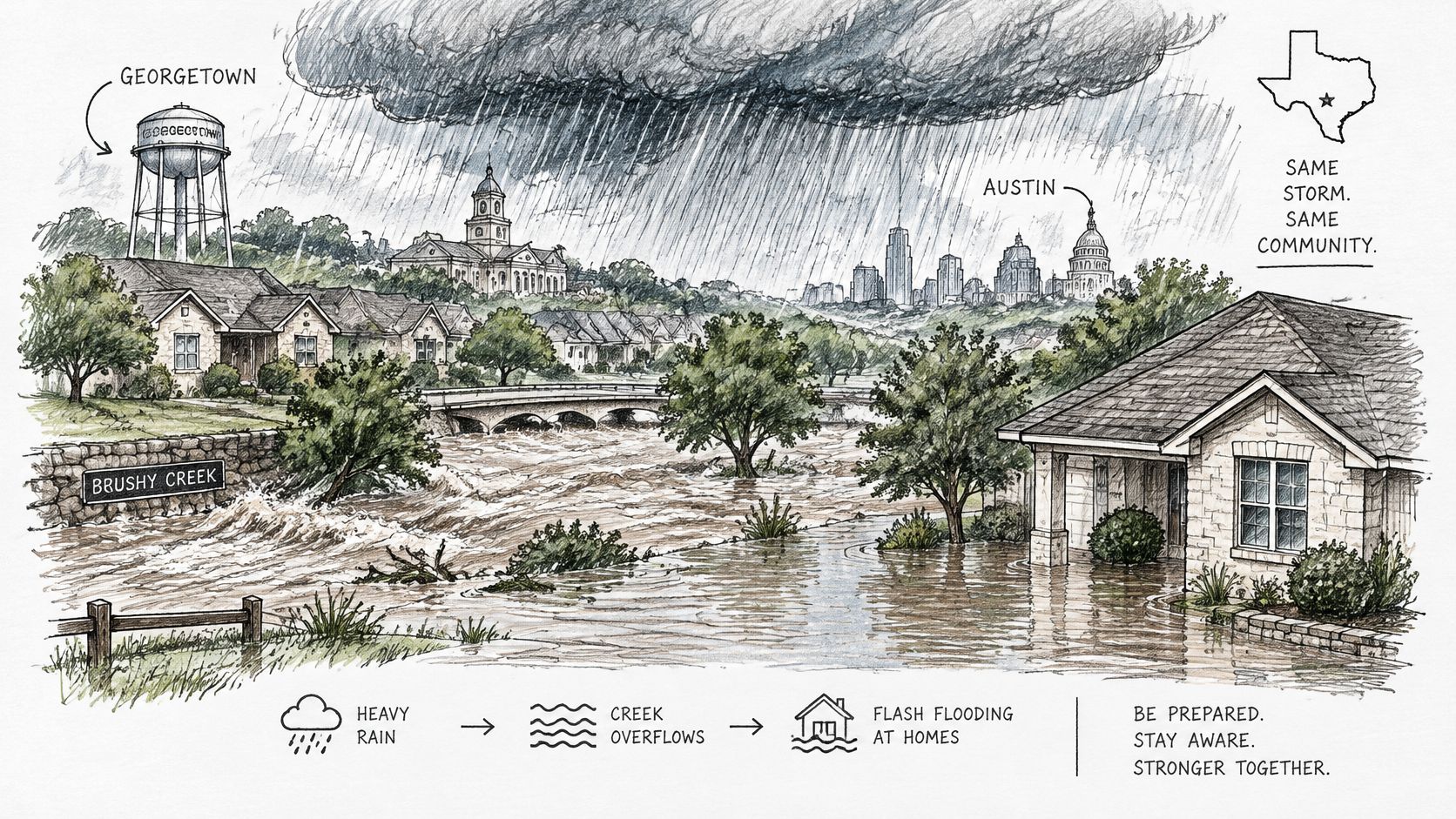
That's the scene that generates the paperwork: a creek out of its banks behind a row of suburban homes, water across the yard, and a homeowner deciding which phone to pick up first. For the mitigation sequence that follows, how heavy rain and flash floods cause water damage in Georgetown walks through the order of operations.
Three Local Losses, Three Different Answers
A creek that rises over the backyard and reaches the slab. This is flood, and it belongs on a flood policy. The proof is the water line on the siding, the debris mark on the fence, and photographs of the street or creek level taken during the storm.
A flash flood that runs into an attached garage. Also flood, because the water travelled across the ground from outside. The garage slab and the door sweep are where the entry point gets documented, not the hallway where the water ended up.
A water heater that fails during a storm-related power outage. This one usually falls to the homeowners policy, not the flood policy, and the plumber's report identifying a tank failure is what proves the cause. The storm being nearby doesn't make it a flood loss.
Checking your own address starts with the FEMA flood map for the property, which you can pull by address and keep with your policy papers. A property outside a high-risk zone can still flood, so treat the map as one input rather than a verdict.
A habit worth starting this week: During the next heavy rain, photograph the creek, the street and the low corner of the yard from the same two spots. Date the images and file them with your policy. When a loss happens, that record shows where the water came from and how high it got.
Documenting the Loss Before Anyone Touches It
Flood insurance is typically a separate policy, either through the National Flood Insurance Program or a private insurer, and the NFIP defines a qualifying flood as a general and temporary condition in which normally dry land is partially or completely inundated, affecting at least two adjacent properties or two or more acres (NFIP Flood Insurance Manual). That threshold is exactly why a single-property plumbing failure doesn't qualify as a flood, and why the cause has to be documented rather than described.
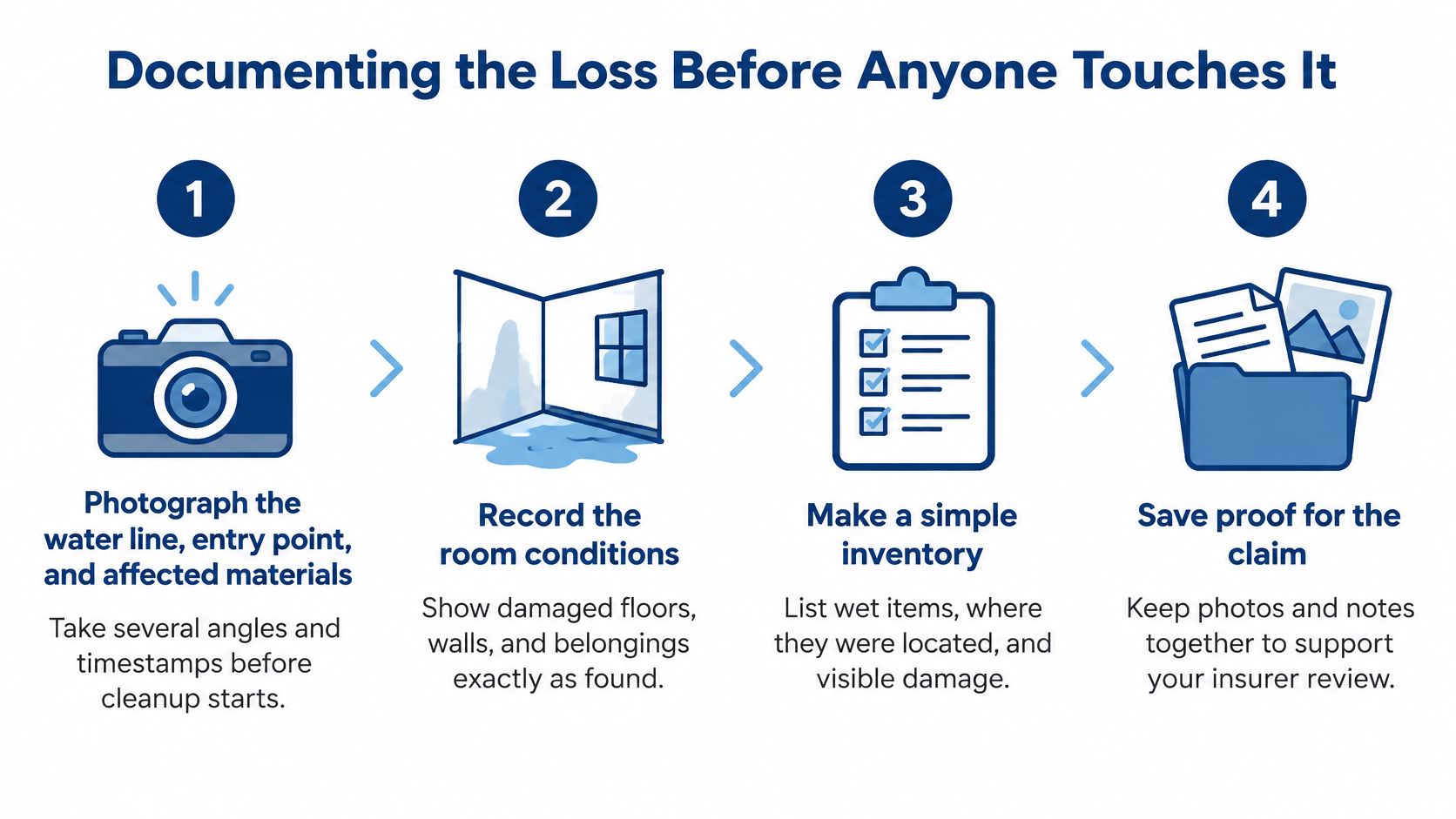
Work through this before the shop vac comes out.
- Photograph the water line, the entry point and the affected materials from several angles, with timestamps. Photos taken before anything moves are the only record of how the water arrived, and arrival is what coverage turns on.
- Write down when you found the water, what the weather was doing, and where you believe it came from. A dated note in your own words, made the same day, carries more weight than a recollection rebuilt three weeks later.
- Log moisture readings, or ask your restoration provider to log them. Readings show how far water travelled inside walls and under floors, which is the difference between a drying job and a rebuild.
- Build a contents inventory listing each damaged item, its age, purchase price and any receipt you can find. The NFIP contents limit is separate from the building limit, so nothing is protected by assumption.
- Keep damaged items until the adjuster has seen them, unless they're a safety hazard or will cause continuing damage. Photograph the disposal either way.
- Save every invoice, contractor estimate and mitigation receipt from day one, including the equipment rental and the fan you bought at midnight.
- Schedule mold testing if odors persist. We recommend testing when there are persistent musty or earthy odors, recent water damage or leaks, past flooding or plumbing failures, visible discoloration on walls or ceilings, respiratory symptoms that improve outside the home, or when buying or selling a home.
A complete file is one folder: photos with timestamps, a dated timeline, the contents inventory, and every receipt in order. If you want the format that adjusters read, progress documentation shows what a daily drying log looks like from the first visit to the final reading.
Practical rule: If you're unsure whether an item is evidence or rubbish, it's evidence. Move it to the garage, photograph it there, and let the adjuster make the call.
Confirm Coverage and File Your Claim
Claims get lost in the gap between what the policy says and what the file proves. Close that gap in the first 48 hours with paperwork, not cleanup.
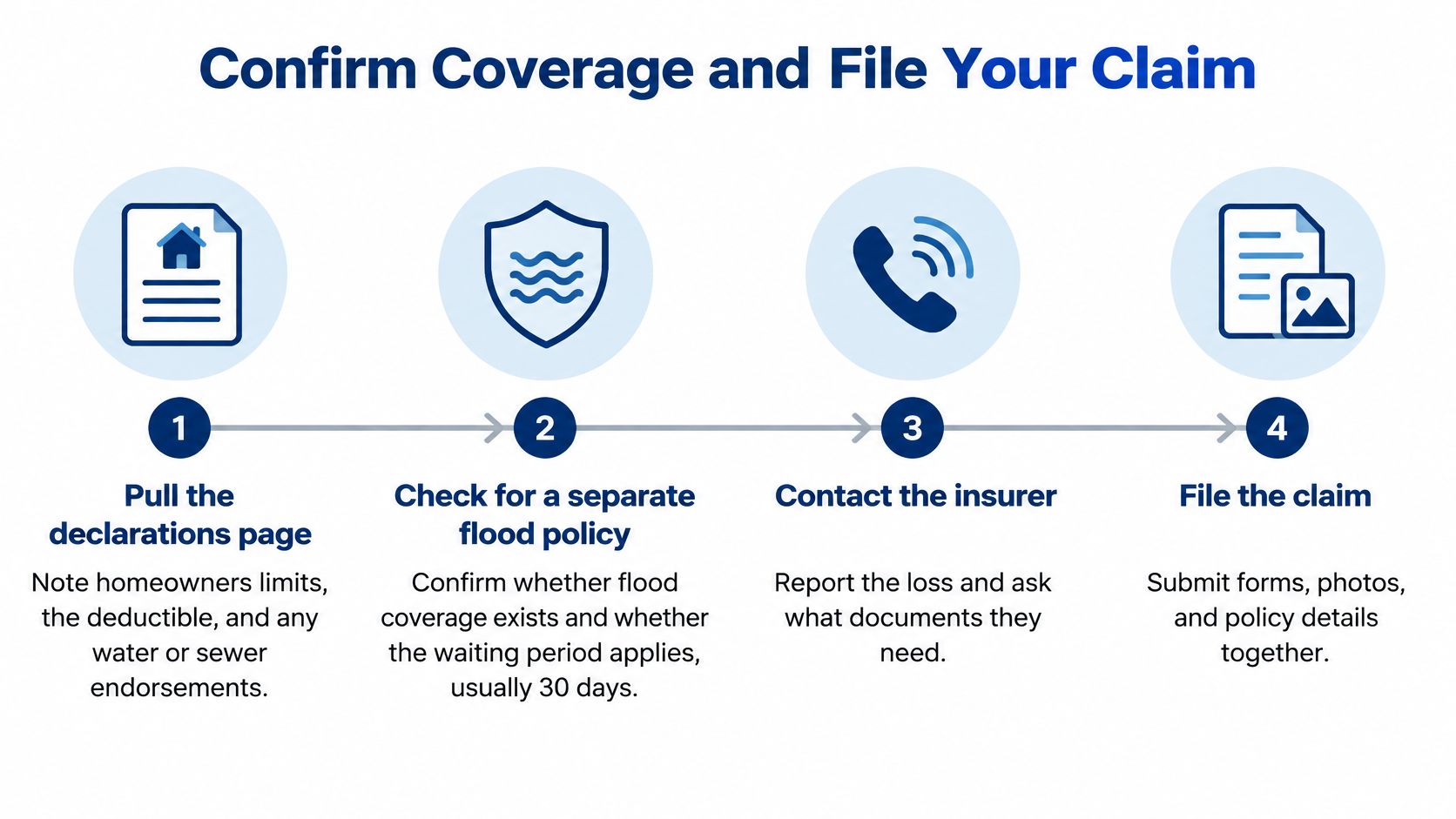
Start With the Paper You Already Have
Pull the declarations page and read three things out loud: the dwelling limit, the deductible, and every endorsement listed. Sewer backup, water backup, and any special water damage sublimit are printed there, and a policy without them answers a backup loss with a denial.
Next, find out whether a separate flood policy exists on the property. Check the closing documents, the escrow line on the mortgage statement, and any agent email from the purchase. If there's no flood policy, ask your agent what can be bought and when it takes effect, because a policy has to be in force before the water arrives. Waiting until the rain starts buying coverage for the next storm, not this one.
Report the Loss Even When Coverage Is Unclear
Call the homeowners insurer and, if you have one, the flood insurer. Do it the same day. Late notice is one of the most common reasons a claim gets denied, and the call costs you nothing but twenty minutes on hold. Ask for the claim number in writing, by email or text, so there's a record of when you reported it and what you described.
Then limit further damage. Stop the leak, dry what's wet, board what's broken, and keep the receipts. Policies expect you to protect the property from additional damage, and those duties start immediately even while coverage is still an open question.
That's also where a restoration provider earns its place in the process. We coordinate plumbing repairs with licensed plumbers, confirm the source is resolved, and begin drying and restoration straight after the repair, so the mitigation record and the claim record start on the same day. One point of contact for the plumber and the drying crew means nobody is waiting on the other trade to show up.
What the Adjuster Needs From You
Expect an inspection, sometimes within days during a storm event and sometimes longer when an entire county is filing. Hand over the folder from the previous section: photos, timeline, moisture log, inventory, receipts, contractor estimates.
While the adjuster works, go back through the estimate line by line when it arrives. Two questions decide more dollars than anything else you'll say on the phone:
- Is the payment actual cash value or replacement cost? ACV pays the depreciated value of what was damaged. Replacement cost pays to buy it again. The difference on a ten-year-old water heater or a section of hardwood floor is real money.
- How is the deductible applied? Once per event, or once per building and once per contents on an NFIP claim? Read the declarations page, not the summary email.
If you bring in a restoration provider, ask for moisture logs and dated photos formatted for the claim file. Mold testing after water damage helps document conditions for insurance purposes, which matters when the adjuster is deciding whether microbial work is part of the covered repair or something else.
File the Proof of Loss on Time
The proof of loss is the formal, signed statement of what you're claiming. It has a deadline printed in your policy, and it is not the same as the day you reported the loss. Put that date in your calendar the day you open the claim.
If you're working with a contractor, ask for the scope in the adjuster's format and the same units of measurement, so the two documents can be compared instead of argued. Reconstruction estimates that list materials, quantities and labor separately settle faster than a single lump sum.
When the settlement lands below your expectation, request a written explanation before you decide whether to dispute it. Ask which line items were reduced, which policy language was applied, and what documentation would change the answer. That request alone resolves a surprising number of gaps, because it forces the reasoning into writing.
Keep at each phase: declarations page at intake, claim number at first contact, receipts and moisture logs at inspection, and the signed proof of loss before the deadline.
If you'd rather see how the claim file is normally assembled, how the home insurance water damage claim process works lays out the sequence from first notice to final payment. We've worked alongside insurance claims through enough of these to know which documents adjusters ask for twice, and we build the file so they don't have to.
Common Claim Denials and How to Respond
The most common denial in a water claim is the flood exclusion, and it's usually correct on its face. Water that crossed your yard before it reached your drywall belongs on a flood policy, not a homeowners policy, and arguing otherwise wastes the weeks you need for the flood claim.
| Denial reason | What it usually means | Next step |
|---|---|---|
| Flood or surface water excluded | Water came from outside the building | Check for a separate flood policy and file a claim with it |
| Gradual damage or wear | The leak developed over time, not suddenly | Request the policy definition and provide repair and maintenance history |
| Sewer backup not covered | No backup endorsement on the policy | Ask about the endorsement before the next event and document the backup now |
| Failure to mitigate | Damage grew because drying or repairs were delayed | Show mitigation steps, dates and invoices |
| Late notice | The claim was reported after the policy deadline | Ask the insurer to review timing and provide proof of when the loss was discovered |
| Deductible exceeds damage | Repair cost falls below the deductible | Get a written estimate and confirm how the deductible applies |
Then work the response in order. Request the denial in writing with the specific policy language quoted, not a summary of it. Compare that language against the cause and timeline in your documentation file, because most successful reversals come from a mismatch between what the letter assumes and what the photos show.
Submit further evidence that speaks to cause: a plumber's report naming the failed component, a moisture log showing the drying curve, dated photos of the entry point. Check whether the policy includes an appraisal clause, which is the mechanism for disputes about the amount of loss rather than whether coverage exists. If the decision still looks wrong, file a complaint with the Texas Department of Insurance.
Remember that a partial denial is not a full denial. Some letters dispute the amount, not the coverage, and part of the claim remains payable. And because the homeowners insurer and the flood insurer each issue their own decision, read both letters separately.
If a denial rests on a cause your file doesn't support, gather the evidence first and respond inside the window the letter gives you.
When a storm puts water in your home, the coverage question and the drying clock start at the same moment. RestoTek TX handles both sides of that morning for homeowners in Georgetown and Austin: we find the source, coordinate licensed plumbing repairs, dry the structure, document every reading and photograph for your claim, and rebuild what has to be rebuilt. Call us for 24/7 emergency response, and visit RestoTek TX to see how the inspection, mitigation and reconstruction process runs from the first visit to the final walkthrough.