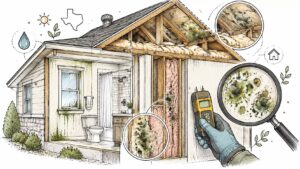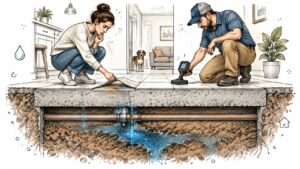
You've pulled a storage bin away from a closet wall, or opened the cabinet under a sink, and found a dark patch you don't remember being there. Your first instinct is probably to search for photos and try to match the color. That's understandable, but it's also where errors with different types of mold in homes often begin. The name matters less than two other questions. What material is it growing on, and how long has that material stayed wet? Answer those, and you'll know far more about the size of the problem, whether you can clean it yourself, and whether it's likely to come back.
Common Household Mold Types and Why Color Cannot Identify Them
The molds you're most likely to meet indoors aren't exotic. The CDC overview of mold and health identifies Cladosporium, Penicillium, and Aspergillus as the most frequently encountered genera in homes. Alternaria belongs on the same short list, and Stachybotrys chartarum, the species usually called black mold, rounds it out. That list comes from what indoor surveys find, not from what looks most alarming in a photo.
Use the table below as a starting reference, not as an identification key. It shows what each type often looks like and where it tends to grow, but appearance alone won't confirm a genus.
Common household mold types at a glance
| Mold type | Typical appearance | Where it grows | Health and removal note |
|---|---|---|---|
| Cladosporium | Olive-green or black, velvety or powdery | Painted surfaces, window frames, caulk, textiles and cool damp spots | Among the most common indoor molds; a frequent allergen source |
| Penicillium | Blue-green or green, powdery | Drywall, insulation, carpet backing and wet wood | Common after water damage; can trigger allergies and asthma symptoms |
| Aspergillus | Green, white or black, powdery | Drywall, insulation, dust, carpet and HVAC filters | Allergen source; some species can cause infections in people with weakened immune systems |
| Alternaria | Dark green to black, fuzzy | Bathrooms, sinks, damp windowsills and ducts | Allergen linked to asthma; often grows where humidity stays high |
| Stachybotrys chartarum | Dark greenish-black, slimy | Cellulose-rich materials that stay wet for long periods, such as paper-faced drywall | Less prevalent than its reputation suggests; needs sustained wetness and professional removal when extensive |
Why the Table Cannot Name Your Mold
Judging a mold by color is like judging a car model by its paint. Many models share the same shades, and the same model comes in several colors. A black patch could be Cladosporium, Aspergillus, Alternaria, or something else entirely. A green patch doesn't rule any of them out.
That's not a cautious guess. It's how these organisms behave. Color shifts with age, with the surface underneath, and with how wet the colony is. Two different genera growing side by side on damp drywall can look nearly identical to the naked eye, while one genus can look olive on a window frame and almost black on caulk. If someone names a species from a phone photo, they're guessing, even if they sound confident.
A species label from a photo is only a guess. Lab analysis of a physical sample is what turns a guess into an identification.
What Indoor Surveys Actually Find
Surface surveys show a wider mix than most homeowners expect. In a study of damp indoor surfaces published in PMC, Cladosporium accounted for approximately 43% of isolates, making it the most frequently detected genus. The next most common organisms were Ochroconis musae at 10.8% and Engyodontium album at 7.4%, two names you'll rarely see in consumer articles.
That same study helps put the familiar names in proportion by showing what it found.
- Cladosporium species combined: Within that genus, C. sphaerospermum, C. halotolerans, and C. herbarum were the leading species.
- Alternaria, Aspergillus, and Penicillium together: These three represented 32.5% of all isolates, which confirms they matter but shows they aren't the whole picture.
- Less familiar organisms: A meaningful share of what grows on damp surfaces falls outside the five names in most lookup tables.
The practical lesson is simple. Your home doesn't contain one mold. It contains a background mix, and persistent dampness lets certain types multiply well beyond that background. The question that matters is which materials stayed wet long enough for that amplification to happen.
The Black Mold Correction
Stachybotrys chartarum gets most of the attention, so it deserves a direct correction here. It can grow on chronically wet, cellulose-rich material such as paper-faced drywall, and it shouldn't be ignored. But it isn't the default explanation for dark growth.
A review cited in that damp-surface research found Stachybotrys in 12.8% of damp dwellings and 4.5% of samples, compared with Penicillium in 96% of dwellings and Cladosporium in 89% of dwellings in the referenced survey. Read those numbers again before you panic over a black spot. The dark patch in your bathroom is statistically far more likely to be one of the common genera.
None of this means dark growth is harmless. It means color can't tell you the risk. Where a mold grows also shapes what you do next. Cladosporium often colonizes cooler, intermittently damp spots such as painted surfaces, textiles, and window areas. Penicillium and Aspergillus more often proliferate on persistently wet porous materials such as drywall, insulation, carpet backing, and wood-based products. The second pattern usually points to a bigger moisture problem, and porous assemblies are much harder to clean than hard surfaces.
Keep one sentence from this section. The genus tells you less than the material it grew on and how long that material stayed wet.
Odor, Texture and Location Clues That Point to Mold
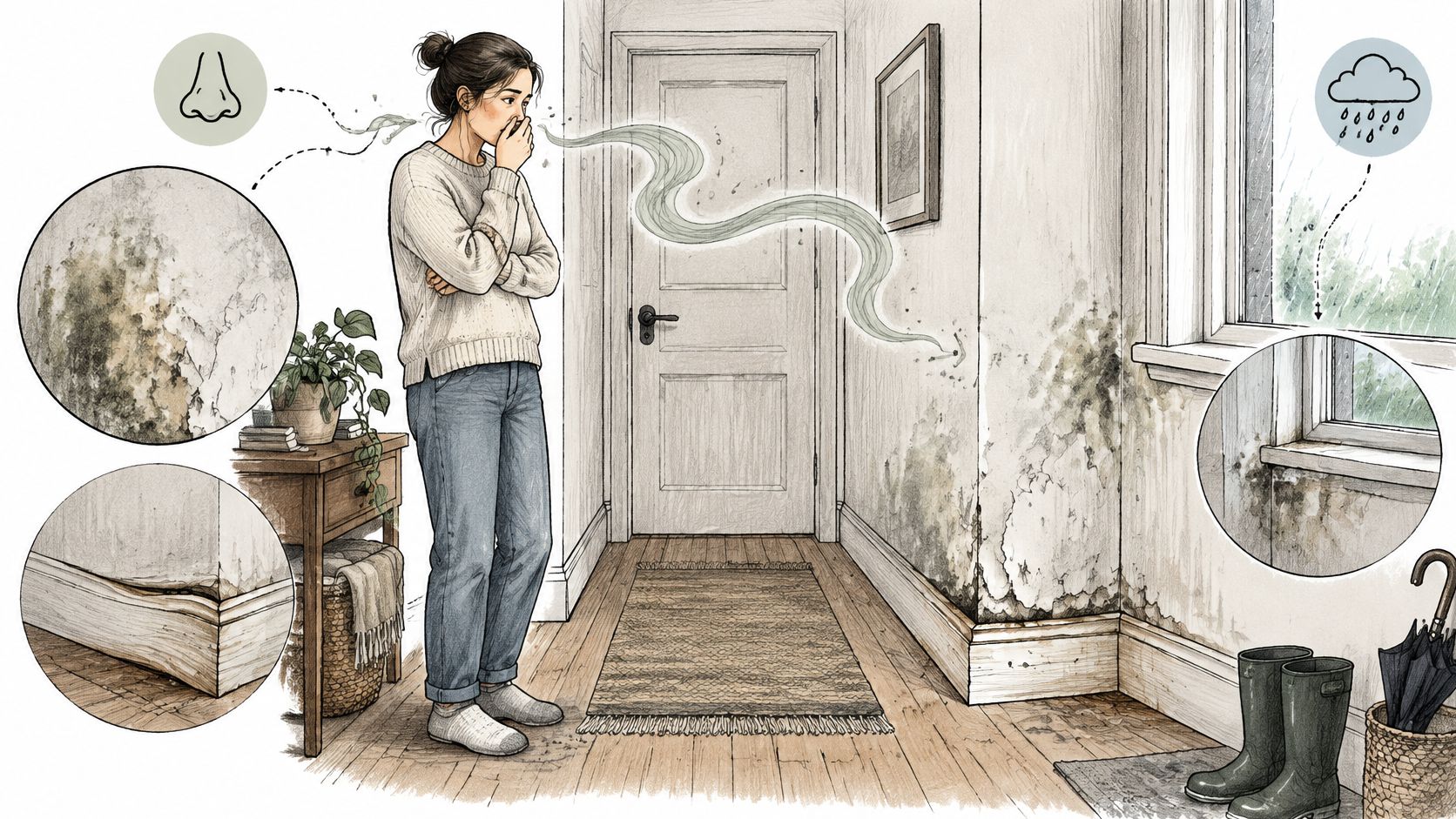
Smell is often the first clue, and it's worth trusting. A musty, earthy odor that gets stronger after rain, or in a room that's been closed up for a few days, usually means growth somewhere out of sight. You may notice it most when you first walk in, before your nose adjusts.
Visible Signs in the Order They Usually Appear
Start with staining or discoloration on walls, ceilings, and window frames. A faint shadow that spreads, or a tideline that returns after cleaning, usually signals moisture moving through the material. Next, look for paint that bubbles, peels, or looks wet from behind. Paint fails that way when water sits in the drywall or plaster underneath it.
Flooring tells the same story in a different form. Laminate and wood that swell, cup, or warp have absorbed water, often from below. Finally, check for fuzzy or powdery patches on caulk, grout, fabric, and cardboard. By the time growth is fuzzy, the material has usually been damp for a while.
Where to Look and What to Record
Location narrows the search quickly. Check near plumbing and under sinks first, then behind furniture pushed against exterior walls, where cool air and poor circulation let condensation collect. Closets on outside walls and the corners of window sills deserve the same attention. If you want a room by room walkthrough, our guide on how mold can hide in your home and what to do about it covers the concealed spots people miss most often.
Your body can be a clue too. Sneezing, congestion, itchy eyes, or wheezing that ease when you're away from the house and return when you come back suggest something in the home is triggering you. That pattern doesn't prove mold, but it's a reason to look harder.
Practical rule: Any combination of odor plus a moisture source is worth investigating, even when no growth is visible.
Write down what you find before you clean anything. Record the date, the exact location, and any recent leak, overflow, or flood. That short history guides every decision that follows, from testing to removal.
Where Mold Grows in Central Texas Homes
Central Texas gives mold plenty to work with. Long humid summers raise indoor moisture for months at a time. Heavy rain and flash flooding push water into wall cavities and under flooring, and many older homes combine slab foundations with attics that run extremely hot. Each of those conditions feeds a different location in the house.
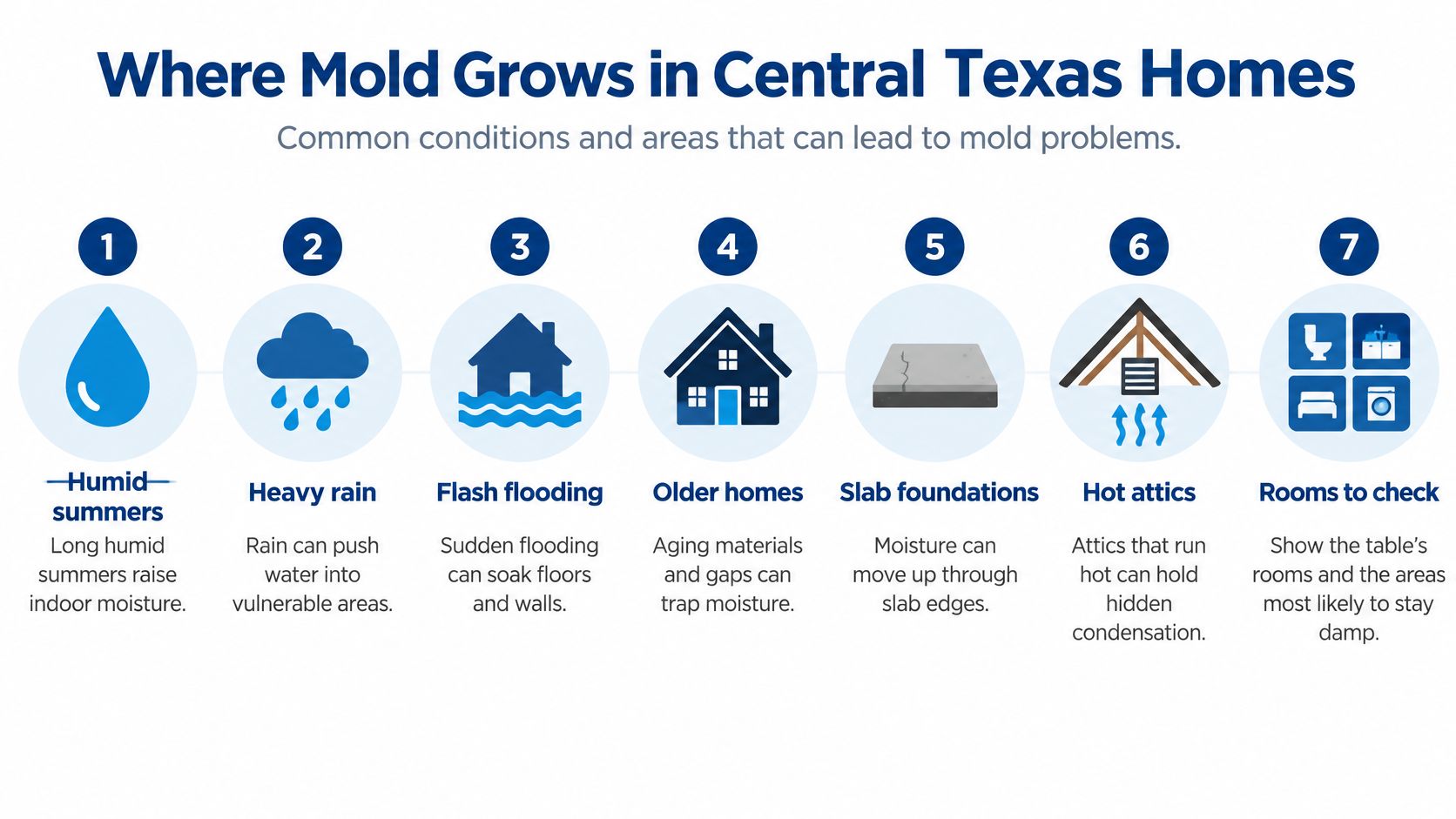
Where molds grow in Central Texas homes
| Location | Usual mold types | Main moisture driver | Check first |
|---|---|---|---|
| Bathroom ceiling and exhaust fan | Cladosporium, Alternaria | Showers, weak or missing exhaust | Ceiling corners and fan housing |
| Attic and roof decking | Cladosporium, Penicillium | Summer heat, roof leaks, condensation on ducts | Underside of roof deck and duct insulation |
| Wall cavities after flooding or plumbing failure | Aspergillus, Penicillium, possibly Stachybotrys | Flood water, leaking supply lines | Baseboards, lower drywall and cut sections |
| Slab-on-grade perimeter and carpet | Penicillium, Aspergillus | Groundwater, flash flood intrusion, slab moisture | Carpet backing and lower wall edges |
| HVAC ducts and drain pan | Aspergillus, Cladosporium | Condensate, high indoor humidity | Drain pan, filter and duct interior |
| Window sills and caulk | Cladosporium | Condensation on cool glass | Sill corners and caulk joints |
Reading the Table Room by Room
Bathrooms fail on ventilation. A weak exhaust fan, or one that vents into the attic instead of outside, leaves shower moisture on the ceiling corners after every use. Attics fail differently. Summer heat meets cooler duct surfaces, condensation forms on duct insulation, and a slow roof leak can wet the underside of the roof deck for weeks before a stain shows below.
Wall cavities and slab perimeters are the flood story. Flood water and sewage backups leave hidden moisture in walls and insulation for days after the visible water is gone. Carpet can feel dry on top while the backing and pad underneath stay wet against the slab. HVAC systems add their own risk, because a clogged condensate drain keeps the drain pan and nearby duct insulation damp all cooling season.
You can monitor one number yourself. Put an inexpensive hygrometer in the rooms that concern you and watch the trend, not a single reading. Sustained high readings tell you the house is holding moisture even when nothing looks wet.
Your Post-Storm Checklist
After heavy rain or a high-humidity stretch, check these spots first:
- Baseboards and lower drywall: Look for swelling, softness, or new staining.
- Under sinks and behind toilets: Feel supply lines and the cabinet floor for dampness.
- Attic duct runs: Check insulation for wet spots below duct joints.
- Window sills and exterior-wall closets: Wipe condensation and check caulk joints.
- HVAC filter and drain pan: Replace a damp filter and confirm the drain is flowing.
Health Risks and Who Is Most Affected
The most common reaction to indoor mold isn't exotic poisoning. It's an allergy-type response. Sneezing, a runny or stuffy nose, watery eyes, coughing, and skin irritation top the list, and spores from Cladosporium, Penicillium, and Alternaria trigger these symptoms in plenty of people. You don't need a rare species to feel miserable in a damp house.
Asthma Changes the Calculation
For someone with asthma, damp-building exposure can do more than cause a stuffy nose. It can worsen existing asthma and make attacks more frequent, even at exposure levels that barely bother another person in the same home. That's why two family members can report completely different experiences in the same rooms. One person's mild irritation doesn't cancel out another person's wheezing at night.
This is also where the species name misleads people. Risk depends far more on how much exposure someone gets, how long it continues, and who is being exposed than on which genus a lab identifies. A small patch of a feared species in a garage may matter less than a large, ongoing growth of a common allergen producer inside a bedroom wall.
Groups Who Need Extra Caution
Some people should treat any indoor growth as a prompt to act quickly:
- Infants and young children: Their airways are small and still developing, so irritants hit harder.
- Older adults: Reduced lung reserve makes respiratory symptoms harder to shake.
- People with mold allergy or chronic lung disease: Ongoing exposure can keep symptoms flared and complicate management of the underlying condition.
- People with weakened immune systems: This group faces the most serious risk, because Aspergillus can cause serious infection in someone whose immune defenses are suppressed.
Watch for the pattern, not just the symptom. Complaints that ease when someone is away from home and return on arrival, or that begin shortly after a flood or a discovered leak, point toward the building rather than a passing virus. Seasonal pollen can mimic this, so timing matters. Symptoms that start right after a known water event deserve attention even during allergy season.
A doctor should evaluate persistent symptoms, while a mold assessment answers the environmental question. Medical care answers the health one, and neither replaces the other.
If a child with asthma is using a rescue inhaler more often, or an immunocompromised family member develops a lingering cough, don't wait for a test result to call the doctor. You can pursue both tracks at once.
How Mold Is Tested and Confirmed
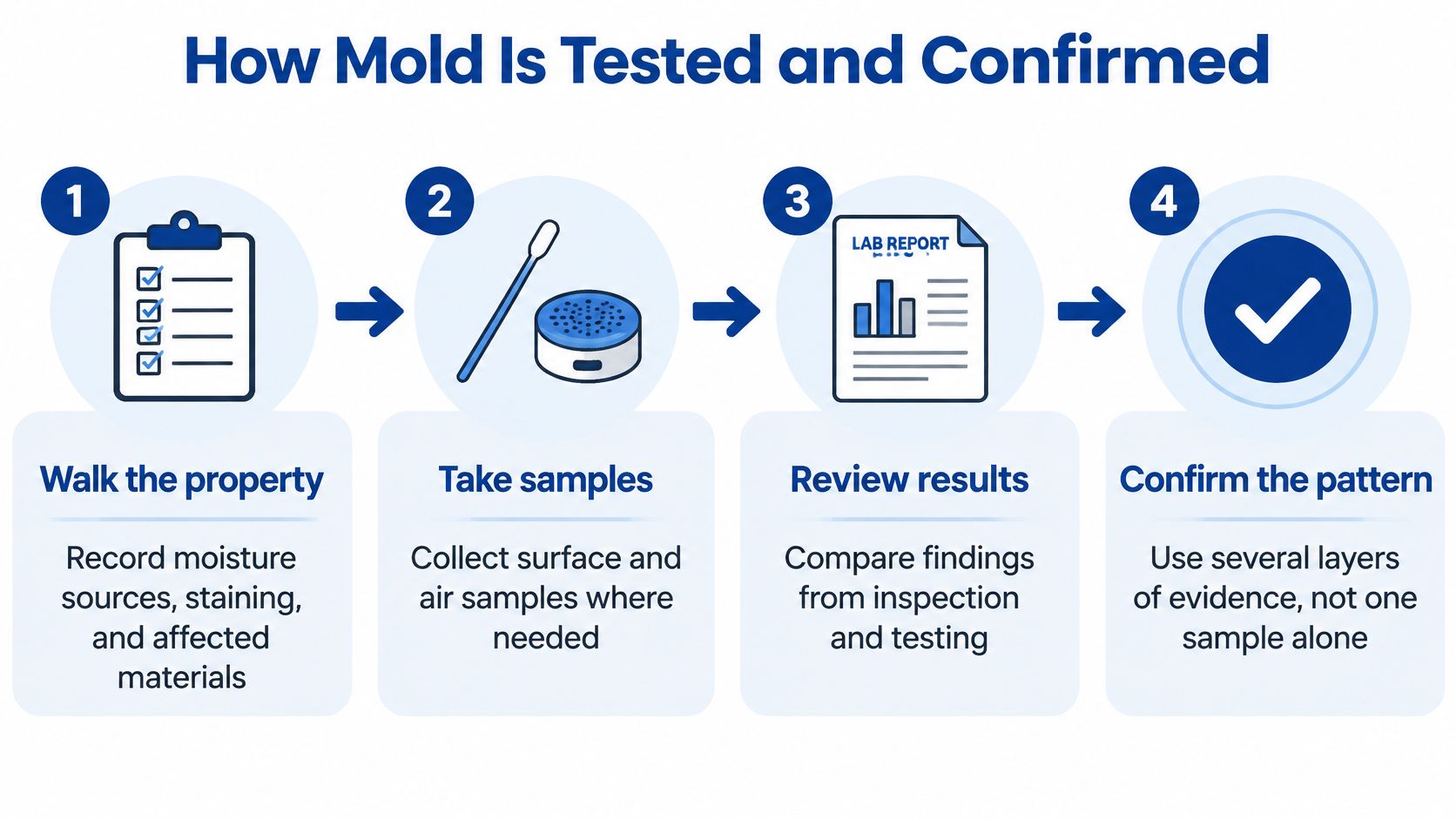
Confirmation happens in layers, not from one sample. A single test result, good or bad, tells you about one surface or one moment of air. A sound assessment stacks several kinds of evidence until they point the same way.
The Usual Sequence
- Walk the property and record moisture sources, staining, odors, and affected materials, room by room.
- Take moisture readings in suspect areas with a pin or pinless moisture meter, then take comparison readings in dry areas of the same material.
- Collect surface samples from materials with visible growth, using tape lifts or swabs that pick up the organisms growing there.
- Collect air samples where odor or symptoms suggest hidden growth, and compare indoor spore levels against an outdoor baseline taken the same day.
- Send samples to a lab for identification and counts, then read the lab results alongside the inspection notes and moisture data.
Our own process follows that logic in four steps, Initial Inspection, Sampling, Analysis, and Results Review, and our mold spore testing service may include air sampling, surface sampling, moisture readings, and visual inspection of high-risk areas. Testing after water damage also helps document conditions for insurance purposes.
Testing methods compared
| Method | What it shows | Best used when | Limitation |
|---|---|---|---|
| Visual inspection | Moisture sources, staining, extent of visible growth | Any suspicion of mold, as the first step | Cannot identify species or detect hidden growth |
| Surface sampling (tape lift or swab) | Which genera are growing on a specific material | Visible growth needs identification | Misses growth inside walls and cavities |
| Air sampling | Airborne spore levels compared with an outdoor baseline | Strong odour with no visible growth, or occupant symptoms | A single snapshot that can vary by time and weather |
| Moisture meter readings | Conditions that support growth, such as wet drywall or framing | After water damage, to confirm drying is complete | Shows moisture, not mold itself |
How to Read the Results Without Overreading Them
The outdoor comparison is what makes an air sample useful. In a one-year study of 77 homes in Delhi published in PMC, the average concentration was 110,091 fungal colonies per cubic meter of indoor air, compared with 107,070 colonies per cubic meter outdoors. Indoor air naturally carries mold because outdoor air does. What you're looking for is an indoor count, or an indoor species mix, that stands out from what's outside your door that day.
Two cautions keep people from drawing the wrong conclusion. First, a clean air sample doesn't prove a wall cavity is clean, because spores trapped behind drywall may never reach the sampler. Second, moisture readings are often the strongest evidence of an ongoing problem, since wet material today means growth tomorrow whether or not a sample catches it.
A useful report pulls it all together. Expect locations, methods, lab results, moisture data, and recommendations in one document you can hand to a remediation contractor or an insurance adjuster.
Remediation Basics and the 24 to 48 Hour Drying Window
One benchmark matters more than any cleaning product. The EPA brief guide to mold, moisture, and your home states that wet or damp materials dried within approximately 24 to 48 hours will, in most cases, avoid mold growth. Speed of drying beats chemistry. Every hour a wall stays wet moves you closer to a removal job instead of a drying job.
That window explains why the first moves after a leak are unglamorous. Stop the water, extract what you can, and get air moving with fans and a dehumidifier. Our guide on how to prevent mold after water damage walks through that first response in order. Cleaning comes after drying is underway, not before.
Fix the Source or the Growth Returns
Cleaning without correcting the moisture source lets growth come right back. The plumbing leak, roof breach, groundwater intrusion, or condensation pattern has to be fixed first, or you're scheduling the same job twice. When plumbing is the culprit, we coordinate repairs with licensed plumbers, confirm the source is resolved, and begin drying and restoration immediately after repairs.
Use these scope thresholds to decide who's doing the work:
- About 10 square feet or less: Homeowners can generally manage smaller areas using appropriate precautions, including gloves, eye protection, and a well-fitting respirator.
- Larger than about 10 square feet: Get a professional assessment, because containment and air filtration start to matter.
- Extensive water damage: Treat it as a professional job even if visible growth looks small, since hidden wet material determines the full extent.
- Suspected HVAC contamination: Don't run the system. Operating contaminated HVAC equipment can distribute spores through the whole building.
Cleaning Small Areas and Handling Porous Materials
For small areas on hard surfaces such as tile, sealed countertops, or painted metal, scrub with detergent and water, then dry the surface completely. That's the method EPA recommends. Its guidance doesn't recommend relying on biocides such as bleach as the primary mold-removal method, and bleach on porous material is worse than useless, since the water in it soaks in while the active ingredient stays near the surface.
Porous materials follow a different rule. Mold-contaminated drywall, ceiling tile, insulation, or carpet may require removal when they can't be thoroughly dried and cleaned. You can't scrub the inside of insulation. Bag removed material before carrying it through clean rooms, and avoid dry sanding or aggressive scraping that launches spores into the air you're breathing.
Records to keep: Save moisture readings, a list of affected materials, notes on any HVAC involvement, and confirmation that drying is complete. Odor and surface color aren't proof of clearance.
For significant jobs, professional remediation adds containment sheeting, HEPA air filtration, removal of contaminated materials, moisture-source identification, and preparation for clearance. The species name rarely changes those steps. The extent of wet, porous material does.
Decide Whether to Test or Call a Professional
Start with a simple decision path. Check the signs, find the moisture source, estimate the size of the affected area, then choose. Mold testing identifies whether mold is present and at what levels, and it doesn't remove mold. Remediation is a separate service that removes mold and addresses the underlying moisture. Testing is the right step when you don't yet know what you're dealing with.
We recommend testing when you have:
- Persistent musty or earthy odors with no visible source
- Recent water damage or leaks, or past flooding or plumbing failures
- Visible discoloration on walls or ceilings
- Respiratory symptoms that improve outside the home
- A home purchase or sale where both sides need documentation
If testing finds higher levels, we can guide you through next steps, including professional remediation options if required. We provide mold testing and inspection in Georgetown, Austin, and throughout Central Texas. For today, do one thing. Photograph the affected area, note the moisture source and the date you found it, and book an inspection if any item above fits your situation.
If you've found growth, a musty odor, or water damage you can't fully explain, RestoTek TX offers mold testing and inspection for Georgetown, Austin, and Central Texas homes, plus the drying and remediation guidance to act on what the results show. Visit RestoTek TX to request an inspection and get a clear, documented next step for your home.