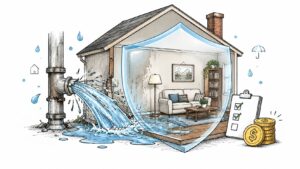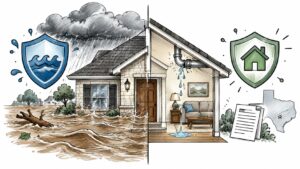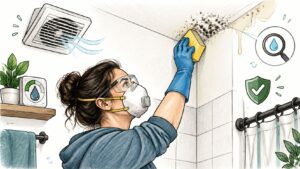
Standard homeowners and renters policies usually cover resulting water damage from a sudden, accidental burst, but not the failed pipe itself; long-running leaks and outside flooding are typically excluded. Homeowners coverage generally addresses the building and belongings, while renters coverage generally protects the tenant's belongings.
That creates a counterintuitive outcome: an insurer may pay to restore a soaked kitchen while leaving the homeowner responsible for the small plumbing fitting that caused the mess. For homeowners in Austin and Georgetown, the useful question isn't “Does insurance cover burst pipes?” It's which water source caused which damage, and what evidence supports that explanation?
What Insurance Pays for After a Burst Pipe
A standard policy usually addresses the damage caused by escaped water, not the cost of replacing worn-out plumbing. Allstate's water-damage guidance distinguishes sudden, accidental losses from gradual leaks and maintenance problems, with coverage subject to policy terms, deductibles, and limits.
Separate the loss into building damage, damaged belongings, emergency work, and the failed component. Those categories can receive different coverage decisions even when they appear on the same contractor's estimate.
Typical Burst Pipe Claim Items and Coverage
| Item | Usually Covered? | Reason |
|---|---|---|
| Drywall, ceilings and insulation | Yes | Resulting damage from sudden discharge |
| Flooring and cabinets | Yes | Resulting damage under dwelling coverage |
| Personal belongings | Yes | Personal-property coverage, subject to limits |
| Emergency extraction and drying | Usually | Reasonable mitigation the insurer expects |
| The burst pipe or fitting itself | No | Failed component, usually not covered |
| Corroded or worn plumbing | No | Deterioration and wear are excluded |
| Water heater failure | Usually not | Failed equipment itself is evaluated separately; check endorsements |
| Mold from a long-running leak | No | Gradual damage and unresolved maintenance are commonly excluded |
| Outside floodwater | No | Requires separate flood coverage rather than ordinary burst-pipe coverage |
The table describes typical treatment, not a promise of payment. For example, a failed water heater and the flooring it soaked belong on separate estimate lines because the insurer may evaluate them differently.
Dwelling coverage generally addresses attached building materials. Personal-property coverage addresses belongings such as furniture, clothing, and electronics. Renters shouldn't assume their contents policy pays to replace the landlord's cabinets or walls.
Emergency extraction and drying deserve their own documentation. A bill that identifies affected rooms, moisture conditions, equipment, and work performed gives the adjuster more useful information than a single charge labeled cleanup.
Practical rule: Separate the cost of stopping the leak from the cost of restoring what the water damaged.
The financial exposure can be substantial. Insurance Information Institute figures covering 2019–2023, reported by This Old House, found that 1 in 67 insured U.S. homes filed a water-damage or freezing claim annually, with an average claim amount of $15,400.
Before estimating what your own claim might return, check the declarations page for the applicable deductible and coverage limits. An average claim amount isn't a repair estimate, and a covered loss doesn't mean every invoice will be reimbursed.
Why Sudden Discharge Decides the Claim
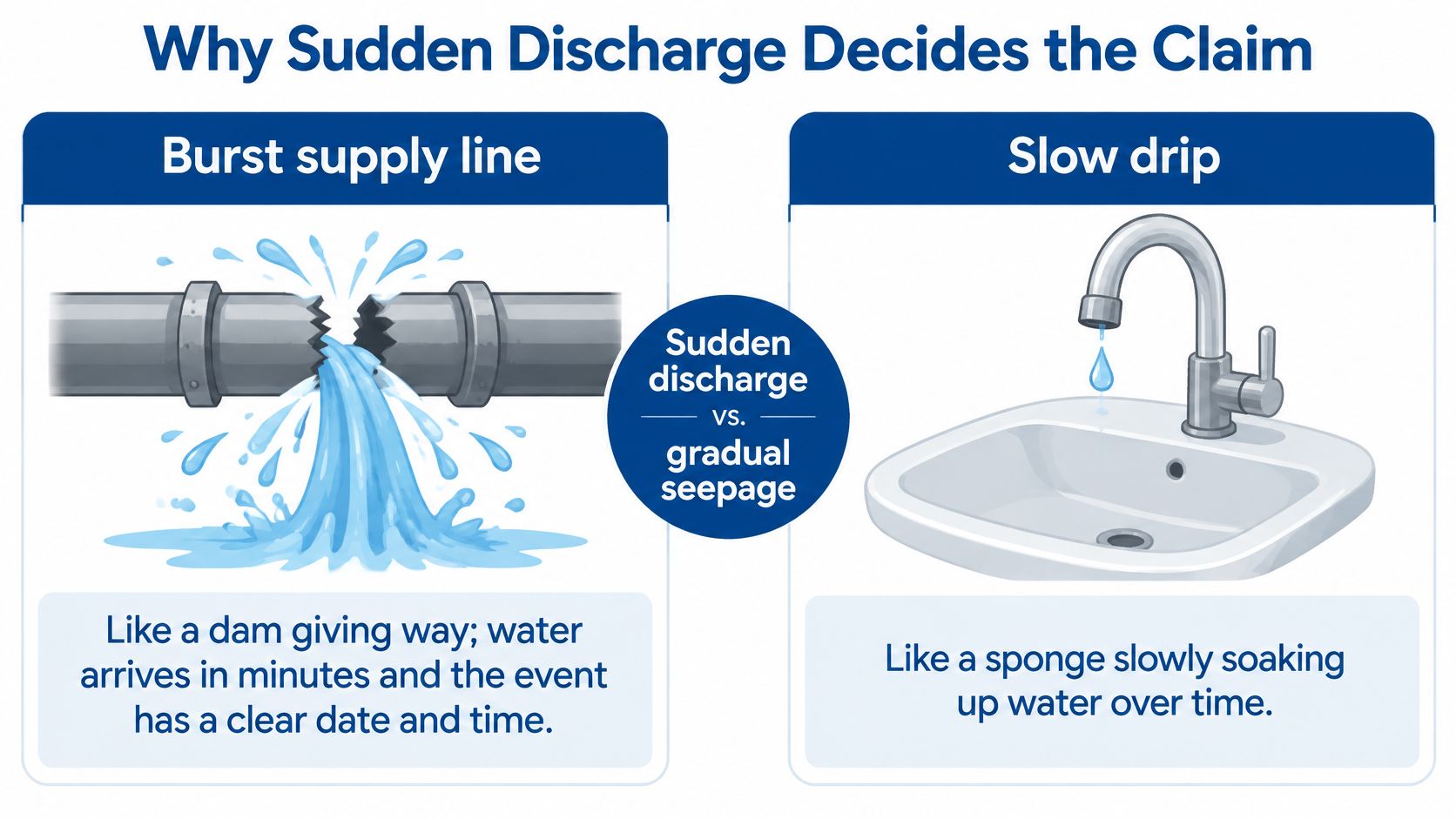
A burst supply line is like a dam giving way: water escapes abruptly, and there may be a clear point when normal conditions changed. A slow drip beneath a sink is more like a sponge gradually soaking a floor. Both can ruin building materials, but the insurer evaluates their timelines differently.
Sudden and accidental describes the discharge, not your surprise when you discover it. Finding a wet cabinet today doesn't establish that the leak started today. Maryland's insurance regulator distinguishes sudden indoor pipe bursts from slow leaks and explains that the pipe itself may not be covered.
What the Adjuster Will Examine
An adjuster may compare your account with the condition of the materials around the leak. Fresh standing water, staining, warped subflooring, mold growth, and rot can help explain the loss, but no single visual sign establishes the entire timeline.
- Location: Does the wet pattern lead back to the failed fitting, or are several entry points possible?
- Material condition: Is the wood newly wet, or does it show deterioration that needs further investigation?
- Earlier warnings: Were there previous stains, musty odors, repair recommendations, or recurring drips?
- Plumbing findings: Does the plumber describe an abrupt rupture, a loose connection, or ongoing seepage?
Don't turn uncertainty into a confident statement on the claim form. If you know when you discovered the water but not when it began escaping, state exactly that and provide the plumber's findings.
A worn component also doesn't automatically settle whether every part of the claim is excluded. The insurer must evaluate the failed component, the discharge, and the resulting damage under the actual policy language.
Ask yourself whether the evidence supports a discrete release or continuing seepage, what the plumber identified as the cause, and what you did after discovery. Those questions are more useful than merely describing every unexpected leak as a burst.
Frozen Pipes and the Duties That Decide Payouts
Many policies cover damage from a frozen pipe that bursts, but the owner's precautions can determine whether coverage applies. The Texas Department of Insurance's storm-damage guidance explains that frozen-pipe damage may be covered while policy limitations and maintenance duties still matter.
Start with the freeze provisions before cold weather arrives. Don't assume a precaution recommended by a neighbor satisfies your particular contract, especially if the property is vacant, unoccupied, or undergoing construction.
Freeze Precautions and the Evidence to Keep
| Precaution | Why It Matters | Evidence to Keep |
|---|---|---|
| Maintain heat during freezing weather | Failure to maintain required heat can jeopardize coverage | Thermostat or smart-home temperature logs |
| Insulate attic and garage pipes | Exposed lines need protection from freezing conditions | Photos of wrapped pipes and receipts |
| Shut off and drain water when vacant | Vacancy safeguards may be conditions of coverage | Shutoff record and property inspection logs |
| Disconnect outdoor hoses | Helps protect exposed hose connections from freeze damage | Dated photos |
| Open cabinets under sinks during a freeze | Allows warm room air to reach supply lines | Notes and photos from the event |
| Shut off water before thawing | Limits water released if a pipe has split | Time-stamped record of the shutoff |
The District of Columbia insurance regulator's frozen-pipe guidance emphasizes reasonable care and heat requirements, including circumstances involving vacant or under-construction properties. Temperature records, inspection logs, and insulation photographs can support your account of those precautions.
Why Vacancy Changes the Decision
Turning off the heat to reduce utility costs can create a much larger coverage problem if the policy requires heat to remain on. A property manager should assign responsibility for checking the building rather than assuming someone else is monitoring it.
For Central Texas properties, prepare for a short cold snap as deliberately as a prolonged freeze. Know the shutoff location and use our guide to what happens when pipes freeze to organize the immediate response.
Before the next winter, ask your agent to identify the exact freeze and vacancy provisions in writing. If the policy allows different protective methods, confirm which method applies to your property and retain evidence that you followed it.
Flood Exclusions and When Water Came From Outside
Standing water doesn't identify the insurance policy that should respond. An interior supply-line rupture and rising water entering from the yard can soak the same room while falling under different coverage provisions.
FEMA's flood-insurance guidance states that most homeowners policies don't cover flood damage and identifies NFIP residential coverage limits of $250,000 for buildings and $100,000 for contents, with flood deductibles that can range from $1,000 to $10,000.
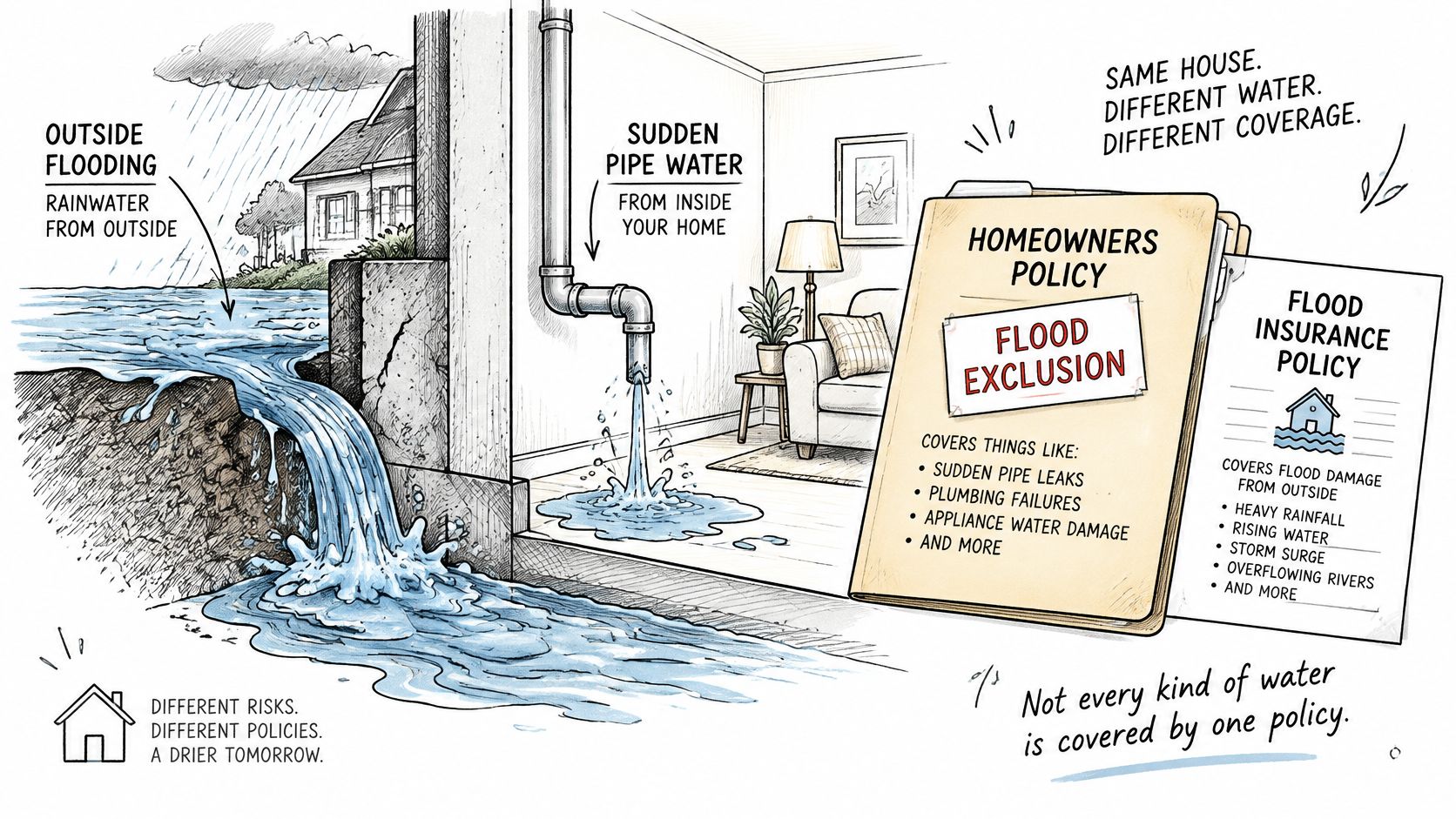
Which Policy Responds to Each Water Source
| Water Source | Usually Responds | Check Before Assuming |
|---|---|---|
| Interior supply line burst | Homeowners or renters policy for insured property | Sudden discharge and the deductible |
| Rising floodwater or river overflow | Separate flood policy | Selected flood deductible and coverage limits |
| Storm-driven water through a foundation opening | Flood policy for qualifying flood entry | Entry point, cause, and elevation evidence |
| Sewer or drain backup | Often requires a water-backup endorsement | Whether the endorsement is included |
| Burst pipe during outside flooding | Both policies, each for its covered cause | Separate deductibles and causation disputes |
Not every instance of water entering through a foundation automatically qualifies for flood coverage. The cause of entry and policy definitions still need review. Likewise, a backup shouldn't be reported as a supply-line burst just because both involve plumbing.
Preserve Evidence of Both Causes
Suppose a supply line ruptures during heavy rain while runoff also enters through an exterior doorway. Photograph the broken line, the doorway, exterior water levels, and the paths of visible water before cleanup removes those clues.
Describe where the water came from before describing everything it ruined.
Record street conditions and the sequence of events. Tell each insurer about the other possible cause, and ask contractors to distinguish their observations from assumptions about coverage.
Our explanation of whether home insurance covers flooding helps distinguish these water-entry situations. When causes overlap, organize the claim room by room and material by material so the adjusters can evaluate which source caused which portion of the loss.
How to Document and File a Burst Pipe Claim
Build a record while preventing additional damage. The Texas Department of Insurance's home-property guidance identifies sudden plumbing losses as potential covered events and emphasizes documenting the source, notifying the insurer, and taking reasonable mitigation steps.
Don't enter standing water near energized equipment or unstable ceilings to obtain photographs. Personal safety comes before evidence collection.
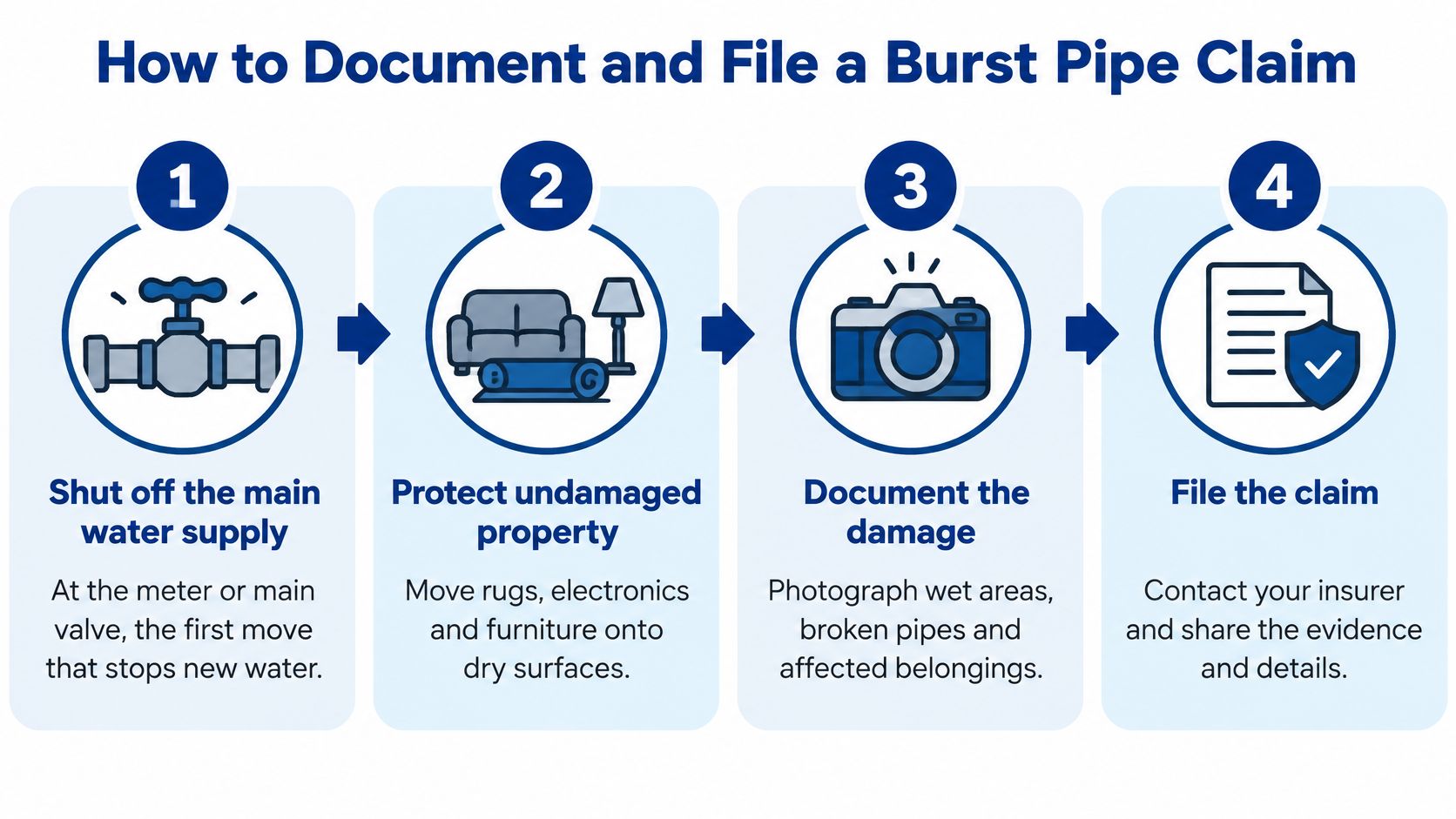
Actions That Protect the Property and the Record
Shut off the main water supply. Use the accessible main valve, or obtain help if you can't safely operate the shutoff. Don't leave water running while searching for policy paperwork; record when you stopped the flow.
Protect undamaged property. Move rugs, electronics, and movable furniture to dry surfaces when it's safe. Photograph their original location first if doing so won't delay urgent protection, and don't carry contaminated items into clean rooms.
Photograph the source and affected areas. Take wide room views, then closer images of wet materials, staining, standing water, and damaged belongings. Preserve original files and timestamps rather than keeping only cropped images sent through a messaging app.
Preserve the failed component. Ask the plumber to retain the pipe or fitting when safe, and label where it came from. Throwing it away before photographs or inspection can remove useful evidence about the cause.
Notify the insurer promptly. Request the claim number, adjuster's contact details, and submission instructions in writing. Don't wait for a complete reconstruction estimate before reporting the loss, and distinguish confirmed facts from suspected causes.
Begin reasonable emergency mitigation. Arrange appropriate extraction and documented drying while retaining invoices, moisture readings, equipment records, and drying logs. Ask for emergency work and later reconstruction to be itemized separately, and avoid authorizing unnecessary permanent work before inspection.
Request written explanations for disputed items. If the insurer reduces or denies part of the claim, ask which policy provision and factual finding support the decision. Compare the explanation with the declarations page, endorsements, photographs, and contractor records rather than relying on a verbal summary.
Keep Deadlines Visible
Check the policy's notice requirements and any deadlines for submitting documents or disputing a decision. Ask the adjuster to confirm outstanding requirements in writing; don't assume an open conversation extends a deadline.
Our insurance claim process guide can help organize the inspection, mitigation, estimate review, and payment stages. The insurer makes the coverage decision, so the documentation must explain what happened and why the claimed work was necessary without depending on a contractor's assurance that everything is covered.
Three Burst Pipe Claims Compared
These hypothetical scenarios show how a decisive fact can change the outcome. They aren't predictions for a particular claim; the policy wording and adjuster's findings control.
A Dishwasher Supply Line Ruptures While the Family Is Home
A braided dishwasher supply line suddenly opens, sending water across the kitchen and into an adjoining room. The owner hears the release, shuts off the supply, photographs the connection, and contacts the insurer that day.
The adjuster accepts the event as sudden and accidental. Damaged drywall, flooring, and a ruined rug fall within the applicable building and contents coverage, subject to the policy's financial terms, while replacing the failed line remains the owner's expense.
Lesson: A documented abrupt release can support payment for resulting damage without making the failed plumbing component covered.
A Bathroom Leak Continues Behind a Vanity
A homeowner notices a musty odor but doesn't investigate until the bathroom floor feels soft. Opening the vanity reveals a dripping connection, deteriorated subflooring, and mold around materials that have stayed wet.
The insurer investigates the history rather than treating the discovery as the start of the loss. If the evidence establishes prolonged seepage and an unresolved maintenance problem, the insurer may exclude most of the claimed damage under the applicable provisions.
Lesson: The date you finally expose a leak doesn't erase evidence that it has been continuing.
A Vacant House Freezes After the Heat Is Turned Off
An owner leaves a house vacant during winter and switches off the heating system. A pipe freezes and splits, and someone discovers the release after water service resumes through the damaged line.
The adjuster requests the vacancy details, heating records, and evidence of any shutoff or draining. If the owner didn't follow required safeguards, the insurer may deny or reduce the claim; if the policy permitted an alternative protective method and the owner followed it, the analysis could differ.
Lesson: For a frozen vacant property, proof of compliance can matter as much as proof of the rupture.
An accurate account with supporting records is more useful than a claim description written to sound covered.
Confirm Your Coverage Before You Call
Don't delay an emergency claim notification while completing a policy review. This checklist is preparation for a focused conversation with your agent or adjuster, not a prerequisite for stopping water or reporting a loss.
Keep the complete policy, not just the insurance identification page. The declarations summarize selected coverage, but forms and endorsements contain conditions that can change the answer.
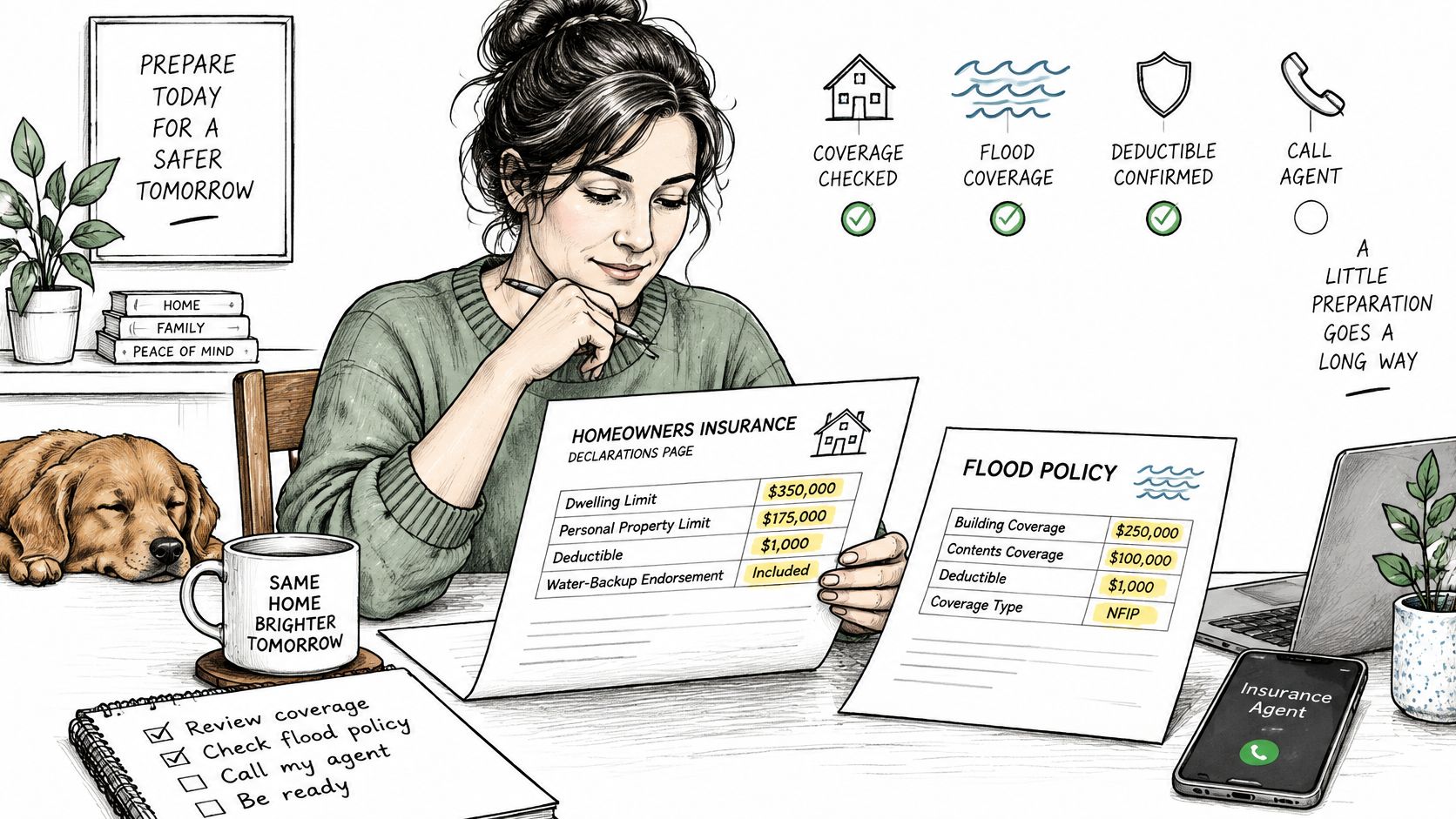
Build a Usable Coverage Checklist
- Declarations and endorsements: Mark the dwelling limit, personal-property limit, applicable deductible, and any water-backup coverage. Ask which deductible applies to this particular cause rather than assuming every water loss uses the same one.
- Separate flood documents: Locate the flood policy if you have one, including its selected building and contents coverage. Keep its reporting instructions with the homeowners documents.
- Occupancy conditions: Identify vacancy, unoccupancy, construction, and freeze provisions. Match each applicable duty to records you can produce.
- Contact information: Save the policy number, agent's details, and insurer's claim-reporting contact somewhere accessible away from the affected property.
- Contractor records: Request a written scope, room-level photographs, moisture readings, and drying logs. Separate source repairs, mitigation, and reconstruction so disputed items don't obscure the rest of the work.
- Decision correspondence: Save written approvals, requests for information, estimate revisions, and partial denials. Record your response dates and retain proof of document delivery.
Ask Questions That Resolve Specific Disputes
Instead of asking whether water damage is covered in general, ask which damaged materials the insurer accepted, which it excluded, and why. If an estimate omits a wet cabinet or wall cavity, submit the relevant photographs and moisture documentation with a precise request for review.
We have experience working alongside insurance claims. Our role is to provide a clear record of the restoration process, not to promise the insurer's decision.
Keep a single claim folder with the declarations page, claim number, correspondence, and every invoice. Name files by room and document type so you can answer an adjuster's request without reconstructing the event from memory.
We coordinate plumbing repairs with licensed plumbers, ensure the water source is resolved, and begin drying and restoration immediately after repairs. If you're dealing with burst-pipe damage in Austin or Georgetown, visit RestoTek TX to request a free estimate and discuss the next steps for documenting and restoring your property.