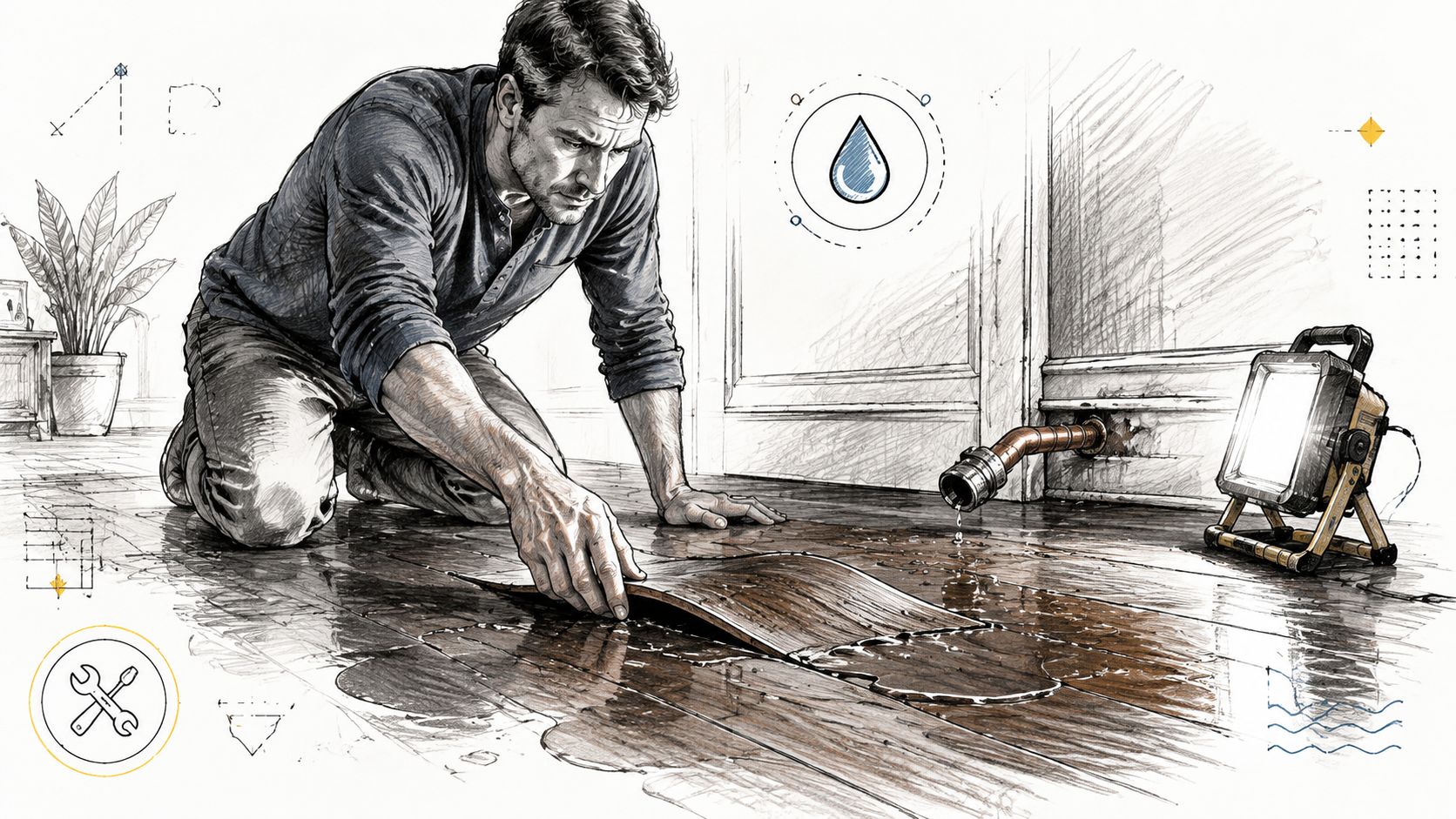
You find the leak after a supply line fails overnight. The water is gone from the surface, but several hardwood boards have begun to cup, the finish looks cloudy, and the room smells faintly musty. That floor may still be repairable, but appearance alone can't tell you whether moisture remains inside the boards or beneath them.
The right way to repair hardwood floor water damage is a sequence of decisions, not a quick sanding job. Stop the source, remove standing water, dry the flooring and subfloor gradually, verify moisture with instruments, investigate concealed damage, and only then choose between refinishing, board replacement, or broader reconstruction.
Assessing the Situation and Acting Fast
A failed supply line leaves more than a wet surface. Start by shutting off the line, appliance valve, or nearby water service if you can do so safely. If water reached outlets, extension cords, appliances, or an electrical panel, leave the area and arrange a qualified electrical assessment. Wet hardwood creates slip hazards, while loose or lifted boards can cause trips.
Your first inspection should establish four facts:
- Where did the water come from? A clean supply-line leak requires a different response from sewage, a drain backup, or stormwater.
- Is water still entering? Drying and repairs cannot succeed until the source is controlled.
- How far has it traveled? Inspect transitions, baseboards, closets, adjacent rooms, and low wall areas.
- What changed? Photograph cupping, stains, cloudy finish, separated boards, buckling, and standing water before major cleanup alters the evidence.
Exposure time affects salvageability. Water enters through seams, board ends, fastener holes, and damaged finish, then can remain beneath boards or inside the subfloor. Clean up promptly, but do not treat a dry-looking surface as proof that the flooring is dry internally. Warm, humid Central Texas conditions may slow drying in concealed cavities.
Practical rule: Preserve evidence and limit spread before pursuing a cosmetic repair.
A restoration professional generally follows this sequence: inspect, contain, extract, dry, test, then decide what can be salvaged. Moisture readings should guide the next step, including whether drying equipment must remain in place and whether hidden areas need investigation. This prevents sanding or refinishing a floor whose boards or subfloor remain wet.
The timeline demands prompt action without guesswork. Guidance from the National Water Damage Authority identifies clean-water exposure as the most repairable situation, while hardwood floors wet for about 72 hours or more are commonly beyond practical salvage in many species. If the source is controlled early and a full-cycle restoration team such as RestoTek TX in Central Texas is needed, professional assessment can preserve more options than rushed DIY repairs.
Immediate Mitigation and Water Extraction
Water removal starts with the materials sitting on the floor. Lift rugs, mats, cardboard, upholstered furniture, and stored items. Blot shallow spills with absorbent towels, then use a wet/dry vacuum on accessible water. Keep the vacuum and its electrical connections away from standing water unless the equipment and setup are rated for that environment.
A consumer wet/dry vacuum can manage a small clean-water spill. Call for professional extraction when water has moved beneath boards, reached the subfloor, entered wall cavities, or spread across multiple rooms. Commercial extractors remove greater volumes efficiently, but technique still matters. Excessive suction or lifting boards without a plan can damage finishes, fasteners, underlayment, and flooring that could have been saved.
Control the source before controlling the climate
Stop the leak before starting fans. Record the initial condition and identify whether the water is clean, gray, or heavily contaminated. Contaminated water needs different handling, and porous materials exposed to Category 3 water generally require removal instead of drying for reuse, according to the water-damage salvage guidance.
Once the source is controlled, extract standing and trapped water, then pair air movement with dehumidification. Air movers encourage evaporation from exposed surfaces, while a dehumidifier removes moisture from the room air. In a humid Central Texas home, fans alone can circulate damp air without lowering the moisture load. Manage doors and windows according to the drying plan, since humid outdoor air can slow progress.
The first 72 hours often determine how many flooring components remain candidates for salvage. If water has been present for about 72 hours or more, the floor may be beyond practical recovery in some species. That window is a decision point, not permission to sand immediately. Moisture readings and the condition of the boards must guide extraction, selective removal, and the decision to bring in a full-cycle team such as RestoTek TX in Central Texas.
Avoid fast, uneven drying
High heat cannot replace controlled drying. If the top of a board dries faster than its underside, the board may change shape, split, or crown after a rushed sanding job. Gradual drying and stabilization should precede sanding or refinishing, as described in the hardwood water-damage guidance from D&G Floors.
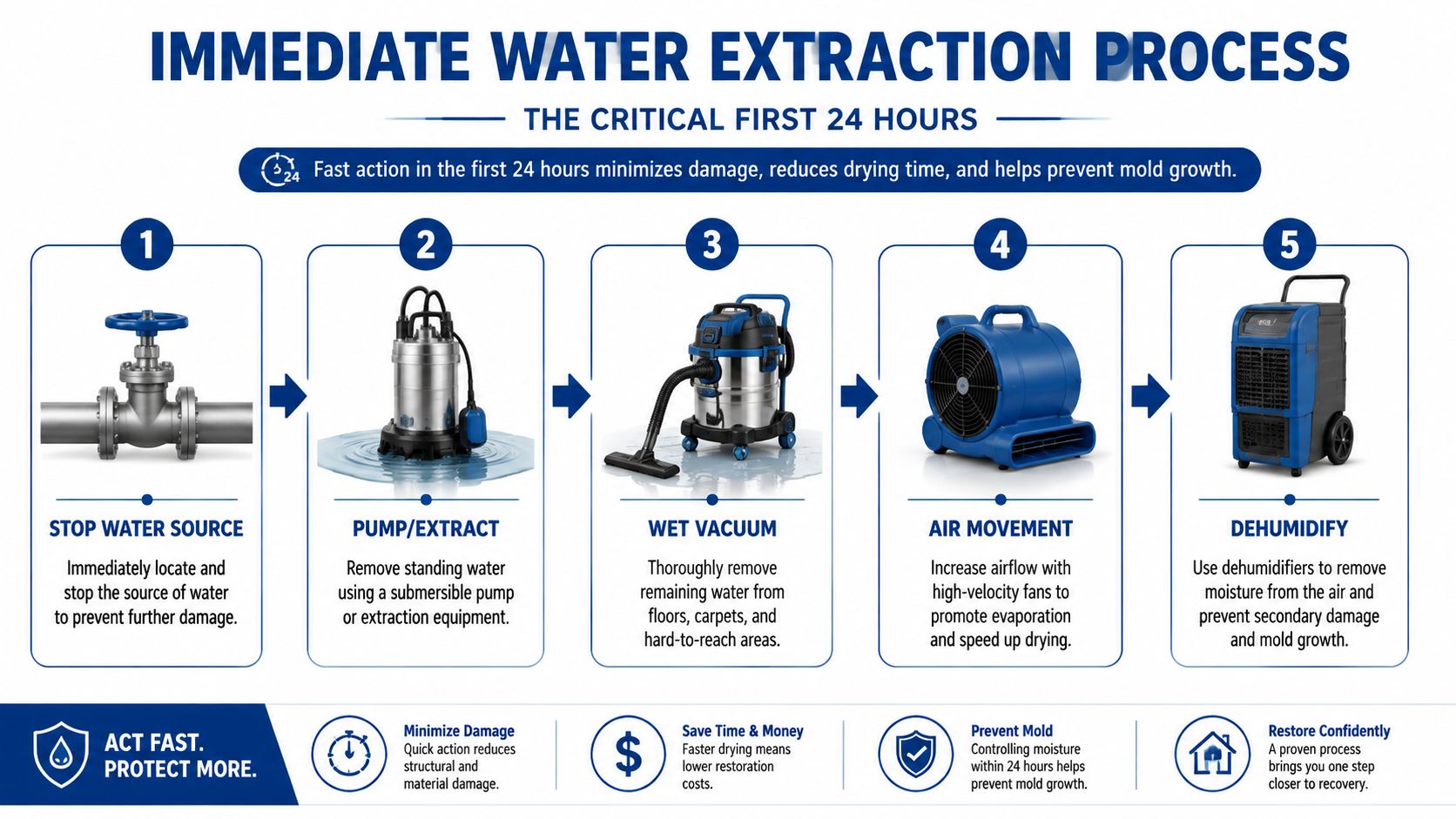
Extraction also protects concealed materials. Water can remain in the subfloor, underlayment, baseboards, and lower wall cavities. A professional crew may remove selected trim or flooring to create drying access, but inspection should support that choice.
Costs can rise when the work includes extraction, structural drying, board or section replacement, refinishing, and subfloor repairs. An industry cost summary reports $4,000 to $10,000 for typical hardwood-floor water-damage repairs, reflecting the full scope of that work.
Structural Drying and Moisture Testing Standards
A hardwood floor can look clean while remaining too wet to sand. Moisture may be trapped inside the boards, beneath the finish, or in the subfloor. Those hidden pockets can keep the floor moving after extraction, so drying is complete only after readings and indoor conditions confirm stability.
The ANSI/IICRC drying guidance sets three practical conditions for sufficiently dried hardwood:
- Moisture content in the affected wood is decreasing.
- The affected wood is within 2.5% of a normal moisture-content control point elsewhere in the same building.
- The HVAC system can maintain normal indoor conditions.
The control point gives each reading context. Compare affected boards with an unaffected area in the same building, using similar flooring and construction where possible. A generic chart value cannot account for that building's materials, humidity, or normal operating conditions.
Measure the wood and subfloor
Pin-type moisture meters can assess moisture below the immediate surface. Test affected boards, apparently unaffected boards, and accessible sections of the subfloor. A board that feels dry to the hand may still hold moisture in its lower layer.
Hardwood commonly targets 6% to 9% moisture content, with the flooring within 2 percentage points of its expected in-use moisture content. If flooring and subfloor readings differ by more than about 4 percentage points, continue drying before sanding, refinishing, or reinstalling boards. The NWFA water and wood guidance outlines these targets and the related testing approach.
| Criterion | Target value | Verification method |
|---|---|---|
| Moisture trend | Decreasing | Repeat pin-type readings during drying |
| Affected-to-control comparison | Within 2.5% | Compare affected wood with a normal control point in the same building |
| Hardwood moisture content | Typically 6% to 9% | Take pin-type readings in representative boards |
| Flooring-to-subfloor difference | Within 4 percentage points | Test both materials before repair work |
| Indoor conditions | HVAC maintains normal conditions | Confirm the system can hold the intended environment |
The 72-hour salvage window makes early measurement especially important. Drying should begin promptly, with readings documented as conditions change. A floor that still has concealed moisture after that period may require more invasive access, particularly when humidity or subfloor moisture prevents steady progress.
Do not sand cupped boards because the surface no longer feels wet. Let controlled drying and stabilization show whether the boards return toward their normal shape. Premature sanding can remove material from wood that later shifts again.
For concealed moisture or difficult humidity conditions in Central Texas, structural drying support in Central Texas can provide drying equipment and documentation before reconstruction begins. Bring in a full-cycle restoration team when readings stop improving, access is limited, or the loss involves flooring, subfloor, and wall cavities together.
Deciding Between Restoration and Replacement
The restoration-versus-replacement decision depends on water category, exposure duration, board movement, and subfloor condition. Preserving original wood can be worthwhile, but sunk cost can lead to repeated refinishing, recurring cupping, and another demolition if the boards or subfloor remain unsound.
Clean water provides the best salvage opportunity when the source is stopped promptly and controlled drying begins within the 72-hour salvage window. Category 3 contamination changes the decision because porous flooring can absorb harmful contaminants. The salvageability guidance from the National Water Damage Authority indicates that Category 3 events generally require removal, while exposure lasting about 72 hours or more is commonly beyond practical salvage for many wood species.
Read the floor's physical response
Moisture readings show whether drying is progressing. Board movement shows whether the flooring can still perform after stabilization. Readings should be compared with unaffected areas and the subfloor before any sanding or replacement decision.
| Damage indicator | Salvage potential | Recommended action |
|---|---|---|
| Mild cupping with improving readings | Often reasonable | Continue controlled drying, then reassess flatness and finish |
| Surface discoloration with stable boards | Possible | Test for moisture, then consider spot repair or refinishing |
| Persistent cupping after stabilization | Limited | Evaluate board thickness, movement, and subfloor before sanding |
| Buckling or tenting | Poor in affected boards | Remove damaged boards and inspect the subfloor |
| Adhesive failure or separated layers | Poor | Replace affected flooring and correct the moisture source |
| Soft, weak, or contaminated material | Very poor | Remove under professional containment and address concealed damage |
Buckling, tenting, and adhesive failure indicate that moisture or expansion has affected the flooring system, rather than only its finish. Replacement may provide a more reliable result. Partial replacement is reasonable when damage is localized and matching material is available. Full removal becomes more practical when damage crosses rooms, the subfloor is compromised, or existing boards cannot be blended convincingly.
A clean-water event does not guarantee salvage, and cupping does not automatically make the floor a total loss. Make the decision after drying data and a physical inspection. If readings stop improving, access is limited, or flooring, subfloor, and wall cavities are involved together, bring in a full-cycle restoration team such as RestoTek TX in Central Texas.
The real measure of success is whether the flooring remains stable after the entire assembly reaches equilibrium.
Surface Repairs After Proper Stabilization
Cosmetic work begins only after the moisture readings support it and the boards have stopped making significant shape changes. If a contractor proposes sanding before testing the flooring and subfloor, ask what measurements support that decision. A fresh finish can hide a problem temporarily, but it can't remove active moisture or repair a weak subfloor.
Start with a board-by-board inspection. Separate shallow finish damage from defects that extend into the wood. Cloudy coating, minor staining, and light surface marking may respond to screening, spot repair, or refinishing. Cracked, loose, stained, soft, or badly distorted boards may need removal even when neighboring boards are sound.
Match the repair to the damage
For isolated damage, a flooring professional can remove selected boards and lace replacement pieces into the existing pattern. The replacement should match species, width, thickness, grain direction, and profile. Older homes in Georgetown and Austin may have flooring that has aged, darkened, or been refinished multiple times, so a new board rarely matches by color alone.
Wood filler has a limited role. It can address small gaps or shallow surface defects after the wood is stable, but it isn't a substitute for replacing a board that has lost structural integrity. Sanding can level minor unevenness, yet aggressive sanding removes the wear layer and can make future repairs more difficult.
The correct sequence is:
- Verify that drying criteria have been met.
- Confirm that flooring and subfloor readings are compatible.
- Remove boards that remain structurally damaged.
- Patch or fill only appropriate surface defects.
- Sand gradually and evenly.
- Blend stain or finish with the surrounding floor.
- Allow the new finish to cure according to the product requirements.
The assigned visual suggests a reading of 8.2 percent, but a single number isn't enough to approve sanding. The relevant question is whether the reading fits the building's control point, whether the subfloor is also stable, and whether the moisture trend has leveled out.
Industry guidance from D&G Floors on water-damaged hardwood warns that rapid drying can cause splitting and that sanding or refinishing should wait until the wood has dried and stabilized. Refinishing is the final treatment, not the repair itself.
Mold Screening and Hidden Damage Investigation
Visible cupping doesn't tell you how far water traveled. Moisture can move under boards, into the subfloor, behind baseboards, and into wall cavities. If you repair only the exposed finish, the concealed source remains available for odor, deterioration, and microbial growth.
Look for clues that justify a broader investigation:
- Persistent musty odor: A continuing odor after surface cleanup can point to damp concealed materials.
- Staining beyond the floor: Dark marks along baseboards, lower drywall, transitions, or cabinet sides suggest migration.
- Soft or weak materials: Spongy subfloor areas, unstable boards, and crumbling trim need more than cosmetic treatment.
- Continuing moisture readings: Readings that don't follow a drying trend indicate that water remains or is being reintroduced.
- Unexplained symptoms: Occupants who notice irritation or other changes after a water event should leave the investigation to qualified professionals rather than disturbing suspect materials.
The Bruce Flooring guide to hardwood repair notes that water damage can lead to mold when the area isn't dried quickly and recommends inspection before sanding or refinishing. It also identifies excessive buckling, warping, and structural weakness as situations where replacement may be safer because damage can be concealed below the surface.
Investigate before demolition creates a new hazard
A proper investigation may combine moisture mapping, selective removal, cavity inspection, and air or surface sampling where appropriate. Infrared equipment can help identify temperature patterns associated with moisture, but it doesn't replace direct moisture testing. Sampling should answer a specific question, not serve as a substitute for locating and correcting the water source.
Older Georgetown and Austin properties may also contain legacy building materials that require testing before aggressive demolition. If flooring, resilient materials, adhesives, or other components could contain asbestos, don't cut, grind, or disturb them casually. A qualified asbestos professional can determine whether testing is necessary before removal.
For local warning signs and concealed-cavity concerns, review signs of hidden water damage in a Georgetown, Texas home. Sanding over a hidden problem may improve the room's appearance while leaving the actual remediation unfinished.
Insurance Documentation and Professional Support
Good documentation starts before cleanup changes the scene. Photograph the failed valve, appliance, or storm entry point, then capture standing water, board movement, stains, baseboards, adjacent walls, and affected contents. Keep a simple timeline showing when the problem was discovered, when the source was stopped, when extraction began, and what materials were removed.
Ask for written records from anyone who evaluates the floor. Useful documentation includes:
- Moisture maps: Locations and readings for affected flooring, control areas, and subfloor.
- Drying logs: Equipment placement, environmental observations, and repeated readings.
- Scope details: Extraction, demolition, drying, cleaning, board replacement, refinishing, and reconstruction.
- Cause information: The failed component or pathway that allowed water to enter.
- Photographic evidence: Before, during, and after images, including concealed areas opened for inspection.
Insurance coverage depends on the policy and the cause of loss, so don't promise yourself that every repair will be covered. A clear, itemized record helps an adjuster understand why extraction, structural drying, selective demolition, or replacement may be necessary rather than optional. Guidance on preparing a claim is available through RestoTek TX's water-damage insurance claim resource.
DIY cleanup can be reasonable for a small, promptly addressed clean-water spill that never reaches seams or the subfloor. Call a restoration team when water has spread under the floor, the source is contaminated, boards are buckling, odors persist, multiple rooms are affected, or you can't verify drying with appropriate instruments.
RestoTek TX serves Georgetown, Austin, and surrounding Central Texas communities with inspection, extraction, structural drying, microbial prevention, mold inspection, asbestos testing where required, and reconstruction. The family-operated company, led by Joan and Josh Garza, also provides 24/7 emergency response and no-cost estimates, which can reduce the handoff problems that occur when separate contractors manage mitigation and rebuilding.
RestoTek TX can inspect the water source, extract standing water, document moisture conditions, dry the flooring and subfloor, and coordinate repairs when boards or surrounding structures need reconstruction. Visit RestoTek TX to request help with your hardwood floor water damage before sanding, refinishing, or replacement decisions lock in the wrong scope.