
A water stain on the ceiling usually shows up at the worst time. You notice it after a storm, after the washing machine overflows, or when you finally track down that damp smell in a hallway closet. Then your mind jumps fast. Is this just wet drywall, or is mold already growing? Do you call a plumber, your insurance company, or a mold inspector first?
That confusion is normal. In Georgetown, water damage and mold questions get tangled up with Texas licensing rules, insurance requirements, and the reality of our climate. A small leak can stay hidden in a wall cavity. A clean-looking room can still have high moisture levels in trim, insulation, or subfloor. And one of the costliest mistakes I see is when a homeowner starts cleanup without understanding when a licensed mold assessment is legally required.
This guide is for that moment. The goal isn't to scare you or bury you in technical language. It's to help you make the next decision correctly, protect your property, and avoid steps that can complicate remediation or a claim.
That Sinking Feeling When You Find a Leak
It often starts with something easy to dismiss. A soft spot near a baseboard. A ring on the ceiling under an upstairs bathroom. A musty smell that seems stronger after the AC kicks on. You open the cabinet under a sink and see swelling on the particle board, or you move a dresser and find the wall cooler than the room and slightly discolored.
Most homeowners don't need a lecture in that moment. They need a calm sequence.
First, stop the water if you can do it safely. That might mean shutting off a fixture supply line, turning off the home's main water valve, or moving contents out of a wet area. If the source isn't obvious, a good starting point is understanding how leak detection works in a home so you're not guessing at whether the problem is plumbing, roof intrusion, HVAC condensate, or something hidden inside the wall.
What matters in the first few hours
The biggest early mistake is focusing on cleanup before documentation. Take clear photos and video before you tear out materials, move soaked contents, or run fans. Capture the source if visible, the path the water traveled, and every room affected.
Then notice the details that tell the full story:
- Smell: A musty odor matters, especially in closed rooms, closets, and under-sink areas.
- Surface clues: Bubbling paint, swollen trim, warped flooring, and staining often point to longer moisture exposure.
- Location: Water below bathrooms, around exterior walls, near windows, and under HVAC components often behaves differently and needs different investigation.
When homeowners slow down just enough to document first and disturb materials second, they usually put themselves in a better position for both remediation planning and insurance conversations.
If you're in Georgetown and you're reading this while standing in a wet room, take a breath. You don't need every answer right now. You need to identify the source, protect the property from further damage, and avoid doing anything that muddies the inspection record.
Why Visual Assessment Trumps Air Sampling
A lot of people assume mold inspection starts with an air test. In many real-world water damage jobs, it doesn't. The more reliable first question is simpler: Where is the moisture, and what can we see or smell?
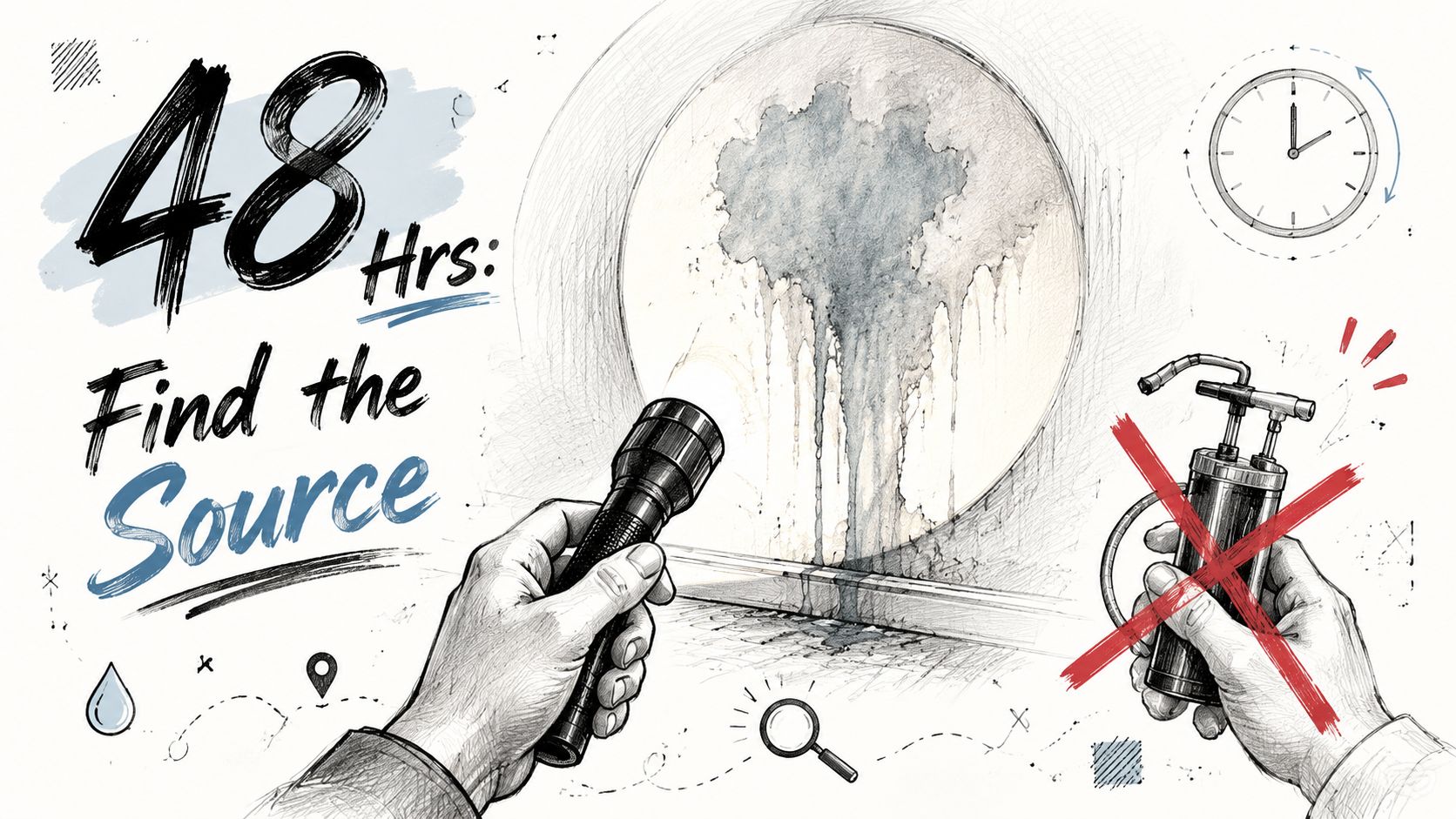
Data from NIOSH and the CDC indicates that visual inspections and detecting musty odors are significantly more reliable for identifying mold presence than air sampling, with approximately 90% of reliable assessments prioritizing the identification of the moisture source over quantifying airborne spores, according to the NIOSH mold guidance from the CDC.
That matches what works in the field. Air samples can be affected by time of day, HVAC cycling, open doors, weather, and simple disturbance in the room. A spore count might look low in one moment and different the next. A wet wall cavity, active condensation, or visible growth tells you much more about what needs to happen next.
What to do before anyone starts testing
If you've just discovered damage, stick to a few practical steps:
Document before cleaning
Photograph visible staining, swollen materials, and any standing water.Reduce active exposure to water
Shut off the source, place a container under a drip, or isolate the area if needed.Don't rip everything open immediately
Pulling materials apart too early can change conditions and make it harder to assess the original moisture path.Watch for visible indicators
Dark spotting, fuzzy growth, peeling paint, and a stale or earthy smell all matter.Treat DIY test kits cautiously
Home kits often create more confusion than clarity. If you've been considering one, it's worth reading how home mold test kits compare with professional inspection methods.
Why moisture source beats spore count
Federal guidance doesn't treat routine air sampling as the default answer, especially because there are no health-based indoor mold limits that give homeowners a clean pass or fail line. What makes a difference in the outcome is finding the moisture source and correcting it.
A professional visual assessment usually answers questions air sampling cannot:
- Is the problem active or old
- Is moisture entering from plumbing, roof, HVAC, or exterior intrusion
- Are materials still wet
- Is visible growth confined or likely spread into adjacent cavities
Practical rule: If you can see mold or identify moisture intrusion, the smarter next move is usually source identification and moisture mapping, not chasing an air number.
In other words, mold inspection in Georgetown works best when it starts with evidence you can act on.
Anatomy of a Professional Georgetown Mold Inspection
A certified inspection is much more than someone walking through the house and saying, "That looks like mold." Texas rules expect a documented process. That's what separates a legally useful assessment from a free glance or a contractor's rough opinion.
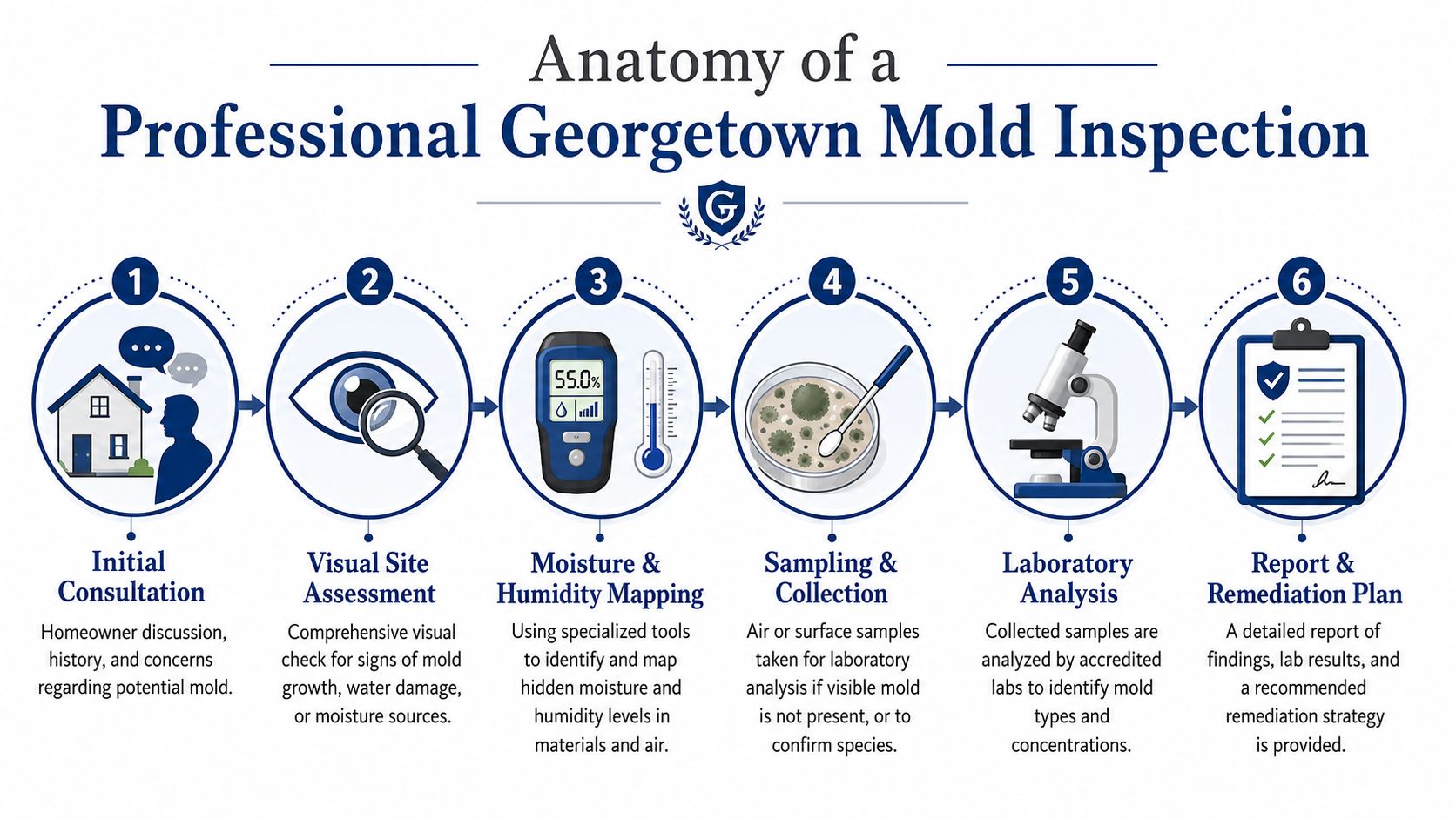
The Texas Mold Assessment and Remediation Rules require non-invasive moisture detection with calibrated meters, a documented assessment of humidity, and photographic evidence of all areas of concern. The formal requirements are laid out in the Texas Mold Assessment and Remediation Rules.
What happens on site
A proper mold inspection in Georgetown usually starts with the building history. The inspector wants to know when the leak started, whether the area has dried, what odors are present, and whether repairs or cleanup already happened.
Then comes the site assessment. Readily accessible areas get examined for water damage, visible growth, staining, and conditions that support microbial growth. That often includes places homeowners don't think to check, such as:
- HVAC drip pans and nearby insulation
- Attics with roof intrusion or poor ventilation
- Crawlspaces with high moisture
- Cabinet backs, vanity interiors, and wall bases near plumbing
- Window perimeters and exterior wall transitions
The tools that matter
A licensed assessor doesn't need to guess. They use instruments to confirm or rule out hidden moisture.
| Tool | What it does | Why it matters |
|---|---|---|
| Calibrated moisture meter | Measures moisture in drywall, wood, and other materials | Helps identify wet materials that look dry on the surface |
| Thermal imaging camera | Shows temperature differences | Can point to hidden moisture patterns that need meter confirmation |
| Hygrometer | Records humidity and temperature | Helps document indoor conditions supporting growth |
| Camera or photo log | Documents conditions and limitations | Creates a usable record for remediation planning and claims |
If an area of concern is found, the assessor documents it. If sampling is needed in the assessor's judgment, it should be tied to a specific question, such as checking suspected hidden growth or clarifying what a stained surface is. The report should also note inaccessible spaces and any limits on the inspection.
A good inspection report doesn't just say what was found. It shows where it was found, how moisture was confirmed, what couldn't be accessed, and what has to be corrected before the problem returns.
Why this is different from a contractor estimate
A remediation contractor may be very good at removal and drying, but Texas separates assessment from remediation for an important reason. Property owners shouldn't have to rely only on the cleanup contractor's judgment about scope.
If your situation moves from suspicion to confirmed contamination, the next phase may include a formal plan for removal, containment, drying, and clearance. That's where a service provider handling mold remediation in Georgetown follows the assessment record instead of inventing scope on the fly.
The Water Damage Restoration Toolkit Explained
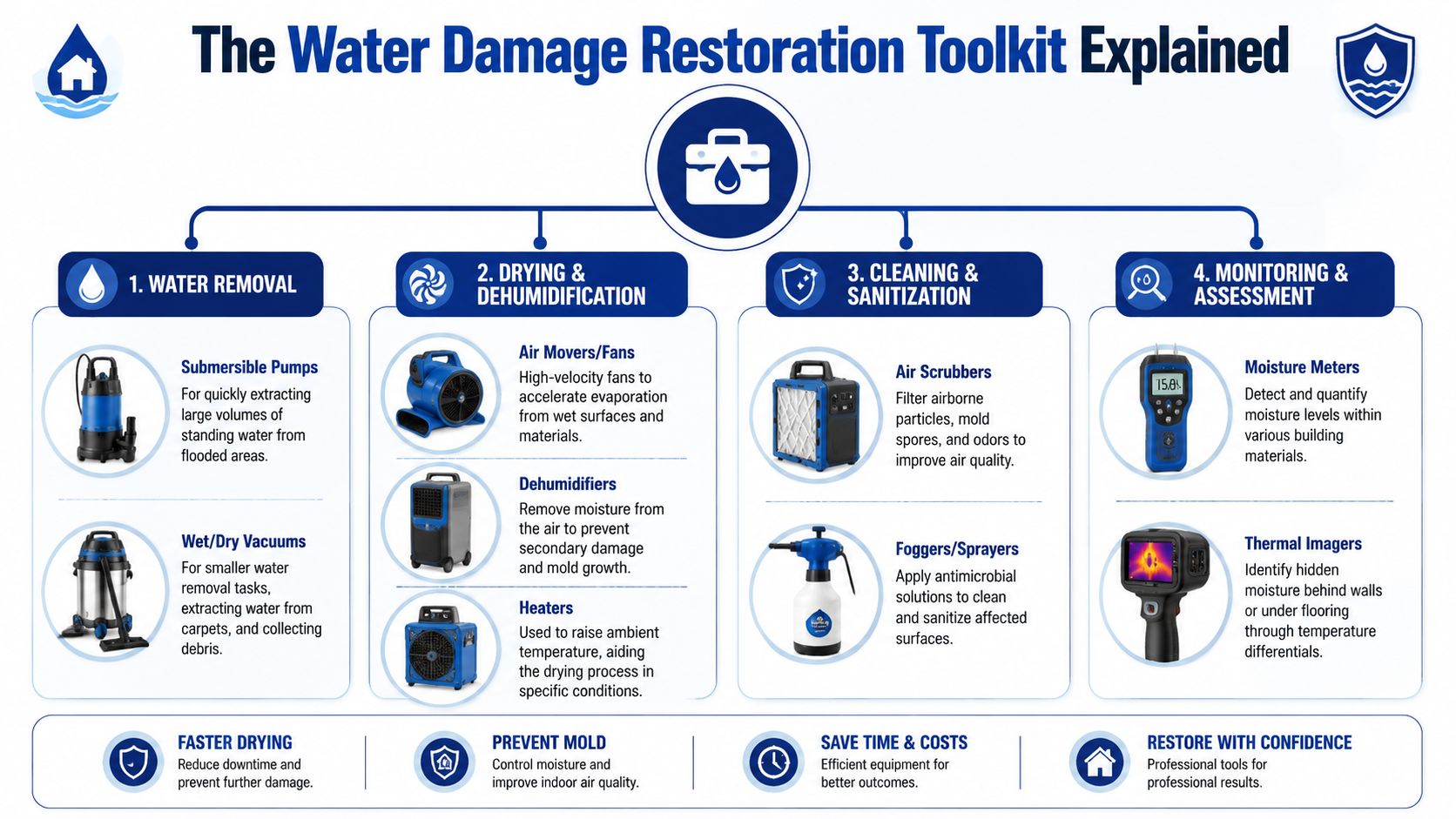
Once water damage is confirmed, the equipment on site can look like overkill if you haven't been through this before. It isn't there for show. Each machine solves a different drying problem, and using the wrong setup can leave moisture behind in framing, insulation, flooring, or air pockets.
Water removal tools
Standing water has to come out first. Drying can't begin properly while liquid water is still feeding materials.
- Submersible pumps handle larger accumulations in low spots, flooded rooms, or areas where water depth is beyond what a vacuum can manage efficiently.
- Wet extractors pull water from carpet, pad, seams, and hard-surface transitions. On many jobs, extraction does more good in the first stage than setting fans everywhere.
- Wands and specialty attachments help remove water from edges, under cabinetry, and along baseboards where puddling hides.
Think of extraction as removing the bulk load before fine drying starts. If you skip that step or do it poorly, every machine after that has to work harder.
Drying and dehumidification gear
After extraction, drying becomes a controlled process. The basic principle is simple. Move moisture out of materials, then pull it out of the air before it settles somewhere else.
Air movers
Air movers create fast airflow across wet surfaces. They don't "dry the room" by themselves. They speed evaporation from flooring, drywall, framing, and contents by sweeping saturated air off the surface.
In practical terms, they act like focused wind aimed where water is trapped. Placement matters more than quantity. Too many in the wrong spots can create dead zones or bounce airflow uselessly around furniture.
Dehumidifiers
Dehumidifiers collect the moisture that air movers push into the air. Professional restoration often uses LGR units because they handle wet environments better than the kind of portable units people rent for a mildly damp garage.
What matters to a homeowner is not the model name. It's whether the machine can keep up with the evaporation load in your actual structure. A soaked bathroom is one thing. A multi-room loss with wet framing and flooring is another.
Heat and specialty drying
Some materials dry poorly with airflow alone. That's when crews may use controlled heat or systems like injectidry equipment to move air into wall cavities, under cabinets, or beneath flooring assemblies.
Drying isn't about making a room feel comfortable. It's about reaching dry standards inside the materials that got wet.
Cleaning, filtration, and monitoring
Drying alone doesn't solve every problem after a water loss. Some projects also need particle control, odor treatment, and ongoing measurement.
A few common tools:
- HEPA vacuums remove settled contamination from surfaces during controlled cleanup.
- Air scrubbers filter airborne particulates and help manage work zones during demolition or cleaning.
- Pump sprayers or foggers may be used to apply antimicrobial or deodorizing products when the situation calls for it.
- Moisture meters and thermal imagers stay in use throughout the job so the crew can verify progress rather than guess.
One option homeowners in Georgetown use is RestoTek TX, which handles inspection, mitigation, structural drying, microbial prevention, and reconstruction as a single service path. That's useful when you don't want separate trades debating where the moisture started or who is responsible for the next step.
What homeowners should pay attention to
You don't need to become a technician overnight. But you should know what to ask when equipment arrives.
What materials are wet
The answer should be specific, not general.How is progress being measured
"It feels dry" isn't enough. Crews should be checking materials, not just air.Why are these machines placed here
Good placement has a reason tied to the wet materials and the airflow pattern.What happens if hidden moisture remains
That's where secondary deterioration and later mold problems often begin.
Renting Equipment vs Hiring a Professional Service
This is the point where many homeowners ask a fair question. Can you just rent fans and a dehumidifier, dry the room yourself, and save money?
Sometimes, yes. Sometimes, that decision becomes the reason a small water event turns into a bigger mold and repair problem.
Where DIY can make sense
If the water exposure is limited, visible, and easy to control, rental equipment may be enough. A small clean-water overflow on a hard floor, caught quickly and fully dried, is different from a leak that traveled under flooring or into wall cavities.
DIY is strongest when the loss is:
- Small and recent
- Clearly sourced
- Limited to accessible materials
- Easy to monitor without opening assemblies
Where DIY starts breaking down
The risk isn't usually the fan you rented. The risk is what you didn't detect.
A homeowner can dry the surface of a room and still miss high moisture in drywall backing, insulation, cabinet toe-kicks, base plates, or flooring underlayment. That's how a room starts looking better while conditions behind the finish keep getting worse.
Here's the tradeoff in plain terms:
| Factor | Renting equipment | Hiring a professional service |
|---|---|---|
| Up-front cost | Lower at first | Higher at first |
| Time required from you | High | Lower |
| Hidden moisture detection | Limited | Better with instruments and experience |
| Documentation for claims | Usually weak | Stronger if properly recorded |
| Drying strategy | Trial and error | Based on material conditions and monitoring |
| Risk of missed damage | Higher | Lower |
The cheapest path is only cheaper if it actually finishes the job.
There's also the legal and insurance side. If mold is involved or suspected beyond a minor housekeeping issue, the question isn't just whether you can clean it. The question is whether your cleanup choices interfere with the assessment record you may need later.
Professional service also means someone owns the drying plan. They decide which materials can be saved, which need removal, how to isolate affected areas, and when conditions meet dry standards. That's hard to replicate with a rental cart and a guess.
Navigating Texas Insurance Claims and Regulations
For Georgetown homeowners, this is the part that gets missed most often. Texas state law requires a professional mold assessment by a licensed assessor before any non-exempt remediation project can begin, and over 65% of mold-related claim denials in Central Texas stem from failing to provide this certified inspection report, according to the Texas mold licensing FAQ from TDLR.
That means the inspection isn't just helpful. In many situations, it's the document that keeps the whole process on solid legal ground.

When a certified inspection is legally required
If a remediation project is non-exempt under Texas rules, a licensed mold assessor has to evaluate the property before remediation starts. The point is accountability. The state doesn't want the same party who benefits from cleanup deciding the scope without independent assessment.
That matters for homeowners because the sequence affects claims. If you start tearing out material, spraying products, or hiring remediation before the proper assessment, you may create avoidable disputes about cause, extent, and necessity.
Where insurance trouble starts
A lot of claim problems don't begin with the insurer. They begin with missing paperwork and rushed decisions.
Common mistakes include:
- Skipping the licensed assessment
- Failing to notify the carrier promptly
- Discarding damaged material before documentation
- Using contractors who can't support the file with proper records
- Confusing a free estimate with a compliant inspection report
A practical claim checklist
If you're trying to protect coverage, keep your process disciplined.
Review your policy language
Look for water damage terms, mold limitations, exclusions, and notice requirements.Document immediately
Photos, videos, timeline, source location, affected rooms, and any emergency actions taken.Notify the insurer fast
Delay can complicate the file, especially when the carrier questions when the loss occurred.Use TDLR-licensed professionals where required
For mold assessment and non-exempt remediation, licensing isn't a detail. It's a threshold issue.Keep every record
Reports, invoices, emails, work authorizations, moisture logs, and photos all matter.
Insurance reality: A claim file is easier to defend when the moisture source, affected materials, and sequence of work are documented before cleanup changes the evidence.
Required versus optional in plain English
A common dilemma for many Georgetown homeowners revolves around mold. If you have a small visible spot caused by a brief, controlled event, you may not always need a formal mold assessment. But once the issue involves hidden moisture, broader contamination, insurance reimbursement, or a non-exempt remediation project, the stakes change.
That is why mold inspection in Georgetown shouldn't be treated like a casual add-on. In the right scenario, it's the step that protects both your health decision-making and your claim.
Why Central Texas Humidity Changes the Game
A Georgetown house can look dry and still hold enough moisture to restart mold growth a few weeks later. That happens here more than homeowners expect, especially after a leak under flooring, inside an exterior wall, or around an HVAC line set.
Central Texas creates a stubborn drying environment. Outdoor humidity stays high for long stretches. Afternoon heat drives moisture through materials. Then a storm rolls through, the house closes up, and damp air lingers in closets, wall cavities, and bathroom corners. A cleanup that might hold in West Texas can fail here if drying and follow-up are too casual.
That matters for a second reason beyond cleanup. In Georgetown, recurrence often turns a simple water-loss file into a mold claim, and that is where owners get surprised by Texas rules and policy limits. If new growth appears after the initial event, the insurer may ask whether the moisture source was fully corrected, whether conditions were documented, and whether a licensed mold assessment became necessary before more work was done.
Why recurrence happens here
I see the same patterns over and over in Central Texas homes:
The leak was fixed, but the materials never reached a dry standard
Carpet pad, subfloor, insulation, and cabinet toe-kicks can stay damp longer than the surface suggests.Indoor humidity stayed too high after the emergency work
Drying equipment helps, but the house also has to be managed correctly after pickup, especially during humid weather.A concealed area was missed
Behind shower walls, under laminate, inside exterior-facing wall cavities, and around supply boots are common trouble spots.The building has an air or moisture weakness that only shows up seasonally
Poor bathroom exhaust, duct leakage, condensation near vents, and minor exterior intrusion often reveal themselves later.
Texas homeowners should pay attention here. Once mold returns, the question is no longer just whether something smells musty. The question may become whether the next step is routine cleanup or a situation that needs a licensed mold assessment to protect health decisions and avoid insurance problems.
What helps after remediation
The smartest post-remediation habit is targeted rechecking, not guesswork.
Reinspect the original loss area after heavy rain or several days of AC use
Focus on baseboards, closet corners, cabinet backs, window surrounds, and exterior walls.Treat a returning odor as an early warning
Musty air often shows up before staining or visible growth.Watch for condensation patterns
Supply vents, uninsulated boots, cold-water lines, and under-ventilated bathrooms can keep feeding moisture into the same area.Get a professional review if the original loss involved hidden cavities or multiple materials
That is especially true when insurance is involved and the line between water damage and mold remediation is starting to blur.
For Georgetown homeowners, the long-term fix is moisture control that holds through our weather, not just removal of what was visible on the first visit.
Frequently Asked Questions About Mold Inspection
What does a professional mold inspection in Georgetown usually cost
Pricing varies by property size, scope, accessibility, whether sampling is needed, and how much documentation is required. Because costs weren't provided in the verified data, the best approach is to ask for a written scope, not just a price. You want to know what the inspection includes, what tools will be used, whether photos and moisture readings are part of the report, and whether the work is being done by a licensed assessor when required.
How long does the inspection take
That depends on the number of affected areas, whether the source is known, how accessible attics or crawlspaces are, and whether the inspector needs to evaluate hidden moisture patterns. A focused single-area inspection moves faster than a whole-property assessment after a multi-room water loss. The important thing isn't speed by itself. It's whether the inspection answers the key moisture question.
Can I legally clean a small spot of mold myself
Minor surface cleaning may be possible in some situations, but homeowners need to be careful not to confuse a small visible spot with a small moisture problem. If the issue may involve hidden moisture, insurance reimbursement, or a non-exempt remediation project, Texas rules can require a licensed assessment before remediation begins. If you're unsure, pause before disturbing materials.
What's the difference between mold testing and mold inspection
A mold inspection is the broader process. It looks at the building, the moisture source, visible conditions, affected materials, humidity, and areas of concern. Mold testing is only one possible tool within that process. Testing may involve surface or air samples, but it isn't the whole job and it isn't always the most useful first step.
Does insurance require a certified mold inspection
Policies differ, but if your loss involves mold remediation, documentation is critical. In Texas, the legal requirement for a licensed assessment before non-exempt remediation and the high rate of claim denials tied to missing certified inspection reports make this one of the first questions to resolve. Don't assume a contractor's estimate will satisfy an insurer.
Should I wait to call for help until I can see mold
No. Wet materials, a musty odor, or recurring staining can justify investigation before visible growth becomes obvious. Waiting can make the property damage worse and can also blur the timeline you may later need to explain to an adjuster.
If you're dealing with a leak, musty odor, or suspected mold growth in Georgetown, RestoTek TX can help you sort out the next step without guesswork. Joan and Josh Garza's team handles water damage inspection, drying, microbial prevention, and repair work across Central Texas, with practical guidance for homeowners who need clear answers fast.