
A musty smell after a storm, a dark stain creeping up from the baseboard, or a bathroom vanity that never quite dried out. That's usually when a Georgetown or Austin homeowner starts searching for professional black mold removal and hoping the answer is simple. It usually isn't simple, but it is manageable when you treat it as a moisture problem first and a mold problem second.
What Professional Black Mold Removal Really Means
A slow leak behind a vanity is a good example of how this starts. The spot on the trim looks small, the smell comes and goes, and a homeowner reaches for bleach because it feels like a cleaning issue. By the time a qualified crew gets there, the job is already clear, because professional black mold removal is a structured remediation process, not a surface wipe-down. It usually includes containment, removal of damaged materials, drying, and repairs, especially when moisture has spread behind walls or into hidden cavities, as reflected in the cost and scope patterns described by Angi's mold remediation cost data.
Why the label matters less than the moisture source
The phrase “black mold” gets attention, but the color alone doesn't tell you what's happening inside the wall. A qualified crew starts by finding the leak, condensation point, or drainage failure that fed the growth, because remediation that ignores water intrusion doesn't hold up. That's why professional guidance centers on moisture control, containment, and selective removal instead of trying to “kill” mold in place. The EPA's position, echoed in homeowner guidance, is that the decisive issue is the wet building material, not a dramatic-sounding label, and the same logic appears in Central Texas mold guidance.
Practical rule: if the wall, cabinet, or floor is still wet, stained from an active leak, or smells musty after drying attempts, surface cleaning isn't the finish line.
What a real crew does that a handyman usually doesn't
A professional crew isolates the work area, removes contaminated porous materials that can't be reliably cleaned, and confirms dryness before reconstruction starts. That's a different job from spraying a product on visible discoloration and hoping for the best. The homeowner should be watching for whether the company talks about source control, material removal, drying targets, and documentation, because those are the parts that determine whether the problem stays gone.
If you want a plain-language view of what a local remediation company may handle from assessment through rebuild, the service overview at RestoTek TX's mold remediation page shows how the work is usually organized in practice.
Health Risks and Why Color Is Only Part of the Story
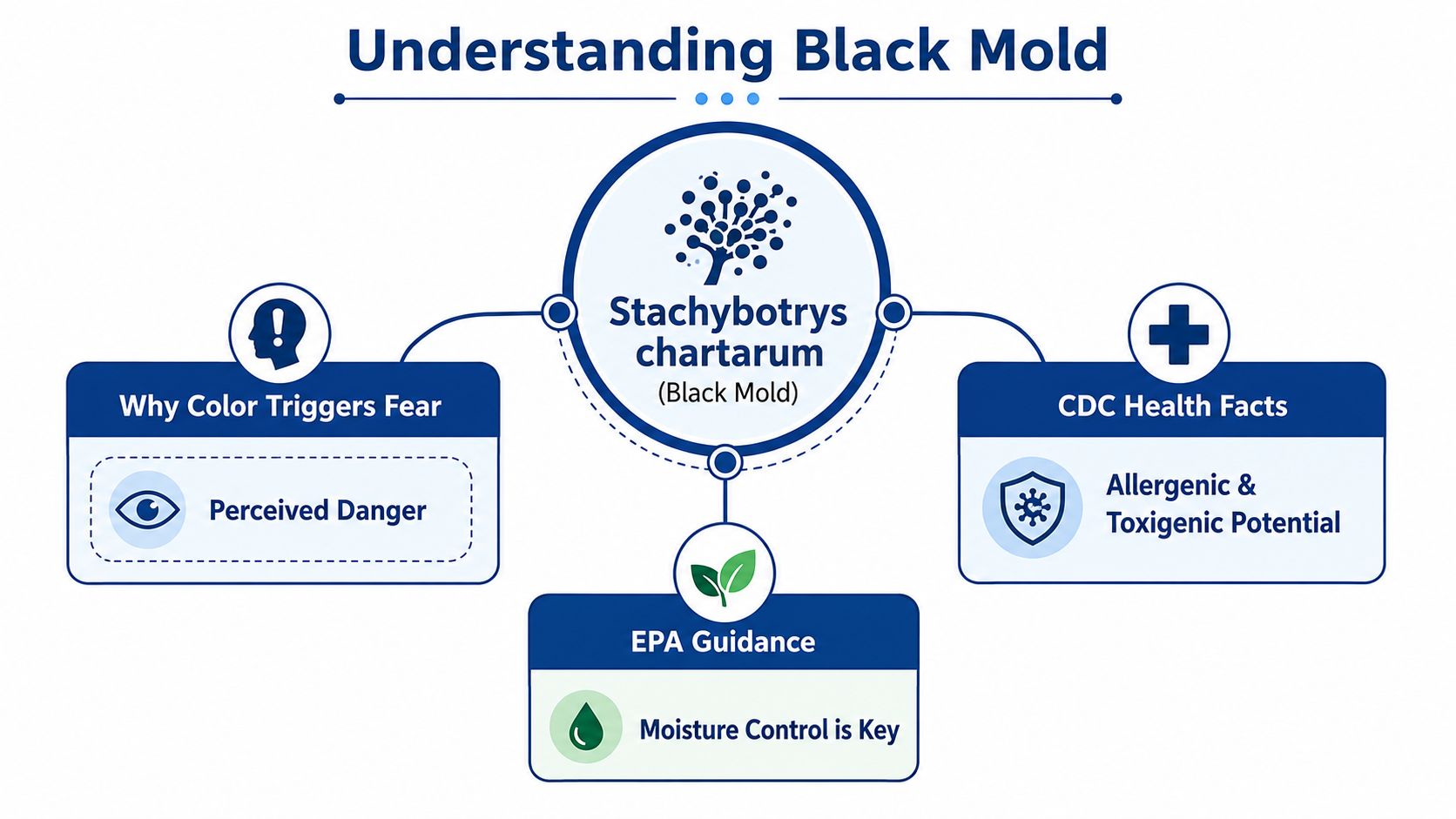
The fear around black mold comes from two things. The dark color looks severe, and people often treat “mold” as if it were one single hazard. Indoor mold is better understood as a moisture-linked contaminant that affects different households in different ways. Professional guidance puts the focus on whether the space is wet, how far the growth has spread, and who lives there.
What matters for your household
The health concerns are real, but they are not all the same. Mold exposure can aggravate asthma, trigger allergic reactions, and irritate the respiratory system, so a household with young children, older adults, or anyone with respiratory sensitivity should move sooner on professional help. If someone in the home is immunocompromised, the decision gets more cautious, because hidden growth and ongoing dampness create a different level of risk than a small, isolated surface patch.
The useful comparison is simple. A small patch on a bathroom caulk line after a steamy shower is one thing. Growth that keeps returning under flooring, behind drywall, or inside a wall cavity is another. The second pattern tells you the moisture problem has not been solved, and fear-based cleanup advice does not help at that point.
Why professionals don't treat every dark spot the same way
The EPA and CDC center cleanup on removing contaminated materials and drying the area, not on chasing a mythic “black mold” category. That matters because a homeowner can overreact to a stain that is limited to the surface, or underreact to hidden growth that keeps feeding itself from a leak. The right response depends on extent, location, and whether the material can be dried and salvaged.
A bathroom ceiling stain and a wall that stayed damp after a plumbing leak are not the same job. One may be cosmetic. The other can mean wet materials inside the assembly, and that is where professional removal becomes the safer call.
If you are sorting through local health and building concerns, this Central Texas guide does a good job of framing the issue around moisture control rather than color alone.
Warning Signs Every Homeowner Should Know
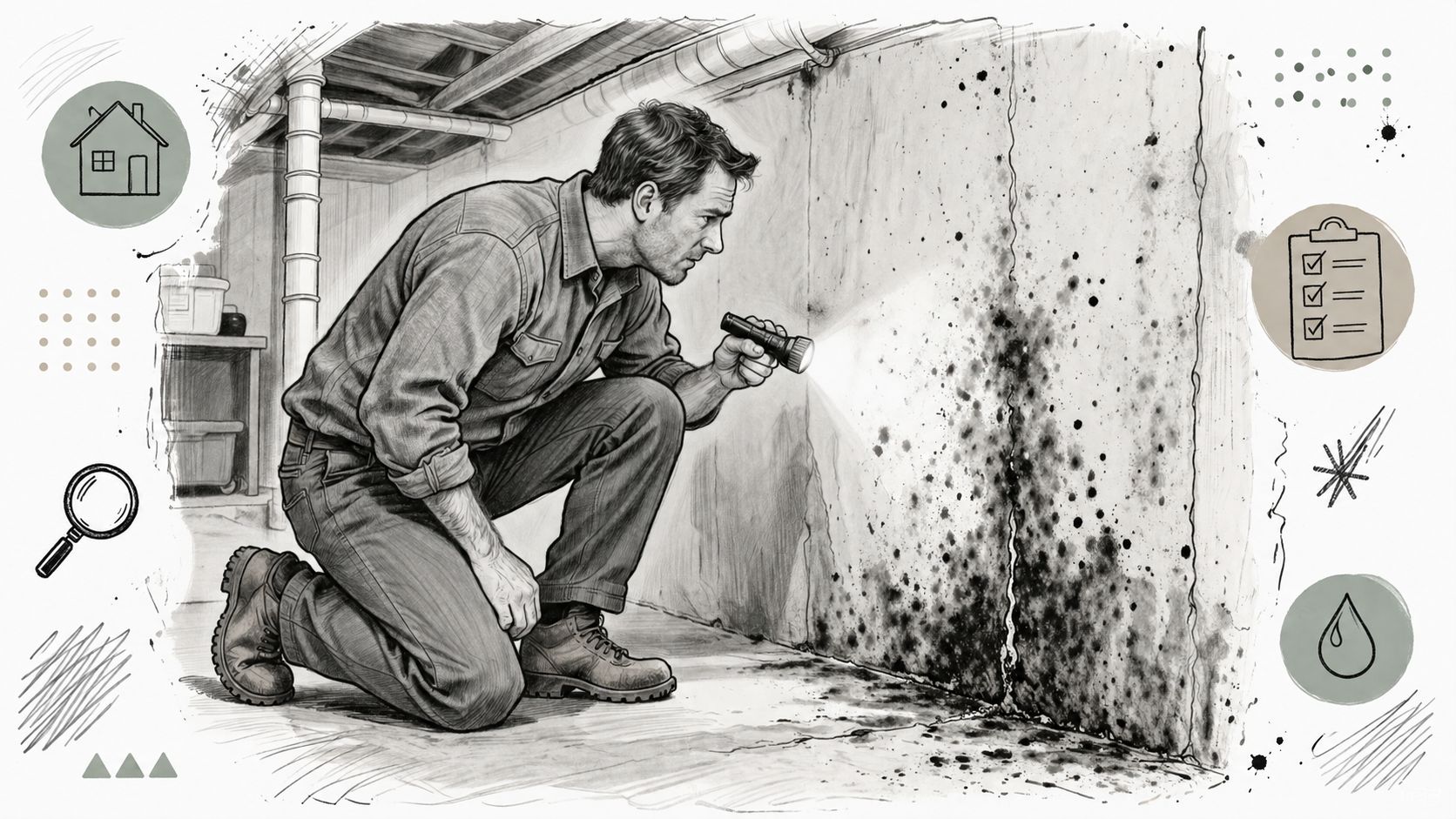
A homeowner usually notices mold before they can prove it. The first clue might be a smell that never leaves a bathroom, even after cleaning. The second might be paint that bubbles at the base of a wall, or a baseboard that feels warped when you press it with your thumb.
The signs that matter most
Watch for musty odors, dark spotting, peeling paint, softened drywall, warped trim, and recurring condensation on cold surfaces. Recent water events matter too, especially a leak that “seemed small” but never fully dried. That's how hidden growth gets a head start in slab-on-grade homes, behind vanities, or in areas around plumbing penetrations.
A Georgetown homeowner dealing with a hot water line leak under a bathroom floor may only see cosmetic damage at first. The floor can look fine while moisture stays trapped underneath. By the time the trim starts to buckle, the problem has already moved beyond a wipe-and-seal job.
If the same stain returns after cleaning, treat that as a moisture signal, not a cleaning failure.
When DIY stops making sense
Small, isolated surface growth on a non-porous material can sometimes be handled cautiously by a homeowner. Once the affected area is large, the material is porous, or the growth is hidden behind walls, in HVAC components, or under flooring, the job belongs to a professional. Health symptoms in the household are another line you shouldn't ignore, especially if anyone has asthma, persistent coughing, or recurring irritation when the space is occupied.
For homeowners trying to locate what's hidden in plain sight, this guide on mold hiding spots is a useful companion to the warning signs above.
Inside the Professional Remediation Workflow
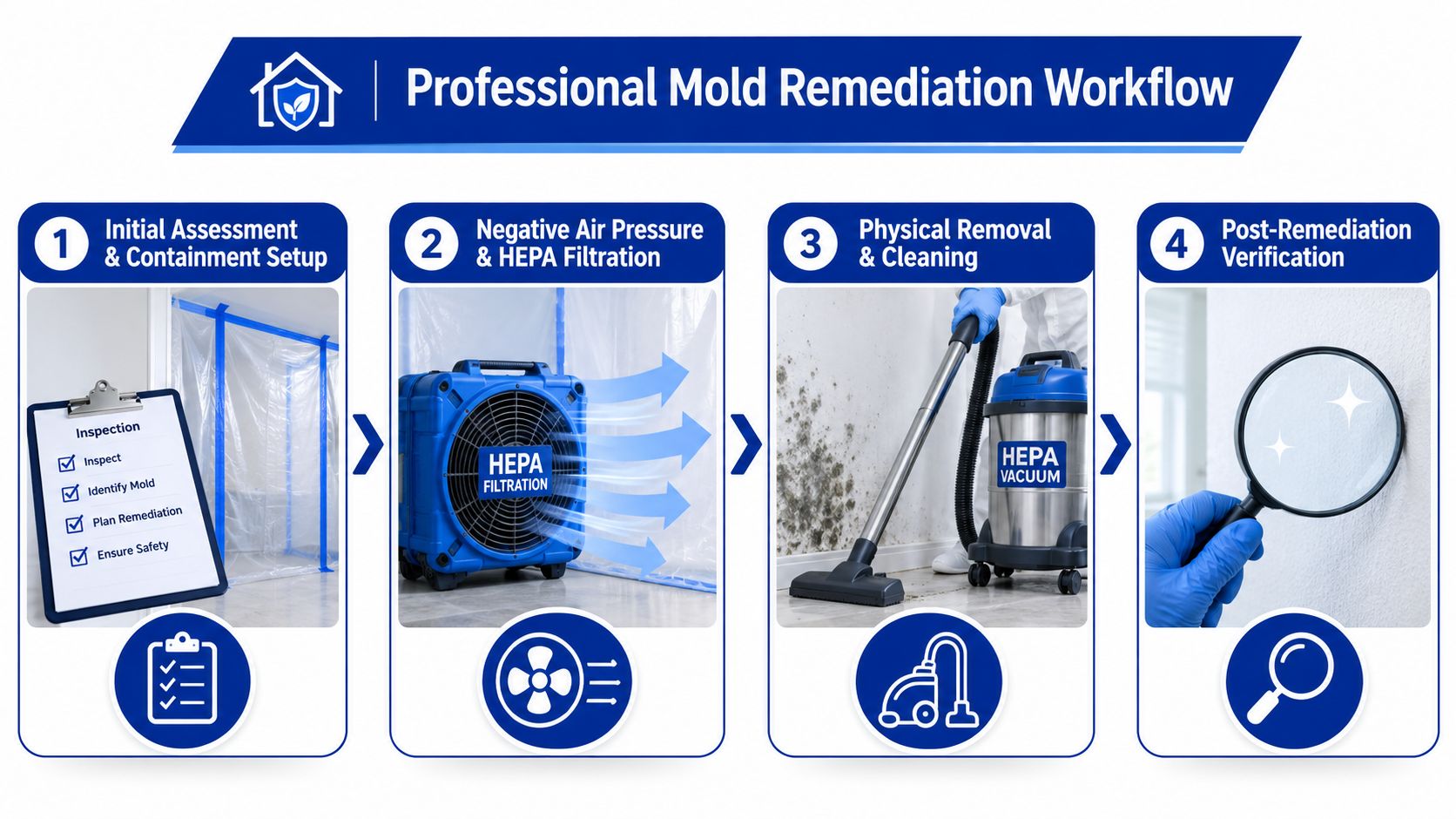
The cleanest way to understand professional black mold removal is to follow a real water-loss job. A pipe leaks slowly behind a kitchen wall in Austin, the drywall stays damp, and the homeowner notices a smell before any growth shows up. A remediation crew does not begin with fragrance sprays or a quick surface scrub. It starts with inspection, moisture mapping, and a judgment call about how far the wet material and contamination likely extend.
What happens first on site
The first visit usually starts with a visual assessment, moisture readings, and a containment plan. If the water source is still active, that gets handled before anything else. Remediation only works after the moisture problem is controlled, and drying has to continue until readings are verified with a calibrated moisture meter, according to professional remediation guidance.
Then the crew sets the boundary. They use critical or full containment with plastic sheeting, then place negative-air machines with HEPA filtration so pressure stays directed inward. Guidance on containment commonly describes negative pressure in the range of 0.02–0.05 inches of water column to help keep spores from moving into occupied areas, as noted in industry containment guidance.
Why drywall, carpet, and insulation often come out
Porous materials usually cannot be trusted once mold has taken hold. Drywall, insulation, carpet pad, and some trim materials absorb moisture and support deeper growth than a homeowner can see. That is why a qualified crew removes and bags those materials inside the containment zone instead of trying to clean and keep them.
After that, the structure gets dried with dehumidifiers and air movement, then cleaned with HEPA filtration and cleared for the next phase. A good contractor also talks about prevention, not just removal, because the finish line is making sure the same wet condition does not return.
What you should hear from the contractor
You want to hear terms like moisture source, containment, selective demolition, drying verification, and reconstruction handoff. If the conversation stays on odor elimination and stain removal, the plan is too shallow. The work is about restoring a dry building, not just making it look cleaner.
Costs, Timelines, and Insurance Realities
The money question is usually the first one homeowners ask, and it should be. Professional black mold removal is not a quick wipe-and-go expense. The cost depends on how far the moisture traveled, how much material has to come out, and whether the job stops at remediation or includes drying and rebuild. In general, Angi's cost breakdown shows that small jobs stay in the lower range, while larger or more invasive work climbs fast once containment, demolition, and reconstruction are part of the scope.
What pushes the cost up
The biggest drivers are usually straightforward. More square footage means more labor, more containment, and more drying time. Hidden growth behind walls, in crawlspaces, or inside HVAC systems takes longer to inspect and remove because the crew has to open materials, verify the spread, and clean the affected areas fully.
Reconstruction changes the bill in a hurry. If the contractor is only removing damaged material, that is one scope. If the crew is also replacing drywall, trim, insulation, cabinets, or flooring, the price moves because the job now includes putting the space back together. Access matters too. Tight attics, finished walls, or confined utility spaces take more labor and more protection work than an open room with clear entry.
Timeline follows the same pattern. A small contained area may take a few days. A larger loss with demolition, drying, and rebuild can take much longer, especially when the contractor has to open surfaces to confirm the moisture source is gone and the structure is dry enough for the next phase.
Budget rule: if the contractor can't explain how the moisture source, demolition, drying, and rebuild are separated on the estimate, ask for a line-by-line scope before you sign.
Insurance and documentation in real life
In Texas, the practical issue is often the gap between a covered water event and the mold that follows. A claim usually goes more smoothly when the homeowner keeps photos, moisture logs, contractor reports, and clear communication records from the first day. Those records show when the leak started, what was dried, what had to come out, and whether the structure was left stable enough for repairs.
Insurance adjusters and remediation crews do not look for the same things. The adjuster wants a defensible loss file. The remediation contractor is documenting source control, containment, drying, and cleanup. Homeowners who keep both sides organized usually avoid the worst delays, because there is less confusion about what happened first and what was done to limit further damage.
| Typical Black Mold Removal Cost Ranges | Scope | Typical Cost | Typical Timeline |
|---|---|---|---|
| Small contained area | Localized remediation with drying and basic containment | Lower-end pricing for a limited job, consistent with Angi's cost breakdown | A few days |
| Moderate hidden growth | Wall or cabinet removal, containment, drying, and cleanup | Mid-range pricing, depending on access and materials | Several days to over a week |
| Extensive whole-house contamination | Large-scale demolition, drying, and reconstruction | Can reach $10,000–$30,000 when the job is extensive, per Angi's cost breakdown | Often multi-week |
Local Considerations for Georgetown and Austin Homes
Central Texas creates a very specific mold problem. Heavy rain can overwhelm drainage, humidity hangs around long enough to slow drying, and older homes often hide plumbing issues in places a homeowner doesn't check every day. Slab-on-grade construction, pier-and-beam foundations, and attic HVAC routing all change where water collects and how fast growth starts.

What local homeowners should ask first
The first call should be about source, access, and documentation. Ask whether the company checks moisture levels, sets containment, removes damaged porous materials, and provides a written scope. If you're comparing bids, make sure each contractor is pricing the same problem, because one estimate may include drying and rebuild while another only covers removal.
A reputable local firm should also tell you what they found, where the moisture traveled, and what still needs to be verified before reconstruction begins. That's especially important in older Georgetown and Austin homes where leaks can travel through framing, under cabinets, or above ceilings before they become visible.
What to bring to an estimate appointment
- Photos of the first sign of damage so the contractor can see how the problem evolved.
- Dates of any storm, leak, or plumbing event to help narrow the source.
- Insurance claim information if you've already started one.
- Questions about drying and rebuild so you know exactly what's included.
- A request for documentation showing moisture readings, containment, and the final scope.
If you're comparing local options, RestoTek TX offers inspection, drying, microbial prevention, and reconstruction under one provider, which can simplify the handoff between mitigation and rebuild.
After the Crew Leaves and How to Keep It From Coming Back
A good job ends with proof, not reassurance. You want visual confirmation, moisture readings that show the area is dry, and, when appropriate, independent clearance testing so there's a record that the space was returned to a safe condition. If the contractor cannot explain what was checked after cleanup, the job is not really finished.
The habits that prevent a repeat loss
The original moisture source has to stay fixed. That means repaired plumbing, improved drainage, maintained HVAC, or whatever caused the wet condition in the first place. Keep an eye on humidity, replace HVAC filters on schedule, and do not ignore a smell that returns after a rain event or a plumbing repair.
The paperwork from the first job matters later too. If the same room ever shows a new stain or odor, you will have a record of what was removed, what was dried, and where the last issue started. That makes the next diagnosis faster and cleaner for everyone involved.
The true win is a dry building with a paper trail, not just a room that looks clean today.
If mold keeps coming back, that usually means the building still has a moisture problem or the original source was not fully corrected. A specialist should re-evaluate the area and find what is still feeding the growth instead of repeating the same cleanup.