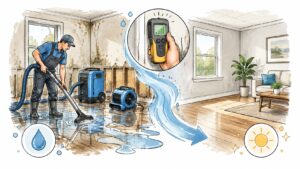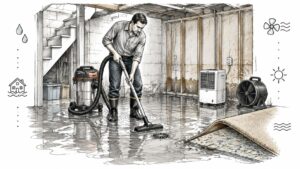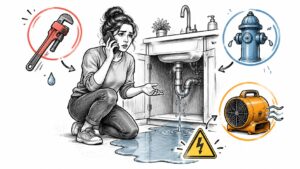
The familiar advice to remove the water, run fans, and start repairs skips the decision that matters most: who verifies that the building is dry enough to rebuild? A floor can look normal while the subfloor beneath it remains wet. Starting repairs at that point can conceal the problem rather than resolve it.
The practical difference between water mitigation vs water restoration isn't just cleanup versus construction. It's the handoff from controlling moisture to repairing permanent damage, and that handoff should happen on documented readings, not appearances.
Mitigation vs Restoration at a Glance
Mitigation is the emergency phase that stops water from causing more damage; restoration returns the property to use after it's sufficiently dry and safe.
Mitigation and restoration compared
| Aspect | Mitigation | Restoration |
|---|---|---|
| Main goal | Stop damage from getting worse | Return the building to safe, usable condition |
| Timing | Starts immediately, with prompt structural drying | Starts after drying and source repair are verified |
| Typical work | Extraction, drying equipment, moisture mapping | Replacing drywall, flooring, and cabinetry; cleaning and odor control |
| Finished when | Materials meet documented drying goals and the source is controlled | Repairs are complete and post-work checks pass |
| Usually led by | Emergency water mitigation crew | Rebuild or restoration team, often with contractors |
The ANSI/IICRC S500 standard formalizes professional procedures for water-damaged residential, commercial, and institutional buildings, including structures, systems, and personal property. That scope helps explain why professional water-damage work involves more than vacuuming floors or replacing stained drywall.
During mitigation, technicians determine where water traveled, extract accessible water, and establish a drying plan. They may remove materials that prevent drying or cannot be saved. Removal during mitigation isn't the same as reconstruction, although it directly affects what the rebuild team must replace.
The sequence matters more than the service label
Planning can overlap. A reconstruction estimator can inspect damaged cabinets while drying equipment runs, and an owner can choose replacement flooring before the drying report is finished. What shouldn't happen is closing a wet assembly because the replacement materials have arrived.
Consider a sink overflow that wets a vanity, the adjoining wall, and the bathroom floor. The emergency crew may control the moisture successfully, but swollen particleboard can still need replacement. Drying prevents further loss; it doesn't reverse every physical change.
Confusion becomes expensive when owners approve a broad rebuild before anyone has established what's salvageable. It also creates billing disputes when emergency extraction, drying, demolition, and finish work appear as an undifferentiated charge.
Practical rule: Authorize the work needed to stabilize the property without treating that authorization as automatic approval of every reconstruction item.
To identify your property's current phase, check the actual conditions. An active source or wet materials calls for mitigation. Verified dryness with damaged finishes remaining calls for restoration. Repairs already underway don't prove that the handoff was justified.
Timing and the Mitigation Steps That Cannot Wait
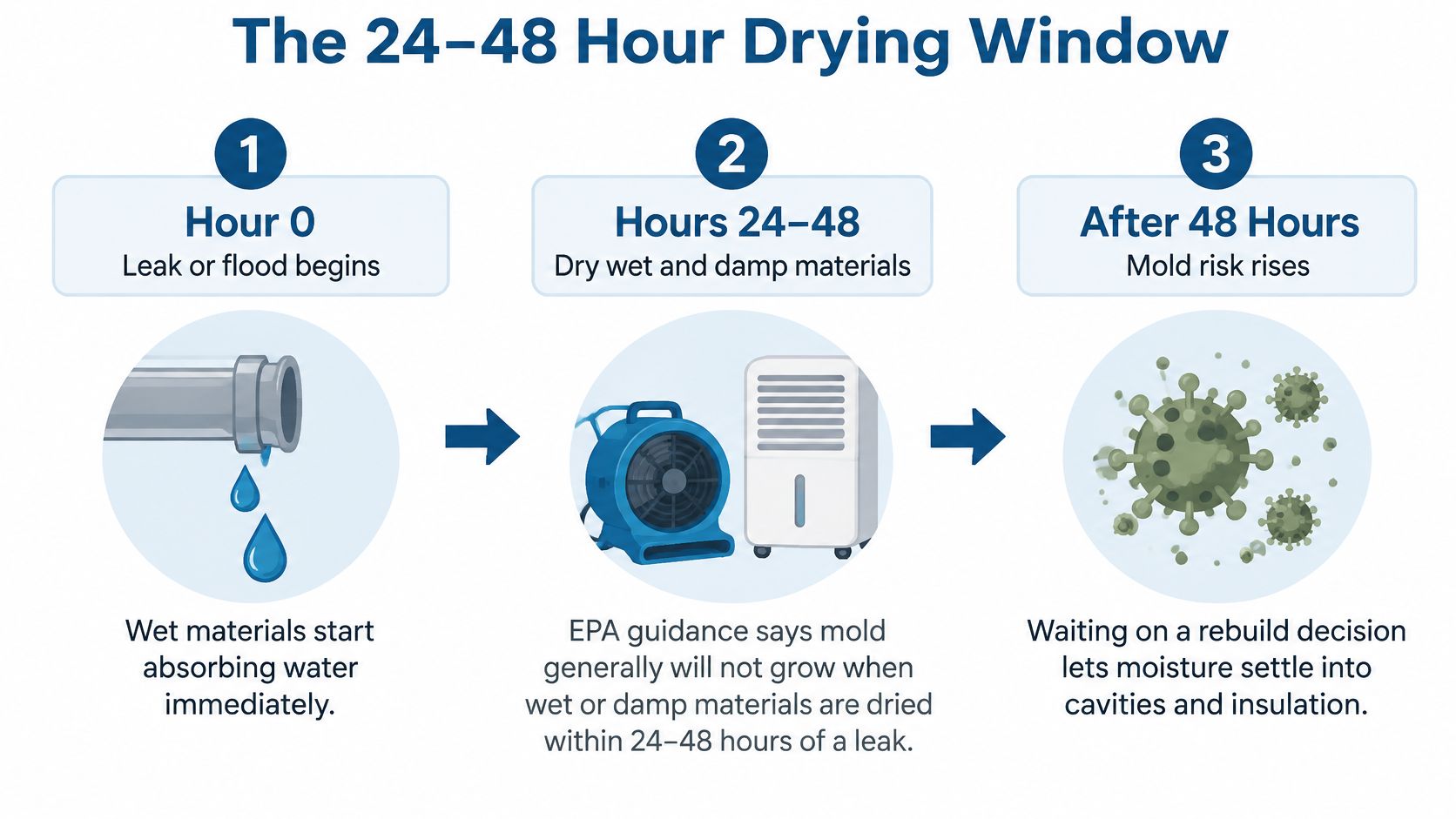
The drying clock starts when materials get wet, not when the contractor arrives. The EPA's guide to mold and moisture states that, in most cases, mold won't grow when wet or damp materials are dried within 24–48 hours of a leak or spill; materials remaining wet beyond that window need evaluation under remediation guidance.
That's a response target, not a promise that every assembly will dry on schedule or that mold is impossible. The EPA also emphasizes fixing the underlying water problem and cleaning or removing existing mold. Drying equipment cannot compensate for a continuing leak.
Control the source and remove accessible water
Stop the source safely. Close the fixture supply valve or main water valve when accessible. If water has reached outlets, appliances, or electrical equipment, stay out of the affected area and have power isolated safely. Don't enter standing water to reach a breaker panel.
Extract beyond the visible puddle. Carpet can feel relatively dry while its pad holds water against the subfloor. Technicians should assess the pad, floor edges, and adjacent rooms rather than stopping at the obvious wet spot. A household vacuum isn't appropriate for water extraction.
Separate affected and unaffected areas. Move dry contents away from the work zone and establish controlled access. Suspected sewage or microbial contamination requires a different approach from a clean supply-line leak. Don't aim household fans across visible mold or contaminated materials.
At RestoTek TX, we coordinate plumbing repairs with licensed plumbers, ensure the water source is resolved, and begin drying and restoration immediately after repairs. Emergency preparation still matters while help is being arranged; our emergency response tips support that initial decision-making.
Build a drying plan, not a collection of fans
Pair air movement with dehumidification. Air movers help moisture evaporate from wet surfaces; dehumidifiers remove moisture from the air. Blowing air around a closed, humid room doesn't establish effective drying. Wall cavities may need controlled access when finishes or insulation block evaporation.
Map and track moisture. Mark affected locations on a sketch, then record readings at consistent points. Include the subfloor, wall bottoms, cabinet bases, and adjoining assemblies where water could have migrated. Record the date, material, location, and instrument used so the next technician can interpret the trend.
Monitor room humidity. The EPA's moisture-control guidance recommends indoor relative humidity below 60%, ideally 30–50%. Room humidity helps evaluate drying conditions, but it doesn't establish that a wall or floor assembly is dry.
Keep equipment decisions tied to measurements. A loud room and a dry-looking surface aren't reasons to unplug the dehumidifier. If readings stop improving, the crew should investigate restricted airflow, trapped moisture, equipment capacity, or another source rather than continuing the same setup without explanation.
Keep photographs of each affected area, dated readings, and equipment operating records together. Those records help distinguish an assembly that's progressing from one that needs a different drying method or selective removal.
Don't use a small visible stain to estimate the whole loss. Water can travel under flooring or behind baseboards before appearing elsewhere. When drying isn't progressing, request a written moisture status and a contamination evaluation before committing to repairs that will conceal those locations.
Proving Mitigation Is Complete Before Rebuilding
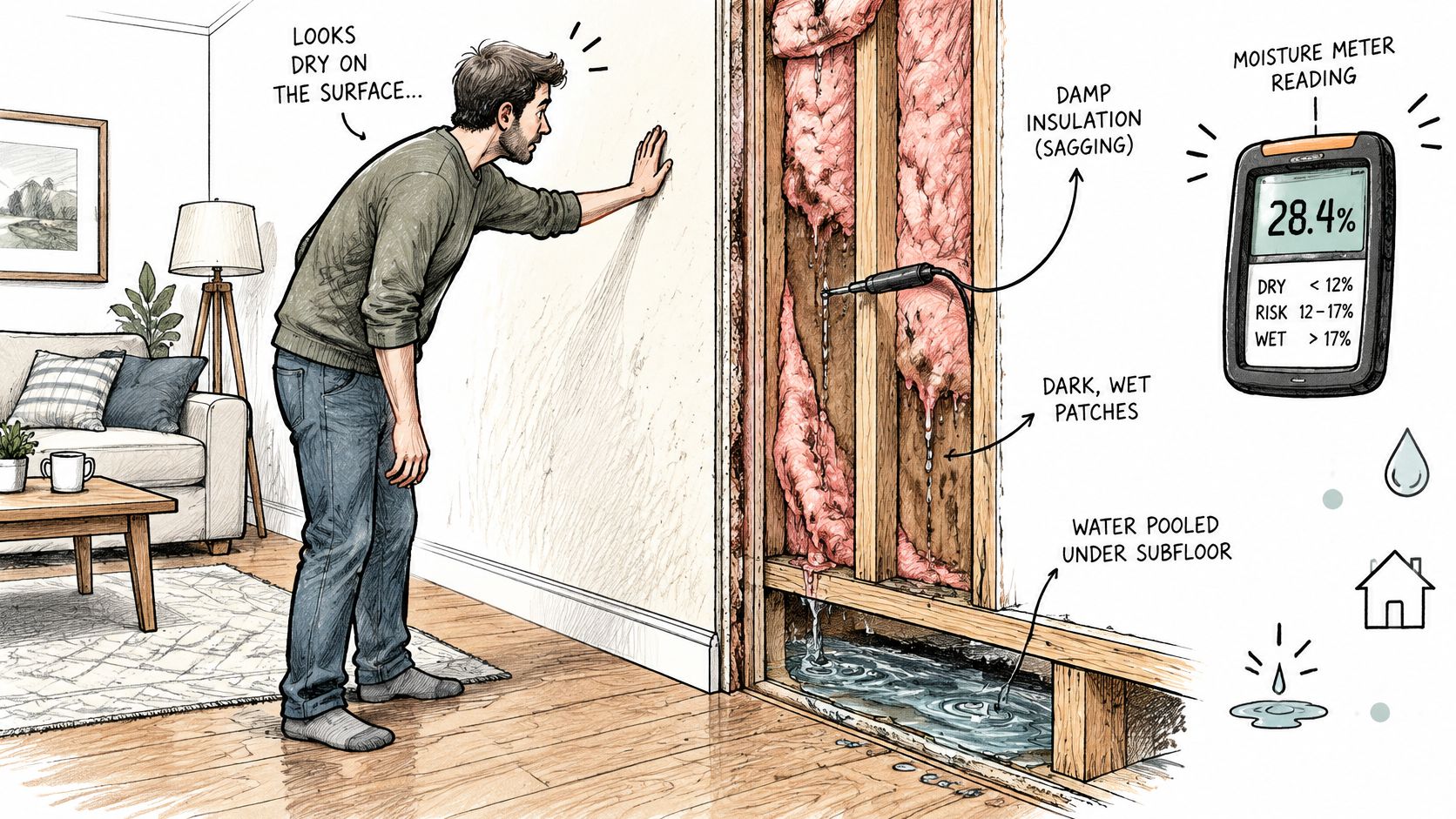
A dry-looking floor doesn't mean mitigation is finished. Touch tells you about the surface, not necessarily the underside of a plank, the insulation inside a wall, or the framing behind a cabinet.
The CDC's guidance for reopening water-damaged healthcare facilities calls for reassessing structural materials with moisture-detection devices and removing materials that cannot be thoroughly dried within 48–72 hours or brought below 20% moisture content. That healthcare guidance underscores the importance of instrumented reassessment; it shouldn't be treated as a universal meter setting for every residential material.
What a defensible completion record contains
A useful drying report connects the initial inspection to the final condition. It should identify:
- Comparable dry readings. Unaffected materials of the same type provide a meaningful reference. A wood reading shouldn't be interpreted using a drywall comparison.
- Consistent measurement locations. Daily readings should follow the same marked points, not a different convenient spot on each visit.
- Concealed-area checks. Record findings behind removed baseboards, inside accessible cavities, and beneath affected flooring where appropriate.
- Equipment removal criteria. State the drying goals and why the final measurements satisfy them.
- Remaining exceptions. Identify any assembly that couldn't be accessed, any material awaiting removal, and any unresolved odor or contamination concern.
A moisture-mapping assessment makes those locations and boundaries easier to understand. An infrared camera can help locate temperature differences worth investigating, but technicians should confirm suspected moisture with an appropriate meter.
Faster extraction is valuable. Faster sign-off isn't valuable unless the measurements support it.
In Central Texas, humid conditions after heavy rain make outdoor air an unreliable drying strategy. Opening windows may introduce moisture rather than remove it, so the crew needs to evaluate conditions before changing ventilation.
Rising readings, persistent musty odors, recurring floor cupping, or damp drywall behind fresh paint call for further investigation. Mold testing after water damage can help document conditions for insurance purposes, but it doesn't replace the drying record. Request the final drying report before approving the rebuild scope, especially where new finishes will hide the affected assembly.
Restoration Work Once the Structure Is Dry
Restoration addresses what drying couldn't save: damaged finishes, contaminated porous materials, lingering odors, and lost building function. The salvage decision should reflect the material's condition and exposure, not whether replacement would be easier.
Salvage or replace by material
| Material | Usually salvaged when | Usually replaced when |
|---|---|---|
| Drywall | Clean-source exposure, thoroughly dried, firm, and intact | Swollen, soft, crumbling, contaminated, or unable to dry thoroughly |
| Hardwood flooring | Minor cupping reverses as moisture returns to the drying goal | Cupping or buckling persists after drying |
| Carpet and pad | Clean-water exposure and both layers can be thoroughly dried and cleaned | Pad remains wet, contamination prevents safe reuse, or deterioration develops |
| Insulation | Its type and condition permit verified drying without loss of function | It holds moisture, becomes contaminated, or cannot be thoroughly dried |
| Cabinetry and trim | Solid wood dries without lasting swelling or joint failure | Particleboard or joints swell and stay swollen |
| Paper and upholstered contents | Controlled drying preserves condition and cleaning is feasible | Porous contents remain damp, deteriorate, or retain objectionable odor |
Salvage is a condition-based decision
Porosity, contamination, visible growth, and physical integrity all matter. A clean supply-line leak doesn't justify the same decisions as a sewer backup. Conversely, a clean source doesn't make a permanently swollen cabinet usable again.
The EPA's commercial-building mold remediation guidance emphasizes correcting the moisture problem and checking that visible mold, mold-damaged materials, and moldy odors are no longer present after remediation. It also notes that no federal airborne mold-concentration standards exist, so a sampling result isn't a universal pass-or-fail certificate for reconstruction.
We treat mold testing and mold remediation as separate services. Testing identifies whether mold is present and at what levels; it doesn't remove mold. Remediation removes mold and addresses the underlying moisture issues.
That distinction prevents a common misunderstanding: ordering a test doesn't resolve the condition that prompted it. Persistent odor or discoloration needs an investigation and an appropriate work scope, not just a laboratory report.
Rebuild in an order that protects completed work
Confirm the moisture-source repair before closing the assembly. Replace necessary insulation and drywall, complete suitable wall preparation, install flooring in the sequence its manufacturer requires, and coordinate cabinetry, trim, and final painting.
The exact order changes with the assembly. Cabinets may need installation before certain flooring systems, and finish coats may follow trim installation. Our reconstruction and rebuild services address the damaged structures, finishes, and fixtures remaining after stabilization.
Before disposal, photograph damaged materials and preserve representative evidence when safe. Don't keep contaminated debris inside occupied rooms merely to retain proof; arrange a safe documentation method with the claim representative.
Who Leads Each Phase in Common Situations
The emergency crew should lead moisture-control decisions; the rebuild team should lead reconstruction decisions. A single provider can coordinate both, but the person authorizing new finishes still needs a documented basis for accepting the structure.
Who leads each phase by situation
| Situation | Mitigation lead | Restoration lead | Watch for |
|---|---|---|---|
| Burst pipe in an occupied home | Plumber controls the source; drying crew handles moisture | Same provider or a separate rebuild team after verification | Documented source repair and drying handoff |
| Line backup in a rental | Mitigation crew handling extraction and contamination control | Restoration team with landlord authorization | Dated tenant access and notice records |
| Storm flooding in Georgetown or Austin | Emergency mitigation crew | Rebuild team coordinating scope with the applicable claim | Flood versus internal water coverage distinctions |
| Commercial space closed for repairs | Emergency mitigation crew mobilized promptly | Restoration team phasing work by area where feasible | Downtime and business-interruption records |
| Home sale after a leak | Mitigation crew documenting completion | Rebuild team, with mold evaluation when indicated | Drying report and repair records retained for disclosure review |
Rental and commercial handoffs need an owner
In a tenant-occupied rental, the contractor may need access to a bedroom while the owner is off-site. Assign someone to coordinate entry, explain equipment restrictions, and retain dated communications. Tenant reports about odors or renewed dampness should enter the project file rather than remain in an informal text thread.
For a small business, reopening one area while another remains under repair can reduce disruption, but only when separation is practical and safe. The drying crew, rebuild supervisor, and operator should agree on access routes, dust control, equipment placement, and which areas remain unavailable.
Handoff check: Name the person who signs the drying report and the person who approves the rebuild scope. Don't assume they're the same person.
Storm-driven flooding requires equally clear coordination. The immediate need to remove water is separate from deciding which policy, if any, pays for the work. Record the apparent entry route and conditions without assuming that every water-related loss falls under the same coverage.
For a home sale, retain the source-repair invoice, drying report, and reconstruction records together. Those documents help the owner and real estate professionals explain what happened and what was completed, rather than relying on fresh paint as evidence.
Confirm One Provider Covers Both Phases Before You Sign
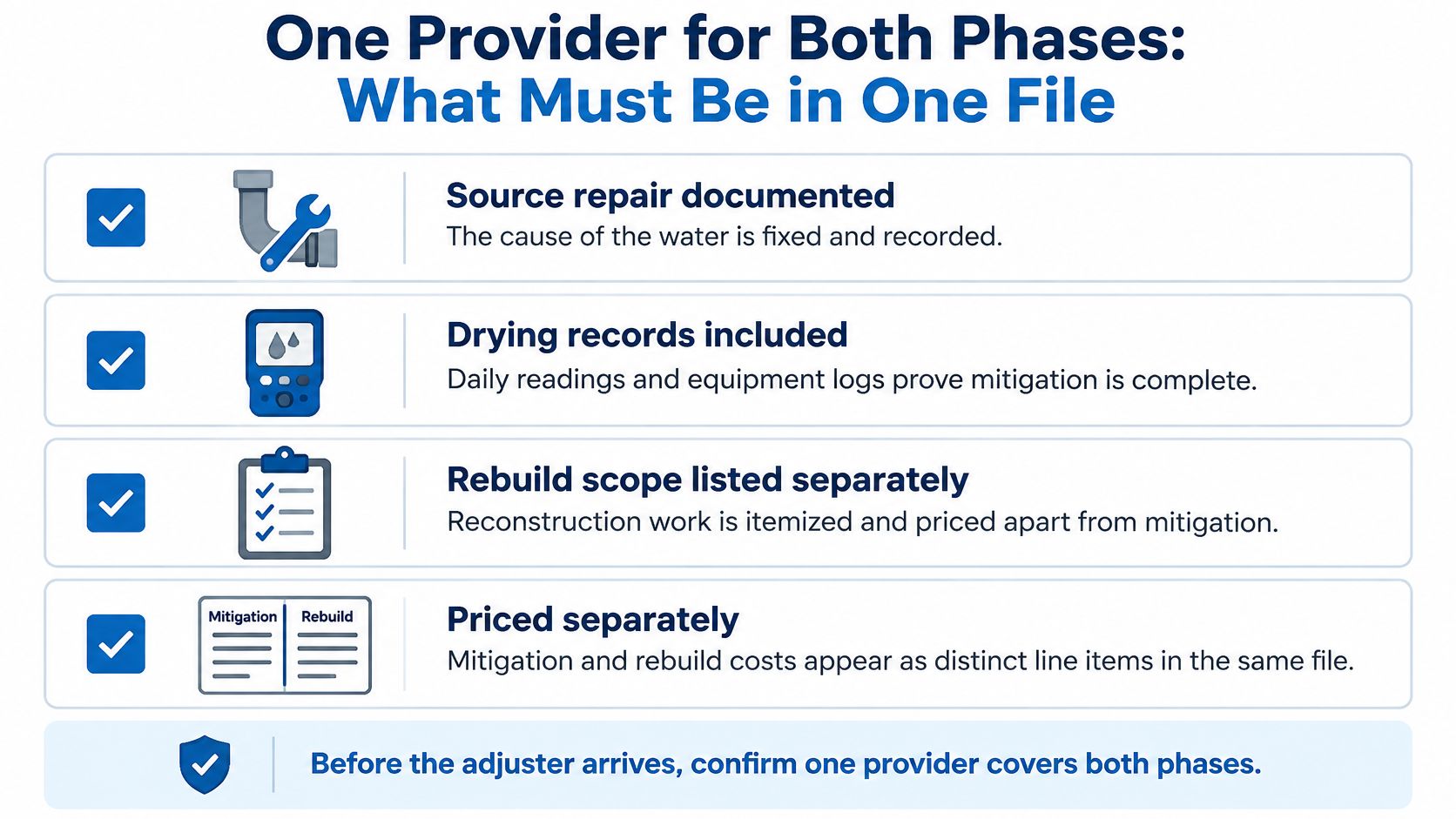
One provider is useful when it keeps source repair, drying records, and reconstruction decisions in a coherent file. It's less useful when a broad contract bundles everything together without showing what you're authorizing or how the charges are separated.
RestoreAdvisor's water-damage insurance guidance explains that policyholders generally need to take reasonable steps to prevent additional damage, while NFIP flood claims have their own proof-of-loss requirements and deadlines. Act promptly while preserving evidence, rather than waiting for an adjuster as active water continues to spread.
Preserve the loss without preserving the hazard
- Shut off accessible water safely. Record what was leaking and who corrected it.
- Resolve electrical hazards before entry. Don't prioritize photographs over personal safety.
- Photograph and video initial conditions. Capture room-wide views, damaged contents, water paths, and close-ups before moving items when safe.
- Retain representative evidence safely. Coordinate disposal of contaminated or hazardous materials rather than storing them indiscriminately.
- Keep receipts and dated records. Include emergency purchases, professional invoices, moisture logs, equipment records, and access communications.
Separate emergency mitigation charges from reconstruction proposals. Neither an emergency response nor a contractor's insurance experience guarantees coverage for gradual leaks, maintenance issues, or flood damage. Get the carrier's position on disputed items without allowing that dispute to leave an active source uncontrolled.
Authorize each phase on its own evidence
The written agreement should identify emergency work, reconstruction work, pricing boundaries, and the contact responsible for coordination. If the full rebuild cannot yet be estimated, the contract should make that uncertainty clear rather than imply the emergency signature settles everything.
We provide a single point of contact for plumbing repairs and restoration, and we have experience working alongside insurance claims. Plumbing work is completed by licensed and insured plumbing professionals. Those capabilities simplify coordination, but the documentation still needs to distinguish source correction, drying, and physical repairs.
Before signing, request the itemized scope and specify that rebuild approval follows the drying report. If musty odors, discoloration, or health concerns remain, include an appropriate mold evaluation rather than accepting cosmetic completion as the final answer.
RestoTek TX offers a free estimate and coordination from plumbing repairs through mitigation, structural drying, and reconstruction. Visit RestoTek TX to discuss your Georgetown or Austin water loss and request a scope that clearly separates emergency drying from the rebuild.