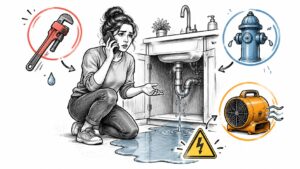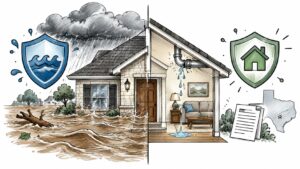
Call a licensed plumber for interior pipe or fixture leaks, the utility for water coming from a public main, and an electrician for water near outlets, panels or wiring, or 911 if there's immediate danger. If building materials are already wet, arrange a restoration assessment once the area is safe.
You might be standing beside a spreading kitchen puddle, listening to water behind a bathroom wall, or watching a ceiling stain grow. The frustrating part is that the person who fixes the leak isn't necessarily the person who dries the damage. Choosing who to call for water leak emergencies starts with the source, the hazard and what's already wet, not the size of the puddle.
Who to Call for Each Type of Leak
| Situation | Call first | Call next | Why |
|---|---|---|---|
| Dripping faucet, toilet or showerhead inside the home | Licensed plumber | No additional trade unless water spreads | The failed component is an interior fixture |
| Water from a street, curb or public main | Austin Water for properties it serves | Plumber if the leak is on the owner's service line beyond the meter | Responsibility follows the affected pipe |
| Water near outlets, a panel, appliances or wiring | Electrician or utility, with emergency services for immediate danger | Plumber for the failed pipe | Electrical safety takes priority over cleanup |
| Water already in walls, floors, ceilings or cabinets | Water-damage restoration provider, once hazards are controlled | Plumber if the source still needs repair | Repairing the pipe won't remove moisture from materials |
| Sewage, backup or floodwater | Restoration provider; emergency services if unsafe | Plumber or utility for the source | Contamination changes how the area must be handled |
| Source unknown | Plumber for suspected indoor plumbing; utility for apparent public-side water | Restoration provider if materials are wet | Investigation and damage control are separate jobs |
Calling a restoration provider first isn't always the safest choice. A crew can assess damage, but it can't make an energized electrical panel safe or repair a public main. Conversely, a plumber can replace a split supply line without addressing water trapped beneath the flooring.
Choose by cause, not appearance
Say water appears beneath a bathroom cabinet. If it's dripping from a supply connection, isolate that fixture and arrange plumbing repair. If the cabinet base and adjoining wall are soaked, add a restoration assessment rather than assuming the plumber's repair completes the job.
Water entering during a storm needs a different investigation. Don't assume every wet ceiling means a failed plumbing pipe, or that every storm-related loss has the same insurance treatment. FEMA's flood-insurance guidance explains that standard homeowners policies generally don't cover flood damage, while separate flood insurance may cover building and contents losses.
Practical rule: Match the first call to the immediate hazard, then assign separate responsibility for source repair and wet materials.
If your situation matches the fixture row, start with isolation and plumbing repair. If water has escaped into the building, arrange mitigation too. If electricity or unsafe floodwater is involved, stay out and have the hazard addressed before anyone begins inspection or cleanup.
First Five Minutes and What to Have Ready
Don't spend the opening minutes trying to prove exactly which pipe failed. Your immediate job is to keep people safe, stop controllable water and give the responding professional useful information.
- Leave the unsafe area. Stay out of standing water near outlets, panels or appliances, and avoid suspected floodwater or sewage. Keep children, pets and other occupants away.
- Isolate electricity only from a safe position. If you can reach the panel without crossing water or touching wet equipment, turn off affected circuits. Otherwise, leave that task to the utility or an electrician.
- Close the nearest safe water valve. Use the fixture stop valve for an isolated supply leak, or the property's main shutoff for a larger plumbing failure. Don't force a seized valve. This guide to finding your water shutoff valve can help you identify the right location.
- Record conditions without taking risks. Photograph the apparent source, the water's spread and affected materials before moving belongings, where safe.
- Make the hazard-appropriate call. Describe what you can observe rather than guessing at a diagnosis.
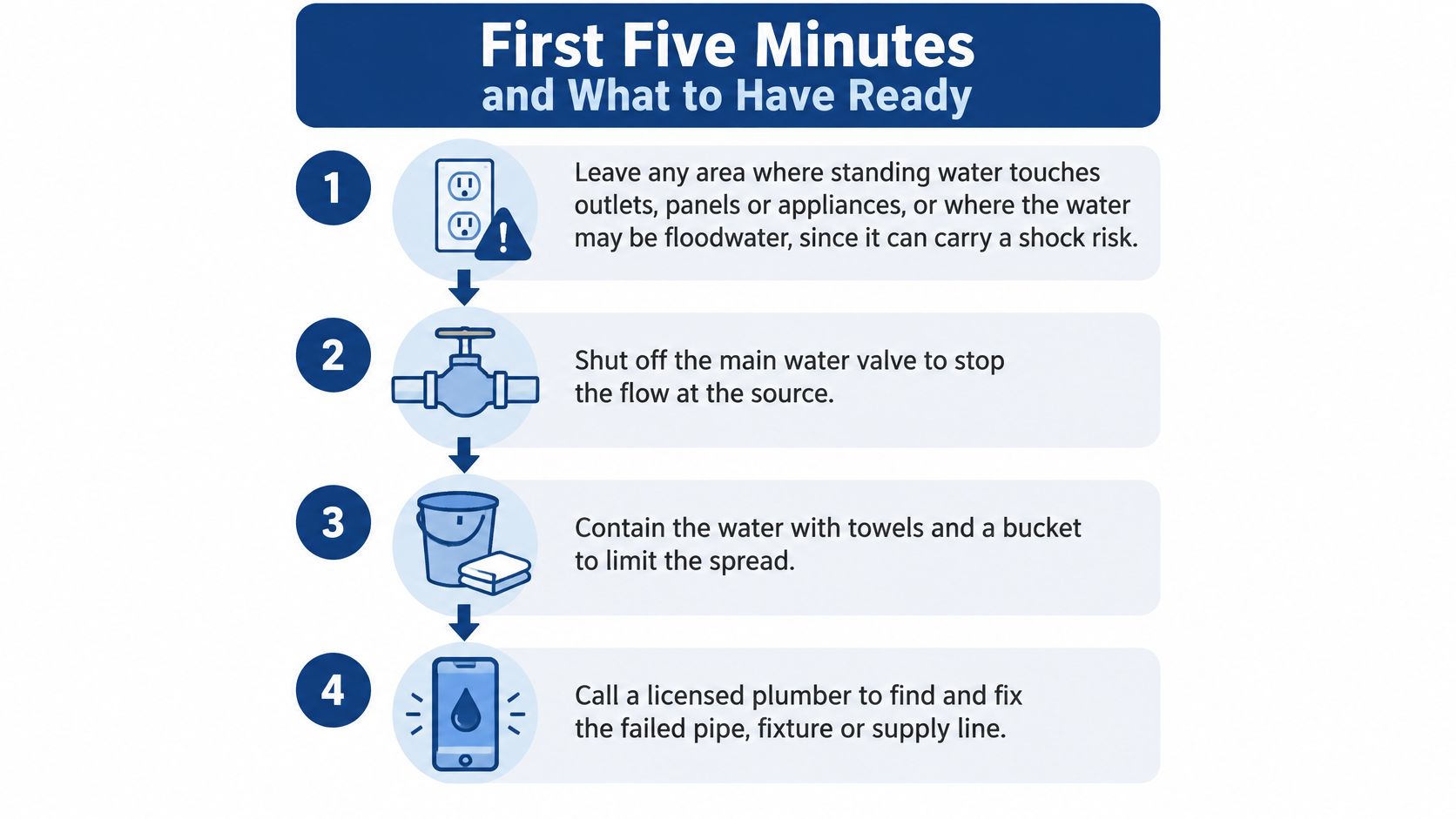
Containment with towels or a bucket is appropriate only for a safely accessible, clean-water leak. It isn't a reason to enter contaminated water or stand beneath a sagging ceiling.
Drying urgency and the call-ready checklist
The U.S. EPA's guide to mold and moisture advises drying water-damaged areas and contents within 24–48 hours, in most cases, to help prevent mold growth. That's a drying benchmark, not permission to leave wet materials untouched until the deadline.
Mopping removes accessible surface water. It doesn't establish whether insulation, subflooring or the underside of a cabinet is dry. Those areas may need extraction, moisture measurement, directed air movement and dehumidification.
Have these details ready:
- Location and access: The property address, affected room and any entry instructions.
- Observed source: Where water first appeared and whether flow changed after a valve was closed.
- Safety conditions: Electrical involvement, suspected sewage or inaccessible areas.
- Damage record: What you've photographed and which surfaces or belongings are wet.
- Claim information: Your insurer and policy number, if available.
For a restoration assessment, RestoTek TX offers a free estimate at 512-818-4728. You don't need a complete diagnosis before calling, but you should clearly state any unresolved hazard.
Utility Pipes Versus Your Interior Plumbing
The property boundary isn't the only boundary that matters. For a water leak, responsibility depends on which pipe failed and where that pipe sits relative to the utility's service arrangement.
Austin Water's water-leak guidance directs residents to report public-main leaks and water or wastewater emergencies 24/7 at 512-972-1000; its guidance also identifies owner responsibility beyond the meter and reports that a leaking toilet can waste about 200 gallons per day. Austin's 3-1-1 system is another route for qualifying issues during its published service hours.
The utility maintains public mains. Owners handle service lines beyond the meter and internal plumbing, including supply pipes, toilets, sinks, appliances and fixtures. That distinction can prevent an unnecessary private-contractor dispatch for a public-side problem.
Use location as a clue, not a final diagnosis
Water bubbling through pavement, flowing from the curb or collecting around a meter box warrants a utility report. A wet meter box doesn't, by itself, establish which connection failed. Let the utility identify whether its infrastructure is involved before authorizing excavation.
A drip beneath a sink or water escaping from an appliance supply connection points toward a plumber. Water appearing through a wall or ceiling also needs investigation, because the visible opening may be well away from the actual source.
Before paying a contractor for outdoor line work, establish:
- Ownership: Who owns the segment that appears to be leaking?
- Failure location: Is the suspected break on the public main or the property's service line?
- Repair responsibility: Will the utility repair it, or must the owner arrange licensed plumbing work?
A puddle's location tells you where water surfaced. It doesn't necessarily tell you where the pipe broke.
Don't dig beside the meter or operate utility equipment to investigate. Report the location, describe the flow and follow the utility's directions.
For Georgetown and other Central Texas properties, confirm the actual water provider rather than assuming Austin Water serves the address. Save that provider's emergency contact information and check its ownership rules before a leak happens. The broad distinction between public infrastructure and private plumbing is useful, but local service boundaries must be confirmed.
When to Call 911 or the Fire Department
Call emergency services when someone faces immediate danger, not just because a pipe needs urgent repair. Water contacting electrical equipment becomes an emergency when people are exposed, someone is trapped, or there are signs of an active electrical fault.
Leave the affected area if you notice sparks, arcing, buzzing or a burning smell near wet equipment. Rising floodwater, an unsafe exit route or a visibly unstable ceiling can also put life safety ahead of any contractor appointment.
What to tell dispatch
Give clear observations rather than an electrical diagnosis:
- Exact location: The address, unit or suite, and where responders can enter safely.
- People at risk: Whether anyone is in the water, injured, trapped or unable to leave.
- Visible hazards: Wet panels, submerged appliances, sparks, smoke or rising water.
- Known power status: Whether power has been disconnected, or whether you don't know.
Don't enter standing water to reach a breaker, unplug an appliance or retrieve a phone. Don't touch a person who may still be in contact with energized equipment. Follow the dispatcher's instructions from a safe position.
Safety boundary: A shutoff you can't reach safely is a job for responders, not a homeowner cleanup task.
Once responders control the immediate danger, the remaining calls follow the failed systems. The utility handles its infrastructure and any necessary utility-side isolation. A licensed electrician evaluates affected wiring or panels, and a plumber addresses a failed pipe or fixture.
The fire department isn't a substitute for routine leak detection or drying. Its role in this situation is the urgent hazard. Before re-entering, confirm who has established that the area is safe, and don't assume that the absence of visible sparks means wet electrical equipment is usable.
How Plumbers and Restoration Crews Work Together
The plumber fixes the water-delivery or drainage failure. The restoration crew addresses the affected building materials. Confusing those jobs creates predictable gaps: a repaired pipe beside a wet wall, or drying equipment running while water still enters the room.
A clean handoff starts with identifying and controlling the source. The plumber repairs the failed pipe, connection, fixture or supply line and checks the repair. The restoration team then establishes the moisture extent and drying approach.
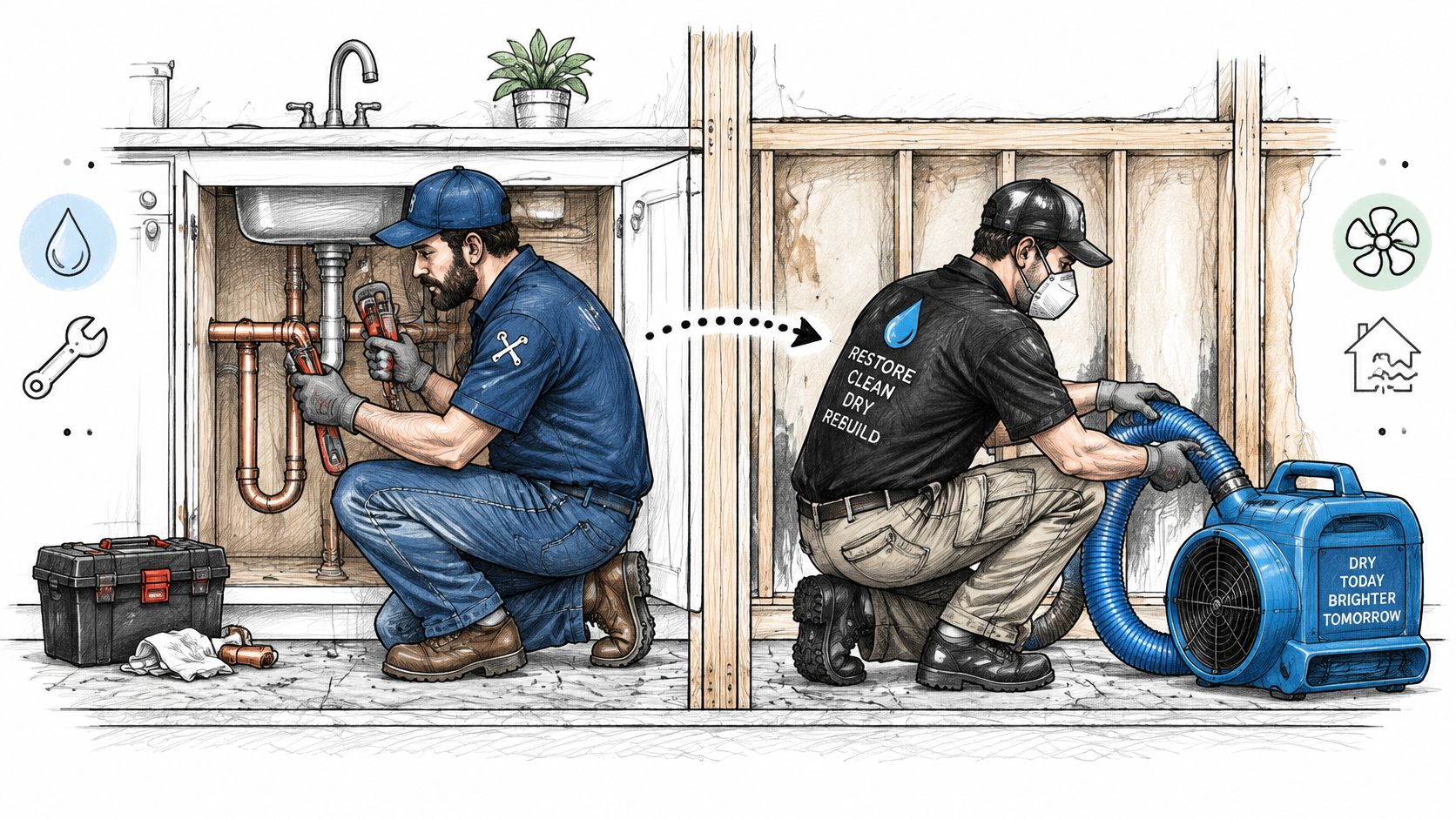
At RestoTek TX, we coordinate plumbing repairs with licensed and insured local plumbers, ensure the source is resolved, and begin drying and restoration immediately after repairs. We provide a single point of contact for the plumbing repair and restoration handoff, so the property owner doesn't have to act as the coordinator.
What a useful handoff includes
The plumber should communicate where water escaped and what was opened or replaced. The restoration technician needs that information, but shouldn't assume the wet area ends at the repair opening. Water can travel beneath finishes and along concealed surfaces.
A water-damage restoration technician uses moisture readings to help define the affected area and track drying progress. Air movers and dehumidifiers serve different purposes: air movement supports evaporation, while dehumidification removes moisture from the air. Equipment placement should follow the material and cavity conditions, not the nearest available outlet.
Keep this checklist on your phone when reviewing the work authorization:
- Source responsibility: Name who confirms that the leak has stopped.
- Repair coordination: Identify the contact responsible for the plumbing-to-restoration handoff.
- Drying plan: Record which materials are affected and what equipment or access is needed.
- Measurement: Confirm how readings will be recorded and compared during drying.
- Documentation: Request photographs, moisture notes and a clear description of authorized work.
Surface appearance alone isn't a completion test. Paint may look normal while material behind it remains damp, and a stain can remain after the material is dry. The decision to close a cavity or replace finishes should follow the condition of the underlying materials, not just whether the room looks tidy.
Insurance Calls and Documentation Before Cleanup
A plumbing loss and a flood loss can follow different coverage paths. Don't assume that water inside the house automatically falls under homeowners insurance, or that rain outside proves the event qualifies as a covered flood.
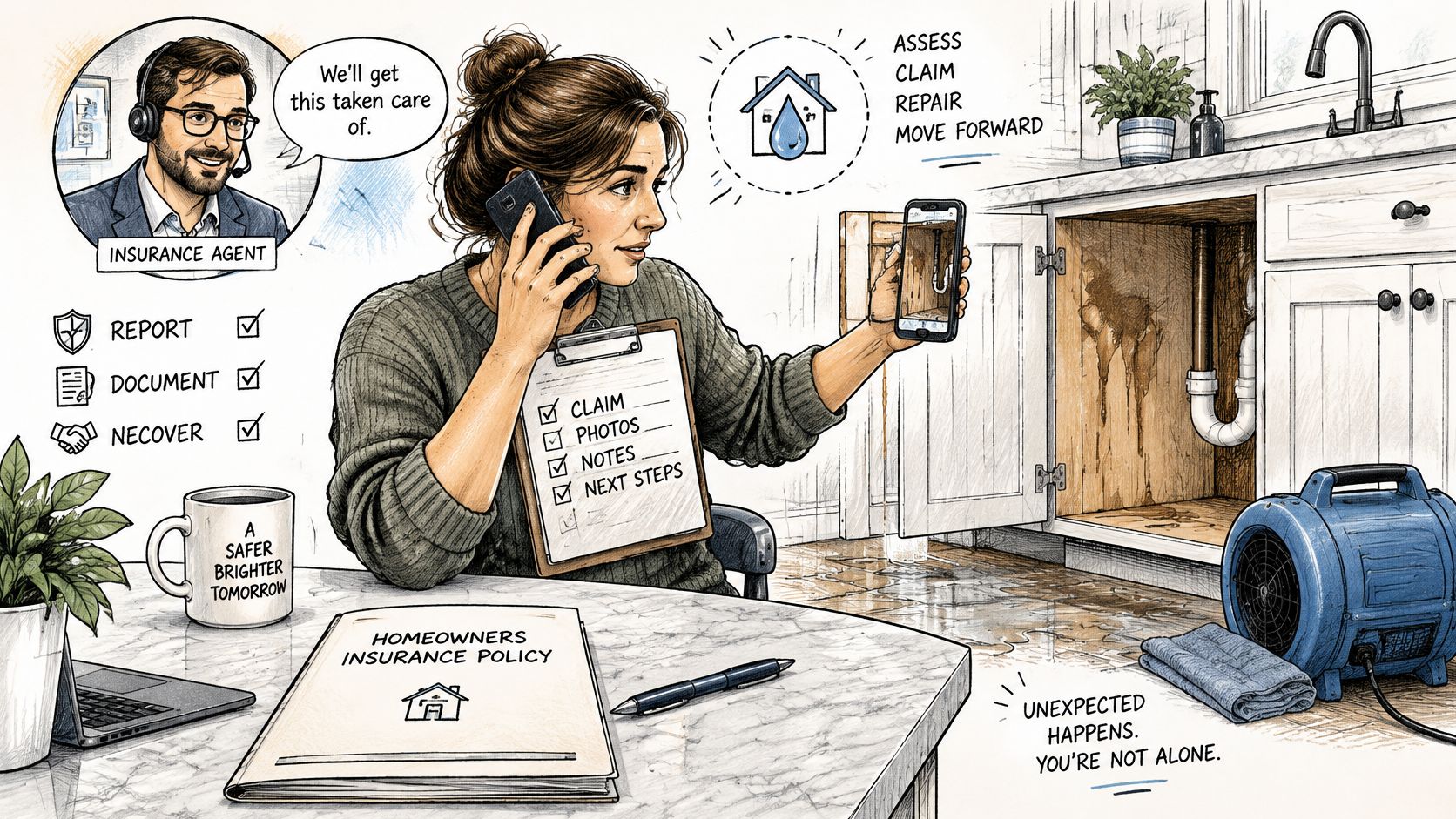
FEMA's flood-insurance fact sheet explains that flood damage is rarely covered by standard homeowners or renters policies and is generally handled through separate flood insurance. For a covered flood loss, contact your agent to begin the claim, document conditions when safe and expect an adjuster inspection.
Describe the observed cause accurately. Say that water entered beneath an exterior door during heavy rain if that's what happened, rather than labeling it a burst pipe or a flood before the cause is established. In Central Texas, storm-driven interior intrusion can resemble plumbing damage while requiring a different coverage assessment.
Separate emergency work from permanent repairs
Notify the insurer promptly, but don't leave an active source running while waiting for a claim appointment. The practical balance is to authorize reasonable emergency work to stop the source, remove standing water and prevent further damage, while documenting why that work was necessary.
Broad demolition deserves a clearer explanation. Ask which materials need removal, what conditions support that decision and how those conditions will be recorded. Opening a wet cavity may be necessary for access or drying; removing unaffected finishes without a documented reason can complicate the claim.
Before materials are disturbed, take wide views showing the room and closer views showing the source and damage. Keep damaged components available for inspection where safe and feasible. Don't store sewage-contaminated material in an occupied room to preserve evidence.
For help organizing the claim record, use this home insurance water-damage claim guide. Coverage decisions still belong to the insurer under the policy, not to the repair or restoration contractor.
Keep the claim file practical:
- Photos and video: Original conditions, apparent source and changes during emergency work.
- Moisture notes: Affected locations, readings and drying progress.
- Invoices and receipts: Plumbing repairs, extraction, equipment and other authorized work.
- Policy information: Policy number, claim number, adjuster contact and written instructions.
Waiting indefinitely can allow further deterioration. Authorizing undocumented reconstruction can create a different problem. Move quickly on necessary mitigation and deliberately on permanent scope.
When a Slow Leak Can Wait for a Plumber
A contained drip can usually take a scheduled plumbing appointment rather than an emergency dispatch. But “slow” doesn't mean harmless, and it says nothing about how long the leak has been running.
The EPA's WaterSense Fix a Leak Week guidance estimates that an average family can waste approximately 180 gallons each week through household leaks. That's a reason to book the repair, even when the water stays inside a sink or toilet bowl.
Judge containment before speed
A faucet dripping directly into a sound basin, with a clear drain and dry cabinet beneath it, is different from a supply connection dripping into particleboard. The first may be schedulable. The second is already affecting a building material.
| What you find | Appropriate response |
|---|---|
| Contained fixture drip with surrounding materials dry | Schedule a plumber promptly |
| Damp drywall, spreading stain or warped flooring | Arrange same-day source investigation and moisture assessment |
| Musty odor with an unexplained water-use change | Investigate a concealed leak |
| Increasing flow or inability to isolate the fixture | Seek urgent plumbing assistance |
For a basic hidden-leak check, stop all intentional water use and inspect the meter's leak indicator or record its reading. Keep faucets, appliances, irrigation and other automatic water users off, then compare the meter again after a quiet interval. Movement suggests water is still flowing somewhere, but doesn't identify the location.
- Check accessible connections: Look beneath sinks and beside appliance supply hoses for droplets, staining or swelling.
- Watch changes: Photograph suspect stains so you can tell whether they're expanding.
- Don't conceal symptoms: Painting a stain or caulking over a wet joint won't resolve the source.
The tipping point isn't the drip rate. Moisture entering a wall, ceiling or floor turns a fixture repair into a building-damage concern, and that warrants a restoration assessment alongside source repair.
RestoTek TX coordinates licensed plumbing repairs and restoration for water-loss events in Georgetown, Austin and surrounding Central Texas communities. If you're unsure whether you need source repair, drying or both, visit RestoTek TX to request help assessing the leak and its damage.