
Water is standing in the hallway, the baseboards are swollen, and someone is ready to cut open the wall so it can dry. Then the contractor asks about asbestos testing. You need the water out now, but you don't want an emergency repair to turn into a contaminated demolition job.
The useful distinction is between removing water without disturbing suspect materials and opening the building to dry or rebuild it. Those activities don't always have to start together. A restoration crew can often extract water and stabilize accessible areas while the owner gets the survey, sampling, and regulatory review needed for destructive work.
When Asbestos Testing Is Required
Start with the building and the proposed cut, not with whether the material looks dangerous. Asbestos testing requirements turn on the building's use, the materials workers will disturb, and the rules governing that work.
When asbestos testing or a survey is required
| Situation | Building | Trigger | Who arranges it | Emergency drying |
|---|---|---|---|---|
| Water removal only, no demolition | Small residential building generally excluded from federal NESHAP | No disturbance of suspect material yet | Owner documents material age, location, and planned work | Yes, extraction and stabilization without disturbance |
| Cut or remove drywall, flooring, ceiling, or cabinets | Small residential building generally excluded from federal NESHAP | Planned disturbance of suspect materials | Owner and contractor arrange qualified evaluation and sampling before invasive work | Extraction yes; selective demolition waits for evaluation |
| Renovation, dismantling, or demolition | Texas public or commercial building | Licensed asbestos survey before the work | Owner, through a licensed consultant or consultant agency | Noninvasive stabilization until the survey |
| Construction that may disturb asbestos | Construction site with workers | OSHA identification, communication, and exposure-control duties | Building or facility owner, coordinated with employers | Only with appropriate exposure controls |
| Demolition with no asbestos identified | Covered Texas demolition | Notification can still be required | Owner or operator | Safe stabilization may proceed; demolition waits for applicable notice requirements |
Match the decision to the actual task
Water removal isn't automatically demolition. Extracting standing water from an accessible finished floor is different from pulling up sheet vinyl, drilling drying holes through wall finishes, or removing a ceiling.
Ask the contractor to describe the proposed work in verbs: extract, lift, drill, cut, scrape, detach. A scope that says only mitigation doesn't tell an inspector which materials need evaluation.
For a home, the practical question is whether the crew can stabilize the loss without disturbing suspect finishes. If it can, that work may proceed under appropriate safety controls. If the next step requires cutting, removing, or breaking material, pause that part of the job until the material has been evaluated.
A Texas public or commercial building needs a different starting point. Arrange the licensed survey before renovation or invasive drying, rather than asking a demolition crew to decide which materials look suspicious.
Job-site rule: Authorize the safe work that can proceed today, and identify the destructive work that remains on hold.
Schools need their own review
Schools shouldn't be treated like ordinary residential service calls. The EPA's school asbestos guidance explains that AHERA requires public school districts and nonprofit private schools to inspect for asbestos-containing building materials, maintain management plans, and use accredited professionals for inspections and response actions.
The school's existing asbestos records belong in the restoration planning process. An accessible ceiling void or ventilation shaft may contain relevant materials even when the wet classroom finishes look ordinary.
Across building types, appearance is a poor release criterion. Intact material can become a problem when someone cuts it, and concealed materials may enter the work scope only after access begins. The owner and contractor need an agreed stop-work point for discoveries, not just a lab appointment.
Federal Quantity and Exposure Limits
Federal asbestos rules address different questions. NESHAP considers quantities of regulated material involved in covered renovation or demolition; OSHA limits worker exposure to airborne fibers.
The federal benchmarks below are summarized in OSHA's construction asbestos training guidance: NESHAP regulated quantities are at least 260 linear feet on pipes, 160 square feet on other facility components, or 35 cubic feet when the material cannot previously be measured, while OSHA limits are 0.1 fiber per cubic centimeter as an 8-hour time-weighted average and 1.0 fiber per cubic centimeter averaged over 30 minutes.
NESHAP quantities and OSHA exposure limits
| Measure | Threshold | What it controls |
|---|---|---|
| Pipe material | 260 linear feet | NESHAP notification and work practices when regulated material removed or disturbed reaches this amount |
| Other facility components | 160 square feet | Same NESHAP quantity test, measured by area |
| Material not measurable by length or area | 35 cubic feet | Same NESHAP quantity test, measured by volume |
| 8-hour worker exposure | 0.1 fiber per cubic centimeter | OSHA permissible exposure limit as a time-weighted average |
| Short-term worker exposure | 1.0 fiber per cubic centimeter over 30 minutes | OSHA excursion limit |
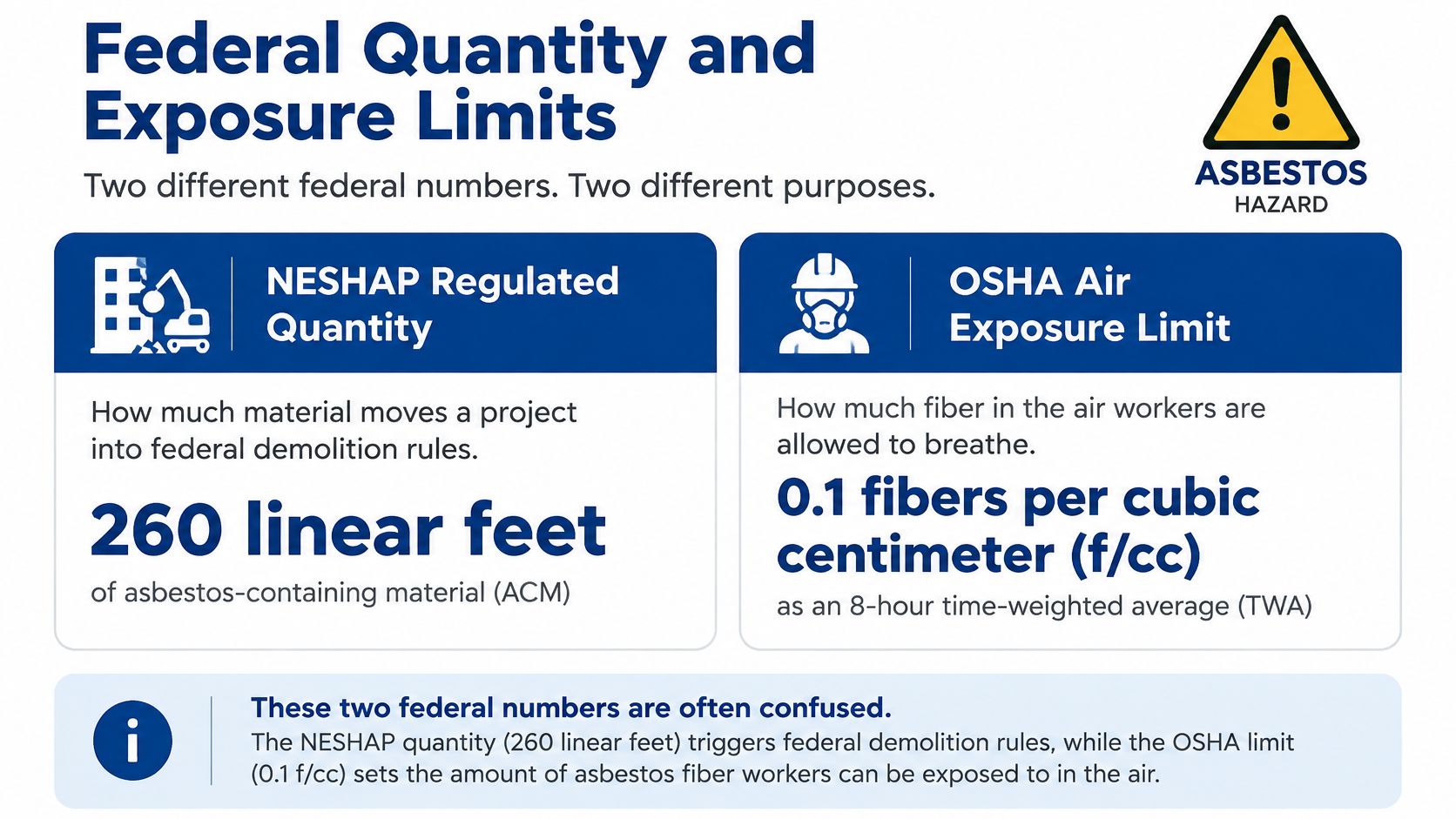
Material quantity isn't airborne exposure
The foot and square-foot figures measure how much material the job will disturb, while the fiber figures measure what gets into the air once it's disturbed. A bulk-material laboratory report doesn't measure the air a worker breathes, and a room measurement doesn't establish whether a floor covering contains asbestos.
For project planning, compare the survey's material quantities with the proposed removal scope. Don't use the wet footprint alone. Pipe insulation, flooring, and ceiling materials require their own identification and quantity assessment.
Falling below the NESHAP quantity triggers doesn't make a project asbestos-free or erase other duties. State rules, building classification, and worker exposure can still require evaluation and controls.
Owners have communication duties too
Before work begins, building or facility owners must identify the presence, location, and quantity of asbestos-containing material or presumed asbestos-containing material and communicate that information to affected employers, employees, tenants, and other relevant parties. Giving the restoration supervisor a report isn't enough if the flooring subcontractor never receives the information relevant to its work.
A workable handoff identifies the material, its location, the authorized work, and the restrictions. Mark those restrictions on the scope or floor plan so a replacement crew doesn't mistake an untouched room for an approved demolition area.
Visible damage doesn't settle either federal question. Evaluate suspect materials before anyone sands, cuts, scrapes, or pulls them.
Texas Survey Gate in Real Water-Damage Jobs
For Texas public and commercial properties, the survey belongs ahead of destructive work. The Texas DSHS asbestos program guidance states that the owner must arrange an asbestos survey through a licensed asbestos consultant or licensed consultant agency before renovation, dismantling, or demolition.
A useful survey does more than list materials an inspector noticed during a walkthrough. It identifies suspect material locations, condition, and friability, with representative bulk sampling where necessary. Friability matters because material that crumbles readily presents different handling concerns from an intact, firmly bound product.
The report should let the restorer distinguish areas suitable for controlled drying from materials requiring licensed abatement. Federal NESHAP also calls for a thorough inspection of the affected facility portion, including friable material and non-friable Category I and Category II materials.
A Georgetown home after a supply-line break
Say a supply line fails in a Georgetown home. Water reaches the hallway, kitchen flooring, and the bottom of a textured wall. The crew can extract accessible standing water, move contents out of harm's way, and assess moisture without immediately cutting the finishes.
The decision changes when someone proposes a drywall flood cut, flooring removal, or ceiling opening. Those tasks disturb building materials, even if the estimate labels them emergency mitigation.
The EPA's asbestos laws and regulations overview explains that federal NESHAP generally excludes residential buildings with four or fewer dwelling units, but that exclusion doesn't remove OSHA worker-protection obligations when construction may disturb asbestos-containing materials.
For the homeowner, the useful preparation is specific:
- Record material history. Note the approximate installation era if known, previous remodels, and areas where finishes differ.
- Identify the proposed disturbance. Mark which wall surfaces, flooring layers, ceilings, or cabinet attachments the crew intends to open.
- Separate accessible drying from removal. Ask what can be extracted or dehumidified without breaking, scraping, or drilling suspect materials.
- Resolve the sampling scope. Have the qualified professional decide what needs evaluation rather than selecting a convenient fragment yourself.
There's a trade-off here. Waiting to evaluate suspect material can delay cavity access, but cutting first can spread contamination and expand the repair. The answer isn't to leave standing water untouched. It's to keep safe stabilization moving while resolving the invasive scope.
An Austin commercial suite after a backup
Now consider an Austin commercial suite where a backup has soaked ceiling tile and pipe insulation. The owner shouldn't authorize ceiling removal because the tiles are wet and easy to lift.
This is commercial work. Arrange the licensed survey and give the consultant the actual restoration scope, including intended access above the ceiling, removal of damaged insulation, and any wall openings needed for drying.
Ask for a report that connects findings to locations crews can recognize. Sample identifiers, marked plans, photographs, laboratory results, and descriptions of homogeneous material areas make the report usable in the field. An unexplained stack of laboratory pages doesn't tell a demolition worker which ceiling bay is restricted.
A negative result applies to the material represented by the sample, not every product or concealed layer in the room.
If the planned opening reveals a different material, stop that disturbance and have the scope reviewed. Don't extend an earlier result to something the inspector didn't evaluate.
How Sampling and Lab Analysis Work
Testing works when the sample, its location, and the planned disturbance stay connected. A bag of debris with an uncertain origin may produce a laboratory answer without producing a defensible work decision.
OSHA's construction asbestos standard references the bulk-sampling approach in 40 CFR 763.86, with testing, evaluation, and sample collection performed by an accredited inspector or certified industrial hygienist. Asbestos work in regulated areas also requires supervision by a competent person.
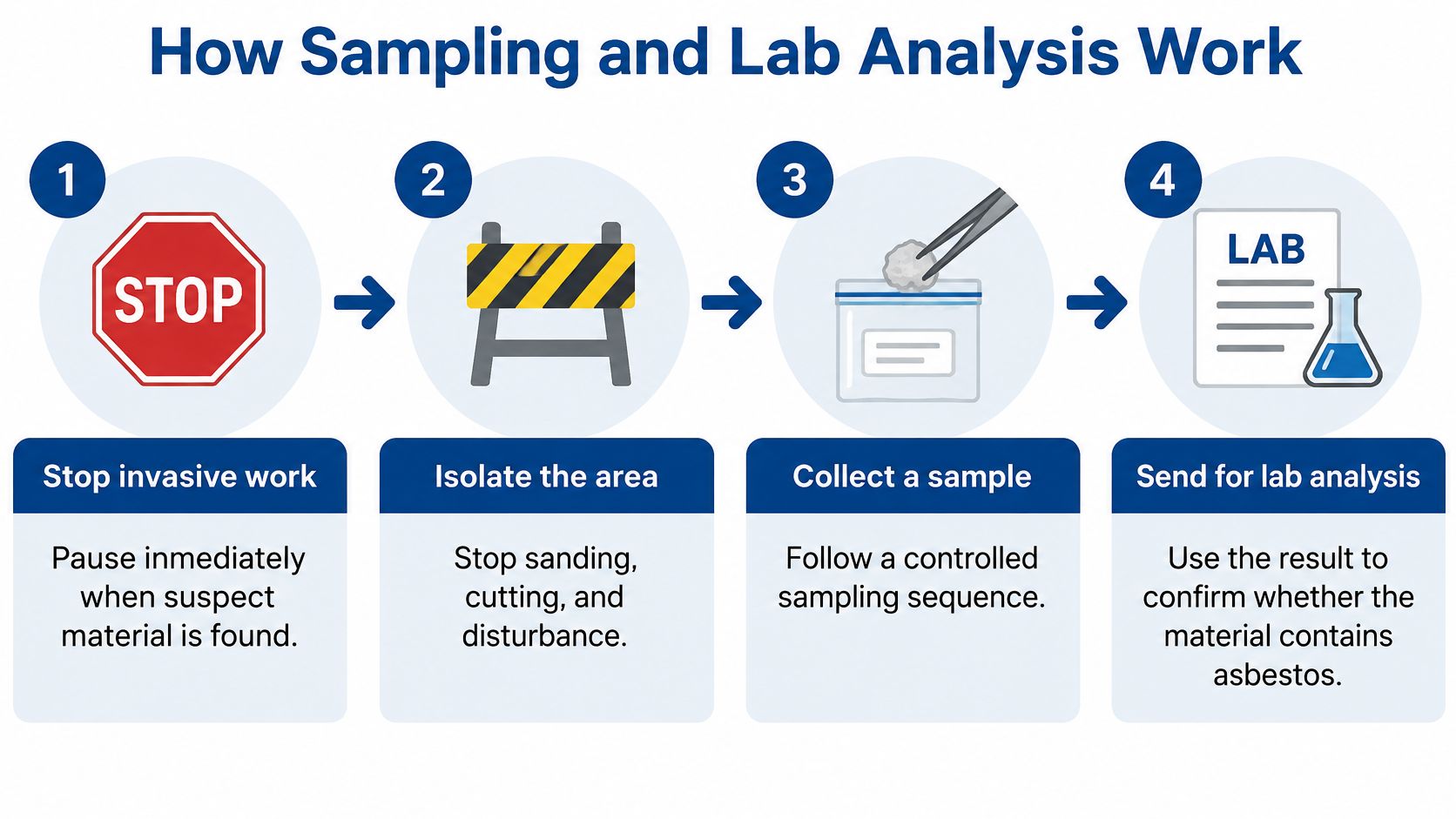
Keep the sampling sequence controlled
Stop the invasive task. Pause cutting, drilling, scraping, and removal when suspect material enters the work scope. Tell the supervisor exactly where the discovery occurred.
Isolate the affected area. Keep occupants and unrelated trades away. Don't sweep debris, use an ordinary shop vacuum, or aim an air mover across suspect dust.
Have the qualified professional define and collect samples. The inspector groups materials into homogeneous areas: materials that appear consistent in composition, use, and installation characteristics. Similar-looking materials installed during different repairs may need separate consideration.
Preserve sample identity through laboratory analysis. Each sample needs a location and material description that match the report. Distinguish ceiling texture from substrate, and flooring from adhesive, rather than describing everything as room debris.
Turn results into a work plan. The consultant evaluates the findings against material condition, friability, proposed disturbance, and applicable quantity requirements. The contractor then uses the specified exposure controls and qualified supervision.
Plan removal and disposal before starting. Where regulated material must be removed, emission-minimizing practices include wet methods, leak-tight packaging, and disposal at an approved landfill. These aren't instructions for an untrained homeowner to perform abatement.
Read the report for coverage, not just a result
Check the laboratory sample identifiers against the survey's location descriptions. A result has limited practical value if nobody can tell whether it represents the hallway wall finish or an unrelated patch in the garage.
Sampling also has to match the depth of the intended work. Removing a cabinet can expose wall coatings, backing, flooring, or adhesive that wasn't accessible during an earlier inspection. Give the inspector that removal plan before sampling so the evaluation addresses the work rather than just the visible surface.
Bulk analysis identifies the sampled material. It doesn't establish worker exposure during removal, prove that an unsampled cavity is clear, or replace any required post-abatement release process.
The final instruction to the crew should be operational: which materials may be disturbed, which remain restricted, who supervises regulated work, and what discovery requires another pause. Testing belongs inside that exposure-control plan, not in a folder separate from the demolition scope.
Notifications After a Clear Test
A clear lab result may let water extraction and other noninvasive work continue, while destructive reconstruction remains on hold. It does not, by itself, clear a demolition schedule or remove every communication duty.
For demolitions covered by federal NESHAP rules, the owner or operator generally must submit notice at least 10 working days before demolition begins, as described on the EPA asbestos laws and regulations page. Emergency or ordered demolitions may be handled differently. Confirm the procedure with the applicable authority before setting the start date.
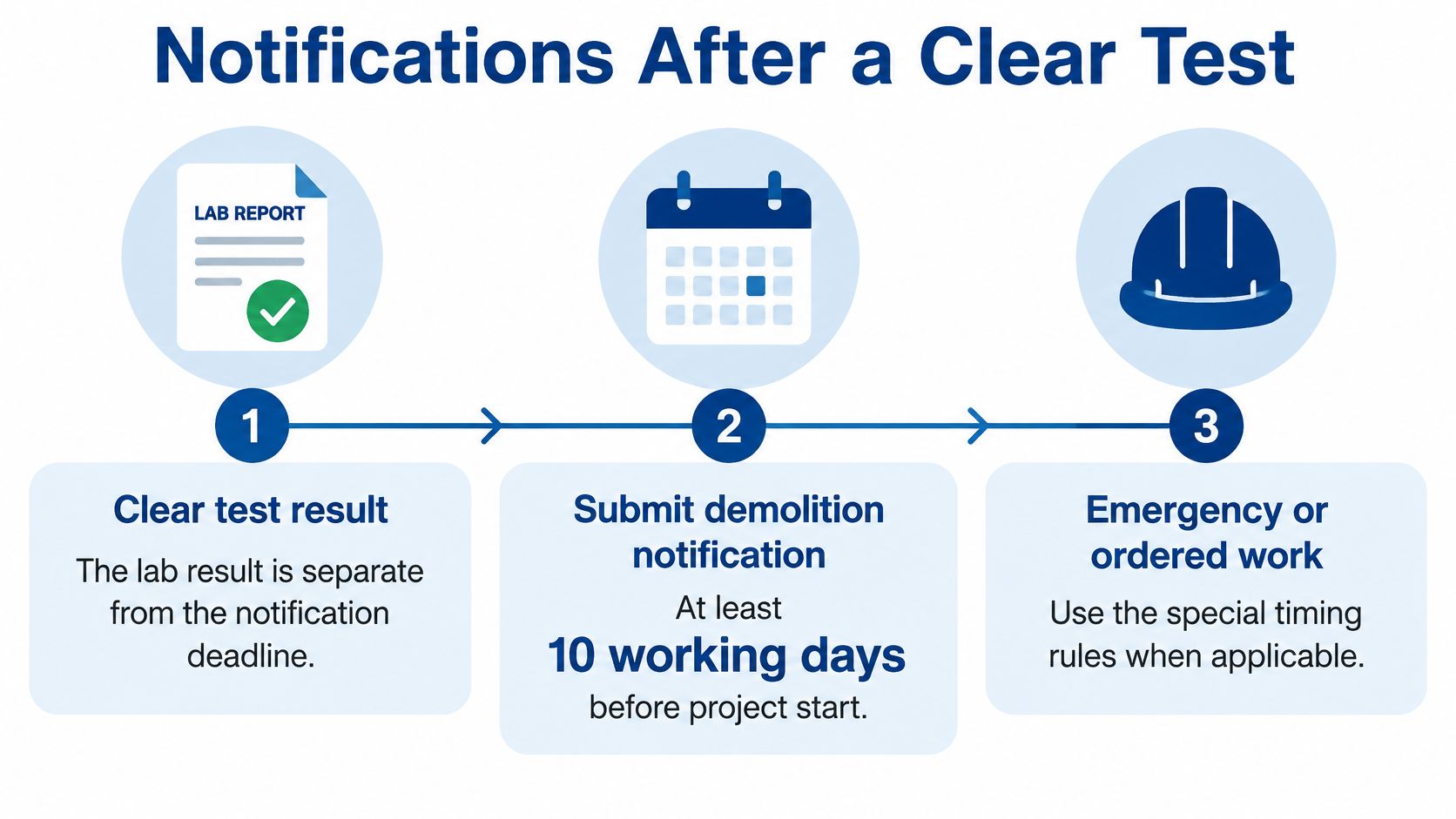
Put the regulatory review on the schedule
Keep the owner, consultant, restorer, and adjuster aligned on the proposed work:
- Define the affected work area. Include demolition access and reconstruction openings, not just visibly wet finishes.
- Commission the compliant survey. Confirm that it covers the materials the planned work will disturb.
- Classify the findings and project. Check whether material types, quantities, or demolition activities trigger additional requirements.
- Submit required notification. Confirm the applicable start date before booking destructive work.
- Coordinate licensed abatement when needed. Keep its scope separate from ordinary debris removal and reconstruction.
- Retain the record. Keep the survey, lab results, notices, correspondence, photographs, and applicable release documentation together.
Federal notification responsibilities apply to covered demolitions and renovations. OSHA communication is a separate duty: relevant information about asbestos-containing or presumed asbestos-containing materials must reach affected employers, employees, and tenants before work.
A negative result applies to the materials evaluated. It does not resolve known or presumed materials elsewhere in the work area. Crews need clear instructions on what the result covers and which areas remain restricted.
Scheduling advice: Set a demolition date after the survey and notification review, not when the extraction truck leaves.
When reviewing asbestos testing results, check what the report supports and what remains unresolved. Noninvasive stabilization can proceed when it will not disturb suspect material, while destructive reconstruction waits for the required review and approvals.
What to Do Before the Next Cut
Before anyone opens a wall, write down the building's use, the known history of its finishes, and the exact materials slated for removal. Give that list to the restoration supervisor and the qualified asbestos professional so they evaluate the same job.
Make the work authorization specific
- For Texas public or commercial property, arrange the licensed survey before renovation or invasive drying. Include any proposed changes to the original scope.
- For a house, don't assume a residential federal exclusion establishes that the materials are safe. Resolve suspect finishes before selective removal.
- For work involving crews, confirm who handles worker-protection planning, communicates restrictions, and checks notification requirements.
- For emergency stabilization, authorize extraction and accessible drying only where they won't disturb suspect material or spread contamination.
- For the claim file, retain photographs, marked work areas, survey documents, laboratory reports, and notices. Make the approved scope available to subcontractors.
Containment equipment doesn't replace material identification. Where the work plan calls for negative-pressure systems, their setup and operation belong within the specified controls, not as a reason to start unsurveyed demolition.
A homeowner can coordinate the inspector and restoration contractor separately, or use a restoration provider that helps organize both scopes. In Georgetown, Austin, and nearby Central Texas, RestoTek TX is one option for separating emergency drying from rebuild work and coordinating asbestos testing where suspect materials will be disturbed.
Bring loss photographs and a room-by-room removal list to the assessment. The useful outcome is a written distinction between work that can proceed, work awaiting evaluation, and work requiring regulated handling.
RestoTek TX offers water extraction, structural drying, asbestos testing coordination, and reconstruction for water-damaged properties. Visit RestoTek TX to request an assessment and identify what can be stabilized now before authorizing drywall, flooring, ceiling, or insulation removal.