
“Call your insurer and wait for the adjuster” is incomplete advice after water damage. Call, yes. But don't leave wet walls untreated while you wait, and don't assume claim approval means you can afford the rebuild. For a Georgetown or Austin property owner, insurance claim recovery support should connect emergency work, physical evidence, repair quantities, and payment timing. Your job isn't to send more paperwork. It's to send a record that explains what happened, what got wet, and what restoring it will require.
Why an Approved Water Claim Still Falls Short
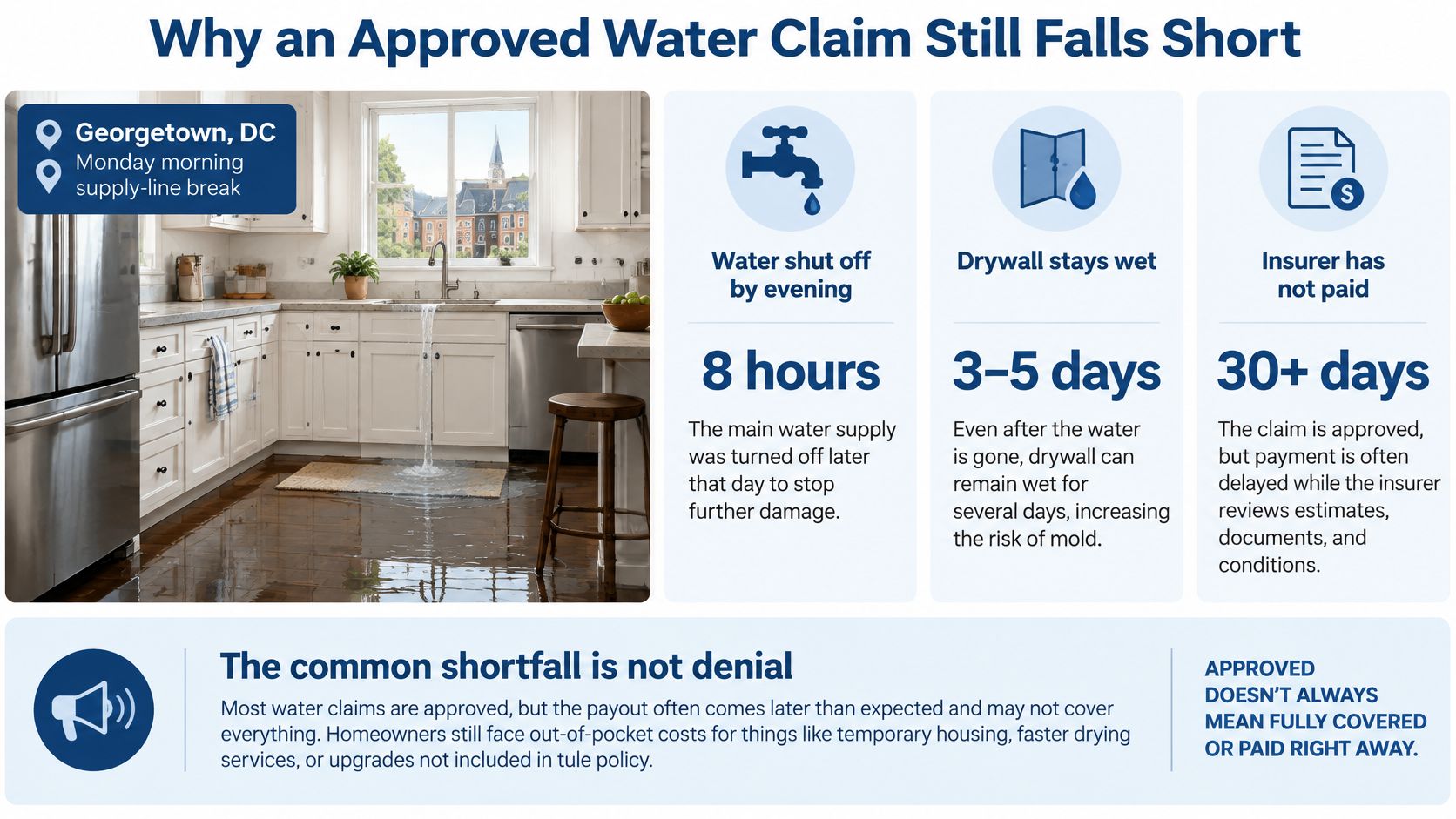
Say a supply line breaks on Monday morning in a Georgetown kitchen. By evening, someone has shut off the water and extracted the puddles. The drywall behind the cabinets is still wet, the toe-kicks are swollen, and the insurer hasn't paid.
The owner's immediate problem isn't a denial. It's deciding which work must proceed, what evidence must survive demolition, and how to pay the contractor before the claim is settled.
In a 2025 survey of U.S. homeowners, 91% reported that their home-insurance claims were approved, according to MarketWatch Guides. That finding doesn't establish whether those payments covered complete repairs. Approval answers a coverage question, not every question about quantities, pricing, deductions, or available cash.
Find the right coverage pathway
Don't describe every indoor water loss as a flood when reporting it. Describe the event precisely: a failed supply connector, an overflowing fixture, a sewer backup, or water entering from outside. The insurer must evaluate that cause under the applicable policy terms.
Flood insurance and disaster assistance are also different pathways. FEMA's publication of more than 2 million National Flood Insurance Program claim records dating back to 1978 illustrates the scale of flood-insurance recovery, but those records aren't a payment benchmark for an interior plumbing leak. Identify the policy that applies before comparing benefits or assuming assistance will fund repairs.
For a kitchen supply-line failure, ask the insurer to identify the applicable coverage, deductible, and any relevant limitations in writing. Don't let an imprecise description substitute for investigating the source.
Build a recovery package, not an invoice pile
Useful support produces a controlled file:
- Loss narrative: When you discovered the damage, what you observed, and how the source was stopped.
- Room photo index: Images labeled by location, material, and stage of work.
- Moisture map and equipment log: Measurements that explain the drying scope.
- Contents inventory: Damaged belongings, their condition, and supporting purchase records.
- Reconciled repair scope: Contractor quantities compared with the adjuster's estimate.
An invoice shows what someone charged. It doesn't necessarily explain why the work was needed or connect it to the reported loss.
Practical rule: Treat approval as permission to examine the payment details, not proof that the rebuilding budget is complete.
Manage the loss on separate tracks: urgent mitigation and the slower process of determining and paying covered costs. Neither track can substitute for the other.
Texas Clocks and the Evidence File to Send
Texas water-claim clocks and what to send
| Control point | Usual clock | What you send | Watch-out |
|---|---|---|---|
| Written notice | Send on discovery; verify the applicable NFIP reporting and proof-of-loss deadlines | Discovery date, time, observed cause, weather, and requests for the applicable policy section and deductible | Verbal-only reporting without a timestamp |
| Claim acknowledgement | Generally 15 days for a Texas residential claim | Request the adjuster's name, claim number, and required proof list | No written record of who is assigned |
| Accept or deny | Generally 15 business days after required information is received | Completeness index and full evidence package | Missing information leaves the decision timeline unresolved |
| Added review time | Written explanation required for additional time | Ask what remains outstanding and request the revised decision date | Informal calls saying the claim is still under review |
| Payment after approval | Generally 5 business days | Confirm payee details and mortgagee involvement | A jointly payable check without an endorsement plan |
| Disaster extension | Handling deadlines can lengthen | Dated log of notices, submissions, and insurer responses | Assuming ordinary deadlines apply unchanged |
The Texas Office of Public Insurance Counsel's claim-payment guidance explains the general 15-business-day decision period after required information arrives and the 5-business-day payment period after approval, along with additional-time and disaster-related exceptions. These are general handling rules, not a promised completion date for every claim.
Turn each control point into a written action
Send notice immediately. You don't need a finished repair estimate to report damage. State what you know, distinguish observations from suspected causes, and ask how the insurer wants supporting documents delivered. Save the submission confirmation.
Identify the person handling the file. Record the adjuster's name and contact details, then ask who handles mitigation review, contents, and reconstruction if different people are assigned. A generic claims inbox isn't a substitute for knowing who must answer a specific question.
Document completeness. Send an index naming each attachment and its purpose. Ask the adjuster to confirm receipt and identify anything else required for a decision. Don't assume uploading files means someone has reviewed them.
Require a useful explanation for additional review. Ask whether the insurer needs a cause investigation, contractor clarification, inspection, or policy review. A specific answer lets you resolve a missing item; an open-ended status update doesn't.
Prepare the payment route. Confirm whether a lender will appear on the check and obtain its release requirements before payment arrives. Ask the insurer to distinguish approved amounts from amounts still being evaluated.
Track disaster-related changes. If an extension applies, ask which deadline changed and what date the insurer is using. Keep the response with the claim correspondence rather than relying on a phone summary.
Make the package easy to audit
Use an indexed PDF or an organized shared folder, following the insurer's submission requirements. Keep original photographs and readings separately so you don't lose timestamps or underlying records when creating the presentation copy.
A usable folder structure separates cause and discovery, mitigation, contents, repair scope, and communications. Name revised estimates clearly and retain earlier versions. Otherwise, an adjuster may review an outdated scope while your contractor is discussing a newer one.
Include a short cover note listing what you're requesting: review of an omitted room, clarification of a partial denial, approval of a documented drying charge, or an explanation of a deduction. Avoid sending a large file with no stated decision needed.
A clean file improves auditability. It doesn't change exclusions, create coverage, or guarantee payment.
How to Document the Loss Before Anything Is Torn Out
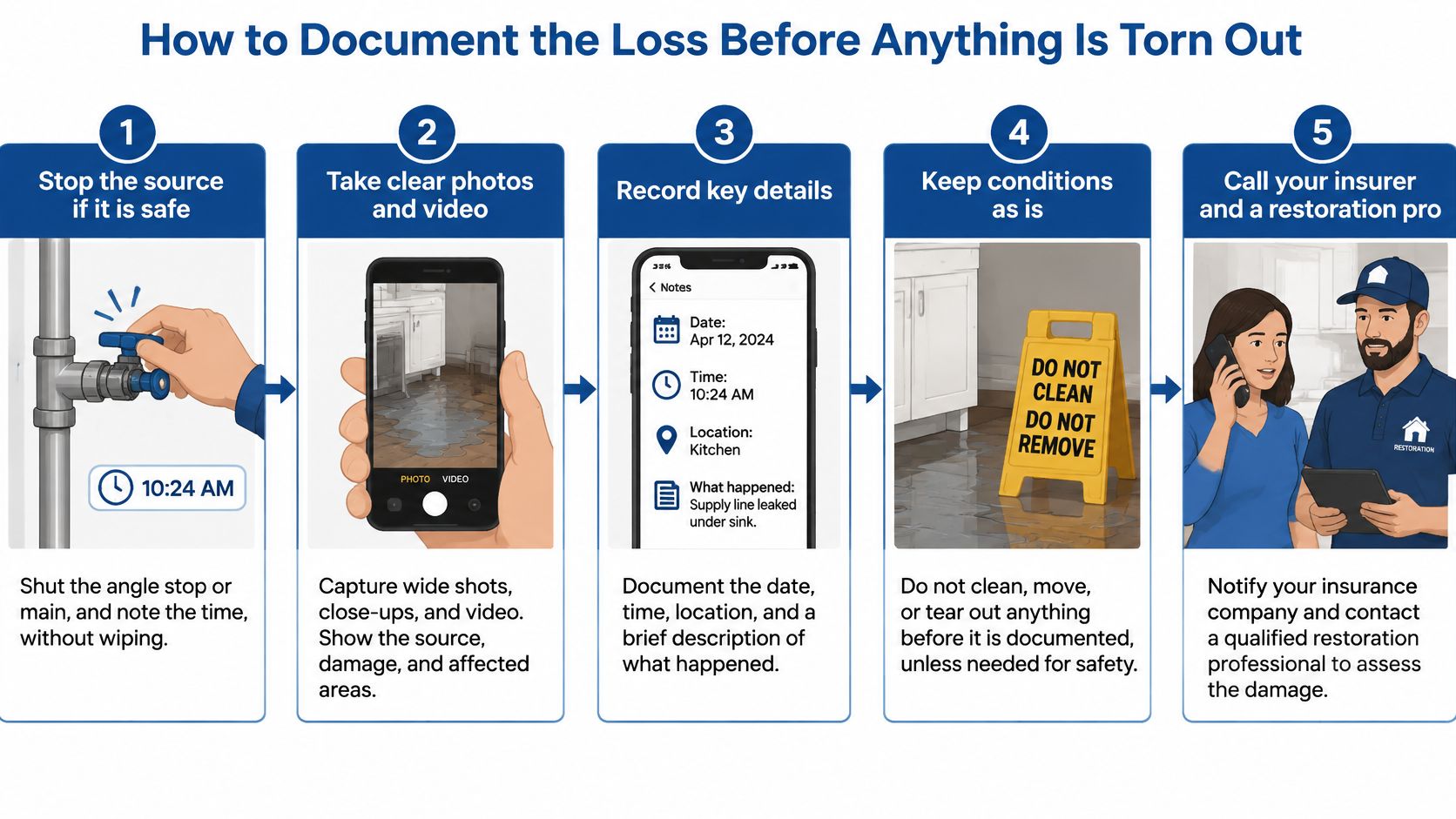
Work with your phone and the restoration technician's instruments. You need a record of the property's condition before removal, not just photographs of an empty room after demolition.
The Texas Department of Insurance's claim guidance recommends documenting damage before repairs, retaining receipts, and recording calls, adjuster details, requested documents, and submission dates. Build that record while the work happens, when locations and conditions are still clear.
Run the field sequence
Stop the source if it's safe. Shut the fixture's angle stop or the main water valve and note the time. Don't enter standing water near electrical equipment or disturb a sagging ceiling. If the source remains uncertain, have the appropriate professional investigate rather than labeling a guess as a confirmed cause.
Photograph wide views, then details. Start at each room's doorway so the location is recognizable. Follow with close-ups of water lines, swollen trim, damaged contents, and the suspected failure point. Check adjoining spaces and the ceiling below an upstairs leak, because the visible puddle doesn't define the entire affected area.
Write a factual cause note. Separate the sudden release from old staining, previously soft baseboards, or earlier roof marks. Use descriptions such as fresh water observed beneath the connector rather than claiming a concealed component failed before anyone has examined it. This distinction prevents unrelated deterioration from confusing the new loss.
Allow necessary extraction and stabilization. Don't preserve evidence by leaving unsafe or actively damaging conditions untreated. Before selective removal, have the crew photograph affected drywall, cabinet toe-kicks, and exposed layers, then map their moisture condition. Ask whether a representative failed part or material sample can be retained safely.
Record drying conditions and equipment. The technician should identify measurement locations, material types, meter readings, equipment placement, and drying objectives. Air temperature and relative humidity help explain conditions, while repeated material readings show progress. A thermal camera can help locate suspicious areas, but a temperature image alone doesn't confirm moisture.
Inventory contents by room. Include damaged pantry goods, linens, small appliances, storage bins, and other ordinary items, not just furniture. Photograph labels and model information where available. Retain receipts you have, and clearly distinguish documented purchase information from estimates.
Walk the adjuster through the same locations. Use the photo index instead of relying on memory. Record questions, requested documents, inspection observations, and who will review concealed damage if additional removal exposes it. Ask for coverage explanations in writing rather than interpreting a casual conversation as approval.
Submit and log the package. Save the delivery confirmation, attachment list, and submission date. When new conditions appear, add a dated update instead of replacing the original record.
Avoid the evidence mistakes that are hardest to repair
The most damaging shortcuts are discarding materials before they're documented, blending old deterioration with new damage, omitting inexpensive contents, and combining emergency dry-out with reconstruction on an unexplained invoice. Each makes a different part of the claim harder to evaluate.
Ask whoever performs the work to provide organized restoration progress documentation, including location-labeled photographs and drying records. The owner shouldn't have to reconstruct a technical file from scattered text messages after the walls are closed.
Reconcile the Contractor Scope with the Adjuster Estimate
A claim can be approved and still leave a rebuilding shortfall. The usual gap is an estimate that leaves out work or money that has not yet been released, not necessarily an outright denial. Compare the work included in each estimate before arguing over totals. Identify whether the difference is scope, quantity, price, or coverage.
In an Austin bathroom with a failed supply line, wet subfloor, and discontinued tile, a small surface patch may not account for the access needed to inspect or repair the subfloor. Nor does that automatically mean full replacement is covered. Ask for a written explanation of how the proposed repair will work and what additional evidence is needed to review concealed damage.
Use a worksheet instead of a total-versus-total argument
Water-loss estimate reconciliation worksheet
| Category | Usually priced by | Proof to attach | Where money disappears |
|---|---|---|---|
| Emergency drying and stabilization | Restoration contractor | Moisture map, equipment log, daily readings | Charges mixed onto the rebuild invoice |
| Hidden moisture and selective demolition | Contractor, then adjuster review | Readings and photographs before removal | A cavity opened before its condition is mapped |
| Code-required upgrades | Contractor with a code note | Applicable citation for plumbing or electrical work | Necessary compliance work treated as an elective improvement |
| Matching finishes | Contractor, with insurer coverage review | Photographs of remaining tile, flooring, or cabinets | A patch allowance without a workable restoration method |
| Contents | Owner inventory | Photographs and receipts, including small items | Ordinary goods omitted |
| Debris removal | Contractor invoice | Load records or hauling invoice | Disposal bundled without quantities |
| Microbial or mold-related work | Separate specialist or contractor scope | Inspection findings and testing if needed for the claim | Coverage assumed despite a separate limit or exclusion |
| Depreciation, deductible, policy limit | Insurer calculation under policy terms | Declarations, settlement provisions, and payment breakdown | Approval mistaken for immediately available rebuild funding |
Keep extraction, air movers, dehumidification, and any justified treatment identifiable as separate work. Equipment records should show where equipment operated and why it remained necessary, rather than listing rental charges alone.
For hidden damage, connect each requested opening to a recorded condition. Before anything is torn out, make sure the affected area has been photographed and its condition documented. For code work, identify the applicable requirement and have the contractor explain why it applies to the repair. Do not label a preferred upgrade as mandatory.
Matching finishes also need a clear explanation. Photograph the remaining material and document availability problems. Ask the adjuster to explain how the allowed repair can restore the affected area and which policy provision governs any limit on matching. Keep contractor communication in writing, with disputed quantities and repair methods stated plainly.
Calculate what the owner must actually fund
Separate contents, hauling, and microbial work from structural repairs so their treatment is visible. Then reconcile the deductible, depreciation withholding, prior payments, and remaining limits. When comparing a revised estimate with a payment already issued, account for deductions already taken. Do not subtract them twice.
Premiums have been rising in many areas, and reducing coverage to manage those costs can leave policy limits short of the rebuilding need. Better documentation can support covered costs. It cannot increase the policy's limits.
A supplement should identify the omitted line, requested correction, supporting photographs and measurements, and the reason the estimate needs to change. Approval is not the same as rebuild cash in hand. Before signing a rebuild contract, know the expected insurance payment, the amount still disputed, and what you must fund yourself.
If a supported supplement remains unresolved, check whether the policy permits appraisal for a valuation dispute. Consider a licensed public adjuster or attorney when appropriate, especially for coverage disagreements, and contact the Texas Department of Insurance about handling concerns. A restoration contractor documents physical conditions and repair scope. That role is different from representing the insured or providing legal advice.
Keep Drying Moving and Act This Week
Do-now versus wait list during a late claim
| Work | Timing | Keep for proof |
|---|---|---|
| Emergency extraction and structural drying | Start promptly when safe | Invoices, daily readings, and receipts supporting an advance request |
| Stabilization and temporary housing | Address immediate safety needs and log dates | Receipts labeled as expenses to submit |
| Cabinet replacement, flooring upgrades, uncontested rooms | Get a written scope and funding answer before permanent work; schedule genuinely uncontested work separately | Supplement with photographs and quantities |
| Mortgage payee endorsement | Plan early | Lender details and payment-release requirements |
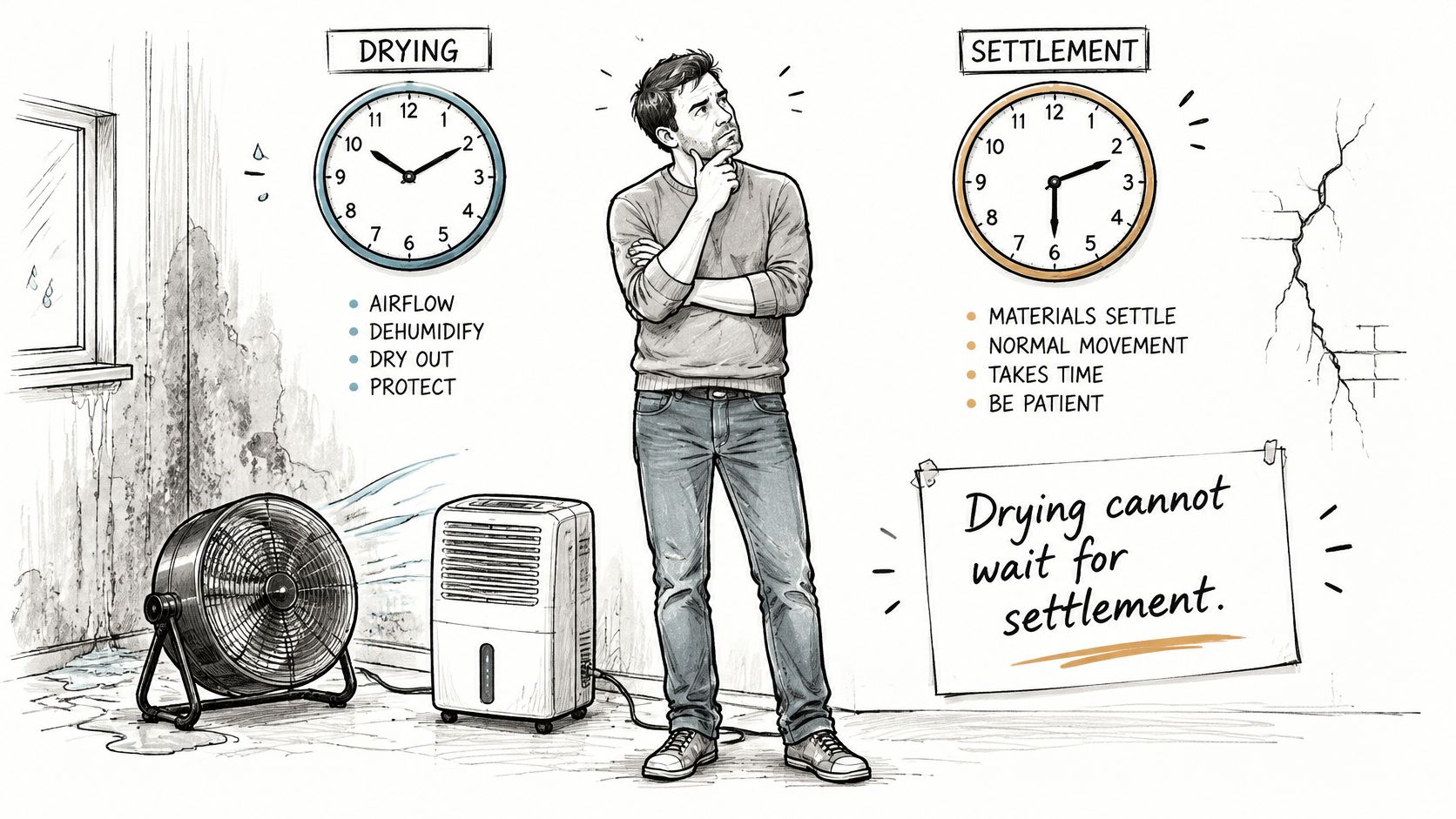
Drying cannot wait for settlement. In J.D. Power's 2025 U.S. Property Claims Satisfaction Study, repairs averaged 32.4 days from filing to completion, while the average time from first notice of loss to final payment exceeded 44 days. Those are national averages, not a drying schedule or a promised local payment date.
Decide what can safely proceed
Emergency extraction and structural drying address current conditions. Cabinet layouts, upgraded flooring, and contested finish replacement are permanent financial commitments. Don't treat them as equally urgent just because they appear on the same contractor proposal.
A room described as uncontested still needs a clear scope, price, and payment plan. If all parties agree and you can fund the work, it may proceed independently. The reason to pause is unresolved scope or money, not the existence of an open claim elsewhere in the property.
Ask the adjuster in writing whether an emergency advance or partial payment is available and which documents support it. Ask which approved amounts can be released without waiting for every disputed item. Don't assume that requesting an advance establishes coverage for the expense.
The distinction matters while crews are still working.
Keep temporary housing receipts separate from repair invoices. A business owner should similarly track closure dates, interrupted operations, and related expenses for submission under any applicable coverage. Label these as expenses being claimed, not benefits already approved.
For drying expectations, use the property's readings and structural drying timeline guidance rather than choosing a removal date because equipment is inconvenient. Ask the technician what remains wet and what evidence will establish completion.
Set the first week's priorities
At discovery, send written notice and preserve the scene before damaged materials leave. Record the source-control work and retain the plumber's findings if a plumber investigates the failure.
At the initial inspection, arrange moisture mapping and necessary drying. Ask the technician to assess affected assemblies in the actual building, including slab-on-grade flooring systems or accessible pier-and-beam spaces where relevant. Don't assume a dry-looking surface means the concealed assembly is dry.
When the adjuster is assigned, confirm the deductible, submission method, required documents, and inspection arrangements. Contact the mortgage servicer if its endorsement may be required. Ask about contractor deposit requirements before promising a payment date.
When the estimate arrives, compare disputed lines rather than resending the entire argument. Attach the relevant images and quantities, state the correction requested, and retain the response.
End the week with a dated status update identifying completed mitigation, outstanding documents, pending decisions, and the next site activity. Send an updated completeness index when the file changes. That gives the insurer and contractor a usable record without burying them in duplicate attachments.
If water is standing, odors are increasing, or the source remains unclear, contact a local restoration professional rather than waiting for a settlement decision. Proceed with documented stabilization, but don't authorize contested permanent work without understanding who will pay.
RestoTek TX offers water-loss inspection, moisture documentation, structural drying, and reconstruction support for Georgetown and Austin properties. Visit RestoTek TX to request an assessment and discuss the field records and repair scope needed to support your insurance claim.