You're standing in a house or building that doesn't feel safe anymore, and the first instinct is usually wrong. People want to start scrubbing, airing it out, or moving items around. Don't. In a biohazard cleanup event, the first minutes matter more than the mop, because the wrong move can spread contamination, damage evidence, and make the cleanup harder than it needs to be.
The right response is simple, but it has to be disciplined. Isolate the area, keep people out, and call a qualified remediation team that knows how to handle biological hazards, waste, and documentation. That's the difference between an emergency that gets controlled and a problem that lingers.
What Exactly Is Biohazard Cleanup
A sewage backup in a Georgetown bathroom. An unattended death in a quiet Austin home. A rental unit left packed with waste, or a trauma scene that nobody wants to talk about out loud. Those are all different situations, but they share the same core problem, biological contamination that can't be handled like ordinary mess.
Biohazard cleanup is the specialized process of removing, cleaning, disinfecting, and disposing of hazardous biological materials so a space can be used safely again. It covers blood, bodily fluids, sewage, decomposition residue, animal waste, contaminated porous materials, and other materials that can carry infectious risk. It is not janitorial work, and it is not a quick wipe-down.
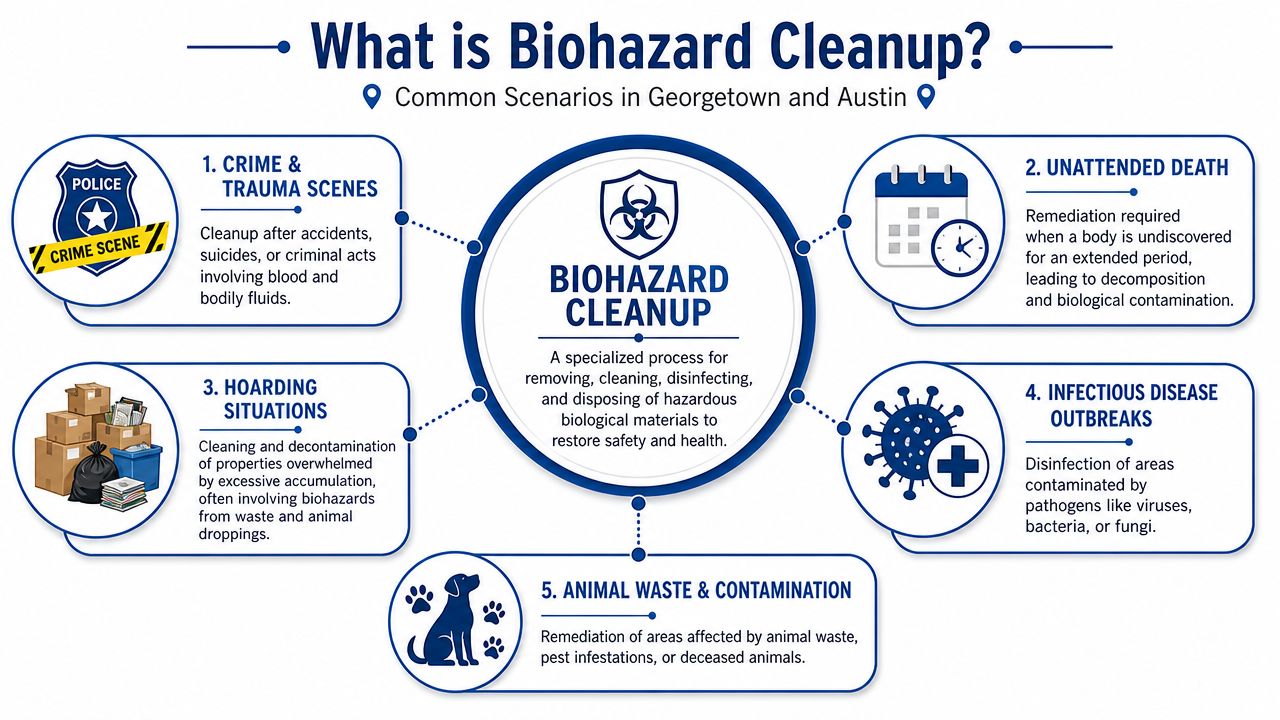
The situations that usually require it
Biohazard work comes up in predictable categories. Crime and trauma scenes involve blood and bodily fluids after accidents or violent events. Unattended deaths often require removal of decomposition contamination that has spread beyond what you can see. Hoarding situations can hide waste, mold, pests, and animal droppings inside clutter. Infectious disease outbreaks require targeted disinfection. Animal waste and contamination often show up after pests, pet accumulation, or deceased animals.
The reason owners get caught off guard is that these jobs often look smaller than they are. A small visible area can hide contamination in baseboards, flooring, fabrics, HVAC pathways, or subfloor materials. That's why the cleanup plan has to be systematic from the start, not reactive.
Biohazard cleanup is a specialized, compliance-driven industry. One market report estimates the global market at about USD 5 billion in 2025, with a projected 7% CAGR through 2033, underscoring that this is a professional field governed by safety standards, not a simple cleaning task. Another market summary places the segment at roughly $2.5 billion annually, which shows how much estimates can vary while still pointing to a multi-billion-dollar category. You can review that market framing in this industry report on biohazard and crime scene cleanup.
If you're dealing with a sewage event, the practical issue is usually less about the mess and more about the scope. A good starting point on cost variables is this sewage backup cleanup cost guide, because backup severity, material loss, and disposal obligations all affect the final plan.
Understanding the Health Risks of Improper Cleanup
The danger isn't the visible stain. The danger is what you can't see after the stain is wiped away. Bloodborne pathogens, sewage-borne bacteria, viruses, and decomposition contaminants can all remain in materials or spread through handling if the cleanup is rushed.
Why DIY cleanup is a bad bet
Blood and bodily fluids can carry serious infectious risk. Raw sewage can contain organisms associated with gastrointestinal and respiratory illness. Decomposition can create contamination that penetrates surfaces, settles into porous materials, and continues to release odors and residues long after the room looks better. That's why household disinfectant and a pair of gloves are not enough.
The occupational-health case for professional cleanup is strong. A global analysis estimated 550,819 deaths in 2022 were attributable to biological risk factors at work, including 476,000 from communicable infectious diseases and 74,000 from noncommunicable factors. It also attributed 223,650 COVID-19 deaths at work that year. Those figures make one point very clear. Biological hazards belong in a controlled response, not an improvised one. You can read the analysis in this global occupational biological risk study.
Practical rule: if a material may be infectious, porous, or difficult to fully inspect, assume the contamination goes deeper than the surface.
What improper handling actually causes
The first problem is exposure. Someone cleaning without proper containment can track contamination into hallways, adjacent rooms, vehicles, or clothing. The second problem is incomplete removal. If organic material remains, disinfectant performance drops materially, and a surface can still be biologically contaminated even if it looks clean. The third problem is disposal failure, because contaminated waste often can't be handled like normal trash.
That is also why the pre-arrival steps matter so much. A property owner who secures the area and avoids disturbance can keep the incident from becoming a larger cross-contamination event. For broader water-loss situations that can overlap with microbial concerns, this mold remediation resource for Georgetown homeowners is useful context.
The right mindset is simple. You are not trying to make the scene look better. You are trying to keep people safe until trained technicians can isolate, remove, disinfect, and verify the space.
The Professional Biohazard Remediation Process
Professional remediation follows a controlled sequence because biology doesn't respond well to guesswork. The crew isn't just cleaning. They're isolating the hazard, removing contamination, treating the surface correctly, and making sure the space can be handed back safely.
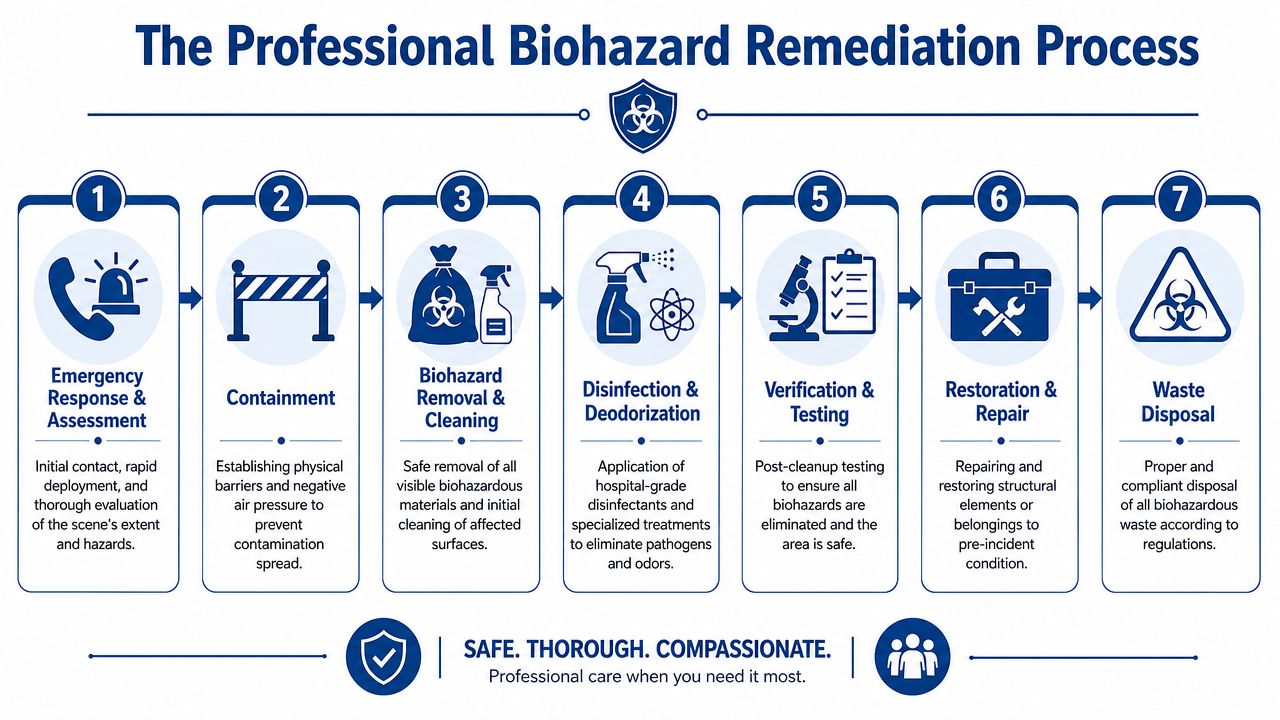
Assessment and containment first
The first job is to identify the hazard, the boundaries, and anything that could be affected by spread. Containment keeps foot traffic, airflow, and tools from moving contamination into clean spaces. In practice, that means establishing barriers, using the right PPE, and deciding what stays and what gets removed.
Cleaning and disinfection are not the same step
CDC environmental-cleaning guidance says contaminated surfaces should first be cleaned with friction to remove organic matter, then treated with a sporicidal disinfectant such as sodium hypochlorite at 1,000 ppm or 5,000 ppm or enhanced hydrogen peroxide at 4.5%, with cleanliness verified using residual bioburden tools such as ATP or culture swabs. That sequence matters because disinfectant works poorly when organic material is still on the surface. The full guidance is in this CDC environmental cleaning procedure.
Direct rule: if there's visible soil, clean it off before you disinfect it. Skipping that step weakens the whole job.
Blood spill response follows its own protocol
CDC spill guidance recommends a two-stage response for bloodborne-pathogen spills. First, remove visible blood or other potentially infectious material with detergent. Then apply disinfectant and keep at least 15 minutes of contact time before wiping and bagging disposables as biohazard waste. For large blood or body-fluid spills on nonporous surfaces, the guidance also notes that a 1:100 bleach dilution can be appropriate after gross soil removal, while 1:10 bleach is recommended when flooding a spill with germicide to fully wet the spill and absorbent material. That protocol is laid out in this CDC bloodborne pathogen spill job aid.
Verification and waste disposal close the loop
A competent crew doesn't stop when the room smells better. They verify what was removed, document what was treated, and dispose of waste under the right rules. That last part matters because contaminated waste, sharps, and porous materials often need special handling. The job is only finished when the site is clean, the hazard is gone, and the waste trail is compliant.
Navigating Insurance Claims and Legal Duties
The emotional side of a biohazard event is obvious. The money and paperwork side catches people by surprise. Owners want to know who pays, what needs to be saved, and what could become a liability if they handle it wrong.
Insurance usually turns on the cause of loss and the policy language. A sewage backup, a trauma scene, or contamination tied to another covered event may trigger a claim, but the carrier will want documentation. That means photos, notes, a clear service report, disposal records, and an itemized invoice that shows what was done and why.
Keep this straight: if the scene changes before the adjuster or investigator sees it, you may lose the details that justify the claim.
A proper remediation company helps by documenting the scene before work begins and by keeping a clean chain of custody for removed material. That isn't paperwork for its own sake. It protects the owner if the insurer questions scope, timing, or disposal. It also helps reduce friction when a landlord, tenant, or property manager needs to show that the space was treated responsibly.
Legal duty is just as important as insurance. Property owners and managers are expected to restore safe, habitable conditions, and they can't do that with ordinary cleaning alone. They also need to be careful with disclosure, occupancy, and re-entry decisions if the property is being rented, sold, or reopened after a serious contamination event.
The waste side is where many owners underestimate exposure. Contaminated waste may require red-bagging, manifests, and transport by licensed medical-waste haulers. A qualified provider has to comply with local, state, and federal rules to avoid downstream environmental risks and legal liability for the property owner. That regulatory burden is discussed in this biohazard cleanup compliance overview.
If you're dealing with a property that also needs water-loss mitigation, one practical option is a restoration company that can coordinate the broader cleanup and repair work. In Central Texas, RestoTek TX handles water damage restoration, microbial prevention, and reconstruction, which can help when a biohazard event overlaps with structural damage or hidden moisture.
How to Choose a Qualified Cleanup Provider in Central Texas
Not every restoration company is qualified for biohazard work, and plenty of general cleaners shouldn't be anywhere near it. You want a provider that treats the job as a controlled health and compliance event, not a fast surface wipe.
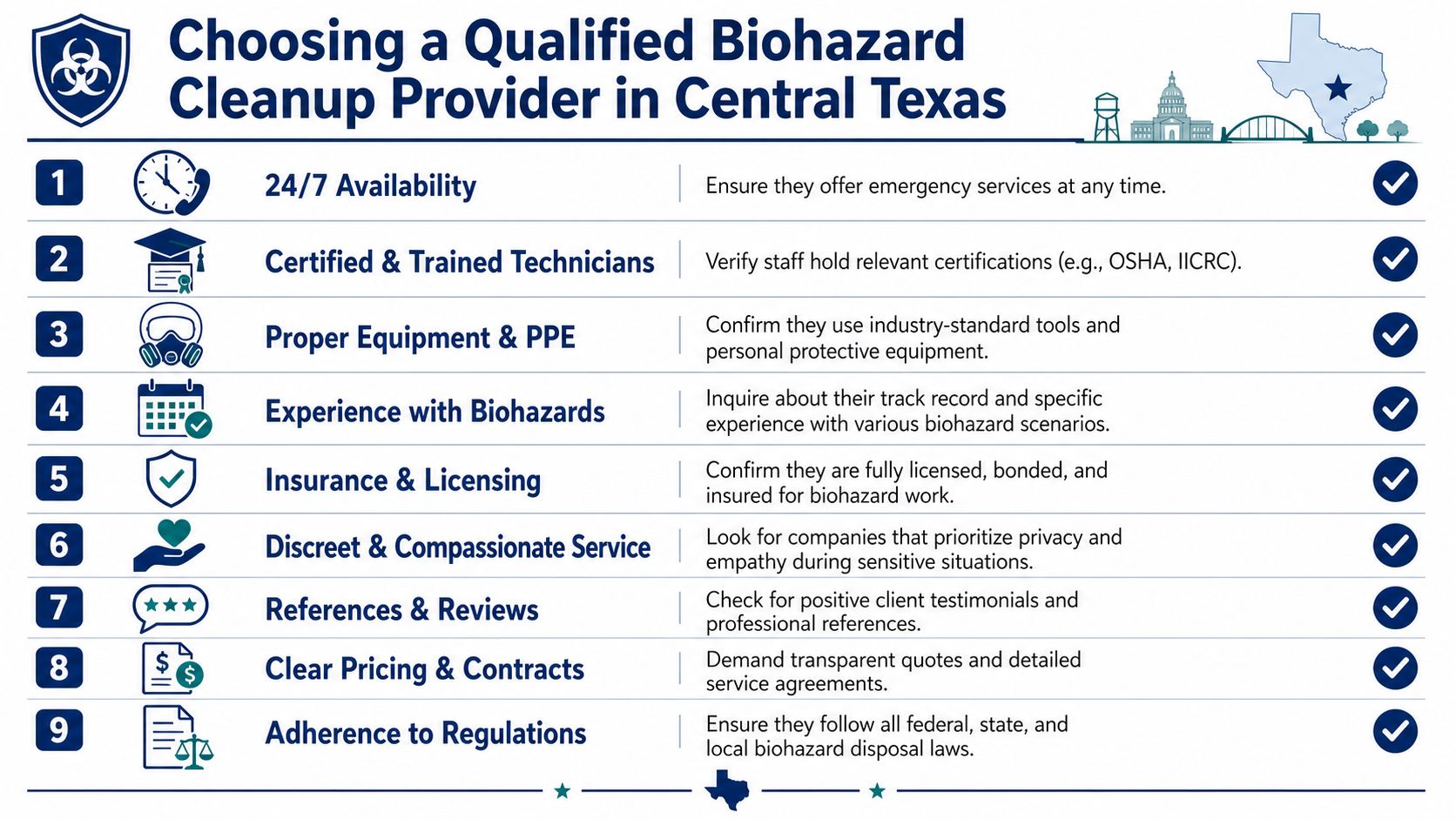
What to ask before you hire anyone
Use a simple filter.
- 24/7 availability: emergencies don't wait for business hours, and the response window matters.
- Certified and trained technicians: ask what training they have for bloodborne pathogens, PPE, and hazard awareness.
- Proper equipment and PPE: they should arrive ready for containment, removal, disinfection, and waste handling.
- Experience with biohazards: trauma, decomposition, sewage, hoarding, and animal contamination are not the same job.
- Insurance and licensing: confirm they're covered for the work they're performing.
- Discreet and compassionate service: privacy matters, especially at homes and occupied properties.
- References and reviews: look for real local feedback, not generic marketing claims.
- Clear pricing and contracts: you need a written scope, not a vague promise.
- Adherence to regulations: waste handling and disposal have to follow the rules.
The disposal point is the one most owners overlook. Contaminated waste may require red-bagging, manifests, and transport by licensed medical-waste haulers, so ask directly how they handle regulated waste and who signs off on disposal. That is a legal and environmental issue, not a housekeeping detail.
A local provider should also understand mixed-scope jobs
In Central Texas, biohazard events often overlap with water damage, hidden moisture, or reconstruction. That creates a mixed-scope job where one crew may need to remove contaminated material, another may need to dry framing or subfloors, and another may handle rebuild. A provider with end-to-end capability reduces handoff errors and keeps the site moving.
The best question you can ask is blunt. “Show me how you secure the site, document the work, and prove disposal compliance.” If the answer is vague, keep calling.
Your Immediate Next Steps in Georgetown and Austin
If you're in the middle of this right now, stop trying to solve the whole problem at once. Focus on three moves that reduce risk immediately.
-
Secure the area and limit access. Keep children, pets, tenants, and curious helpers out. If the scene could be part of an investigation, don't disturb anything. Shut down HVAC systems if there's a chance of cross-contamination, because airflow can spread contamination farther than people realize. The practical guidance on isolating the area is reflected in this community biohazard cleanup resource.
-
Avoid contact and don't attempt to clean. Don't drag wet materials around, don't spray random disinfectants on organic material, and don't bag contaminated items with household trash. The goal before professionals arrive is damage control, not cleanup. If you need to protect records for an investigation or insurance claim, take photos from a safe distance and then step back.
-
Call a certified professional immediately. Ask for a crew that can explain containment, disposal, and documentation before they start work. If the event is tied to water intrusion or structural damage, make sure the provider can coordinate the broader restoration plan, not just the cleanup.
For Georgetown and Austin property owners, the fastest practical route is a local response team that can show up, assess the scene, and give you a clear next step without pressure. If you need help coordinating emergency cleanup, inspection, or restoration after a contamination event, use this emergency restoration service page as your starting point.
A CTA for RestoTek TX.