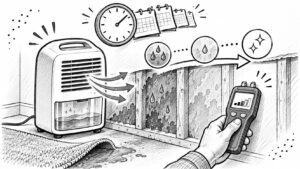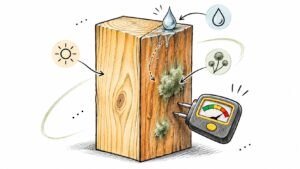
Yes, mold can grow on wood when moisture stays high. Spores can germinate in 24–48 hours, and growth risk rises once wood moisture is about 20%.
A stain on a baseboard is a late clue. The lumber can already be feeding mold while the paint still looks ordinary, because the food is the wood itself and the switch is water left in the grain. A vanity line that weeps overnight, a dishwasher that dumps onto plywood, storm water at a sill plate, or condensate on a cold stud can all do it. What matters next is the moisture number, not the color of the mark.
"Yes Mold Can Grow on Wood"
Mold can grow on wood because lumber is an organic food source and moisture is the switch that lets spores already in indoor air use it. The USDA Forest Products Laboratory reports that mold spores may germinate within 24–48 hours when suitable moisture, temperature, and nutrients are present. Temperature needs are broad, and the wood already supplies the food, so pulling water out fast is the control that matters.
That same window is the drying target for wet materials, and growth may still start even when drying finishes inside it. A face that feels dry isn't proof that framing, a subfloor edge, a wall cavity, or the back of a panel is safe.
Ordinary losses do this without a dramatic flood:
- Vanity supply leak: A slow drip wets the cabinet bottom and the plate behind it.
- Sink or dishwasher overflow: Water crosses plywood and sits in the seams.
- Storm water at a sill plate: Rain soaks the base of a wall and never floods the room.
- Air-conditioner condensate: Cold studs collect moisture that never shows as a puddle.
Finished trim, raw studs, plywood, and particleboard can all host surface growth if they stay damp. Wood is the pantry. Water is the key left in the lock.
The moisture chart below splits early surface mold from true decay. After that come the signs on nearby surfaces, then the point where more fan time should give way to a documented look inside the cavity.
Moisture Levels That Let Mold Start
Most molds need a wood surface moisture content of approximately 20% to begin growing. The U.S. Forest Service also notes that fully air-dried wood generally contains no more than 20% moisture and is substantially less vulnerable to fungal damage while it stays there. Serious decay is a different hazard. It generally needs moisture above the fiber-saturation point, which averages about 30%. Decay fungi are supported from about 10–35°C (50–95°F), with an optimum near 24–32°C (75–90°F). Warm rooms after a leak speed that activity. "Not yet visibly moldy" does not mean dry enough.
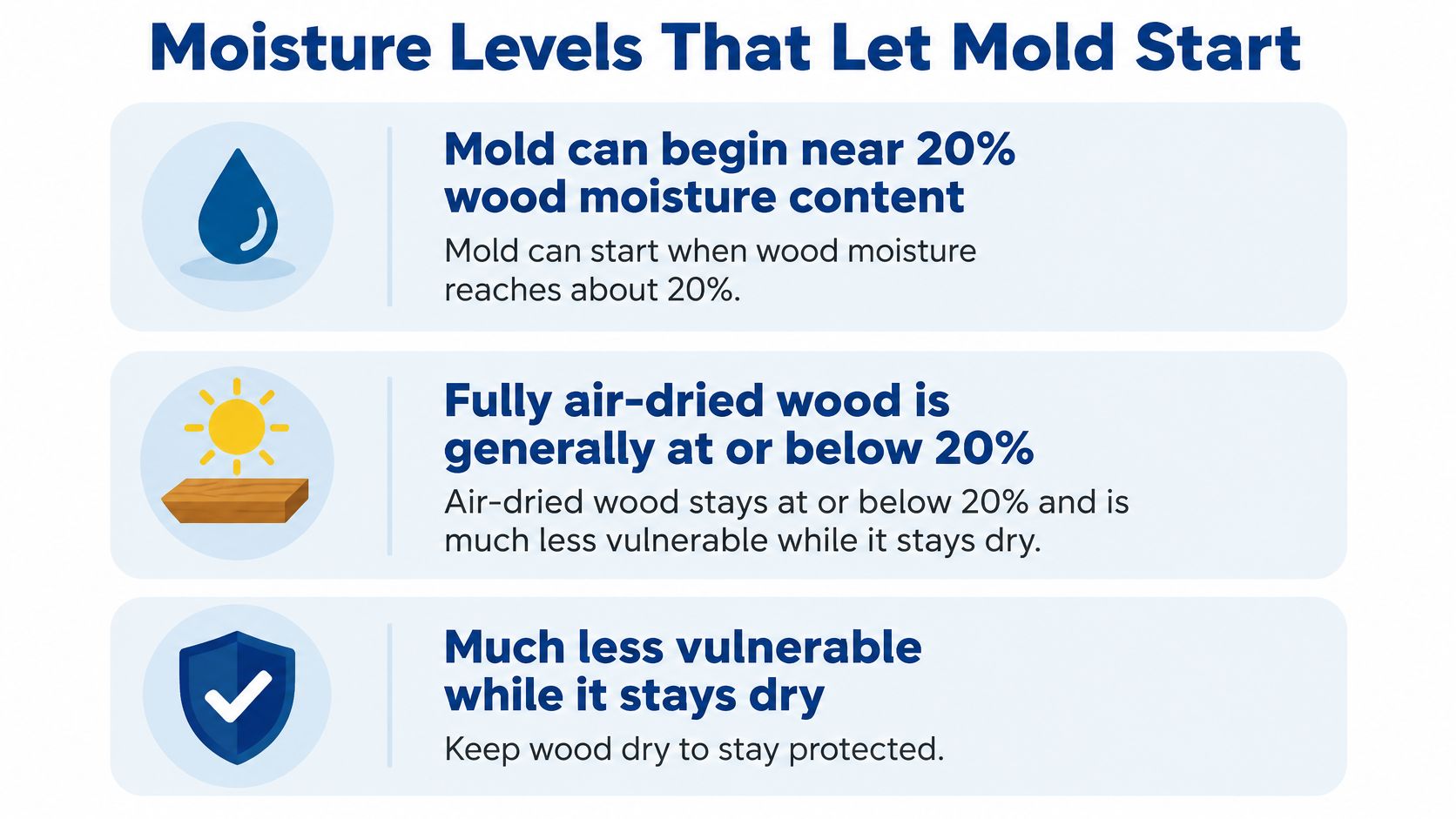
Read the rows as a screening chart, not as a single pass-fail stamp.
| Benchmark | Reading or condition | What it means |
|---|---|---|
| Mold can begin | About 20% wood moisture content | Dry promptly; a Forest Service screening level after leaks and floods |
| Air-dried lumber | Generally at or below 20% | Substantially less vulnerable to fungal damage while it stays there |
| Often-cited mold-risk ceiling | 19% wood moisture | An upper target for lowering risk; one reading does not clear a cavity |
| Dampness of concern | Above 15% wood-moisture-equivalent | ASHRAE threshold for organic materials that stay damp |
| Water activity rarely a problem | Below 0.8, about 80% ERH at the surface | Room air can feel fine while the wood face stays wetter |
| Kiln-dried wood reinfection | Moisture back near 28–30%, by species | Previously dry wood can support fungi again once it rewets |
| Serious decay | Above fiber saturation, about 30% average | Usually needs free water from leaks, rain, condensation, or wet ground |
| Decay-fungi temperature | About 10–35°C (50–95°F); best near 24–32°C (75–90°F) | Warm indoor conditions speed activity after water intrusion |
| Indoor humidity target | About 30–60%; EPA prefers under 60%, ideally 30–50% | Helps drying but does not replace wood moisture readings |
Why a comfortable room still grows mold
ASHRAE states that mold growth is rarely a problem when the water activity of interior materials stays below 0.8, about 80% equilibrium relative humidity at the material surface, not necessarily 80% in the room air. Persistent moisture above 15% wood-moisture-equivalent in organic materials is a dampness threshold of concern. Kiln-dried wood can be reinfected when moisture content rises to roughly 28–30%, depending on species. Indoor humidity held around 30–60% lowers favorable conditions, but it doesn't replace a meter on the wood.
A cold stud, wet end grain, or the back of paneling can keep a wet boundary layer while the living room feels fine. Say the thermostat reads a pleasant mid-70s and the hallway smells normal. The end grain of a sill that wicked last night's rain can still sit in that wet film.
Practical rule: Treat anything above about 20% as dry-it-now, not wait-for-a-stain.
Readings change with species, temperature, depth, coatings, and meter type. A pin pushed into painted trim and a scan across a subfloor will not match, and neither one certifies a cavity. Check framing, subfloors, cavities, and trim again until the numbers trend down. A moisture meter reading is useful only when you take it in the places water hid.
How Fast Staining and Decay Can Appear
Picture a stack of untreated studs in a warm garage after a roof leak. They were fine while they stayed dry. Once they climb back above the safe line, the clock starts, and a dry-looking face on Monday doesn't tell you what the core is doing by the next weekend.
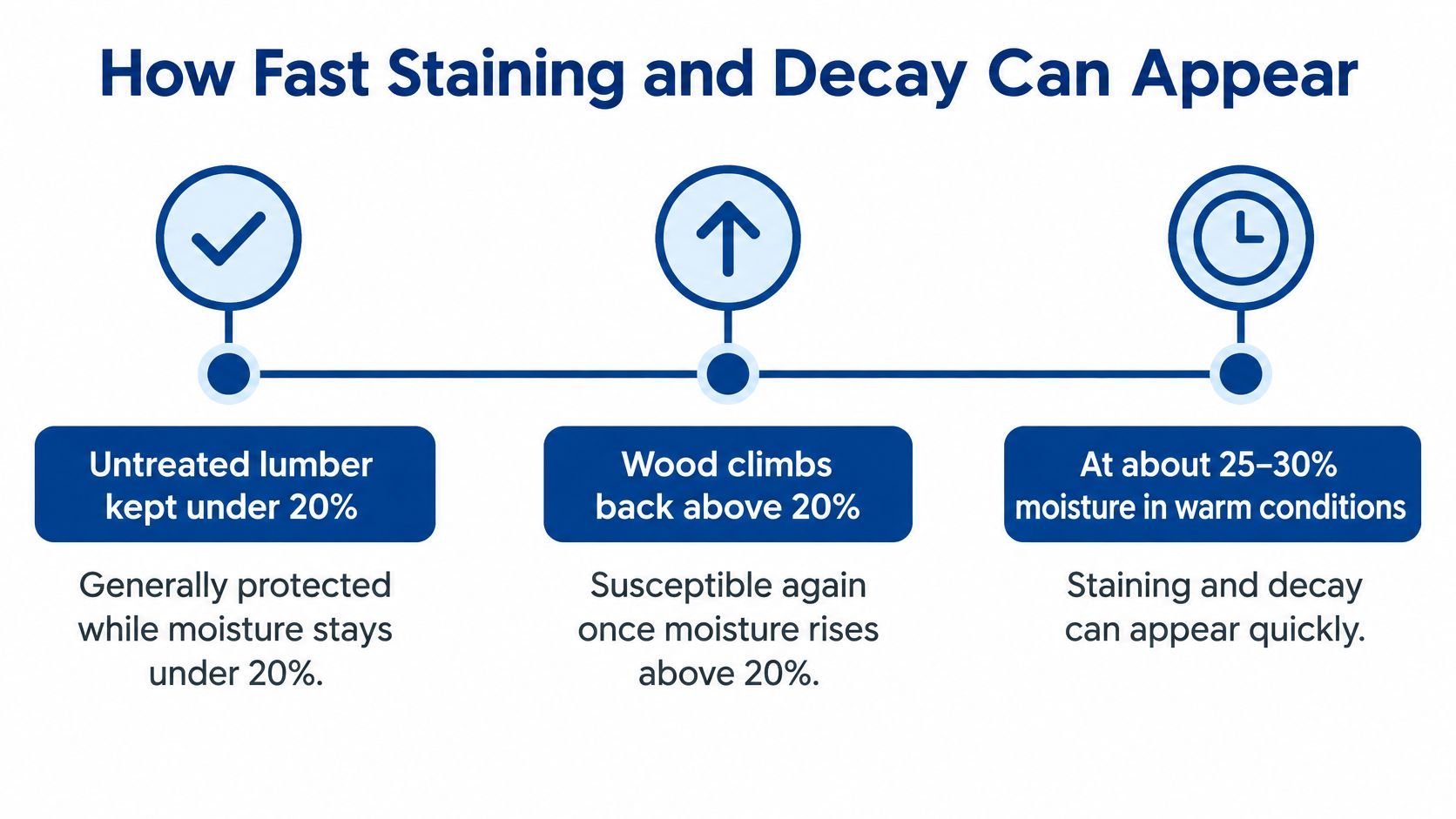
U.S. Forest Service guidance states that untreated lumber maintained below 20% moisture content is generally protected from fungal attack, but wood that regains moisture above 20% becomes susceptible again. At approximately 25–30% moisture content, lumber stored in warm conditions may show visible staining within about one week and early decay infection within about one month.
| Moisture situation | Rough timing | What may show |
|---|---|---|
| Wood that rises back above 20% | As soon as it rewets | Susceptible again even if it was previously dry |
| About 25–30% in warm storage | About one week | Visible fungal staining can appear |
| About 25–30% in warm storage | About one month | Early decay infection can be established |
| Above fiber saturation, about 30%, with free water | Longer, species-dependent | Decay fungi, not just surface mold, become the concern |
| Fully soaked until water drains | Variable | Low oxygen limits some fungi until excess water leaves |
Those week and month marks are historical benchmarks, not a deadline for every house. Species, temperature, ventilation, surface dirt, and wood type all move the date. Mold can colonize a damp face early. Decay fungi typically need moisture above fiber saturation, averaging about 30%, and free water from rain, condensation, or wet-ground contact is often what gets wood there.
What the week and the month cost
A wrung-out kitchen sponge still feeds growth. Only measured dryness stops it. A flooded joist isn't safe just because it is waterlogged either. Soaked wood can sometimes be too oxygen-poor for certain fungi until excess water drains. When that water leaves and oxygen returns, the piece can still be wet enough for decay.
A 2024 Ghent University study tracked fungal degradation of spruce, poplar, and thermally modified poplar for 10 weeks. Degradation caused a significant density decrease, particularly after 15 days, and thermally modified poplar showed less degradation under moist conditions. Density loss is lost strength, not just a stain you can sand off.
Log readings over several days in cavities, not one photo of a floor that looks dry. Wood can stay above the risk line after standing water is gone. The signs in the next part are what that clock looks and smells like, not a repair recipe.
Warning Signs on Wood and Nearby Surfaces
Start with your nose, then the color, then the feel of the wood. A persistent musty or earthy odor that lingers after surfaces look dry is the earliest household clue. Fuzzy or spotty discoloration in green, black, white, or gray on studs, trim, cabinet backs, and subfloor edges is the next.
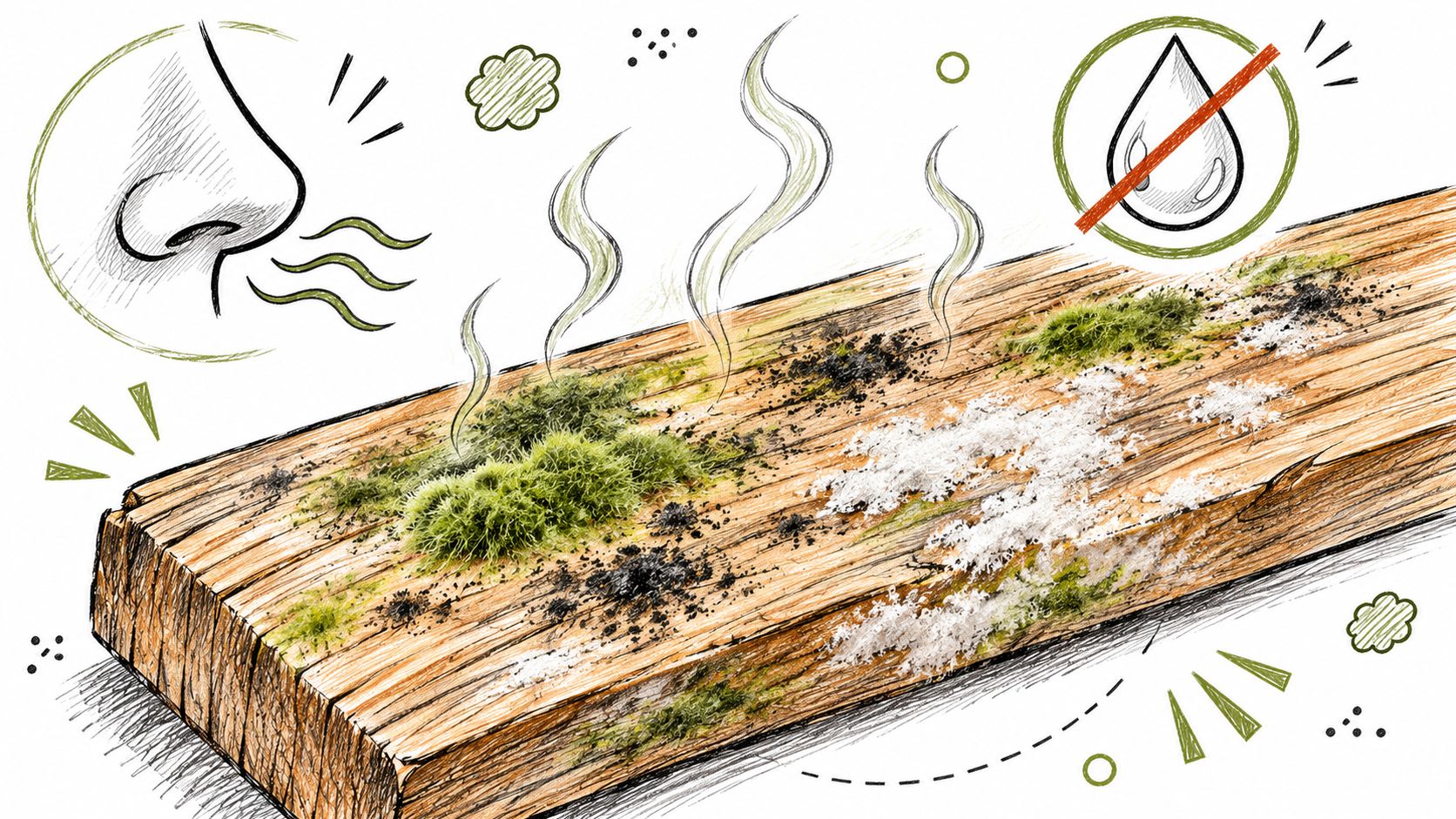
Paint bubbles, cupped boards, swollen baseboards, and dark end grain mean the piece has been wet long enough to move. Softness or crumbling means the problem has gone past a surface film. Some people cough, sneeze, or feel worse at home and better after they leave. That pattern is a reason to look harder at the building. It isn't a diagnosis.
A dry-looking face over wet wood
The EPA mold course recommends indoor relative humidity below 60%, ideally 30–50%, and flags wood moisture content as important, citing 19% as an upper threshold suggested for reducing mold risk in wooden materials. One meter blip can't certify a wall or floor as mold-free. Readings vary by species, temperature, depth, coatings, meter type, and whether moisture is trapped behind finishes.
A "dry-looking" surface may sit over wet framing, a subfloor seam, a wall cavity, or a condensation-prone stud.
The EPA identifies concealed plumbing leaks, roof leaks, condensation, floods, and high humidity as moisture sources that can support growth. After a Central Texas storm, a plumbing backup, or air-conditioning condensate, you can have risk with no standing water at all. Ambient humidity, surface dampness, and wood moisture content are three different things. A comfortable room reading doesn't clear the lumber.
Check the back of paneling, the toe-kick under a sink, and the sill after heavy rain. Stop at recognition. Finding the spot is the job of this pass. Deciding how to clean it, or whether the piece stays, comes only after you know how wet it still is and what kind of water hit it.
Drying Wood Before Mold Takes Hold
Dry in one sequence. Each move exists so the next one isn't fighting new water or a false sense that the paint is done.
- Stop the source. Shut the valve, stop the overflow, or cover the storm entry. New water will undo every fan you set.
- Extract standing water. Pull it from floors and cabinet bottoms. Waiting for a puddle to evaporate leaves the wood wet far longer than it needs to be.
- Expose what is trapped. Pull toe-kicks, lift wet rugs, and separate wet paneling from the wall when it is safe to do so. The back of a panel can stay soaked while the room side looks fine.
- Move air and pull humidity. Blow across the exposed wood and run dehumidification. Gentle heat can help. Don't cook the room, and don't close it up with wet lumber inside.
- Measure, then measure again. Check framing, subfloor edges, and cavities, and keep checking until readings trend toward the project's dry target and indoor humidity sits in a moderate band. The failure mode is declaring victory because the paint feels dry while the cavity is still above the chart.
- Change the plan when the simple dry-out is over. If the wood is still wet after the first two days, growth is visible, the water was sewage or floodwater, or an odor remains after the surface looks dry, stop treating it as a fan project. Move to documented assessment.
Where people stop too early
Extraction without a second-day reading is the usual miss. The floor looks better, the dehumidifier bucket is full, and the cavity that never got opened is still feeding growth. Fans move air. They don't tell you the stud is dry. A meter on the same spots, written down, is what shows the trend.
When Wood Can Be Cleaned or Should Be Replaced
Solid, finished framing with surface growth only, dried quickly, can usually be cleaned with mild detergent and clean water, then dried. Soft, crumbling, or swollen wood, and porous composites, are usually replaced or opened up. The EPA says mold can grow on wood, recommends drying with dehumidifiers, fans, and gentle heat, and notes that treated or finished wood may be cleaned with mild detergent and water. Materials wet for more than 48 hours need more careful judgment. Dry doesn't automatically mean safe. Mold may already have developed even when materials are dried within that period. Routine bleach use isn't recommended for mold cleanup, so a surface scrub isn't a fix.
| Situation | Typical outcome | Why |
|---|---|---|
| Solid finished wood, surface growth only, dried quickly | Clean with mild detergent and water, then dry | Finish limits how deep a surface film sits |
| Solid framing, no softness, moisture brought down | May remain if growth is only on the surface | Structure can be sound once moisture is verified down |
| Swollen plywood, OSB, particleboard, or MDF | Often remove | Edges and glue lines stay wet after the face looks dry |
| Insulation-backed or tight paneling | Separate from the wall or remove | Trapped moisture on the back is invisible from the room |
| Subfloor edges after an overflow | Open and evaluate, do not assume a mop-up finished it | Seams and the underside stay above risk longer |
| Sewage, category-3 water, or floodwater | Professional scope, not a household wipe | Contamination is not the same problem as a clean-water drip |
| Soft, crumbling, or structurally weak wood | Replace | Decay or saturation has changed the piece, not just the surface |
| Still wet after 48 hours or growth already visible | Documented assessment, not fans alone | Mold may already be established even if drying was fairly fast |
Firm solid framing that is verified dry and only filmed on the surface can stay. Swollen plywood, OSB, particleboard, and MDF often can't, because the edge and the glue line stay wet after the face looks done. Insulation-backed paneling has to come off the wall far enough to see the back. A subfloor edge after an overflow needs to be opened, not mopped and forgotten. Sewage, category-3 water, and floodwater aren't a household wipe. The same is true for a hardwood floor that cupped: how to remove mold from hardwood floors starts with the moisture history, not a scrub.
Five checks you can make tonight
- Water category: Clean supply drip, or sewage and floodwater?
- Hours wet: Still damp past the first two days, or brought down quickly?
- Finish versus raw composite: Solid finished wood, or plywood, OSB, particleboard, or MDF?
- Odor and swelling: Musty smell, cupping, or a soft spot under a screwdriver tip?
- Cavity access: Can you see the back of the panel, the toe-kick, and the sill, or is that face still closed?
If two of those checks fail, the piece isn't a wipe-down. It's a scope question.
When to Book Mold Inspection in Central Texas
Book an inspection when a musty odor persists, there was a recent leak, flood, or plumbing failure, discoloration is on wood, walls, or ceilings, symptoms ease outside the home, or a purchase or sale needs documentation. We recommend testing in those same situations, including when you're buying or selling.
Testing documents whether mold is present and at what levels. It doesn't remove mold, and it doesn't fix the moisture. Remediation is a separate step if levels are elevated.
Testing after a water loss also helps document conditions for insurance. Our process has four beats: initial inspection, sampling, analysis, and a results review that explains the findings and the next steps. Sampling can include air samples, surface samples, moisture readings, and a visual pass of high-risk wood and cavities. If levels come back high, we can walk you through remediation options.
We provide mold testing and inspection in Georgetown, Austin, and throughout Central Texas. If you already have water damage, start with a mold inspection in Georgetown rather than another day of waiting for a stain to fade. Book it when the wood is still above the screening line, growth is visible, or the cavity was never opened.
If wood in your Georgetown or Austin home is still damp, smells musty, or was never opened after a leak, RestoTek TX can inspect it, document mold conditions, and carry drying and reconstruction when the water damage calls for it. Testing shows what is there. It doesn't clean the wood by itself. Visit RestoTek TX to request an inspection and get a clear next step.