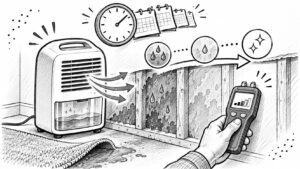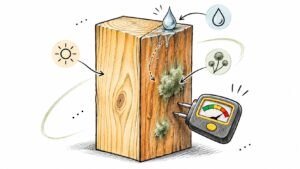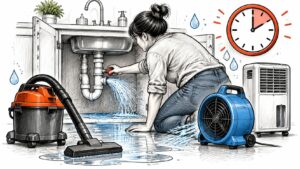
The dehumidifier should run continuously until the building and its contents are measurably dry, and the milestone that governs everything is 24 to 48 hours. That's not a run time you can set on a timer. It's the deadline you're racing while the machine works.
The consequences of missing it are blunt, and the U.S. Environmental Protection Agency's guidance for flooded homes spells them out: dry a flooded home and its contents within 24 to 48 hours whenever possible, and assume mold growth if flooded materials couldn't be dried inside that window. What the deadline doesn't tell you is when to switch the machine off. That answer comes from readings taken inside the materials, never from a clock on the wall.
Most losses land somewhere between four days and two weeks of continuous running, and the spread comes down to which assemblies swallowed the water and how fast the bulk of it came out. Find your closest case in the table below, then let a moisture meter set the actual finish line.
Typical Dehumidifier Run Times by Flood Scenario
Here's the number you can act on today. A contained loss with wet carpet and the bottom of the drywall usually needs several days of continuous operation, a whole-floor flood runs into a second week, and the difference between those two situations is which materials absorbed the water. The table sorts the common cases from quickest to slowest.
Typical drying times by flood scenario
| Flood scenario | Typical drying time | What controls the time |
|---|---|---|
| Shallow carpet and pad, extracted within hours | 2-4 days | Pad removal and airflow |
| Drywall wicked up to about 1 ft (30 cm), water removed same day | 3-5 days | Speed of water removal and moisture inside the wall |
| Wall cavities, insulation or wet subfloor | 5-7 days or longer | Access to moisture trapped in enclosed spaces |
| Concrete slab or basement floor | 1-2 weeks | Slab thickness and indoor air humidity |
| Solid hardwood flooring | 1-3 weeks | Depth of moisture and risk of cupping |
| Contaminated floodwater | No reliable single range. Most porous materials get removed rather than dried | Whether porous materials can be dried or must be removed |
Every range in that table assumes three conditions are already met: standing water is gone, air movers are stripping the wet surfaces, and the dehumidifier is running around the clock on a drain hose rather than a tank that fills at 2 a.m. Break any of those and the row stretches.
How to read the table: match it to your worst material, not your best. A damp rug on a dry slab behaves like a carpet job. A dry rug over a soaked subfloor behaves like a cavity job.
Be suspicious of the fastest rows. Carpet that dries in two to four days is carpet whose pad came out on day one, because a wet pad holds water and blocks airflow from below. Drywall that wicked up a foot of water can read dry on the face in three days while the paper and the stud behind it stay damp, which is where most "it felt dry" surprises start.
The slower rows share one feature. The water is enclosed. A cavity, a subfloor under finished flooring and a concrete slab all hold moisture where moving air can't reach it, so the machine has to pull it out through the surface, one layer at a time. Solid hardwood gets its own row because it fails in both directions: dry it too fast and it cups and gaps, dry it too slow and it stains.
Contaminated floodwater deliberately has no range. Water that arrived from outside, from a sewer backup or across the ground carries contamination that turns drying into removal. Find the row closest to your loss, then read your meters to replace the estimate with a real number.
The 24 to 48 Hour Clock That Sets the Pace
The clock starts when the water stops arriving, not when you notice the stain on the ceiling.
The window is easier to follow as a sequence than as a deadline. Each phase has a check you can do with your hands or a moisture meter, because hours on a clock do not tell you the wood is dry.
Hours zero to six. Extraction. Wet vacuums, pumps, and mops come first, then removal of anything that cannot be saved: carpet pad, saturated insulation, cardboard, bedding, the sofa cushions that squelch. Bulk water is what a dehumidifier cannot touch. Press a towel into the lowest corner. If it comes up dripping, extraction is not finished, and every later hour will run long.
The first 24 hours. The machine runs continuously, day and night, with air movers aimed across wet floors and the lower foot of wet walls. Doors and windows stay shut unless the outdoor air is drier than the indoor air. At the end of this stretch, the air movers should still be blowing across the wet surfaces, the drain hose should be emptying, and the room should not smell like a closed wet closet.
The 48-hour checkpoint. If materials are still wet here, the working assumption shifts from drying in progress to a real chance of mold, and the plan needs to change rather than continue on hope. Push a moisture meter into the base of the wall and the subfloor, not just the carpet face. A cover that feels normal can hide what is still wet underneath, the way the middle of a soaked newspaper stays stuck together after the top sheet has dried.
Day three and beyond. Moisture still trapped in framing, subfloor, cabinets, and wall cavities keeps the machine on long after the room feels normal.
Say a family room took water across the carpet and the bottom of two walls. The unit runs 36 hours, the carpet reads dry, and a meter pushed into the subfloor near the baseboard still shows high moisture. Water migrated down through the pad and sat in the wood. The machine keeps running until the wood gives it up. Runtime follows that reading, not a fixed count of hours.
If you want to see why those first two days decide so much, this walkthrough on preventing mold after water damage covers what happens when the window closes with materials still damp.
Day-one record keeping: write down three things before you forget them. The time extraction ended, the room humidity at that moment, and the time the dehumidifier went on. Those three lines anchor every later reading and every insurance conversation.
Why Room Humidity Is Not the Finish Line
Your hygrometer can sit at 48 percent while a wall stud two feet away is still wet. That isn't a contradiction. It's the difference between the air in the room and the assemblies inside the wall.
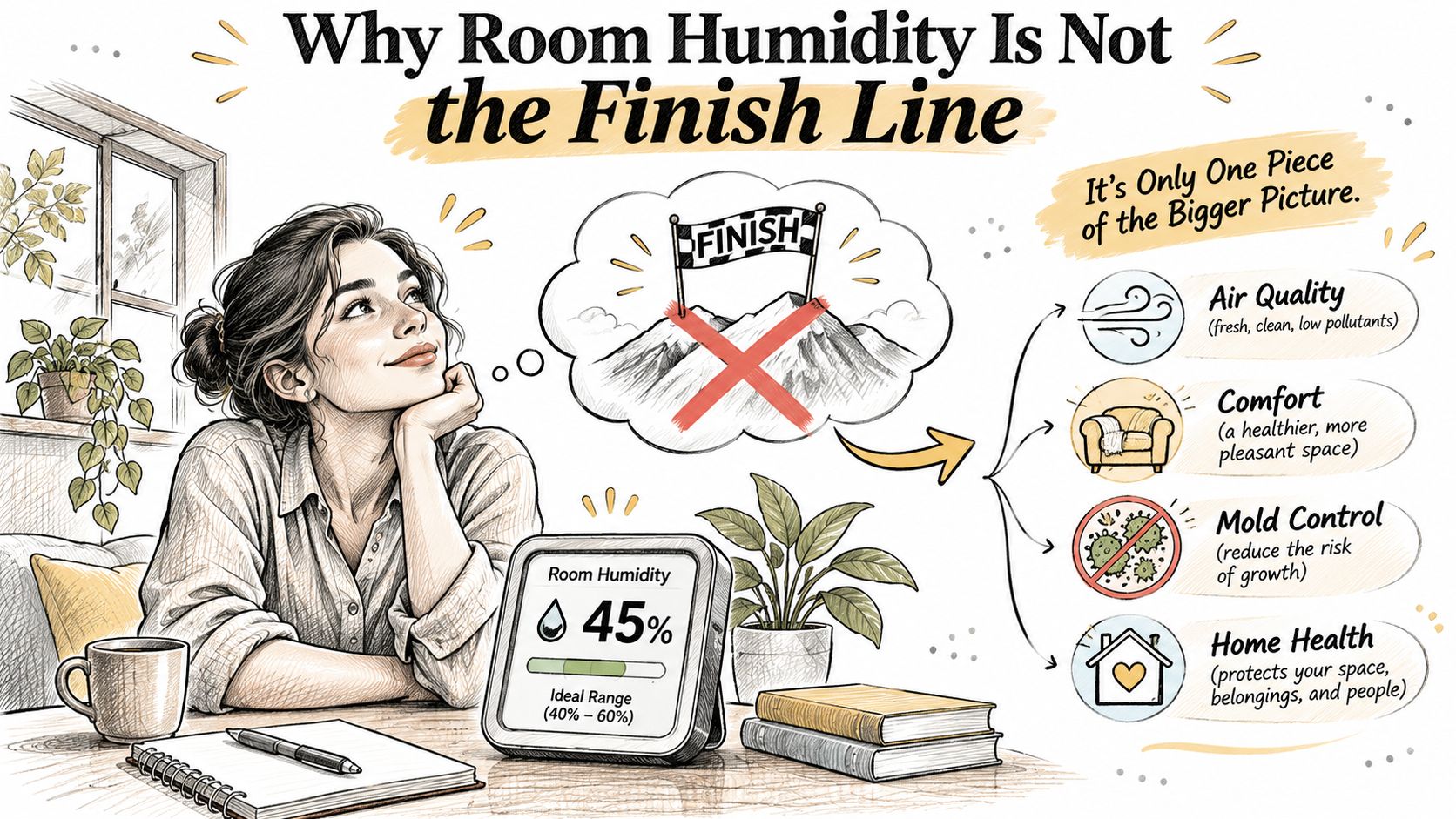
Set a soaked sponge on a plate in a dry room. The room dries long before the sponge does. A dehumidifier's job is to keep the room air thirsty so water keeps leaving the sponge, and the moment the sponge stops releasing moisture the room reading flattens. That flattening is what people misread as finished.
The ASHRAE Handbook chapter on damp buildings treats material-surface conditions as the more relevant concern. Mold risk is associated with persistent water activity above 0.8, while high air humidity alone doesn't reliably predict growth. It also names two practical warning signs: gypsum board moisture consistently above 15% wood-moisture-equivalent, and an indoor dew point persistently above 60°F.
Air humidity still matters. It's the check that tells you whether the machine is doing its job, and the table pairs the air-side targets from EPA with the material-side thresholds from ASHRAE.
Dryness thresholds to check
| Check | Target or warning level | Source |
|---|---|---|
| Indoor relative humidity | 30-50% ideal; keep below 60% | EPA |
| Material water activity | Persistently above 0.8 linked to mold risk | ASHRAE |
| Gypsum board moisture | Consistently above 15% WME is a warning sign | ASHRAE |
| Indoor dew point | Persistently above 60°F signals trouble | ASHRAE |
This is the answer to the question that confuses nearly every homeowner: why is the machine still running when my monitor says the room is fine? Because dehumidifiers pull moisture out of air, and drying continues only while water migrates out of wood, drywall, concrete, carpet padding, insulation and wall cavities. The room reading is the exhaust of that process, not the process itself.
A room reading tells you how well the machine is working. A material reading tells you whether the building is dry. Judge the second one.
Longer isn't automatically better, either. ASHRAE notes that prompt drying after occasional wetting generally avoids long-term risk, so the goal is verified dryness and safe indoor conditions, not an indefinitely running machine. Persistent dampness is the problem, not every brief splash.
Factors That Lengthen or Shorten Drying Time
Two identical rooms can take wildly different times, and the variables are predictable once you name them.
- Water category. Clean water from a supply line or an overflowing sink dries on a fairly predictable curve. Groundwater, stormwater and sewage backups can force removal of porous materials instead of drying them, because contamination doesn't evaporate.
- What got wet. Carpet pad, insulation and drywall hold far more water than tile or sealed concrete. Gypsum board in particular has a paper facing that stays damp and feeds growth, which is why how long sheetrock takes to dry depends on whether the cavity behind it can breathe.
- Contents. EPA guidance holds that paper, cloth, wood and other absorbent contents wet for 48 hours or more may need disposal because they can keep seeding mold, and FEMA's mold prevention fact sheet advises removing items that can't be cleaned and dried completely within 24 to 48 hours. Sentimental value doesn't change the moisture physics.
- Size and layout. One bedroom is a small air volume. A basement, or a ground floor with a dozen enclosed cavities, needs more units, more airflow and more days.
- Outdoor weather. A humid Central Texas week slows evaporation, because the machine is fighting moisture coming in as well as moisture coming out of the walls.
- Equipment and setup. One residential unit in a large open space, with interior doors shut and no air movers, is the slowest version of this job. Extra air movers and a dehumidifier placed inside the affected zone are the fastest.
The clearest example is carpet. A single bedroom with soaked carpet can be dry in a few days. The same carpet spread across an open ground floor, with two units and doors propped open, takes noticeably longer because the equipment is working on a much larger volume of air.
When any factor on that list applies to you, plan on the longer end of your table row rather than the middle. The stopping point stays the same either way: moisture readings that have come back to a dry condition, with room humidity holding steady, rather than a timer running out.
How to Confirm Dryness Room by Room
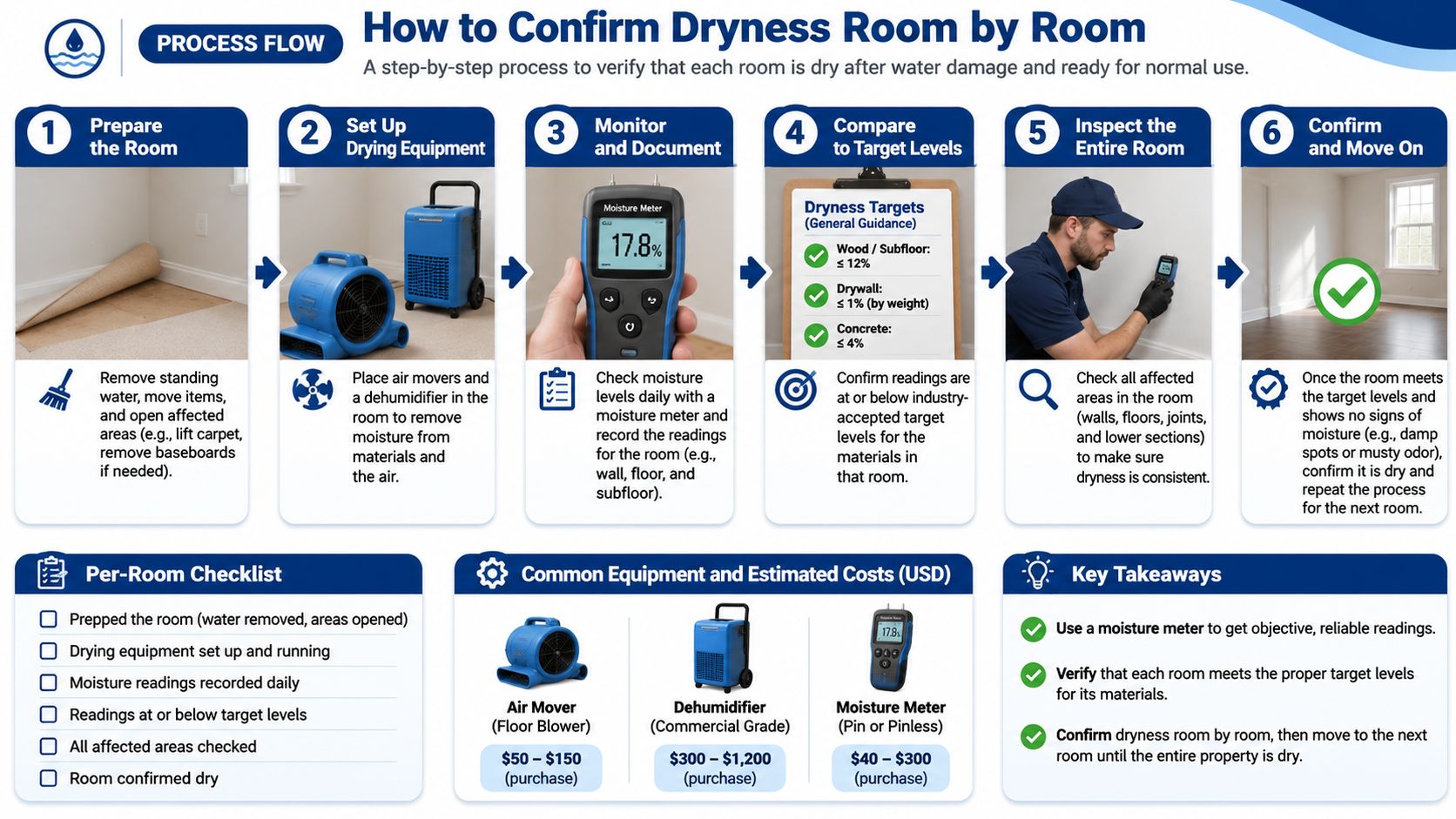
Here's the routine that turns guesswork into a decision. It takes about fifteen minutes a day once you know the spots.
- Set the baseline. Record the date, the room temperature, the room humidity and the outdoor humidity. Without a starting point, a reading of 14 percent on a baseboard means nothing, because you don't know what dry looks like in this house.
- Map your spots. Pick a fixed grid in each affected room: floor level near the wet area, the base of each wall, behind cabinet toe-kicks and under any area rug. This is the same logic professionals use in moisture mapping, just smaller, and the point is that you sample the same places every day instead of hunting for a good number.
- Take material readings. Push a pin-type meter into drywall, subfloor, baseboard and concrete, then take a reading from an unaffected spot of the same material in a dry room. That second number is your reference, and the wet spot is dry when it matches.
- Read the air. Your hygrometer confirms the room is still inside the drying band rather than drifting up toward the range where mold gets comfortable. If the room climbs while the machine runs, the machine is losing.
- Check the dew point. A dew point that stays high tells you the air is loading up with water faster than the equipment can remove it, which usually means more wet material is exposed than you thought.
- Log it at the same time every day. Same clock time, same spots, same instrument. Mold doesn't care about your schedule; the trend line tells you whether the building is giving up water or just cycling it around the room.
- Mark a material dry only after consecutive days. One good reading is a moment. Two days of matching the reference spot is a result.
- Open what you can't reach. If a ceiling or wall cavity keeps reading high, cut a small inspection opening. Wet cavities are the single most common reason a drying job runs long, and an access hole costs far less than the mold behind a sealed wall.
A dry result has a signature. The readings hold low across the whole grid, they match the reference spots in unaffected rooms, they don't climb overnight when the machine cycles down, and the room smells like nothing in particular.
Signs the Drying Has Stalled and What to Do
Drying usually doesn't fail dramatically. It plateaus, and the plateau is easy to miss if you're watching the machine instead of the numbers.
- Readings flat for two to three days while the unit runs. Either the equipment lacks capacity for the volume it's working on, or airflow isn't reaching the wet surface. Add air movers and check the unit's clearance before you add hours.
- A musty or earthy smell that keeps returning. Odor is a moisture report you can smell. Escalate to a moisture investigation rather than masking it with a deodorizer.
- Visible discoloration on walls or ceilings. That's growth, not a stain. Turn the fans off rather than blowing air across it, because fans spread spores through the house.
- Damp material behind a wall or under a floor you can't reach. This is the case for an inspection opening or a professional assessment, since no amount of room-side drying reaches an enclosed cavity.
The distinction between testing and remediation matters, and people mix them up constantly. Testing tells you whether mold is present and at what levels. Remediation removes the growth and fixes the moisture source behind it. One doesn't do the other's job.
Testing earns its cost in specific situations: a persistent musty or earthy odor, recent water damage or leaks, past flooding or plumbing failures, visible discoloration on walls or ceilings, respiratory symptoms that improve when you leave the house, or a home sale in progress. RestoTek TX recommends mold testing in exactly those cases, and guides customers through the next steps, including professional remediation options, if high levels turn up.
If visible mold already covers a wall, stop the fans, keep the dehumidifier running if it's safe, and get an assessment before you touch the drywall.
Know When to Switch the Dehumidifier Off
A room can feel dry to your hand and still be wet inside the wall. The flooded assembly works like a sponge: the face dries first, while the center keeps holding water. You switch the dehumidifier off when material readings stay dry, not when a fixed count of hours is up. How long that takes follows the water left in the materials, the temperature in the room, and whether any new water is still getting in.
Three checks settle the decision.
Material readings need to match their reference spots for at least two consecutive days. Check the same spots both days, because one dry afternoon can bounce back overnight.
Room humidity needs to sit inside the drying band after the machine is off. If the number creeps up once the unit stops, moisture is still leaving the materials.
Hidden areas need a look of their own: wall cavities, the subfloor under finished flooring, and the space behind baseboards. A dry room reading does not speak for a cavity you have not opened or metered.
Any "no" means the unit keeps running. Reread those spots in 24 hours.
Close the source before you treat those readings as final. A plumbing leak, a failed seal, or a damaged subfloor puts water back in, and drying starts over the moment water enters again. RestoTek TX coordinates that repair with licensed plumbers, makes sure the source is resolved, and begins drying and restoration as soon as the repair is done, so the repair and the drying do not sit waiting on each other.
Once the source is resolved and the readings hold, write the result down: date, room humidity, temperature and dew point, material readings by spot, and the time the unit was switched off. Keep that record for an insurance claim, a sale, or the next owner. If the readings still will not hold after the source is fixed, or you suspect mold, return to the escalation steps above rather than running the machine indefinitely and calling it progress.
Call RestoTek TX for an inspection of your flooded property in Georgetown or Austin, or use the site's no-cost estimate request form to start the process.