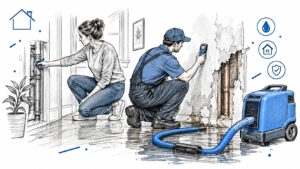
You're standing in a lobby or a suite that wasn't supposed to be wet, and the first thing you notice is how fast the phone starts ringing. Tenants want answers, your insurer wants documentation, and someone on site wants to start tearing out material before the damage spreads. That first impulse is usually wrong. In commercial property restoration, the first decisions set the pace for everything that follows, especially when the building still has to function while crews work around people, systems, and schedules.
What Happens When Water or Fire Hits a Commercial Property
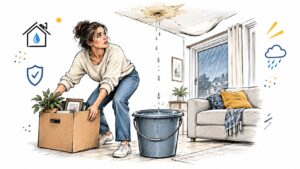
At 7 a.m., a property manager opens a suite and finds water running through the carpet edge and under the baseboards. The ceiling tile is sagging, an HVAC closet smells damp, and two tenants are already asking whether they can open on time. That's the moment most losses go from a maintenance problem to a business problem.
The manager's first instinct is usually to get the water out and make the room look normal. That's understandable, but it's the wrong priority if you skip documentation and source control. Hidden moisture travels into wall cavities, subfloors, and adjacent rooms, and in a commercial building that can quickly turn into a wider loss than what you can see from the doorway.
Practical rule: don't let the panic stage dictate the project. Secure the source, document the condition, then decide what can stay open and what has to be isolated.
Fire losses create the same pressure in a different form. Even when the flames are small, smoke, soot, and suppression water can push the response into a full mitigation and rebuild cycle. That's why commercial property restoration isn't cleanup. It's a controlled recovery process that has to protect people, preserve evidence for the claim, and keep the building usable if at all possible.
The reason this matters in practical terms is simple. Commercial losses are often insurance-driven, and the industry data shows 65% of property restoration projects are initiated by insurance companies (source). That means the manager isn't just solving a water problem, they're building the record that will support the claim from day one.
What Commercial Property Restoration Covers
Commercial property restoration is not just cleanup after a loss. It is the work that gets a building back to a usable condition while protecting tenants, staff, records, and the claim file at the same time. In an occupied property, that means every decision affects operations. In Central Texas, it also means weather can force a tighter timeline, heavier documentation, and faster calls on what gets dried, removed, or isolated.

The five phases that matter
The first phase is inspection. Crews document the source, photograph conditions, map moisture, and record the affected zones before anything gets torn out. In a restaurant or office building, that inspection is what separates a contained problem from one that has already moved into adjacent rooms or tenant spaces.
The second phase is mitigation. That means stopping the source, extracting standing water, removing unsalvageable materials, and stabilizing the space so the loss does not spread. A sloppy demo crew can make the situation worse if it pulls the wrong assemblies or misses the path the water took.
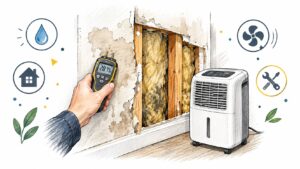
The third phase is structural drying. This is the point where real restoration work starts to matter more than appearance. Crews use dehumidification, air movement, and psychrometric monitoring to drive the structure toward drying targets, not just to make the surfaces look acceptable. If you need a plain-English guide for property owners dealing with commercial water damage, this Georgetown-focused resource is the kind of reference that helps owners understand what proper drying looks like.
The fourth phase is microbial control. That can include deodorization and treatment where conditions require it, especially if the loss sat long enough for hidden moisture to turn into a second problem. The goal is to make the building safe for the next phase, not to pretend the problem never existed.
The fifth phase is reconstruction. That is the rebuild, the finishes, and the coordination with code and occupancy requirements. In an occupied commercial property, reconstruction has to work around tenants, access limits, and the parts of the building that still need to stay open.
Commercial water loss work is often driven by moisture and hidden damage rather than the visible puddle. Market data also shows water damage makes up a large share of restoration revenue, which matches what owners deal with. The easy part is what you can see. The hard part is what is sitting behind drywall, under flooring, and inside framing, especially when a storm or flood has pushed water into multiple zones at once.
The Restoration Workflow From First Call to Final Walkthrough
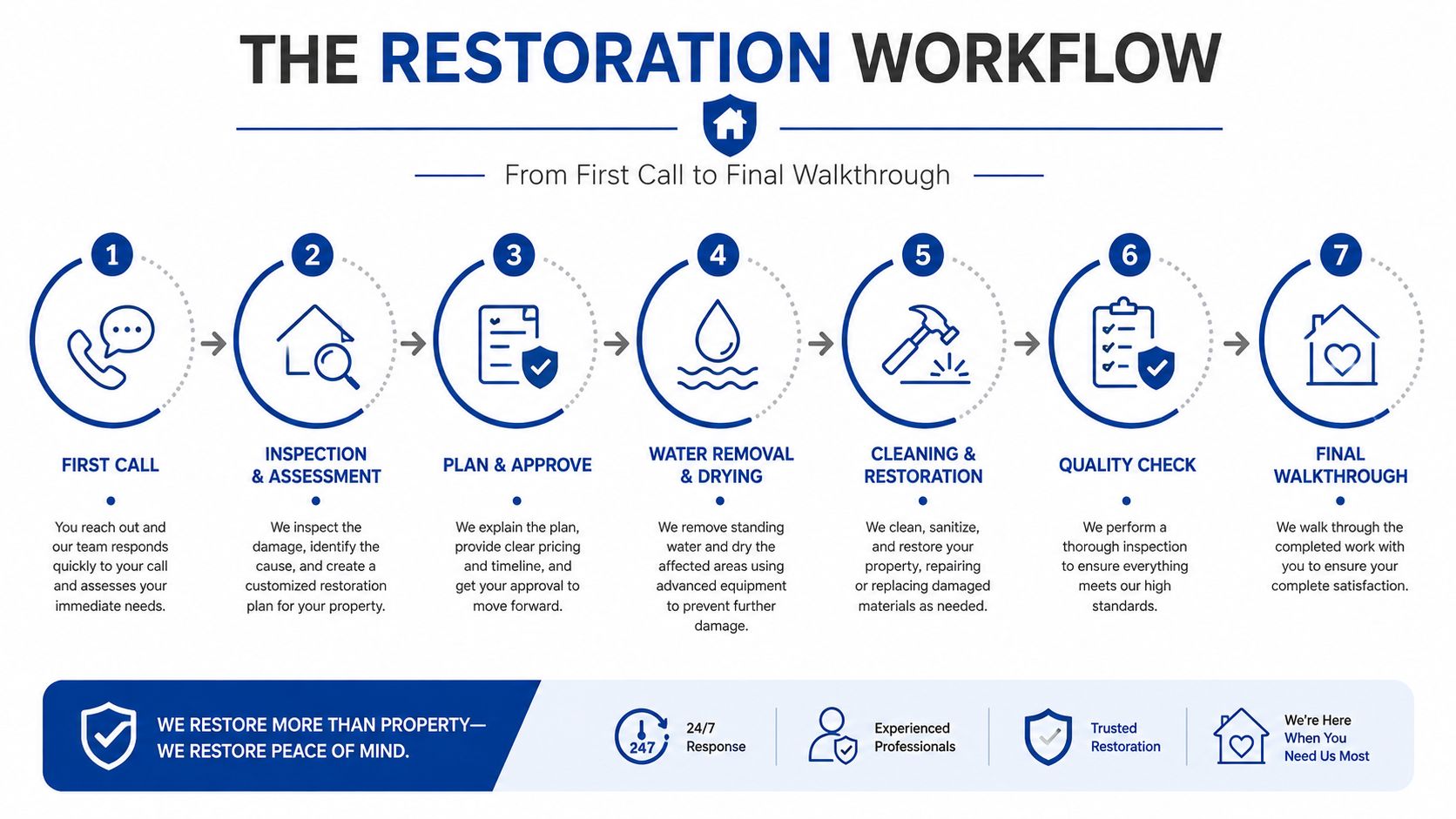
A commercial loss starts getting expensive the minute the phone call is handled badly. If the contractor answers with guesswork, slow callbacks, or a vague promise to “take a look,” the owner is already losing time, documentation, and control over the claim. A serious team shows up ready to stabilize the site, protect occupied areas, and document every move in a way that can hold up under insurance review.
Inspection and documentation come first
The opening file should include pre-mitigation photos, moisture mapping, and psychrometric readings, including temperature, relative humidity, dew point, and wet-bulb values, taken with calibrated instruments, along with a job log at 24-hour intervals that records equipment placement, serial numbers, and moisture readings (source). That documentation chain matters because commercial losses often run through HVAC systems, multiple zones, or regulated materials, so the visible damage rarely tells the full story. If the owner later has to justify scope, sequencing, or denied access to a tenant area, this file is the proof.
The first site visit should also separate what can be saved from what has to come out. Good documentation is not busywork, it is the record that shows the building was stabilized correctly and that the contractor did not jump ahead of the evidence.
Mitigation, drying, and rebuild happen in sequence
Once source control is handled, extraction and demolition of unsalvageable materials can begin. After that, the drying phase has to run to target, not to a guess. Industrial dehumidification and air movement need to be set up across affected zones, because hidden moisture in wall cavities, subfloors, and mechanical spaces will keep feeding secondary damage even after the surface looks acceptable (source).
The building is not dry because someone says it is. It is dry when the readings support it.
That sequence matters even more in occupied properties. If tenants are still working, the crew has to isolate areas, manage access, and keep the rest of the building functional while the loss is being controlled. For owners dealing with storm-driven water intrusion in Central Texas, a plain-English commercial water-damage guide for property owners in Georgetown is useful because local flood conditions change how fast water spreads, how much documentation you need, and how carefully the work has to be staged.
After drying comes microbial control and odor treatment where conditions call for it, then reconstruction. In an occupied commercial property, reconstruction should be planned around code requirements, tenant schedules, and the spaces that cannot shut down. The building should come back in controlled phases, not all at once, because a rushed rebuild creates avoidable rework and tenant disruption.
Costs, Timelines, and Insurance Realities
A commercial loss gets expensive fast when people judge it by square footage alone. Severity drives the bill. A small leak that reaches HVAC, wall cavities, or several occupied zones can cost more than a larger but cleaner loss, because the hidden damage multiplies the labor, the drying, and the documentation. Industry benchmarks have put the average commercial property water damage claim above $85,000, while a typical residential claim sits at $12,514 (source). That spread is the reason commercial scope control has to be tight from the first visit.
What pushes a project beyond the obvious damage
The cost drivers are predictable. HVAC contamination, multiple affected zones, regulated materials, and delayed discovery all turn a simple-looking loss into a much bigger job. Commercial losses also take longer because drying cannot be rushed if you want to avoid hidden moisture showing up later in wall cavities, under flooring, or inside mechanical spaces. If the building is occupied, sequencing matters as much as the repair itself. That is where a solid commercial water-damage prevention plan for Georgetown buildings becomes relevant, because the best claims are the ones you keep smaller before they spread.
Insurance is just as blunt. One industry summary says the average U.S. property restoration claim payout was $8,500 in 2023, and water damage claims made up 40% of all property insurance claims in 2023, up 5% from 2022 (source). That does not tell you what your claim will pay. It tells you the carrier already sees water as routine, which means your photos, moisture logs, estimates, and scope notes need to be cleaner than average if you want the file to move without a fight.
| Dimension | Typical Residential | Typical Commercial | Why It Matters |
|---|---|---|---|
| Claim size | $12,514 typical water damage claim | Above $85,000 average commercial water damage claim | Commercial severity can jump fast when systems and occupancy are involved |
| Claim context | Single-family or small dwelling | Offices, retail, mixed-use, and similar properties | More stakeholders, more coordination, more documentation |
| Workflow | Often simpler and faster | Phase-linked, insurance-heavy, occupancy-aware | The record matters as much as the labor |
| Downtime impact | Inconvenient | Operationally disruptive | Lost revenue and tenant frustration can exceed repair cost |
A good contractor should explain the timeline in plain English. Drying, demo, repairs, inspections, and insurer sign-off do not happen on a neat schedule just because the loss is handled quickly. Occupied buildings make that harder, not easier, because every phase has to respect tenant access, safety, noise, and code requirements. If your contractor cannot show how they will document each phase, they are not ready for commercial work.
The same goes for coverage. Your policy may pay for building repairs and some contents loss, but business interruption, temporary relocation, tenant claims, and extra operating costs often sit in different buckets. Owners who assume one policy covers everything end up arguing about money after the work is already underway. Get the coverage conversation on the table early, before the scope grows and the invoices start stacking up.
Keeping the Building Open During Restoration
Too many owners assume a major loss means total shutdown. That's lazy thinking. In commercial property restoration, the job is often keeping part of the building functional while the damaged zones are isolated and worked in sequence.
Occupancy-aware planning beats blanket closures
The best projects use phased work zones, temporary enclosures, negative air containment, and after-hours scheduling so tenants and customers can keep moving. A retail strip can often be handled unit by unit. An office building can often be restored floor by floor instead of sending everyone home. The point is to control the work environment, not surrender the whole asset.
Communication is what makes that possible. Tenants need to know where they can walk, what noise to expect, and when access changes. Facility managers need a clear contact tree and a daily plan. Security needs to know which doors are open, which zones are locked, and who's authorized to move through the work area. If your contractor treats that as optional, they're not built for occupied buildings.
The business case is obvious. U.S. businesses lost about $1.1 trillion in gross operating surplus from disasters in 2023 (source). That's the clearest argument for phasing work instead of shutting down every time the building takes a hit. Physical repair is one cost. Loss of operations is the bigger one.
Bottom line: restoration has to serve business continuity, not the other way around.
If you're weighing options in Central Texas, use an experienced local operator who can keep the file moving and the building functional. RestoTek TX handles the full cycle from mitigation through reconstruction, which matters when you don't want to hand off the job in the middle of a live occupancy problem.
For owners trying to prevent repeat losses in active buildings, this commercial water-damage prevention guide for Georgetown buildings is a smart reference to pair with your maintenance calendar.
Central Texas Flooding and Seasonal Storm Risk
Central Texas changes the restoration timeline because the weather doesn't give you the luxury of a slow response. Heavy rain, flash flooding, and seasonal storms can turn a manageable leak into a building-wide moisture problem in a single event. That's especially true in Georgetown, Austin, and the surrounding communities where water can enter multiple zones at once and push hidden moisture into wall cavities and subfloors.
Why the local weather changes the playbook
After a flash flood, I don't trust surface dryness. I want readings, I want cavity checks, and I want a contractor who understands how fast water can travel through assemblies that looked untouched at first glance. Seasonal storms also mean restoration schedules can't be planned like a neat office remodel. Crews need to be ready to pivot when another event threatens the site before the first one is closed out.
HVAC systems are another local complication. In commercial buildings, a sudden intrusion can affect more than the room where the water showed up, especially when ducts, returns, and adjacent zones are in play. That's why local experience matters. A contractor who regularly works Central Texas losses is more likely to document aggressively, dry defensively, and coordinate with regional adjusters who know the local storm cycle.
Don't let anyone tell you a wet floor is just a wet floor after a storm. In this region, it's often the visible sign of a larger moisture path.
Older commercial stock makes that problem worse because the building may have layered modifications and incomplete records. That's where the scope gets tricky, and it's one reason I'd rather work with a team that already knows how Central Texas buildings are put together than a crew learning on my project. General national advice doesn't account for local flood behavior, roof loads, or the way storm timing collides with tenant schedules.
How to Choose the Right Commercial Restoration Contractor
Pick the contractor like you're choosing a project manager, because that's what you're really hiring. The truck and the fans are the easy part. What matters is who runs the file, how they document the work, and whether they can carry the job from emergency response through rebuild without losing control of the scope.
Questions that expose the real operators
Ask who handles the project day to day. If the answer is vague, expect confusion later. Ask what the documentation chain looks like from the first visit to the last invoice, because commercial work lives or dies on records.
Ask whether mitigation and reconstruction are handled under one roof. Separate vendors create handoff risk, and handoff risk is where delays, scope gaps, and blame games start. Also ask whether they can mobilize 24/7 for storms, backups, and after-hours incidents, because water damage does not wait for business hours.
You should also ask about in-house capabilities. Extraction, drying, microbial prevention, plumbing tie-ins, and reconstruction should all be part of the conversation. If the contractor outsources everything, you're adding more moving pieces to an already messy situation.
Useful filter: if a contractor talks more about gear than process, keep looking.
For Georgetown and Austin owners, the restoration project management approach is a better model than a piecemeal vendor list because it treats the job as one coordinated file. That's the kind of structure you want when tenants, insurers, and facility staff all need different answers at the same time.
I also prefer local, family-operated accountability over a faceless dispatch network. In a commercial loss, responsiveness matters, but follow-through matters more. The people who answer the first call should be the people who stay with the job.
Your Decision Framework After a Commercial Loss
Use this as the working order after a loss, and don't get cute with it.
- Secure the site. Stop the source, isolate hazards, and keep people out of unsafe areas.
- Document before cleanup. Photograph conditions, note affected rooms, and preserve anything the adjuster may need.
- Call a contractor who handles the full cycle. You want inspection, mitigation, drying, microbial control, and reconstruction under one plan.
- Notify the insurer early. The claim file should start while the evidence is still fresh.
- Plan for occupancy, not automatic shutdown. If the building can operate in phases, protect revenue and tenant trust.
- Track every change. Scope expands fast in commercial losses, so every new condition needs to be recorded immediately.
The big mistake is treating commercial property restoration like a cleanup call. It isn't. It's a project management discipline under pressure, and the first 48 hours usually shape the next six months. The owners who do best are the ones who slow down long enough to document properly, then move fast on the right decisions.
If you're dealing with a commercial loss in Georgetown, Austin, or nearby Central Texas, RestoTek TX can handle the inspection, mitigation, drying, microbial prevention, and reconstruction as one coordinated job. Visit RestoTek TX to get help from a local team that works the way occupied commercial buildings need to be restored.