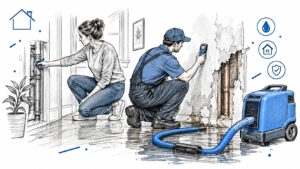
A burst pipe at 2 a.m. doesn't just leave a wet floor. It leaves a living room full of decisions you didn't ask for, with damp cushions, a tilted bookcase, a charger sitting in water, and the quiet fear that every thing you own is now a claim issue, a cleanup issue, and a loss all at once.
If you're in Georgetown or Austin and the water has finally stopped, the hardest part is usually the first hour after that. You're trying to shut off the source, keep people safe, and figure out whether the couch, the dresser, the boxes in the hall closet, and the family photos on the shelf can still be saved. That's exactly where contents restoration services come in, because in a real water loss, the belongings inside the home are often where the emotional damage lives.
When the Water Stops but the Worry Begins
The call usually starts the same way. A homeowner hears a rush of water behind a wall, steps into a hallway that's suddenly cold and wet, and sees the bottom of a sofa darkening as the moisture climbs. By the time the shutoff valve is found, the structure has a problem, but the room's contents are already sending up their own alarms.
What gets people in trouble is the gap between “the water is off” and “I know what to do with all this stuff.” A lamp on the floor might be fine. A drawer full of documents might not be. A wood table can sometimes recover, while upholstered chairs, electronics, and paper goods need fast, specific handling.
The first 24 hours matter more than most homeowners expect
The practical order is simple, even if the moment isn't. Stop the source if it's safe, keep everyone out of standing water, take photos before moving anything, and call your insurer so the claim opens while the scene is still intact. That last part matters because once items are tossed or relocated too quickly, the record gets fuzzy and the claim gets harder to defend.
Practical rule: if you're unsure whether something is salvageable, document it first and move it second.
That early hesitation is normal. Most homeowners are not trying to become restoration experts overnight, they're trying not to make a mistake that costs them money or a keepsake they can't replace.
The reason this service exists is simple. Contents often carry a huge share of the loss, financially and emotionally, and they need a process that's more careful than trash removal and more systematic than a weekend cleanup. That's why a contents team exists at all, to handle the belongings separately from the drywall, flooring, and framing that a structural crew addresses.
What Contents Restoration Services Actually Do
Contents restoration services are the professional cleaning, deodorizing, repairing, inventorying, and storage of personal property after water, fire, smoke, mold, or storm damage. The work can cover furniture, clothing, electronics, documents, soft goods, office equipment, and other household items that still have value after the event. Industry overviews describe the segment as a meaningful part of the broader restoration economy, not a side task, with the contents restoration market estimated at $10.5 billion globally in 2022 and projected at a 4.9% CAGR from 2023 to 2028 (global contents restoration market estimate and projection).
The easiest way to think about it is triage. A hospital doesn't treat every patient the same way, and a contents crew doesn't clean every item the same way either. A wet paperback, a hardwood dresser, and a smoke-coated toaster all need different handling.

Building restoration and contents restoration are not the same job
Structural restoration focuses on the building, drying walls, removing damaged flooring, checking cavities, and getting the home safe again. Contents restoration focuses on the things inside that building, which means the contractor has to track each item, not just each room.
That difference matters because the workflow is built around chain of custody. Inventory logs, photos, and tagged items create the paper trail that supports insurance scope, dispute resolution, and pack-back accuracy (contents chain of custody and inventory documentation). Without that record, it becomes hard to show what was removed, what was treated, and what came back.
Why the category is bigger than it looks
The U.S. damage restoration services industry was valued at $7.1 billion in 2026 and included 60,020 businesses according to IBISWorld (U.S. damage restoration services industry size). That scale tells you something important. The work is common, repeatable, and supported by a large service network, because water losses and other property events create constant demand for contents handling.
For homeowners, that means the field isn't built around guesswork. It's built around repeatable methods, item-level documentation, and fast decisions about what should be cleaned, what should be dried, and what should be set aside as a replacement item. In other words, the belongings in your home are now a formal part of the restoration plan, not an afterthought.
The Step-by-Step Contents Restoration Workflow
The process starts with a walkthrough, but not the casual kind. A technician is looking at each item as a separate decision, because a couch, a box of tax files, and a standing lamp don't have the same recovery path. The goal is to sort quickly enough to protect salvageable items, but carefully enough not to move the wrong piece into the wrong treatment.
Triage first, packing second
During item-level triage, every affected piece gets identified, photographed, and logged. Some companies use barcodes or numbered tags, which helps keep the record straight when a home contains dozens or hundreds of belongings. That inventory becomes the basis for the insurance scope and later pack-back accuracy, which is why a sloppy list can cause avoidable friction.
After triage comes pack-out. Wrapped items leave the home, padded for transport and sent to a controlled facility where humidity, temperature, and cleaning methods can be managed more precisely than in a damp house. This is the part many homeowners underestimate, because moving the belongings out is often what allows the structural crew to dry the home properly.
Cleaning depends on the material, not the room
Hard, non-porous goods can often go through specialized cleaning, including ultrasonic cleaning after loose debris is removed. Paper-based items may need freeze-drying so moisture is pulled out while distortion is minimized. For porous items, drying needs to be controlled closely because residual moisture is what drives mold growth, warping, and adhesive failure (moisture management and item-specific drying).
What the equipment is doing matters more than the label on the box. A safe-looking object can still hide moisture inside seams, joints, or layered materials.
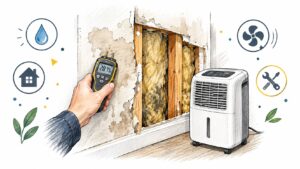
That's why technicians use moisture detectors, targeted dehumidification, and drying methods matched to the substrate. A book, a leather chair, and a metal tool don't age the same way after a loss, so the response can't be one-size-fits-all.
Storage and return finish the job
Once items are cleaned and stabilized, they're often stored in a climate-controlled space until the home is ready for reinstallation. That protects them from a second round of damage while drywall, flooring, or finish work is completed. After the structure is ready, the contents are packed back in place, ideally with the same inventory accuracy that was used on the way out.
For homeowners who want a practical reference while that work is underway, a water-loss checklist like the one at this contents recovery checklist can help keep the first few decisions organized without turning you into a technician.
When DIY Makes Sense and When It Does Not
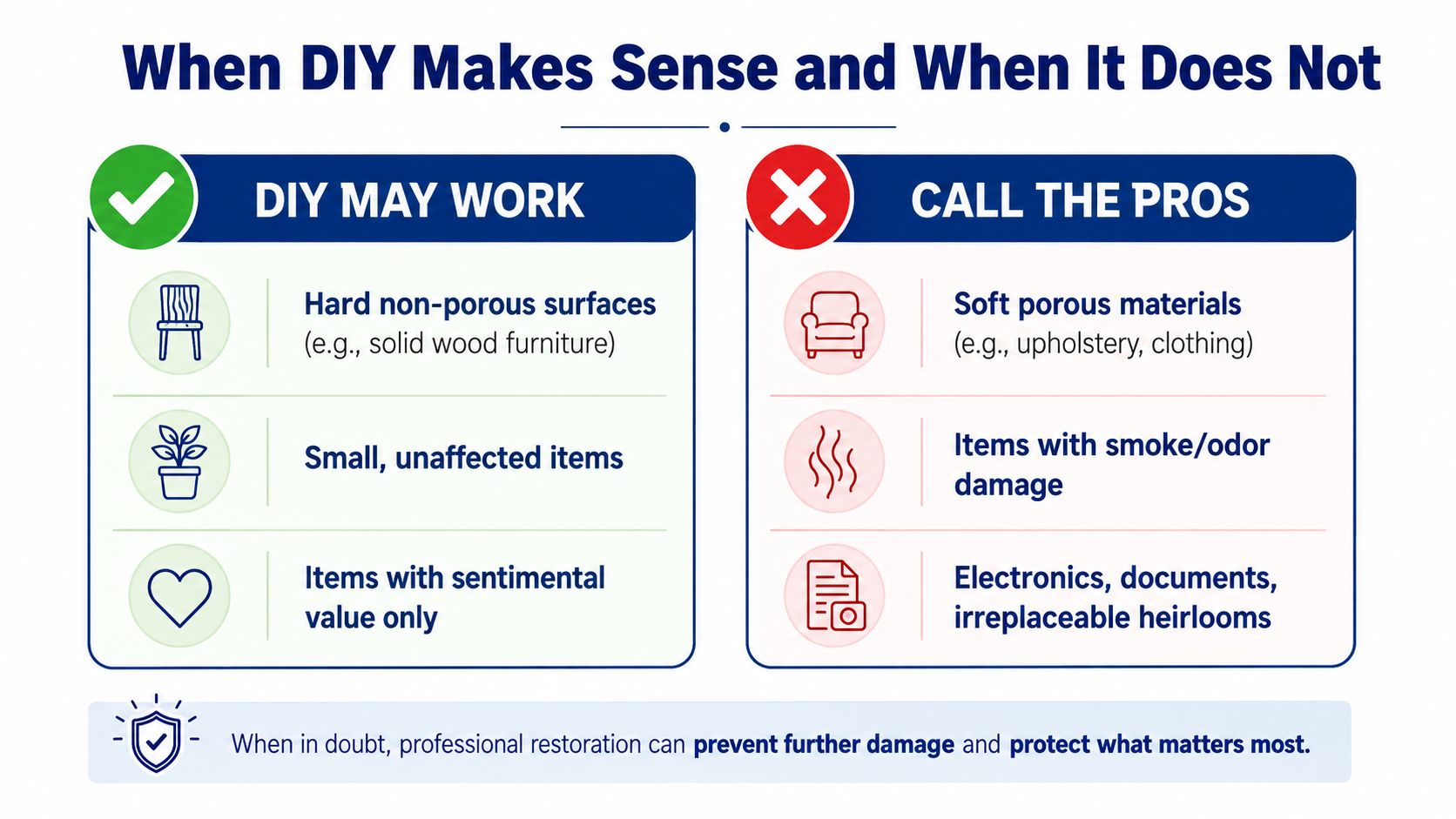
Some items really do belong on the DIY side of the line. A dry plastic toy, a glass vase, a metal hand tool, or a simple container with no hidden electronics can often be washed, dried, and inspected at home if the water was clean and the item never sat in contaminated liquid. A homeowner shouldn't pay a specialty crew to wipe down a product that never needed expert treatment in the first place.
The problem is that many household items look simpler than they are. Upholstery can trap moisture deep in the foam. Books can buckle. Electronics can corrode later, even if they look fine the day you pick them up.
A simple way to sort the room
If the item is hard, non-porous, and clearly uncontaminated, DIY may be enough. If it's soft, layered, absorbent, or electrically powered, the risk climbs fast. Documents, heirlooms, and anything touched by contaminated water belong on the professional side almost every time.
Water-loss economics make that judgment easier. The U.S. industry estimate above places water damage at roughly 35% of total property restoration revenue, and common restoration cost benchmarks are often cited in the $3,000 to $8,000 range per incident (U.S. damage restoration market and water-loss cost context). Those figures don't tell a homeowner what one object is worth, but they do show how often the math favors salvage instead of reflexive replacement.
If the item is expensive to replace, emotionally irreplaceable, or exposed to anything beyond clean water, let a contents team evaluate it before you throw it away.
The biggest DIY mistake is timing, not effort
Homeowners usually don't ruin salvageable items because they clean too little. They ruin them because they wait too long or dry them the wrong way. A heater pointed at a damp document stack or a closed-up box of clothing can lock in odors and moisture instead of removing them.
That's why the best DIY candidates are the easy ones, the objects you can clean thoroughly, dry completely, and inspect visually without opening a mold or corrosion problem. Everything else deserves a second opinion before you spend the energy, or the insurance claim, in the wrong place.
Insurance Estimates Documentation and Realistic Timelines
A contents claim stands or falls on evidence. Adjusters need to know what was there before the loss, what was damaged, what was packed out, and what was cleaned or discarded. If the record is thin, the estimate becomes a negotiation instead of a straightforward review.
The most useful habit is also the simplest. Photograph each room before anything gets moved, then take close-ups of damaged items, serial numbers, brand labels, and anything that proves ownership or condition. Keep receipts if you have them, but don't wait to start documenting just because you can't find old paperwork.
What should stay on your phone and in your folder
Keep a basic claim file with photos, a running list of damaged items, and every email or text you send to the insurer or restoration company. If an item gets discarded before the adjuster or contents technician sees it, that creates a gap that can slow payment or reduce recoverable value. The same goes for missing serial numbers on electronics or appliances.
A claim estimate usually has more moving parts than homeowners expect. It can include pack-out labor, specialty cleaning, storage, repair, deodorization, and replacement value or actual cash value, depending on the policy and the item category. For a practical overview of the carrier side of that process, the guide at how to handle a home insurance water damage claim is a useful companion.
Real timelines are driven by the home, not the calendar
A smooth contents job doesn't end in a day or two. Drying, sorting, repair work, and rebuild coordination all affect when items return, and the total timeline often stretches across weeks rather than hours. What matters most is that the contents move through the workflow in the right order, because rushing the final pack-back before the structure is ready can undo the work already done.
Keep one rule in mind when you talk to the adjuster. Ask what needs to be documented before disposal, and ask what needs pre-approval before cleaning starts.
That question alone prevents a lot of headaches. It helps you avoid tossing the wrong thing, and it gives the insurer the record it needs to process the contents side of the loss with less back-and-forth.
What Georgetown and Austin Homeowners Face Specifically
Central Texas puts its own pressure on a water-loss job. Heavy rain can overwhelm a garage, a slab leak can move through a wall cavity, and a supply-line failure can turn a normal evening into a houseful of wet belongings before anyone knows what happened. In a climate like that, a contents response has to be fast, local, and comfortable dealing with surprise callouts.

Why the local rhythm changes the work
Georgetown homes and Austin homes don't always present the same restoration puzzle. Older construction can hide leaks differently than newer builds, and storm-driven water can create contents issues that start in the garage, move into storage areas, and spread from there. Mineral-heavy water can also leave behind residue that makes textile cleaning more complicated than a simple rinse.
A 24/7 response matters here because the first few hours are still the best chance to preserve belongings. A Saturday-night overflow doesn't wait for a weekday office slot, and a contents crew that can't respond quickly loses the best window for salvage.
Why one provider often makes the process easier
Homeowners get stuck when they have to juggle separate companies for extraction, contents, drying, and rebuild. Each handoff creates another delay, another explanation, and another chance for an item to be mislabeled or left in the wrong room. A single provider that handles inspection, mitigation, contents, structural drying, and reconstruction keeps the record cleaner and the schedule tighter.
That's the practical reason local, end-to-end help matters. It reduces confusion when the homeowner is already trying to manage photos, insurance calls, and temporary living arrangements. It also keeps the restoration plan aligned from the first wet towel to the final pack-back.
For Central Texas residents, that's the kind of support needed, someone who can look at the room, explain what's saveable, and move quickly without adding noise to an already stressful event. In a loss like that, speed is useful, but clarity is what keeps the rest of the job from going sideways.
What to Do Right Now If You Are Facing a Loss
If you're staring at wet belongings tonight, don't start with the trash bags. Start with safety, photos, and a claim call. If the source is still active and you can shut it off safely, do that first, then document everything before you move or discard a single item.
A contents team is worth it when the items are valuable, sentimental, or exposed to water that isn't clearly clean. It's also worth it when you need the inventory and documentation to stand up to insurer review, because the record matters as much as the cleaning.
For a short, practical checklist on the next steps after a water event, use what to do immediately after water damage in your Central Texas home and keep the focus on the first 24 hours.
RestoTek TX helps Georgetown and Austin homeowners handle water-loss damage from the first inspection through drying, mitigation, and reconstruction, so the contents side of the loss doesn't get lost in the shuffle. If you need a clear next step and a no-cost estimate, visit RestoTek TX and ask for help restoring the belongings that matter most.