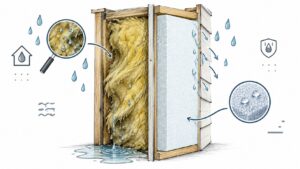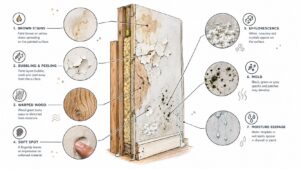
Mold spore testing is not a legal pass or fail test because there are no federal or EPA indoor mold limits, and a standard air sample is often 75 liters collected at 15 liters per minute for about 5 minutes. What it does well is compare indoor air to an outdoor control and help show whether your house has an unusual mold condition that needs a closer look.
If you're reading this in Georgetown, Austin, or nearby, you're probably not researching mold out of curiosity. Usually it starts with a ceiling stain after a storm, a musty closet that won't clear out, warped baseboards after a plumbing leak, or a home purchase where something smells off and nobody has a straight answer.
That's where homeowners get tripped up. They expect one test to tell them whether the house is safe, dangerous, clean, or contaminated. Mold spore testing doesn't work that way. In Central Texas, where heavy rain, flash flooding, hot attics, crawlspace humidity, and fast weather swings can all affect indoor conditions, the value of testing comes from using it for the right reason.
Understanding Mold Spore Testing Fundamentals
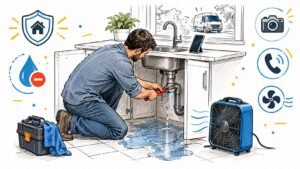
A common Central Texas call goes like this. A homeowner had a supply line leak under a sink, dried what they could, and a few weeks later the cabinet still smells earthy. Another version is storm water intrusion around a window or roofline, especially after a hard rain. By the time they search for mold spore testing, they usually already have a reason to be suspicious.
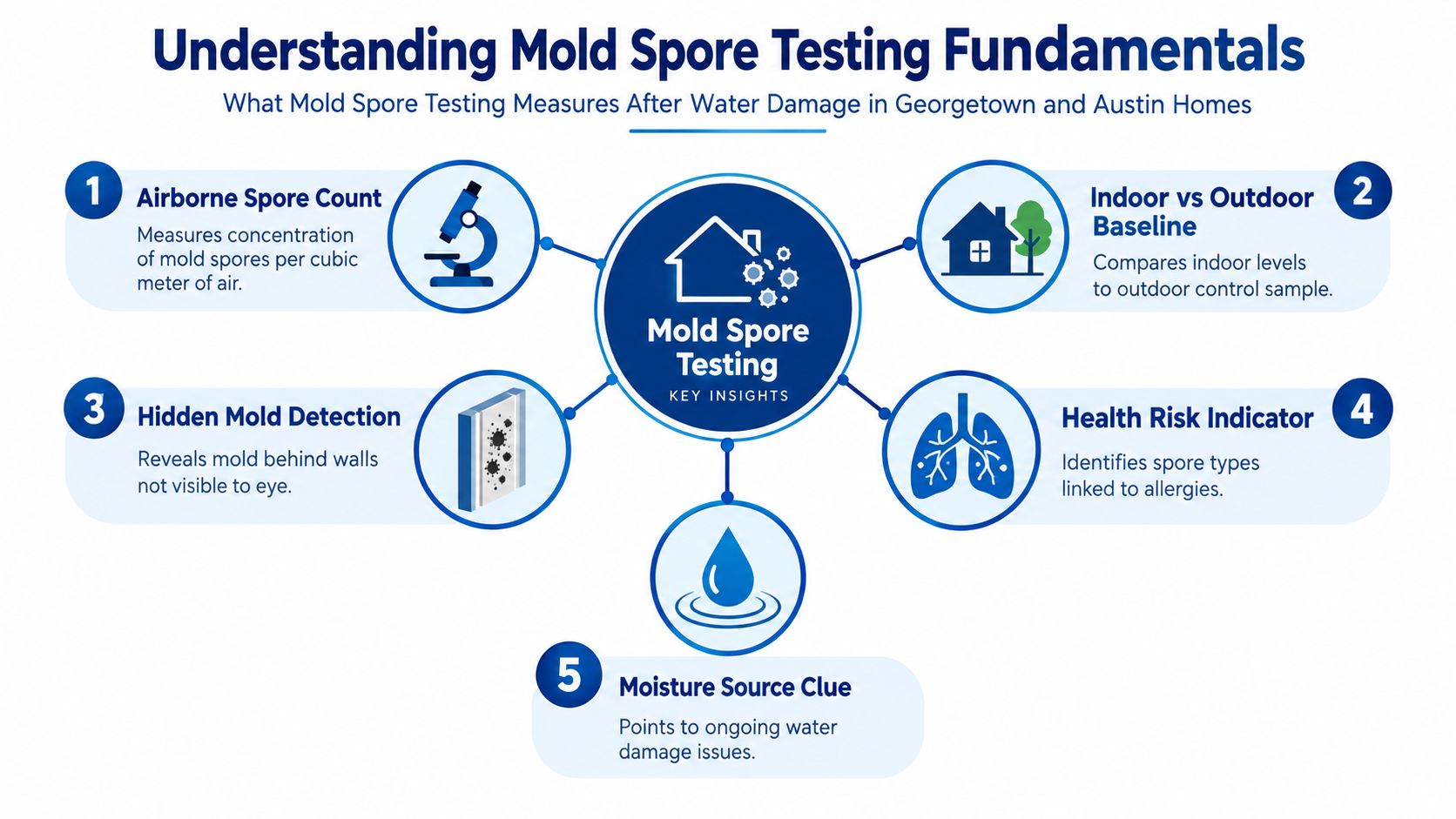
The first thing to know is simple. There are no EPA or other federal limits for mold or mold spores indoors, so sampling can't tell you whether a building complies with a federal safety standard. EPA guidance also says sampling is often unnecessary when visible mold is already present, and it notes that threshold limit values for airborne mold concentrations haven't been set. That's why testing works as a comparative diagnostic tool, not a legal safety stamp, as summarized in federal guidance on mold spore concentrations.
What the test is actually for
When used correctly, mold spore testing helps answer practical questions:
- Is the indoor air unusual: Investigators compare indoor samples to an outdoor control because there isn't a universal indoor cutoff.
- Is hidden amplification likely: If the indoor spore pattern doesn't fit what you'd expect from outside air, that can support further inspection.
- How broad is the problem: Results can help define where to open walls, what rooms need containment, or whether the issue seems localized.
If you already see active growth on drywall, trim, or contents, the house doesn't need a lab report to prove that mold is present. It needs the moisture source identified and the affected materials evaluated.
Practical rule: Test when the result will change a decision. Skip it when the next step is obvious anyway.
Why standard methods matter
The field got more consistent when recognized methods were formalized, including ASTM D7788-14(2023) for collecting total airborne fungal structures through inertial impaction. That matters because a standardized method gives you a more defensible process, even though interpretation still depends on conditions at the property, as described in AIHA guidance on spore-trap sampling methods.
For homeowners trying to sort through options, indoor air quality testing makes the most sense when it's paired with a building inspection, moisture findings, and a clear reason for collecting samples in the first place.
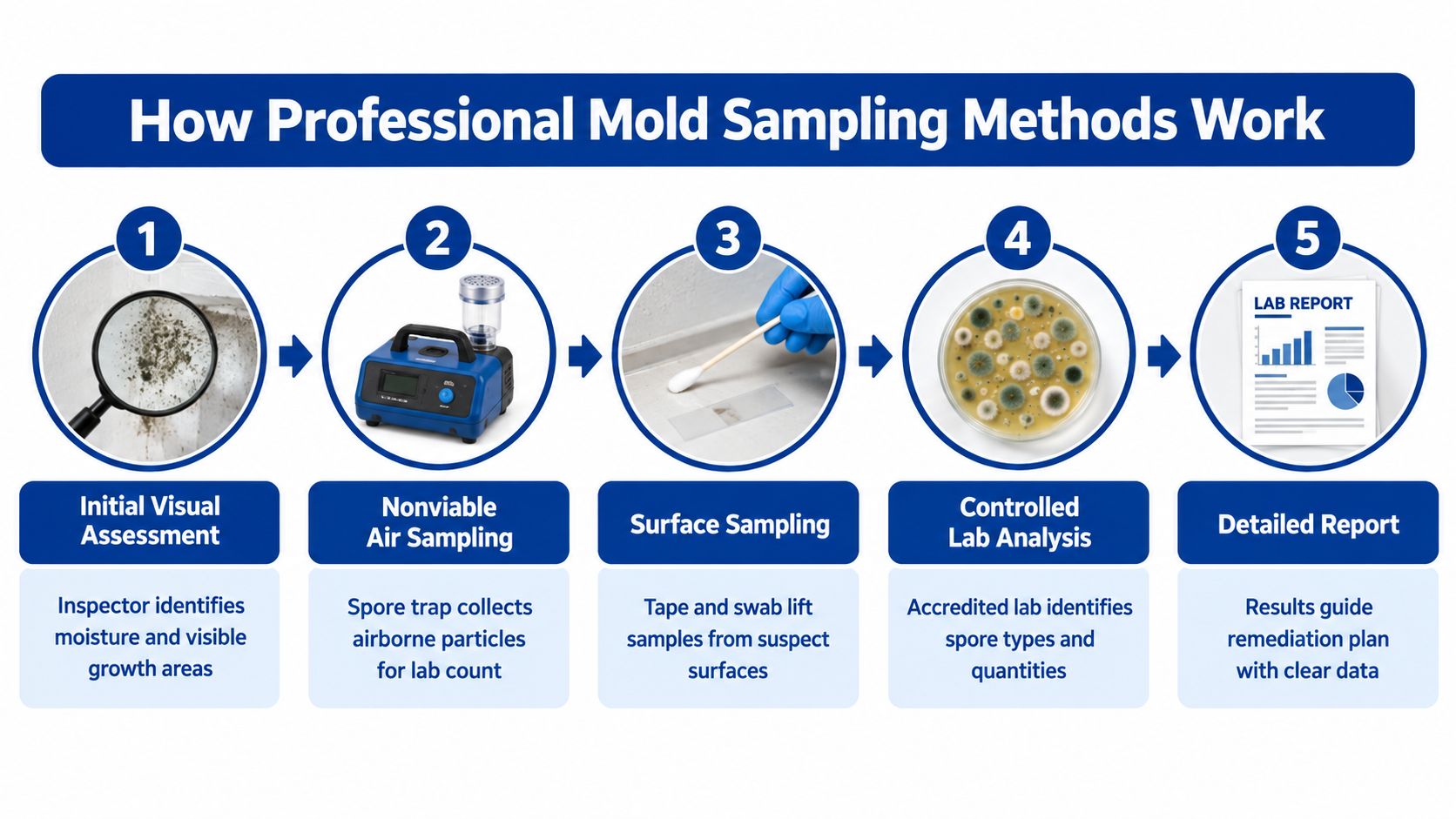
How Professional Mold Sampling Methods Work
Professional sampling is more controlled than most homeowners expect. The standard approach in residential work is usually nonviable spore-trap air sampling. A calibrated pump pulls a known volume of air through a cassette, and a laboratory examines what the cassette captured under a microscope.
What happens during the visit
A solid inspection usually starts before any pump comes out.
Visual review
The inspector looks for staining, visible growth, warped materials, past repair patches, condensation patterns, and odor locations.Moisture-focused investigation
Goal is to connect air results to a possible source. Hidden leaks, wet drywall, damp insulation, or HVAC-related moisture are often more important than the number on the lab report.Air sample collection
A common field protocol is 75 liters at 15 liters per minute for about 5 minutes, with one outdoor baseline sample and multiple indoor samples under controlled conditions. Sample heads are typically placed at breathing height, roughly 3 to 6 feet, and away from walls and supply or return registers for better comparability, according to AIHA direct examination sampling guidance.Optional surface samples
Tape lifts or swabs can help identify visible suspect growth on a material, but they answer a different question than air sampling.
Why timing changes results
Air sampling captures a snapshot, not a long-term average. Open the windows, kick on the HVAC, walk through a dusty room, or sample right after outdoor conditions change, and the counts can shift.
That's one reason experienced inspectors try to control conditions as much as the house allows. In practical terms, if the sampling procedure is sloppy, the report may still look official while answering the wrong question.
Good mold sampling is part building science, part field discipline. The cassette only tells you what was in the air during that brief collection window.
If you're hiring someone for professional mold inspection, ask how they choose sample locations, whether they collect an outdoor control, and what building conditions they want during the test.
Interpreting Laboratory Test Results Correctly
The lab report usually looks more precise than it really is. You'll often see mold types listed with counts reported as spores per cubic meter of air. Homeowners naturally want to know what number is acceptable. That's the wrong first question.
What the report can tell you
The useful reading comes from comparison, not from chasing a single benchmark. Indoor air is evaluated against the outdoor control and against what the inspector found in the building. If the indoor environment shows a pattern that looks out of line with outdoor air, that can support the conclusion that mold is amplifying somewhere inside.
A careful interpretation also looks at species mix, not just total count. Different genera can point toward different moisture histories and different source conditions. A room with a musty odor, elevated moisture in materials, and an indoor spore profile that doesn't match outside air tells a much stronger story than a spreadsheet alone.
What homeowners often misread
Here's where people get into trouble:
| Common assumption | Better interpretation |
|---|---|
| A high number means the house is automatically unsafe | The report shows an unusual condition that must be read with inspection findings |
| A low number means there's no mold problem | Air sampling can miss hidden growth if spores weren't active in the air at that moment |
| One room result applies to the whole house | Conditions can vary from room to room based on moisture, ventilation, and use |
| A lab report clears the property | A report supports decisions. It doesn't certify long-term safety |
The best mold report is the one that lines up with what the building is doing. If the numbers and the house disagree, I trust the house first and investigate why.
What to ask after you get the report
When you review results, ask practical questions instead of abstract ones:
- Where is the likely source: Did the results point to one room, one system, or one moisture event?
- What should be opened or dried: Are there materials that need invasive confirmation?
- Does remediation need containment: Is the issue isolated or likely to spread during demolition?
The report becomes useful when it drives the next step. On its own, it's just a narrow slice of time.
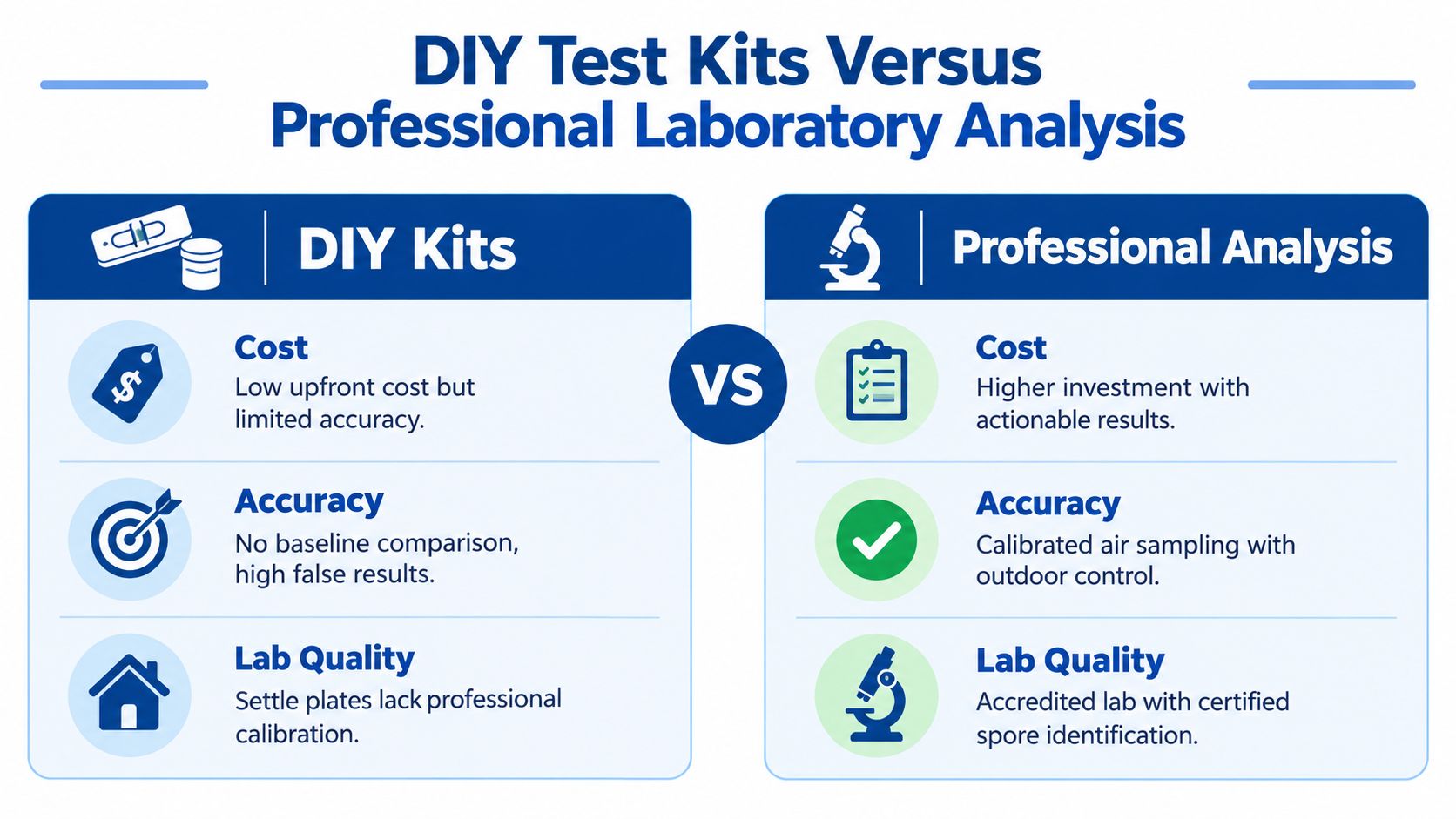
DIY Test Kits Versus Professional Laboratory Analysis
Homeowners buy DIY kits because they want a fast answer without scheduling an inspection. That's understandable. The problem is that many kits create confidence or panic without delivering much decision-making value.
Where DIY kits fall short
Most consumer kits don't recreate the discipline of professional sampling. They usually lack calibrated pumps, don't guide the user on strategic sample placement, and often skip the outdoor control that gives indoor results meaning.
That leaves homeowners with a basic problem. They may learn that mold spores exist, but mold spores also exist in normal environments. Without context, the result doesn't say much.
A side-by-side view makes the trade-off clearer:
| DIY kits | Professional analysis |
|---|---|
| Often simple to buy and use | Takes scheduling and on-site inspection time |
| Can show that particles or growth are present | Can tie results to moisture patterns and room conditions |
| Easy to misread without baseline comparison | Uses outdoor control and structured sample locations |
| Limited value for scope decisions | More useful for remediation planning and documentation |
When a DIY kit might still help
There are limited situations where a basic kit can serve as a prompt to look deeper. If a homeowner is deciding whether to bring in an inspector after a suspicious odor or small isolated concern, a kit may encourage action.
But it won't replace a field assessment when decisions matter. Insurance documentation, real estate disputes, hidden moisture questions, or post-cleanup verification usually need a more defensible process.
For people comparing options, whether home mold test kits are reliable depends less on the package and more on whether the result helps you decide what to do next.
A DIY kit can tell you something is worth investigating. It usually can't tell you how far the problem goes, where it started, or what to remove.
One practical option in Central Texas is RestoTek TX, which offers mold testing and inspection as part of broader water damage and moisture investigations. That matters when the issue isn't just "Is mold present?" but "What got wet, what stayed wet, and what needs to happen now?"
When to Test and When to Skip Mold Spore Testing
This is the part most homeowners care about. Not "What is mold sampling?" but "Should I spend money on it right now?"
The neutral public-health position is straightforward. Sampling is often not needed when visible growth is already present, because there are no health-based federal limits or compliance thresholds for indoor mold spores. In practice, testing helps with documentation, suspected hidden amplification, and remediation scope, but results have to be read in context, as outlined by NIOSH guidance on mold testing and remediation.
Test when the answer changes the plan
Mold spore testing earns its keep in a few specific situations:
- Hidden mold is suspected: You smell mold, but you don't see it, and the property has a leak history.
- Pre-purchase uncertainty: A buyer wants more than a seller disclosure and visible walk-through.
- Insurance or claim documentation: You need third-party evidence of conditions tied to a water event.
- Post-remediation verification: You want support for the decision to rebuild or reoccupy after cleanup.
Skip testing when the next step is already clear
There are also times when testing adds very little:
- Visible growth is present: The material still needs evaluation, cleaning, removal, and moisture correction.
- The moisture source is active: Stop the leak, dry the structure, and stabilize the building first.
- A doctor-level health question is driving the call: Environmental sampling doesn't answer medical diagnosis or individual sensitivity.
The question testing cannot answer cleanly
Homeowners often ask, "Is this house safe to occupy right now?" Current guidance leaves a real gap here. Spore-trap sampling is only a short-term snapshot, results can miss actual exposure conditions, and there are no health-based indoor-air standards for mold spores. That means a single air test doesn't support a reliable safe versus unsafe label, as discussed in federal mold assessment guidance for building decision-making.
In Central Texas, that matters even more after flood events and leak losses because indoor conditions can swing fast with weather, drying equipment, HVAC operation, and which rooms stay closed up during the day.
What to Expect from a Central Texas Mold Inspection Service
A good local inspection service shouldn't feel like a mystery. The process ought to be methodical, plainspoken, and tied to the actual building, not just to a sample count.
What the visit should include
In this region, the first conversation usually starts with the water story. Roof leak, overflow, slab-side plumbing issue, storm entry around a window, or an odor that showed up after a past event. From there, the inspector should walk the property, focus on likely moisture paths, and decide whether testing adds value.
Expect a service visit to include:
- Site history review: When the leak happened, what got wet, what was removed, and what still smells wrong.
- Visual inspection: Drywall, trim, cabinetry, flooring transitions, closets, utility spaces, attic-adjacent areas, and HVAC influence zones.
- Moisture mapping or targeted diagnostics: The point is to connect any sampling plan to a real building condition.
- Strategic sampling if warranted: Not random rooms. Rooms chosen because there's a question to answer.
What the report should do
A useful report shouldn't just list mold names. It should help you make a property decision. That usually means identifying where findings appear normal, where they appear unusual, and what that means for cleanup, further opening, or verification.
You should also expect clear communication about timing. Labs usually take several business days to turn around results, and those results need interpretation. Fast answers are nice, but rushed interpretation causes expensive mistakes.
If an inspector can't explain why each sample was taken, the report probably won't be worth much when it comes back.
For Central Texas property owners, a company that can inspect, document, and carry the job through drying and reconstruction can reduce handoff problems. RestoTek TX is family-operated by Joan and Josh Garza, and its service model covers inspection through repair work, which fits many leak and flood cases where mold concern is only one part of the loss.
Central Texas Specific Guidance for Homeowners
Homes around Georgetown and Austin have a few recurring patterns. We see wind-driven rain entering where owners didn't expect it. We see plumbing leaks that stay hidden inside walls because the first clue was odor, not standing water. We also see houses that were partly dried after a loss, then sealed back up while moisture was still trapped in materials.
That last part is where mold concern grows legs in Central Texas. Heat, humidity, closed houses, and intermittent HVAC use can turn a small wet area into a bigger indoor air complaint.
What matters most locally
A practical homeowner approach in this area looks like this:
- After storms, check transitions: Windows, roof penetrations, exterior wall corners, and attic access areas deserve attention.
- After plumbing leaks, think beyond the visible water: Cabinet backs, toe-kicks, wall cavities, and flooring edges often tell the fuller story.
- Don't chase odor with paint or fragrance: If the smell remains, the moisture history isn't resolved.
- Keep records early: Photos, dates, drying invoices, and inspection notes help with claims and later resale questions.
The smartest next step
Most mold problems here are solved the old-fashioned way. Find the water. Stop it. Remove what can't be saved. Dry what can. Clean properly. Then test only if the result will answer a real unresolved question.
That approach keeps homeowners from wasting time on numbers that don't change the outcome. It also avoids the opposite mistake, which is ignoring hidden moisture because a cheap test looked fine on one day in one room.
If you hire someone, ask direct questions. What moisture source do you suspect? Why are you sampling that room? Will the result change the scope? That conversation usually tells you more about the quality of the service than the lab form itself.
If you're dealing with a leak, musty odor, or suspected hidden mold in Georgetown or Austin, RestoTek TX handles inspection, water damage assessment, drying support, and mold-related documentation under one roof. If you want a practical evaluation of whether mold spore testing makes sense for your situation, visit RestoTek TX and request help based on the actual conditions in your home.