A Georgetown homeowner can go to bed after a hard thunderstorm and wake up to a living room that smells wet, a window blown out, and rain still dripping from the ceiling. In that moment, the priority isn't cosmetic cleanup. It's stopping the property from taking on more damage, keeping intruders out, and documenting the loss in a way the insurer will accept. If you're dealing with that kind of surprise right now, a fast response matters, and local restoration guidance like this Georgetown and Austin emergency restoration overview can help you understand why timing is so critical.
Introduction to Emergency Board Up Service
The first thing most homeowners want to know is simple. What exactly needs to happen after the glass breaks or the roof opens up? An emergency board up service is the temporary securing of damaged openings so the building stops bleeding value through weather exposure, theft risk, and structural deterioration.
That matters in Central Texas because storm cells move fast, hail can shatter windows without warning, and fire or impact damage can leave a home open to the elements before anyone has time to think clearly. A board-up is not a handyman patch. It's a loss-mitigation step that helps protect the structure long enough for permanent repair work to begin.
The urgency is tied to insurance expectations. Standard mitigation obligations expect the opening to be secured within a narrow window, and when that doesn't happen, claims can become harder to defend. If you're standing in a damaged room wondering whether to wait until morning, the safer answer is usually no.
Practical rule: if the property is exposed to rain, wind, or unauthorized entry, treat the board-up as part of the emergency response, not as a later convenience.
Defining Emergency Board Up Service
An emergency board up service is the temporary enclosure of damaged openings, such as broken windows, compromised doors, or roof breaches, with rigid sheet materials that are secured to the frame. In residential work, technicians often use 5/8-inch OSB. For commercial structures, 3/4-inch OSB or plywood is more common. The goal is to stop more damage before permanent repairs begin (property restoration guidance). A board-up is meant to stabilize the structure, the same way a temporary brace holds something in place until a full repair can be made.
The timing matters because the window for mitigation is narrow. After a property loss event, insurers usually expect owners to act within 24 to 72 hours to limit further loss and meet standard mitigation obligations. If that step is delayed, the original storm, fire, or impact is no longer the only problem. Secondary damage starts to take over, and that is often harder to justify on a claim.
A proper board-up serves two jobs at once. It blocks weather intrusion and unauthorized entry, so rain, debris, and trespassers do not keep affecting the property while the next repair phase is being arranged. It also gives adjusters, inspectors, and contractors a stable opening to evaluate instead of a home that keeps deteriorating. If water keeps entering, the repair scope usually grows. If someone can get inside, the security risk grows too.
The work also has a safety side that homeowners do not always see. Technicians are expected to assess hazards before they measure or stage materials, especially on unstable structures and around fall risks, under OSHA 29 CFR Part 1926. That step matters because a damaged opening can hide loose framing, sharp edges, or weakened surfaces. In practice, emergency boarding is not just cutting plywood and fastening it in place. It is a controlled response that tries to protect the building without making the scene more dangerous for the crew or the property owner.
Indicators You Need Board Up Service
You don't always need a full structural repair to need a board-up. You need one any time the building envelope has been opened enough that rain, debris, or people can get inside. A shattered front window after a burglary, a door that no longer latches after fire damage, or a roof puncture after a fallen limb can all trigger the same response.
Common situations that call for immediate action
- Storm damage: Broken glass, torn siding, and roof openings can let water and wind keep working on the home after the storm passes.
- Fire losses: Heat, blast pressure, and firefighting activity can leave openings that make the property vulnerable to both weather and trespassers.
- Vehicle impact: A crash into a wall or storefront can create a direct entry point that needs temporary enclosure.
- Vandalism or break-in: Even if the visible damage looks minor, unsecured openings invite repeat intrusion.
A good mental test is this. If you can stand outside and clearly see a path into the interior, the building is not secure. If you can feel air, rain, or debris moving through the opening, the damage is no longer isolated.
Broken glass is only part of the problem. The real issue is that the building has lost its barrier.
The other clue is change over time. A crack, missing shingle, or half-damaged door might look manageable at first, but exposure makes everything worse. In Central Texas, where weather can shift quickly, waiting often turns a repairable opening into a much larger mitigation job.
On-Site Process Materials and Safety Steps
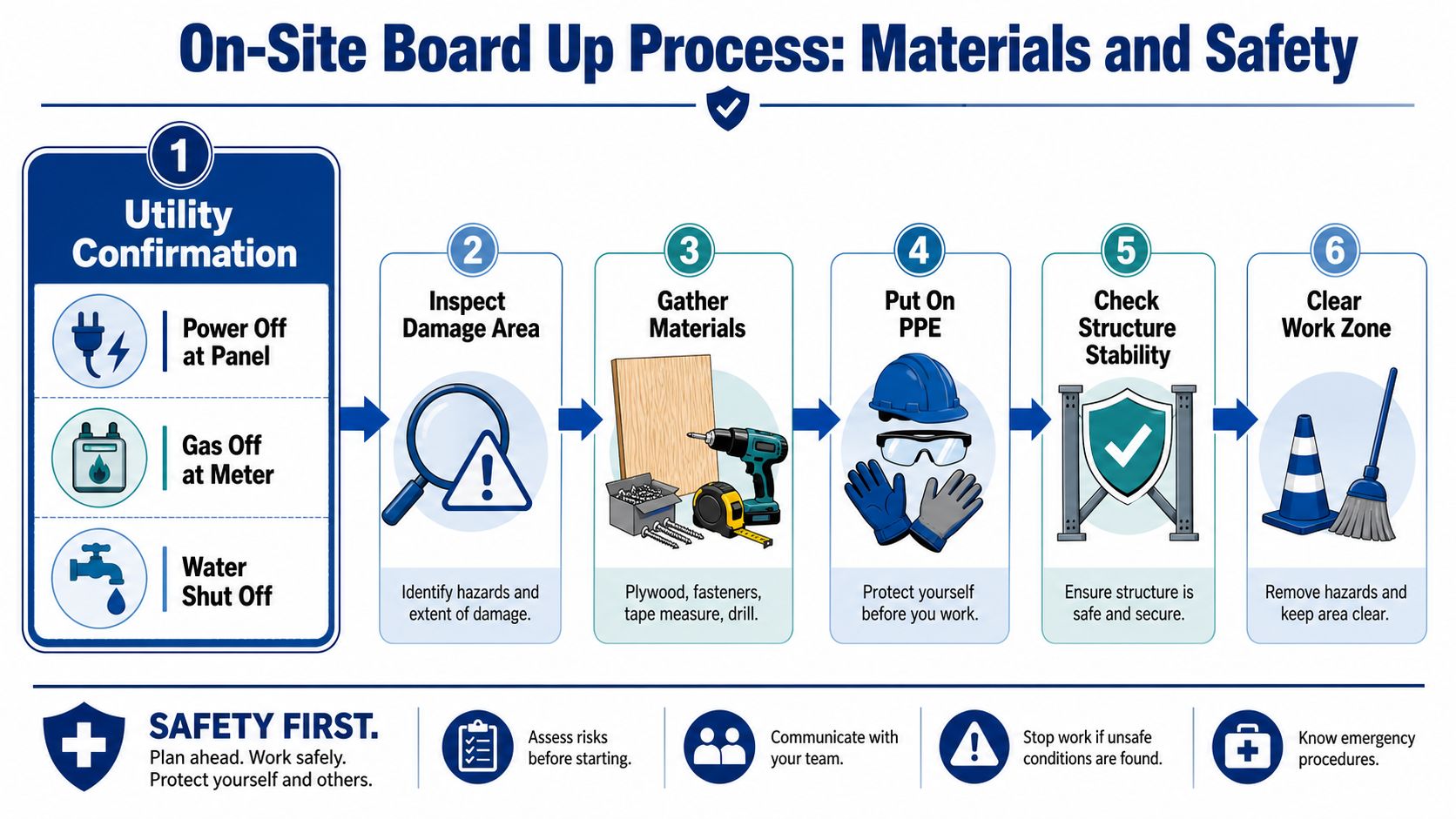
A proper board-up starts before the first sheet is cut. Crews begin by checking whether the site is safe to enter, because a boarded opening can hide a live electrical problem, a gas issue, or unstable framing if the damaged area is sealed too quickly. For a homeowner, that sequence can feel slow in the middle of an emergency, but it is the part that keeps a bad situation from getting worse.
Utility confirmation comes first
The first step is to confirm the utilities tied to the loss. For fire damage, electricity should be shut off at the main panel. For fire or explosion events, natural gas should be shut off at the meter with the utility company involved. The water supply main valve should also be closed so damaged piping does not keep feeding the problem, as outlined in the utility and stabilization protocol. This follows OSHA 29 CFR 1926.416, and the point is simple. A boarded opening should not trap an active hazard inside the structure.
Crews should also keep a written utility log. That record notes how each utility was confirmed, when it was handled, and who handled it. The log becomes part of the job file, and it helps later if an insurer or adjuster asks how the site was made safe. In practice, it is the paper trail that shows the board-up was built on verified conditions, not assumptions.
Hazard assessment and material staging
Once the utilities are clear, the crew examines the opening and the surrounding structure for loose framing, falling debris, and unsafe access points under OSHA 29 CFR Part 1926, as described in property restoration guidance. Only after that check do they measure the openings and stage the panels. For residential work, 5/8-inch OSB or plywood is the usual material, because it gives the opening a temporary skin strong enough to resist weather and unauthorized entry.
The fastening pattern matters just as much as the panel itself. Screws should be placed every 12 inches along the perimeter frame, and deck nails every 6 inches where screws are not used, so the board anchors into sound framing instead of depending on pressure or adhesive alone, according to board-up fastening guidance. The joints should also be sealed with weatherproof tape rated for the expected wind load, which helps the temporary barrier keep out rain, snow, and wind-driven debris. That setup works like a temporary shell around the damaged area, giving the home a short-term barrier until permanent repairs are possible.
Homeowners often expect board-up work to mean only covering a hole with one sheet of wood. However, the job is more controlled than that. The crew is building a temporary exterior system, one that has to hold during changing weather and still leave the structure ready for repair. If roof leakage is part of the same loss, roof drying guidance for Central Texas homes can help you understand what usually comes after the opening is secured.
Costs Insurance and Documentation
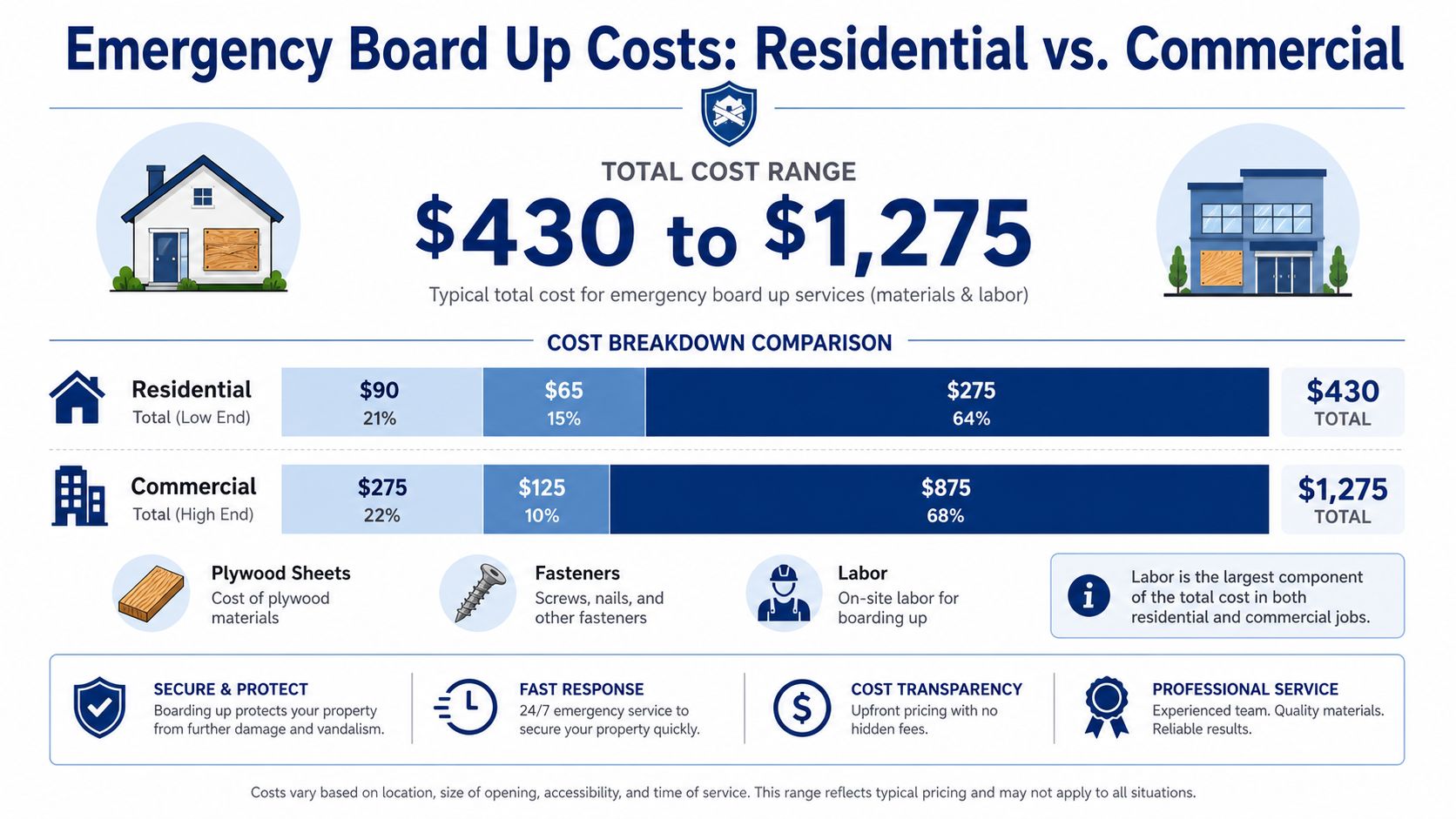
A board-up invoice is easier to read when you break it into parts. For a standard-sized home, emergency board-up services typically range from $430 to $1,275, with $180 to $375 going to materials and $200 to $800 going to labor, according to board-up pricing data. That range changes with the number of openings, how easy they are to reach, and how long the crew has to stay on site.
What drives the bill
Materials for a typical home may include 12 to 15 sheets of 4×8-foot plywood, averaging $15 to $25 per sheet, plus fasteners and braces. Labor is often billed at $50 to $100 per hour, with a work time of 4 to 8 hours. For commercial properties, labor often rises to about $70 per man-hour plus materials.
Budget rule: if the opening is large, elevated, or tied to roof damage, the labor portion can matter as much as the panel itself.
Insurance paperwork that actually helps
Board-up costs are usually treated as mitigation expenses, but the paperwork has to be clean. Photograph the damage before the crew covers it, save the invoice, and ask for written proof that the structure was vulnerable enough to justify emergency enclosure. Insurers often want more than a broken window photo. They want a clear record of the immediate risk, the temporary protection used, and the reason the work could not wait, which is why insurance documentation guidance is useful to keep close while the claim is open.
Homeowners also get tripped up by how reimbursement is categorized. Some policies treat board-up under emergency mitigation or loss-related protections, but the exact handling depends on the claim file and the insurer's documentation standards. If you are preparing a claim after a storm or leak, water damage claim guidance can help you follow the wider paper trail that often comes with a loss event.
Selecting a Reputable Local Provider
A good provider should sound calm, not hurried. They should explain what they'll secure, what utilities need to be checked, what documentation they'll leave behind, and how the temporary barrier fits into the rest of the restoration job. If the first conversation is vague, the on-site work may be too.
What to look for before you sign
- Clear response process: The company should explain how fast a crew can dispatch and what they need from you before arrival.
- Safety discipline: Ask whether they document utility shutoffs and hazard checks in writing.
- Insurance familiarity: They should know how board-up work is tied to mitigation and claim support.
- Full-cycle capability: A provider that can handle inspection, mitigation, drying, and reconstruction makes handoffs simpler.
- Local communication: In Georgetown and Austin, fast contact matters when the weather is still active.
Family-run operators often stand out when they keep the explanation plain and the scope of work tight. That matters because homeowners in a stressful loss don't want a sales pitch. They want someone who can say what's unsafe, what's getting covered, and what comes next.
Ask for the plan in plain English before the first panel goes up. If you can't understand the plan, the file may be just as confusing later.
For Central Texas owners, local knowledge also helps. A provider that understands storm-driven water intrusion, humidity concerns, and the pace of insurance follow-up is usually better equipped to keep the job moving without making promises they can't keep.
Central Texas Weather and Permit Insights
Central Texas weather changes the board-up conversation fast. Flash floods, hail, and heavy rain can turn a roof opening into a moisture problem even when the walls are still standing. In that setting, tarping plus boarding often works better than relying on one temporary fix, especially when roof breaches are part of the loss (Central Texas storm damage guidance).
That local difference matters because water can travel farther than a homeowner expects. A plywood panel may close off an opening, but it does not always keep wind-driven rain from working its way into the structure. National advice often stops at the exterior opening, while Central Texas homes also have to deal with fast-moving storms and the chance that more rain is still coming.
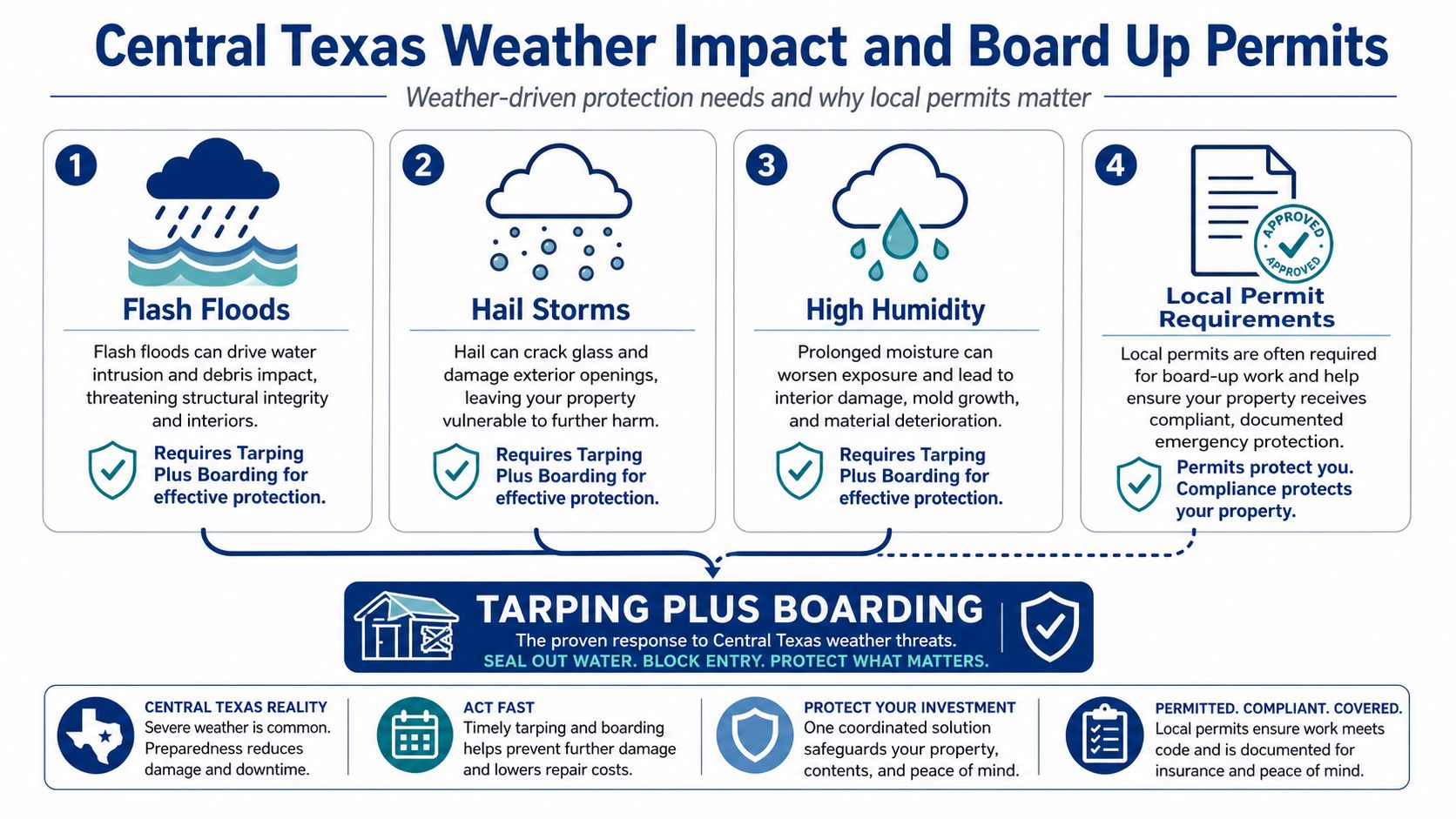
Permit rules can matter too, especially if a temporary repair is visible from the street or changes more than a simple opening closure. Homeowners in Georgetown, Austin, and nearby cities should check local requirements before assuming a board-up can go ahead without sign-off. A permitted temporary repair is easier to explain later than an improvised one that raises code questions during insurance review or a city inspection.
Practical Checklist and FAQs
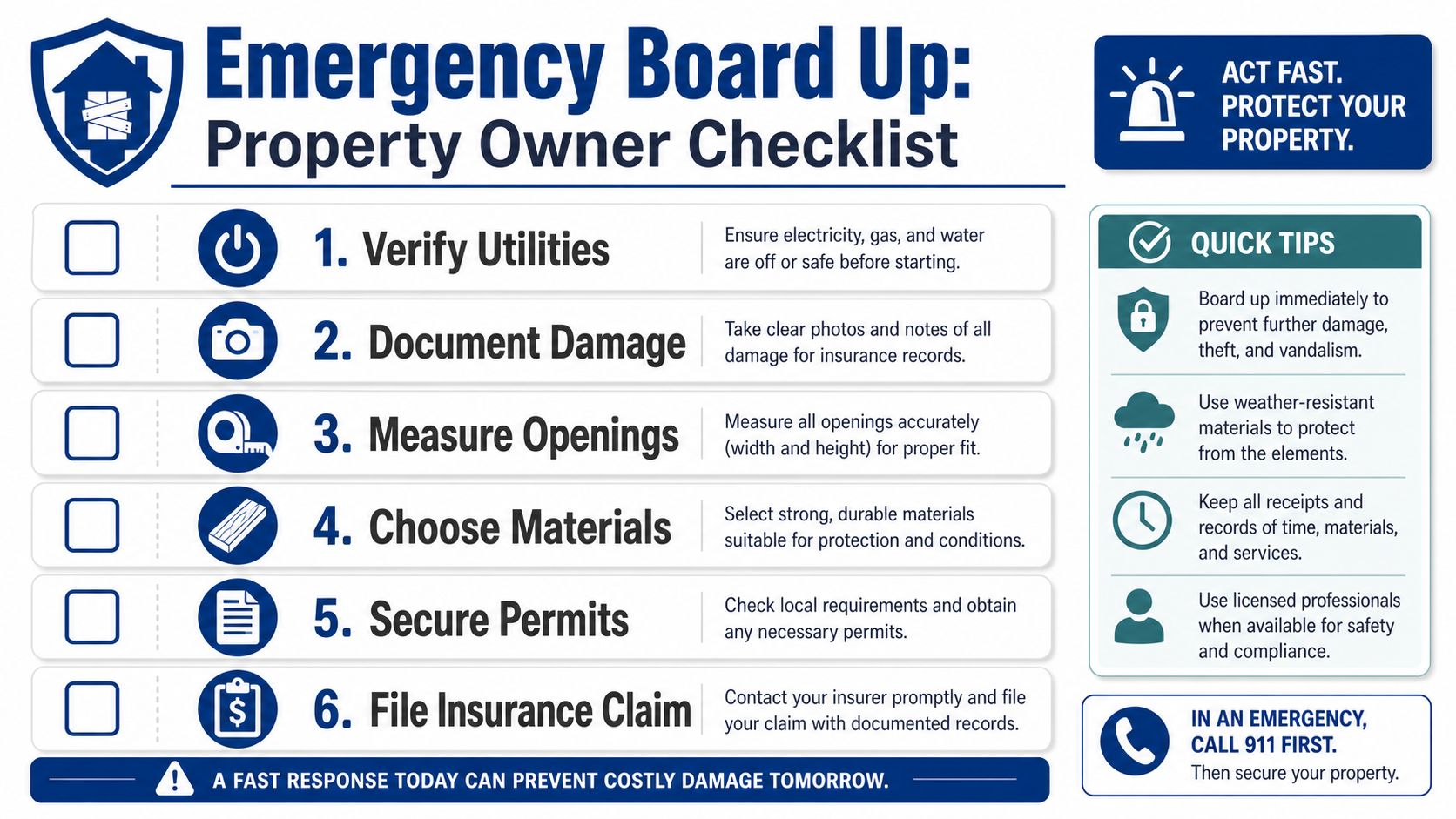
A damaged property is easier to manage when you treat the next hour like a checklist, not a panic spiral. Start with safety, then move to evidence, then move to enclosure. That order protects both the home and the claim.
Quick owner checklist
- Verify utilities: Confirm power, gas, and water status before anyone starts work.
- Document damage: Take photos and short video clips before debris gets moved.
- Measure openings: Confirm which windows, doors, or roof breaches need temporary closure.
- Choose materials: Match the panel thickness and fasteners to the opening and exposure.
- Secure permits: Check local requirements if the repair goes beyond a simple temporary closure.
- File insurance claim: Save the invoice, utility log, and photo set in one place.
FAQs
When should tarping and boarding be used together? Use both when a roof breach can let rain in even after windows or doors are sealed. In Central Texas, that combination is often the safer response during storm events.
How do you speed up insurer approval? Ask for written documentation of the immediate threat, keep the utility log, and send photos before and after the board-up. The cleaner the file, the easier it is to explain why emergency mitigation was needed.
What if the crew is delayed? Protect the interior as best you can without entering unsafe areas, keep people away from unstable openings, and keep documenting conditions. The key is not to improvise a bad fix that creates a bigger safety issue.
If your home or property in Georgetown or Austin has been opened up by storm, fire, or impact damage, contact RestoTek TX today for fast help, clear communication, and emergency restoration support that can secure the property before the damage spreads.