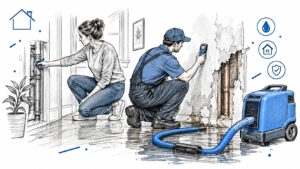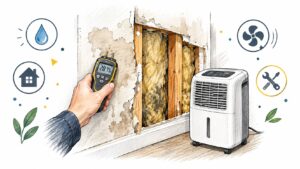
A typical residential water loss often takes 3 to 5 days to dry, but the finished standard is verified by moisture readings, not by the clock. Small isolated losses may reach that point sooner, while saturated assemblies can require 1 to 2 weeks or longer.
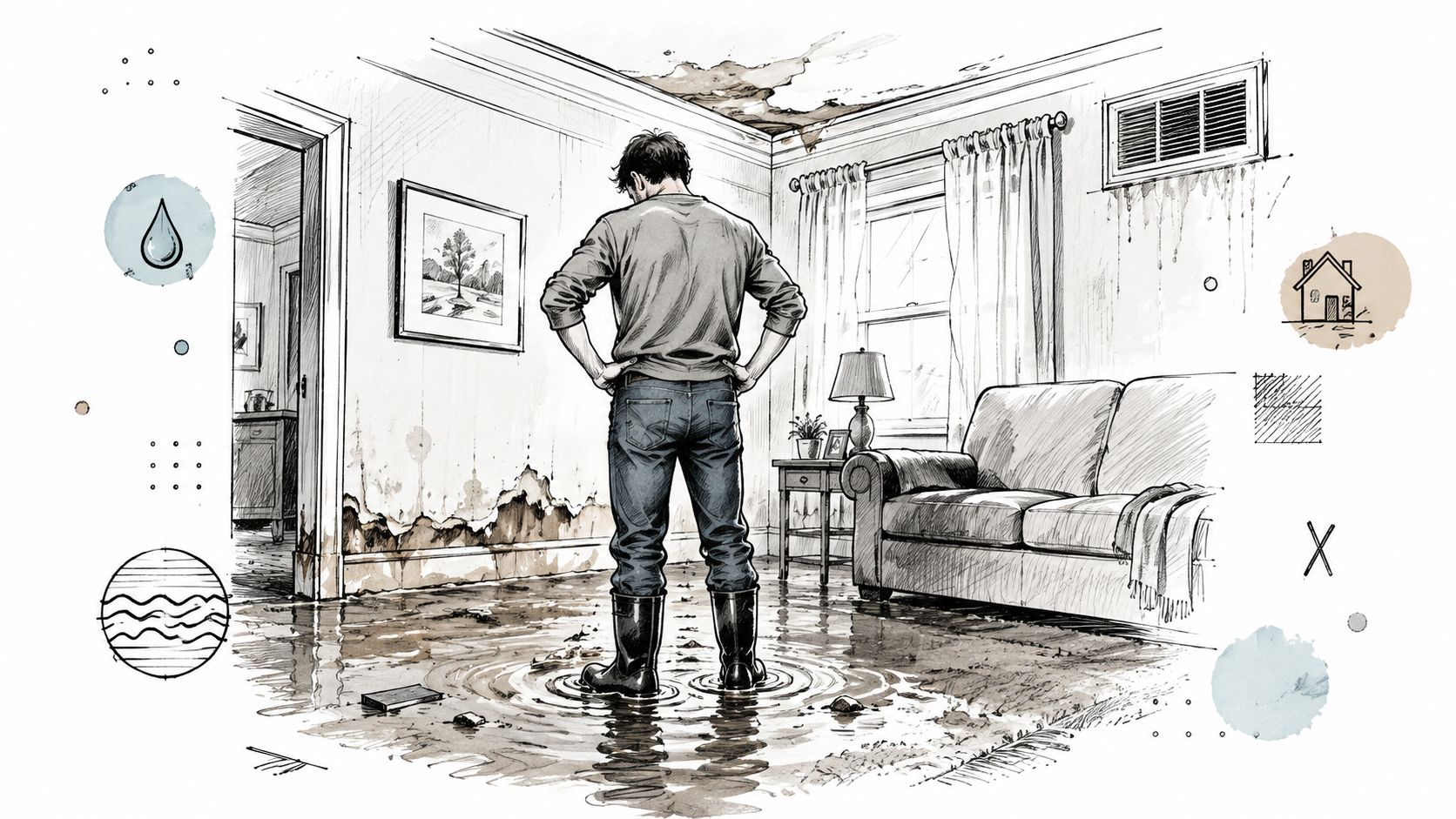
You're standing in an Austin or Georgetown living room with wet carpet under your boots, swollen trim along the walls, and an HVAC system pushing warm, humid air across damp drywall. Someone may tell you it'll be “two days.” That estimate sounds reassuring, but it doesn't answer the question that matters: has the structure returned to its pre-loss moisture condition?
Standing in a Water-Damaged Austin Home and Wondering What's Next
The first walkthrough starts with safety and source control, not equipment placement. We identify whether water is still entering, determine whether electricity is safe around the affected area, and check how far moisture has traveled beyond the visible puddle. A dishwasher supply line in a Round Rock kitchen creates a very different problem from an upstairs washing-machine line that has been leaking into a Cedar Park ceiling.
The questions come quickly:
- What caused the loss? A clean supply line, drain backup, storm intrusion, or sewage event changes the response.
- How long has the water been present? Timing affects salvage decisions and microbial risk.
- Which rooms and assemblies are affected? Carpet, drywall, hardwood, insulation, subfloor, and concrete all release moisture differently.
- What was the home's condition before the leak? Existing swelling, old plumbing damage, and poor ventilation can obscure the baseline.
- Where are the hidden wet areas? Moisture can move behind baseboards, beneath flooring, and into wall cavities.
A homeowner who wants immediate guidance can review this Central Texas water-damage response guide while waiting for an assessment. The first priority is stopping additional water and limiting foot traffic through contaminated or unstable areas.
Once the source is controlled, the crew brings in water extraction equipment, air movers, dehumidifiers, moisture meters, and sometimes thermal imaging. The equipment isn't placed according to a generic room count. It's positioned around the wet materials, air circulation, vapor movement, and readings recorded during the inspection.
The practical standard: Equipment comes out when affected materials match the dry target, not when the calendar reaches a convenient date.
That distinction is the lens for the rest of this guide. The question isn't just how long the machines have been running. It's whether moisture content is still high inside the materials that matter.
The 24 to 48 Hour Window and the 3 to 5 Day Baseline
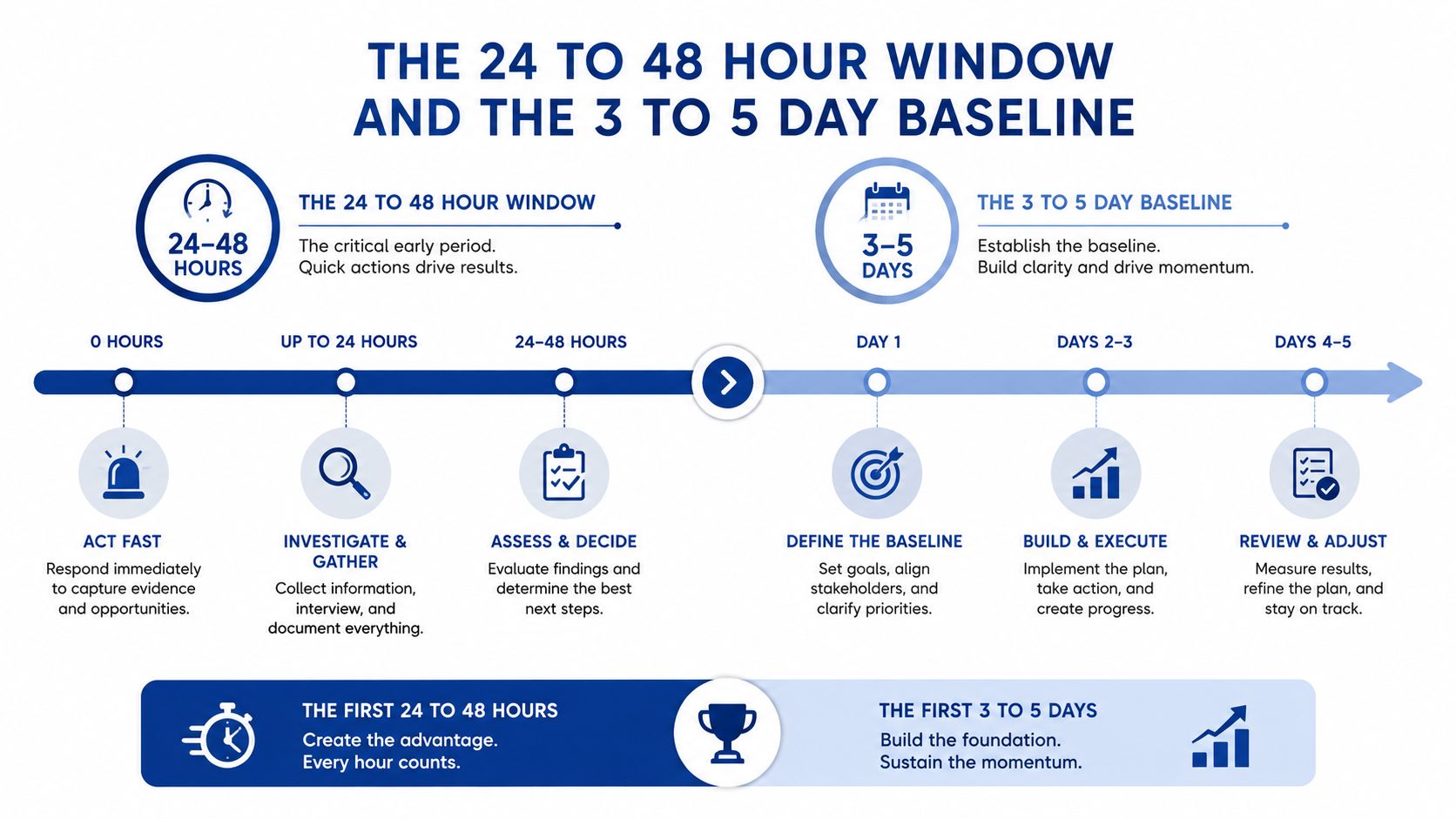
The first 24 to 48 hours set the direction of a water-loss project. Restoration guidance explains that untreated clean water can move toward higher-risk conditions after 48 hours, and many guides flag 72 hours as a point when secondary damage becomes more likely, especially in warm conditions. The water-damage restoration science guidance connects response speed with salvage decisions and the amount of work required.
In Austin, Georgetown, and nearby Central Texas communities, warm air and high humidity can keep moisture active in drywall paper, wood framing, carpet backing, and other porous materials. That climate does not set a fixed drying time. It can, however, stretch the equipment run when humid air enters the home or the affected materials remain enclosed.
Mitigation and drying are different windows
Mitigation stops the loss from getting worse. It can involve shutting off the source, extracting standing water, removing unsalvageable materials, opening affected assemblies, and setting controlled airflow.
Drying removes retained moisture until the affected materials reach the established dry standard. Extraction may finish quickly, while air movers and dehumidifiers continue running for several days. Our water-damage restoration timeline guide explains why the calendar alone cannot determine completion.
For many residential losses, professional equipment supports a 3 to 5 day structural drying period, as described in this restoration timeline estimator. Treat that range as a baseline, not a promise. Heavier Class 3 or specialty Class 4 losses can extend to 7 to 14 days or longer when saturation is deep, materials are dense, or wet assemblies are difficult to access.
Why the clock can't decide the outcome
A surface may feel dry while moisture remains inside a wall, floor, or framing member. Drying ends when affected materials approach their pre-loss equilibrium condition. The crew confirms that condition with moisture readings and comparison points, not by counting equipment days. Starting sooner preserves more options, but verification decides when the job is complete.
What Changes the Drying Timeline
Two homes can experience similar-looking leaks and finish on very different schedules. The major variables are water category, material class, HVAC operation, ambient humidity, and contamination or pre-existing damage.
A clean dishwasher supply-line break on a slab-on-grade Ranch in Round Rock may compress the timeline. Water can be extracted from exposed flooring, affected drywall can be opened where necessary, and air movers can circulate through accessible spaces. An upstairs washing-machine line in a two-story Cedar Park home can stretch the work when water travels through the ceiling assembly, insulation, framing, and lower-level finishes before anyone discovers it.
| Factor | Compresses Timeline | Stretches Timeline |
|---|---|---|
| Water category | Clean water addressed quickly, with limited absorption | Gray water, sewage, or water left standing long enough to raise contamination concerns |
| Material class | Thin, accessible materials with strong airflow | Dense, thick, layered, or enclosed assemblies |
| HVAC operation | Stable air movement and controlled dehumidification | HVAC shut down, overloaded, or circulating humid air without moisture removal |
| Ambient humidity | Dry indoor air that accepts evaporated moisture | High outdoor humidity entering through open doors, leaks, or poor envelope control |
| Contamination and prior damage | Clean assemblies with no existing deterioration | Contaminated water, previous swelling, damaged finishes, or hidden cavities |
Water category changes the decision tree
Clean supply water can sometimes be removed from salvageable materials if the response is prompt. Gray water requires more caution because it may contain contaminants, and sewage-related water demands a different safety and removal approach. The water category doesn't provide a reliable finish date by itself, but it determines whether drying alone is appropriate for each material.
Material and access control the pace
Carpet can release moisture relatively quickly when the carpet and pad are lifted for inspection and airflow. Hardwood, plaster, masonry, and concrete resist vapor movement because they are dense or structurally thick. A sealed wall or subfloor assembly may require baseboard removal, targeted openings, or additional monitoring before the crew can confirm what is happening inside.
HVAC and humidity matter in Austin weather
Air movers move moisture off surfaces. Dehumidifiers remove that moisture from the air. HVAC operation can help maintain circulation, but a system that merely pushes warm humid air around won't replace controlled dehumidification. Open exterior doors, wet crawlspaces, and humid attic pathways can keep feeding moisture into the drying environment.
Use the table as a starting point, not a self-clearance test. The practical range can run from a few days for minimal absorption to 7 to 14 days or longer for heavier losses, as reflected in class-based structural drying guidance. In some real-world properties, drying takes much longer because of thick slabs, restricted ventilation, or inaccessible assemblies.
How Each Material Behaves During Drying
A small Austin room with saturated hardwood can take longer to dry than a larger room with exposed drywall. Dense flooring stores moisture inside the planks and subfloor, then releases it slowly. Material, access, and the location of the moisture set the equipment run time more reliably than room size.
| Material | Typical Days | Key Challenge | Common Action |
|---|---|---|---|
| Drywall and light wall-cavity losses | 2 to 5 | Moisture can remain behind paper and inside cavities | Use air movement, dehumidification, and targeted openings where needed |
| Carpet and pad | 2 to 5 when accessible | Pad can retain contamination and moisture beneath the carpet | Lift for inspection, extract, and evaluate pad for removal |
| Hardwood | 7 to 14 | Plank cores and subfloor release moisture slowly | Control airflow, monitor both flooring and subfloor, consider specialized drying |
| Concrete and masonry | Up to 14 in many structural losses, and longer for thick slabs | Density and vapor diffusion resistance | Use dehumidification and repeated readings over the full affected area |
| Plaster | Multiple days or longer | Dense structure and limited vapor movement | Create access where appropriate and monitor interior moisture |
| Insulation and enclosed assemblies | Multiple days or longer | Moisture can remain hidden from room airflow | Inspect cavities, remove affected material when necessary, and verify readings |
These ranges show why a generic “one-week” answer can mislead. Field guidance reports 7 to 14 days for hardwood and 10 to 30 days for saturated concrete, while lighter surface and wall-cavity losses may fall around 2 to 5 days in suitable conditions. The comparison appears in this structural drying techniques guide. Equipment stays in place until affected materials approach the dry baseline, not until a calendar estimate expires.
Drywall is accessible, but not automatically simple
Paper-faced gypsum often responds well to strong airflow when the affected area is exposed and the water is clean. The timeline stretches when moisture travels behind the board, into insulation, or along the bottom plate. A dry painted surface does not prove the back of the wall is dry, so technicians may need targeted openings and readings from multiple points.
Hardwood and subfloors need patience
Hardwood can hold moisture in plank cores and beneath the finish. Older Austin homes with pier-and-beam construction may add another drying path to manage because the subfloor, crawlspace, and indoor air affect one another. Air aimed only at the finished floor can miss the reservoir below it. Readings from both flooring and subfloor show whether the equipment is reaching the deeper layer.
Concrete stores water deeply
Concrete and masonry may look dry before their internal moisture stabilizes. A Georgetown home with a saturated slab can require prolonged equipment operation, especially when floor coverings, cabinets, or low-permeance finishes restrict evaporation. Thick materials can take multiple days or weeks, and a 100 mm concrete slab may need at least 4 months to dry even in good conditions, according to the flood-drying guidance from Dantherm.
Insulation also varies by structure. Open-cell and closed-cell products do not release or retain moisture in the same way. A sealed subfloor may require access through trim or controlled openings, while ductwork in a wet attic can add hidden moisture that drying the living room alone will not remove. Austin and Georgetown humidity can stretch the run when wet crawlspaces, attics, or open doors keep feeding moisture into the air.
Instruments and Readings That Prove the Structure Is Dry
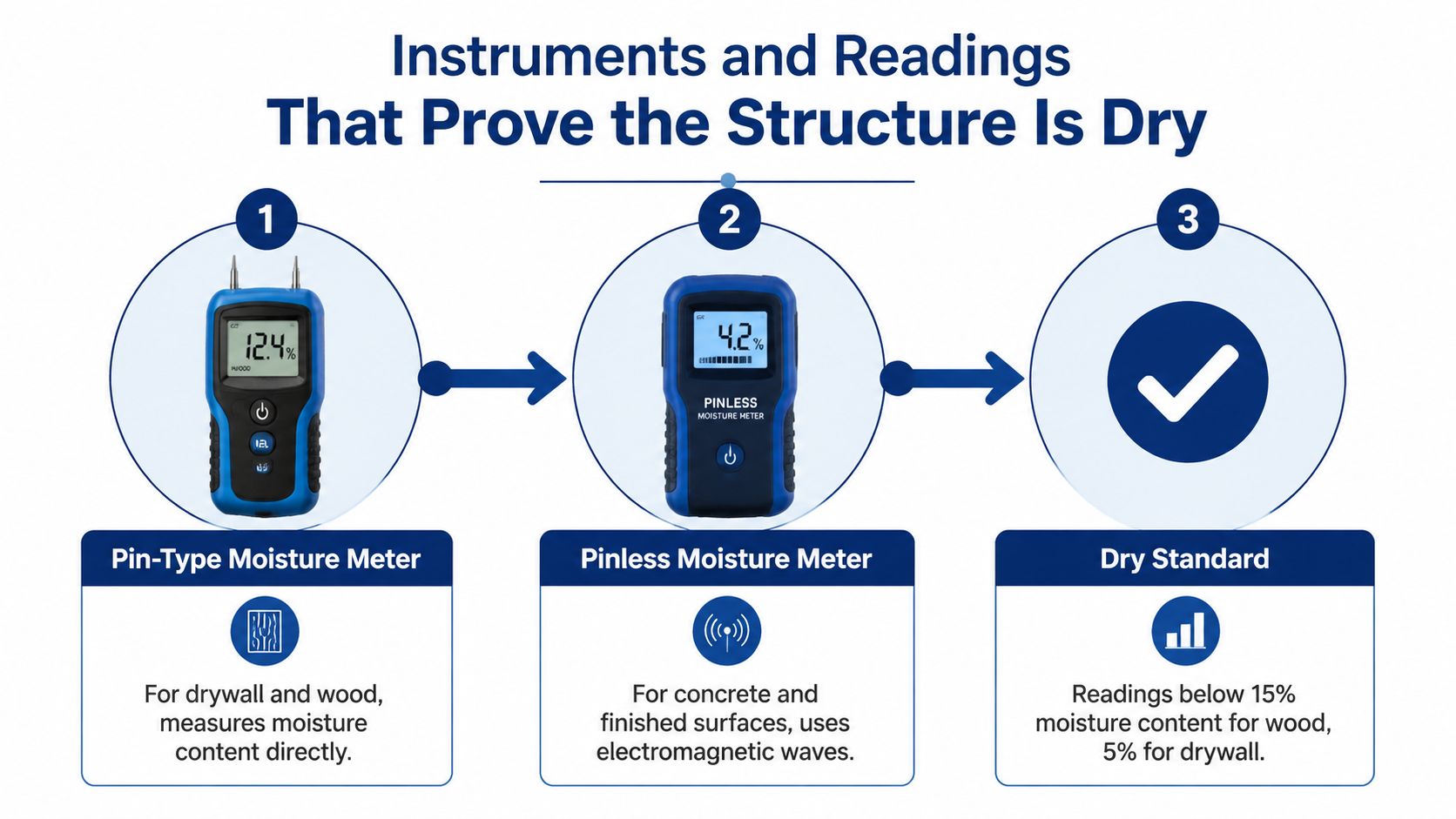
A dry-looking room is not a finished drying job. The crew first establishes an unaffected comparison area by measuring the same material elsewhere in the home. That baseline accounts for wood species, finishes, construction, and the property's normal indoor conditions. The target is convergence with that baseline, not a calendar promise.
The field toolkit
A pin-type moisture meter measures moisture content in wood and drywall where its pins can be inserted. A pinless meter scans finished surfaces and materials such as concrete without leaving holes. Its readings still require judgment because surface layers and metal can affect the result.
A hygrometer records temperature and relative humidity. Those readings show whether the air can accept more evaporated moisture and whether the drying environment is under control. Psychrometric calculations connect air conditions to moisture relationships, including grains of moisture per pound of air.
Thermal imaging helps identify temperature patterns associated with hidden moisture behind walls or below flooring. It does not replace a moisture meter. It helps the technician choose where to test when a visual inspection cannot show the full affected area. RestoTek TX explains how moisture meter readings and moisture mapping help track affected materials during the job.
What daily verification looks like
Technicians map testing locations and return to those same points. A useful drying log records the material, room, instrument type, reading, ambient temperature, relative humidity, equipment placement, and changes to the assembly.
The first visit establishes affected readings and the unaffected comparison. By the fourth day, drywall or wood should show a clear downward trend and move toward the dry standard. If one wall remains high while the rest of the room has normalized, the crew investigates that wall. Equipment comes out because readings support removal, not because the calendar suggests the job should be over.
In an Austin or Georgetown home, a wet crawlspace, attic, open door, or uncontrolled HVAC condition can keep feeding moisture into the air. The equipment run continues until both the materials and surrounding conditions support a stable result.
A written drying report is more useful than “the floor feels dry.” It shows what was measured, where it was measured, and why equipment was removed.
The finish decision rests on convergence with the dry standard under controlled ambient conditions. Visual inspection, odor, and touch support the assessment, but they do not prove that hidden moisture has stabilized.
What the Drying Process Feels Like Day to Day
You will notice the disruption immediately. On Day 1, technicians control the source, assess safety, extract standing water, document conditions, move furniture, and remove damaged trim or wall sections when needed. Air movers and dehumidifiers then run while the crew records baseline moisture readings. The noise is part of the work, not proof that the job is close to finished.
Days 2 and 3 often feel quieter, but evaporation is still underway. Equipment may run continuously, doors may stay positioned for airflow, and technicians return to compare mapped readings. In Austin or Georgetown, humid outdoor air, a damp crawlspace, attic moisture, or limited HVAC control can slow progress, especially during wet weather.
The daily rhythm
- First visit: Source control, safety assessment, extraction, material inspection, equipment placement, and baseline readings.
- Follow-up visits: Same-point moisture readings, relative-humidity checks, equipment adjustments, and inspections for hidden wet areas.
- Clearance visit: Confirmation that affected materials have reached the dry standard under stable ambient conditions, followed by equipment removal and the next cleaning or repair step.
A water-damage drying overview notes that materials can require multiple days or even weeks when moisture is hidden or the assembly is difficult to access. That pattern is common with pier-and-beam homes, enclosed wall cavities, dense plaster, hardwood systems, and saturated concrete.
The equipment should keep running 24/7 until the readings support removal, unless the technician provides a specific safety or operating instruction. A written report with before-and-after measurements matters more than a promised calendar date or a quiet room.
If one mapped area remains wet, the crew adjusts the drying plan and investigates that assembly. Completion is supported by converging material readings, controlled humidity, and stable conditions, not by touch alone.
What Homeowners Can Do and When to Call RestoTek TX
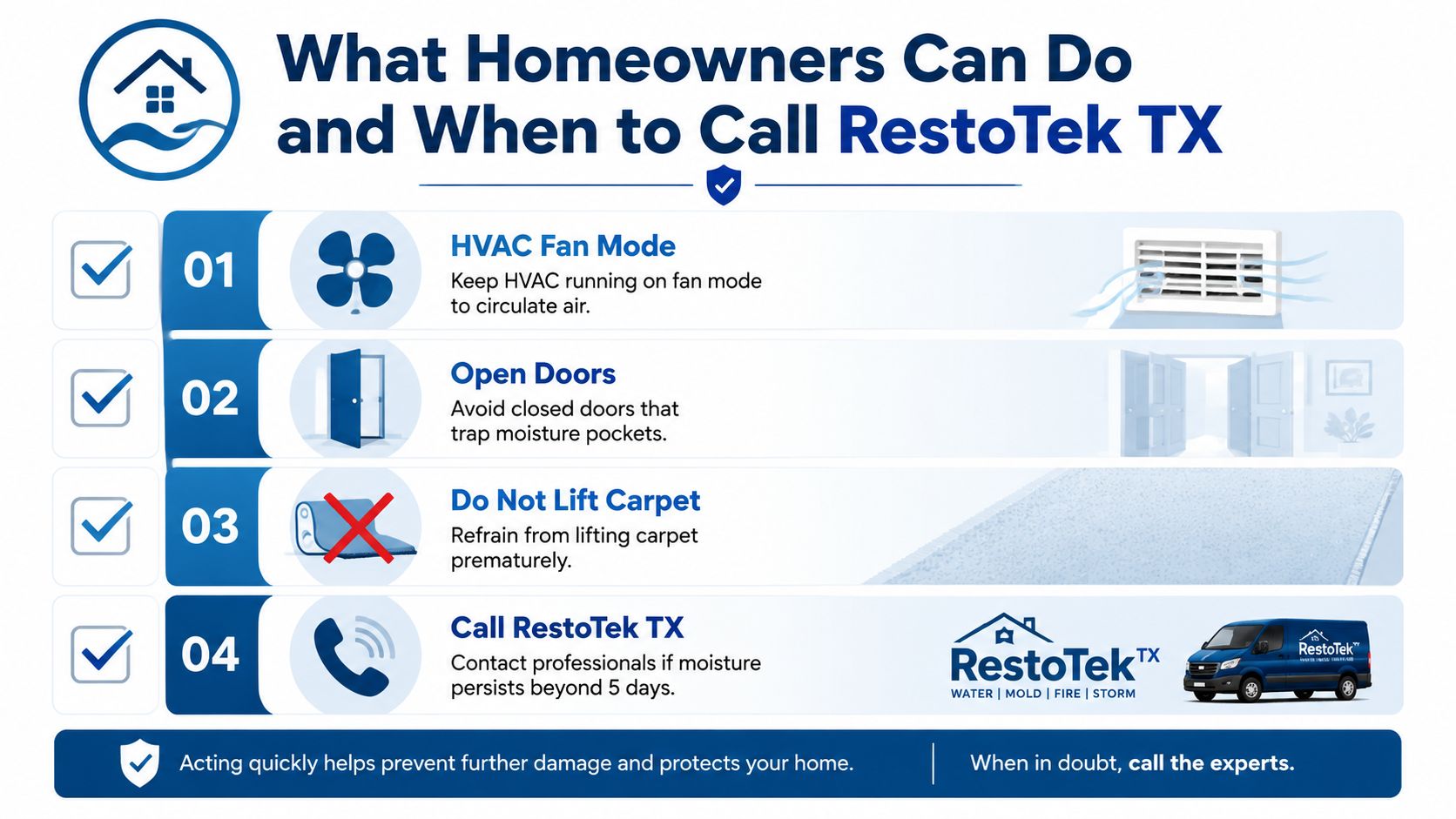
Your actions can support the drying plan, but they shouldn't replace an assessment when the loss is uncertain. Keep the HVAC operating in fan mode when the system is safe and functional, avoid closing doors that trap damp air, and keep the affected area accessible to the drying crew.
Don't pull up carpet, remove baseboards, or open walls without guidance. Those materials may contain contaminated water, conceal electrical hazards, or provide useful evidence for insurance documentation. Photograph conditions and keep records if your insurer requests them, but leave instrument readings and material decisions to the person managing the drying plan.
Call for professional help when the loss is ambiguous
Contact a restoration professional for:
- Active leaks: Stop the source first, especially around supply lines, ceilings, and electrical components.
- Sewage or gray water: Treat contamination as a safety issue rather than a simple drying project.
- Water older than 24 hours: Delayed response can affect salvage and secondary-damage decisions.
- Swollen materials or musty odors: These signs can point to retained or hidden moisture.
- Persistent readings: If moisture remains high after 72 hours of equipment operation, the setup or affected assembly needs review.
- Hidden spaces: Walls, subfloors, crawlspaces, attics, and duct pathways can hold moisture outside the visible area.
Small, clean losses caught early may be manageable with careful extraction and monitoring. Anything involving contamination, concealed assemblies, extensive saturation, or uncertain readings deserves a professional walkthrough because under-drying can cost more than an initial visit. RestoTek TX provides 24/7 emergency response, inspection, extraction, structural drying, moisture mapping, microbial prevention, and reconstruction services for Austin, Georgetown, and surrounding Central Texas communities.
If water has reached your Austin or Georgetown property, RestoTek TX can inspect the affected materials, map moisture, extract water, and manage measured structural drying through the repair phase. Visit RestoTek TX to request help, and call the 24/7 emergency channel when active water or hidden moisture can't wait.