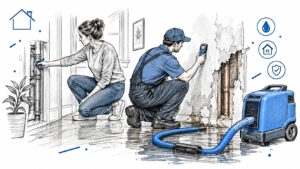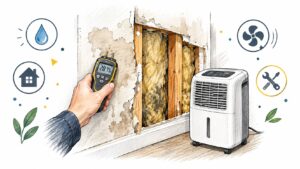
Lightly wet sheetrock typically dries in 24 to 72 hours with professional equipment, while moderately to heavily saturated walls can take 3 to 14 days. If water remains in the wall beyond about 72 hours, replacement often becomes more practical than continued drying.
You may be looking at a spreading ceiling stain from a supply-line leak, or standing water sitting against the baseboards after a Central Texas storm. The first instinct is usually to touch the wall, see that the paint feels dry, and assume the problem is nearly over. That's where many expensive mistakes begin.
The visible surface can dry while the gypsum core, insulation, framing, and wall cavity remain wet. Drying time depends on the amount of water absorbed, the source of the water, indoor humidity, temperature, sheet thickness, airflow, and how quickly extraction and dehumidification started. A neighboring home may have dried in two days because only the surface was damp, while your wall may need days of monitored drying because moisture traveled into the cavity.
Knowing the typical timeline helps you make better decisions about repairs, insurance documentation, and whether the wall can be saved. It also prevents a common failure: closing, painting, or rebuilding an assembly that only appears dry.
What to Expect When Sheetrock Gets Wet
A small clean-water leak discovered quickly may leave a limited section of sheetrock lightly damp. With commercial air movers and dehumidification, that material may reach a dry standard within 24 to 72 hours, while moderate saturation can require about 3 to 5 days and heavily soaked assemblies may take 7 to 14 days or longer when cavities and framing remain wet, as described in this drywall water-damage drying guide.
The clock changes when water has reached the wall cavity. Sheetrock is made with a gypsum core between paper facings, so water can move beyond the stain you see. A baseboard may conceal the lowest wet edge, insulation may hold moisture behind the board, and framing can continue releasing moisture after the face feels dry.
Surface dryness isn't a reliable finish line
Homeowners often judge progress by touch. The wall feels firm, the dark mark fades, and the paint no longer looks glossy. Those signs can show that evaporation is occurring, but they don't confirm that the assembly is dry enough to close.
The Gypsum Association notes that gypsum board can dry thoroughly before mold growth begins, typically within 24 to 48 hours depending on environmental conditions, but it also states that there isn't one universal acceptable free-moisture standard for every wallboard situation. The decision depends on the board's condition, exposure, and drying progress. You can review that guidance in the Gypsum Association assessment of water-damaged gypsum board.
Practical rule: A dry-looking face is an observation, not a clearance to repaint.
Central Texas homes add another complication. Warm indoor air can support evaporation only when dehumidification keeps moisture from accumulating in the room. If humidity stays high or airflow doesn't reach the wall and cavity, the outer paper may dry first while deeper moisture remains trapped.
The most useful early question isn't, "How long does sheetrock take to dry?" Ask instead: How was the wall wet, what was the water source, and can the entire assembly be measured before it's closed?
Joint Compound Drying Versus Structural Sheetrock Drying
Joint compound and water-damaged sheetrock are two different drying problems. A thin coat of mud on a repair dries through evaporation from the exposed surface. Wet structural sheetrock must release water from the gypsum core and, often, from the cavity behind it.
A homeowner repairing nail holes may see compound lighten as it dries and confirm progress by touch. That experience doesn't apply to a wall affected by a washing-machine leak. Water can wick upward from the floor, soak the core, and spread behind paint even when the visible discoloration looks minor.
Why the timelines don't match
Joint compound can dry in hours or over a day depending on the product, thickness, temperature, and humidity. The exact drying time isn't a useful guide for flood-damaged board because compound is applied as a relatively thin exposed layer, while gypsum board holds moisture within a thicker installed assembly.
Controlled testing helps explain why calendar time alone can mislead. ASTM C1789 uses wetted gypsum-board specimens that are dried through at least five steps, showing that moisture leaves the material progressively rather than all at once. Separate building-science research found that a 1/2-inch interior gypsum board specimen reached equilibrium at 75% relative humidity within about one week under standard laboratory conditions. Those findings are summarized in the ASTM C1789 reference.
What happens behind the wall
Consider a slow leak behind a washing machine. The painted surface may feel cool and firm, yet the gypsum core can be saturated and the insulation can still be holding water. If a homeowner seals that surface with primer or paint, the finish may trap moisture and conceal continued deterioration.
Restoration crews treat structural drying as a controlled process. They remove or loosen materials that block access, establish airflow across the board, reduce room humidity, and verify the result with instruments. Waiting for the wall to “air out” isn't a drying plan when the cavity remains wet.
The 2024 research on gypsum drying also found that drying slows as relative humidity rises and gypsum thickness increases. That's why a joint-compound estimate should never be used to decide when water-damaged sheetrock is safe to restore.
Factors That Control How Fast Sheetrock Dries
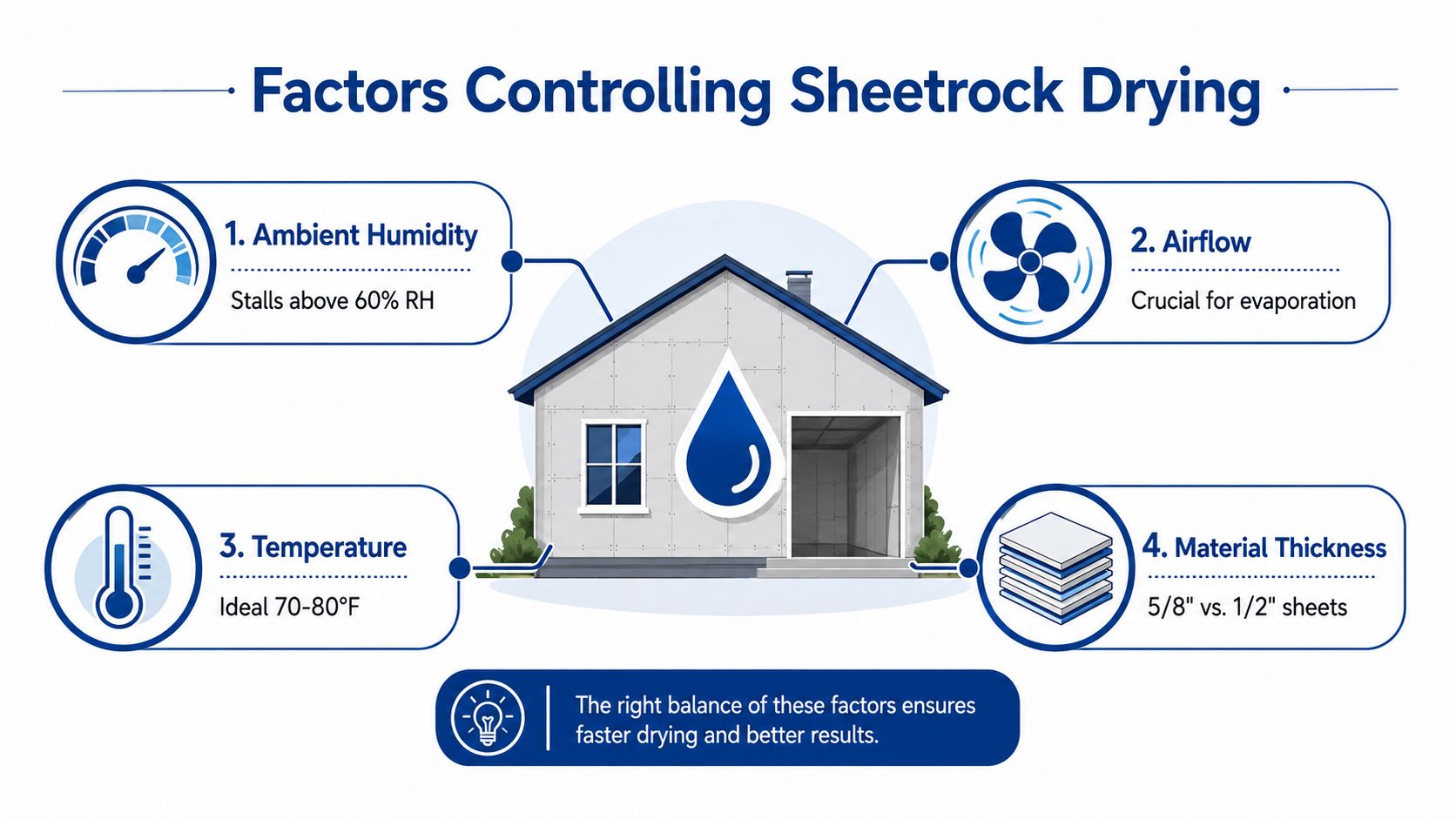
Four variables usually determine whether a wall dries efficiently or stalls: humidity, airflow, temperature, and material thickness. The water source adds a separate salvage question because contaminated water may make removal necessary even if drying equipment could reduce the moisture.
Humidity controls the evaporation ceiling
Air can only accept so much moisture. When indoor relative humidity rises, evaporation slows, and the wall releases moisture less efficiently. Manufacturer guidance for joint compounds illustrates how sharply conditions matter. For a 24-hour drying period, the acceptable relative humidity range rises from 23% at 50°F to 84% at 90°F. For 48-hour drying, the range is 65% to 93% across that same temperature band, according to the USG drying-condition guidance.
Those figures concern joint compound, not a flooded wall, but they demonstrate the basic point. Temperature and humidity work together. A dehumidifier removes moisture from the air so the gypsum can continue releasing it.
Airflow removes the wet boundary layer
Still air next to a wall quickly becomes damp. Air movers work by replacing that layer with drier air, increasing evaporation from the paper surface and exposed edges. Placement matters. A fan pointed randomly across a room may move air without creating useful contact at the affected wall or cavity.
Technicians also adjust airflow as readings change. A wall that dries at its exposed face may need cavity-directed movement or selective access to release moisture held behind the board.
Thickness and construction add mass
A 5/8-inch board has more material to dry than a 1/2-inch board, and dense or specialty panels may release moisture more slowly. Insulation, framing, cabinets, tile, wallpaper, and sealed trim can further restrict movement. In practice, the wall system controls the timeline more than the sheetrock panel by itself.
Water quality changes the decision
Clean water from a supply line may leave a board potentially salvageable when drying begins promptly. Gray water from an appliance or black water from a sewer backup introduces contamination that can make removal the safer choice. A restoration technician must evaluate both moisture and material condition, not moisture alone.
Opening windows isn't automatically helpful in Central Texas. If outdoor air is more humid than the indoor air, it can slow the process. Mechanical dehumidification gives the crew control instead of making drying depend on changing weather.
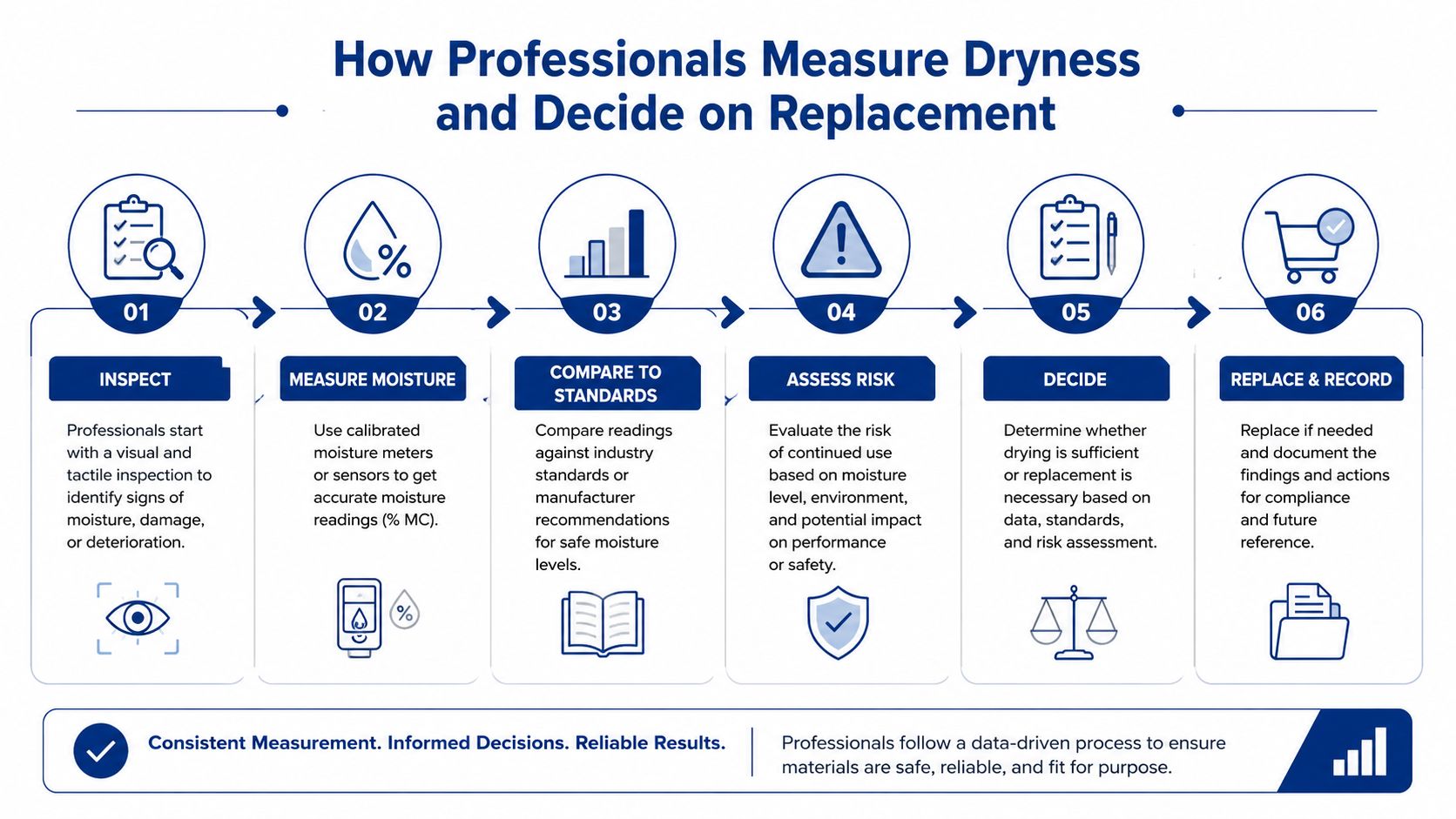
How Professionals Measure Dryness and Decide on Replacement
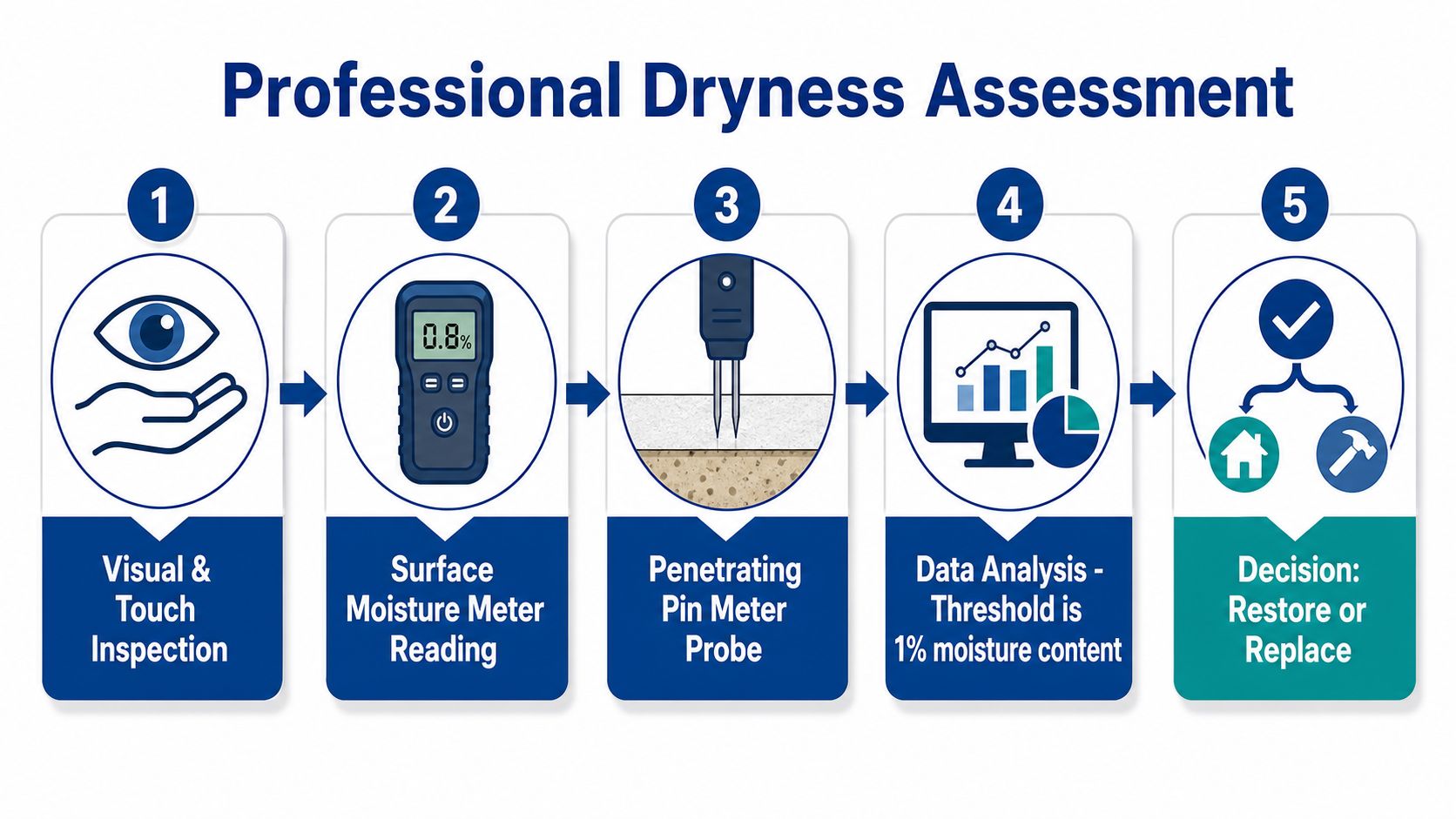
A technician doesn't clear a wall because it feels dry. The normal comparison is an affected area against an unaffected control area, combined with readings from the gypsum, framing, insulation, and other materials that may have absorbed water.
Non-penetrating meters help scan broad sections without making holes. Pin-type meters can probe the material and identify differences between the surface and deeper portions. Thermal imaging can help locate cooler areas associated with evaporation, although a camera supports moisture mapping rather than replacing direct measurement.
The assessment process
A practical inspection usually follows this order:
- Inspect the visible damage. Look for staining, swelling, bubbling paint, soft gypsum, sagging ceilings, and gaps at trim.
- Map the moisture field. Scan beyond the obvious stain because water can travel sideways and upward.
- Probe representative areas. Pin readings help distinguish a dry surface from a damp core.
- Inspect the cavity. Baseboard removal, access openings, or selective demolition may be needed when insulation or framing is wet.
- Compare with control readings. The target is generally close to the unaffected material, not an arbitrary touch-based judgment.
- Choose drying or removal. Sound, clean-water-affected board may be dried. Delaminated, crumbling, contaminated, or persistently wet board often needs replacement.
You can see how moisture meter readings support water-damage decisions before accepting a repair recommendation.
Thresholds require context
Some guidance describes dry drywall as roughly 0.5% moisture in a control reference and raises replacement concerns above about 1% to 2% moisture content, while another field guide describes dry drywall as below 16% moisture content and increased mold risk with sustained readings above 18% to 20% for more than a few days. These figures aren't interchangeable because meters, scales, materials, and testing methods differ. The proper benchmark comes from the instrument, the manufacturer's instructions, and comparison with unaffected areas.
Industry restoration guidance treats wet drywall as a 24 to 72 hour drying problem only when exposure is limited and rapid professional drying begins. Once moisture remains beyond about 72 hours, many field guides advise removal because the board may delaminate, lose integrity, or trap moisture in the facing and cavity. See the water-damage restoration guidelines for that decision framework.
Realistic Drying Timelines by Saturation Level
The table below assumes prompt professional assessment, appropriate air movement, dehumidification, and access to affected cavities. It isn't a promise that every wall in a category will follow the same schedule.
| Saturation Level | Water Source Example | Drying Time, Professional Equipment | Save vs. Replace Likelihood |
|---|---|---|---|
| Light moisture | Minor, promptly stopped clean-water leak | 24 to 72 hours | Often salvageable if the board remains sound and readings approach the unaffected control |
| Moderate saturation | Appliance failure or pipe burst affecting the lower wall and cavity | About 3 to 5 days, sometimes longer | Depends on insulation, framing, access, delamination, and water quality |
| Heavy saturation | Flooding or prolonged exposure | 7 to 14 days or longer when the assembly remains wet | Replacement becomes increasingly likely, especially where gypsum has weakened or water is contaminated |
The homeowner drywall drying guidance distinguishes lightly saturated board at roughly 24 to 72 hours, moderately saturated board at 3 to 5 days, and heavily soaked drywall at 7 to 14 days or longer when the cavity, insulation, or framing stays wet.
What each category means in practice
Light exposure may need only controlled air movement and humidity removal, but the crew still has to inspect beyond the visible spot. A small leak behind a cabinet can behave like a larger loss because access is limited.
Moderate saturation often requires baseboard removal or carefully placed access openings. If the cavity stays closed, the paper face may dry before the insulation and studs, extending the job and increasing the chance of a failed repair.
Heavy exposure is different. Gypsum can lose strength, paper facings can separate, and contaminated water can make salvage inappropriate. Household fans may move air at the surface, but they don't provide the moisture control or cavity access needed for dependable structural drying.
Central Texas Conditions That Change the Drying Equation
Central Texas weather can make a seemingly straightforward wall loss difficult. Austin, Georgetown, San Antonio, and nearby Hill Country communities experience rapid changes in heat and humidity, while storms can push large amounts of water into homes before a homeowner can locate the entry point.
Opening windows may feel like the natural response after a storm. It can backfire when humid outdoor air enters a room and raises indoor moisture. Air movement without dehumidification then circulates damp air around the wall instead of creating a consistently dry environment.
Heat helps only when moisture is controlled
Warmer conditions generally support evaporation, but heat alone doesn't remove water from the building. A closed room with wet sheetrock can become warm and humid, leaving the air unable to accept much more moisture. Commercial dehumidifiers and properly placed air movers address both sides of the problem.
The manufacturer's joint-compound guidance shows the relationship clearly. For a stated 24-hour drying period, acceptable humidity conditions differ substantially between 50°F and 90°F, so a calendar estimate without environmental context is weak. Structural drying is even more dependent on the complete wall assembly.
Storm and plumbing losses need early inspection
Flash-flood water, roof intrusion, slab leaks, HVAC condensation overflow, and supply-line failures create different patterns. Water may enter at the floor, ceiling, exterior wall, or utility closet, and each location changes how quickly the cavity can release moisture.
A professional assessment within the first day is especially useful when the wall is saturated, the water source is uncertain, or insulation may be involved. Structural drying in Central Texas depends on measured moisture removal, not on running fans until the surface looks normal.
Central Texas drying works best when the crew controls the indoor environment instead of asking the weather to cooperate.
If water came from a sewer backup, stormwater intrusion, or another contaminated source, don't treat the job as a normal dry-out. Safety, containment, material removal, and microbial prevention become part of the decision before anyone worries about repainting.
Your Next Steps After Water Damage
Start with the source. Shut off the supply line or main valve if you can do so safely, and keep away from standing water near electrical outlets, appliances, or damaged wiring. Photograph the affected rooms, walls, ceilings, belongings, and visible water lines with timestamps before moving materials.
A practical response sequence
- Stop further water entry. Address the leak, overflow, or storm opening before deploying drying equipment.
- Document the loss. Take wide and close photographs, preserve damaged materials when safe, and notify your insurer according to the policy.
- Create access carefully. Remove wet baseboards when appropriate. Weep holes or selective openings may help a professional ventilate a cavity, but don't cut into a wall without checking for wiring and plumbing.
- Control the environment. Use air movement and dehumidification. Don't rely on open windows when outdoor humidity is high.
- Track readings. A pin-type moisture meter can show whether the core is improving, but readings need to be compared with unaffected areas and interpreted consistently.
- Hold off on repairs. Don't paint, prime, reinstall trim, or close the cavity until the wall system is verified dry.
The first two days matter because prompt drying gives sound, clean-water-affected board a better chance of remaining usable. If moisture continues beyond about 72 hours, replacement becomes more likely, particularly when the paper has separated, the gypsum is soft, or insulation remains wet. A wall that takes several days isn't automatically a failure, but a wall that looks dry while readings remain high isn't ready for reconstruction.
Call a Central Texas restoration company for gray or black water, extensive saturation, visible mold, sagging ceilings, or moisture that isn't responding to controlled drying. Guidance on preventing mold after water damage can help with immediate precautions, but it can't replace an inspection when water has entered the cavity.
Fast action can preserve walls. Patient verification prevents hidden moisture, premature paint, and costly callbacks.
RestoTek TX provides water-damage inspection, extraction, moisture mapping, structural drying, microbial prevention, and reconstruction for homes and properties in Georgetown, Austin, and surrounding Central Texas communities. If wet sheetrock is still showing high readings or you can't tell whether the cavity is dry, visit RestoTek TX to request help with the next step.