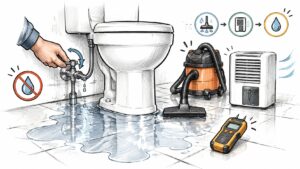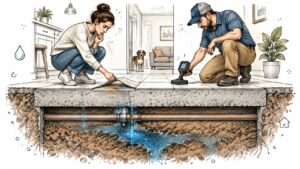
Most residential water extraction visits in 2026 run about $200 to $2,500, or roughly $3 to $7.50 per square foot for clean to gray water. Drying and reconstruction often cost more than the extraction itself, so a pump-out quote should never be read as your final project total.
That's the trap I see stressed Central Texas owners fall into. A crew vacuums the visible water, leaves, and calls the job done. Two weeks later the baseboards swell, the laminate cups, and a musty smell settles into the hallway because nobody mapped moisture inside the wall cavity or under the floating floor. You then pay for a second mobilization, more demolition, and a rebuild that fast, verified drying might have prevented.
Price extraction, drying, and rebuild as three separate decisions. Authorize the first quickly once the source is controlled. Authorize the other two only for materials that moisture readings show are still wet. That discipline, not shopping for the lowest headline number, is how you keep a Georgetown or Austin water loss from doubling.
Water Extraction Prices at a Glance
Start with the dollar bands, then test them against your actual rooms. For typical U.S. property-loss work in 2026, most residential extraction visits fall near $200 to $2,500. Area-priced mitigation commonly lands around $3 to $4.50 per square foot for clean water, $4.50 to $7 for gray water, and $7 to $10 or more for sewage. Monitored drying commonly adds about $1,000 to $3,500, and a full residential restoration average sits near $3,867.
These are typical 2026 ranges, not a national flat fee, and they're not the price of municipal water. You're paying for a crew, a truck, extractors, protective equipment, disposal, and response speed. Austin and Georgetown invoices move inside these bands based on access, contamination, and how fast you need us mobilized.
The Lookup Table to Use First
Match your loss to the closest scope row. Read across to see what that money buys, because the scope difference matters more than the dollar difference between two bids.
| Scope | Typical 2026 price | What the price covers |
|---|---|---|
| Portable extraction, one room, clean water | $200 to $700 | Pump-out, basic containment, short labor |
| Truck-mount extraction, several rooms | $800 to $2,500 | Higher volume removal and mobilization |
| Category 1 mitigation | $3 to $4.50 per sq ft | Extraction and initial stabilization of clean water |
| Category 2 mitigation | $4.50 to $7 per sq ft | Gray-water handling, added PPE and disposal |
| Category 3 mitigation | $7 to $10+ per sq ft | Sewage controls, disposal, and safety steps |
| After-hours emergency surcharge | 50% to 100% added to labor | Nights, weekends, and holidays |
| Monitored structural drying | $1,000 to $3,500 | Air movers, dehumidifiers, and moisture checks |
| Full residential restoration average | $3,867 | Market average for the whole loss, not extraction alone |
Pick a budget band from this table. Then check it against the sample jobs that follow, where extraction, drying, and rebuild sit in separate columns. If a quote you receive gives you one lump sum with no split, send it back and ask for the split before you sign anything.
Why No Honest Estimator Quotes One Flat Fee
Water extraction shouldn't be priced as a single flat fee because the measurable scope includes emergency mobilization, contamination category, affected square footage, access, contents handling, equipment deployment, monitoring, and structural drying. The ANSI/IICRC S500 standard for professional water damage restoration treats restoration as a process involving inspection, loss assessment, water categorization, psychrometry, drying technology, equipment, safety, documentation, and final verification, not just pumping water from a room.
A credible estimate separates the line items. Expect to see labor and truck mobilization, extraction by portable or truck-mounted equipment, disposal or wastewater handling, furniture manipulation, contents packing or cleaning, and any demolition needed to expose trapped water, each priced on its own line. Drying gets its own subtotal and its own equipment and monitoring allowance.
Estimator's rule: If the written scope doesn't show an extraction subtotal apart from drying, you don't have a quote you can compare. You have a guess.
That separation also protects you with an insurer. An adjuster can approve a documented extraction line and a documented drying line far more easily than a single unexplained total. Require moisture readings and affected materials recorded before and after extraction, because dry-looking surfaces don't prove that walls, insulation, subfloors, cabinets, or cavities are dry.
So when you ask how much does water extraction cost, answer it in two parts. Budget the extraction visit from the table above. Then budget drying only after readings tell you which materials are still holding water. Anyone who promises one universal price before inspecting your home is selling you a number, not an estimate.
Sample Estimates for Common Water Losses
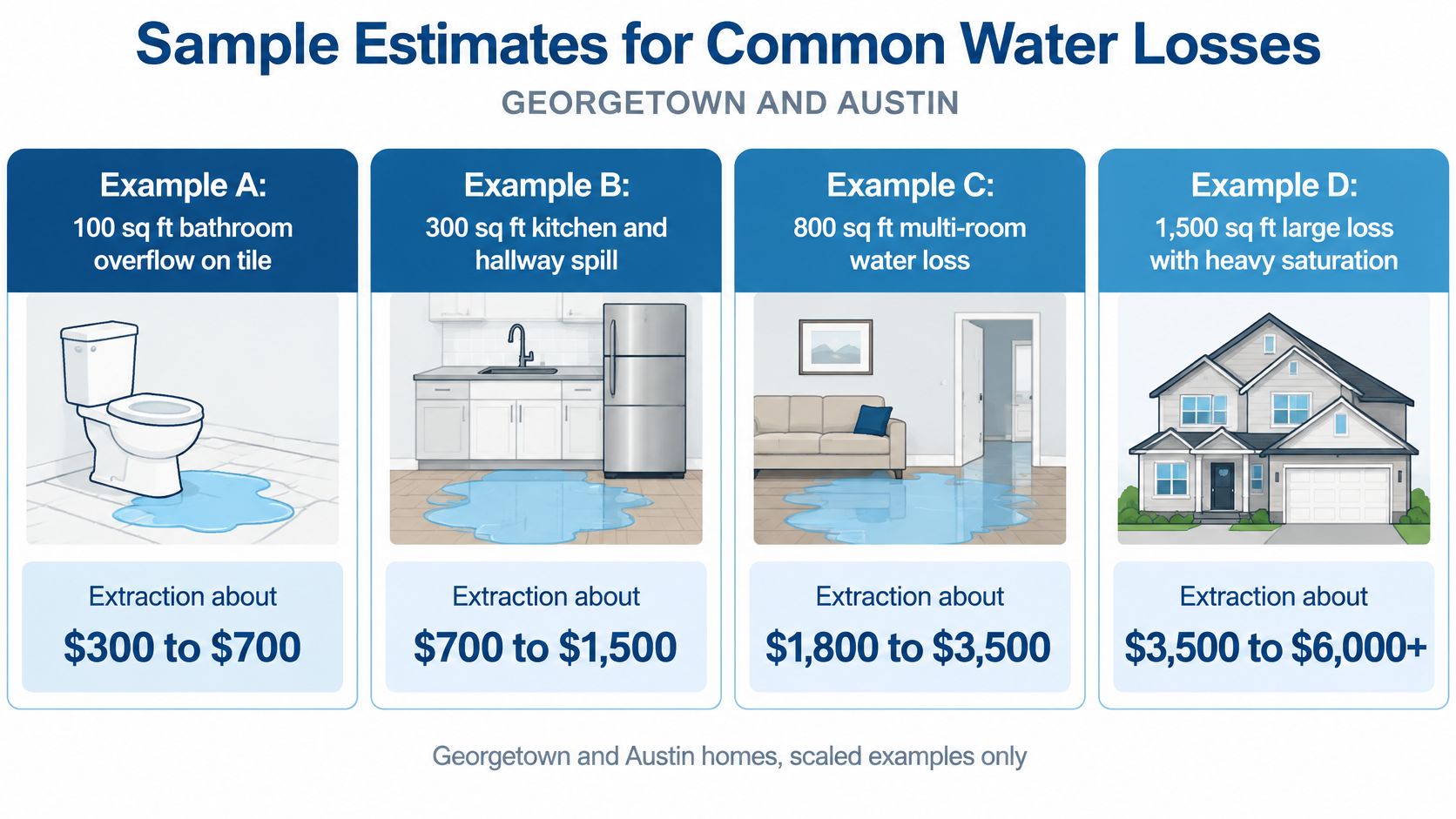
Worked examples beat rate grids when you're standing in a wet hallway at midnight. Read each scenario below as a three-part money story. Extraction is the smallest part in almost every one of them, and that's exactly the point.
Example A and Example B in Real Rooms
Say a toilet supply line lets go in a 100-square-foot bathroom on tile in Georgetown, clean water, caught within the hour. Extraction typically runs about $300 to $700. Light drying with an air mover and a small dehumidifier adds roughly $800 to $1,500. If the baseboards and toe-kick read dry, rebuild can be $0 to about $1,200 for minor trim and paint. Tile and a fast response keep this loss contained.
Now scale up. A supply-line break spreads across about 400 square feet of flooring in an Austin home and wicks into the bottom two feet of drywall. Extraction moves to roughly $1,200 to $2,500 because you're pulling water from pad, flooring seams, and multiple rooms. Monitored drying runs $1,500 to $3,000. Finish repair, meaning drywall patching, baseboards, flooring sections, and paint, often lands between $3,000 and $8,000. Notice the pattern. The rebuild column, not the extraction column, decides what this loss costs you.
Example C and Example D by Water Depth
Depth tells a different story than a service menu. FEMA's flood insurance fact sheet estimates losses at about $12,000 for 3 inches of water and $21,000 for 6 inches in a 1,000-square-foot home. The same source puts an uninsured 1,500-square-foot, single-story home at approximately $15,000 in out-of-pocket flood damage.
Read those figures correctly. They are total damage exposure, not a contractor's extraction price. They bundle flooring, drywall, contents, appliances, and cleanup into one loss number. I use them with owners for one reason only, to answer the question nobody asks early enough. How much later damage does fast extraction and verified drying prevent you from paying for?
| Scenario | Extraction | Drying | Rebuild or total exposure |
|---|---|---|---|
| 400 sq ft supply-line break, wet floor and bottom two feet of drywall | $1,200 to $2,500 | $1,500 to $3,000 | $3,000 to $8,000 |
| 1,000 sq ft home, about 3 inches of water | Not an extraction quote | Included in loss | About $12,000 total damage |
| 1,000 sq ft home, about 6 inches of water | Not an extraction quote | Included in loss | About $21,000 total damage |
| 1,500 sq ft single-story home, uninsured flood | Not an extraction quote | Included in loss | About $15,000 out of pocket |
How to Use These Numbers on Your Own Loss
Find the row closest to your situation, then adjust. Move up a band if water sat overnight, reached cabinets, or came from a drain. Move down only if you caught it fast and readings confirm hard, non-porous surfaces stayed dry underneath.
Don't collapse the three columns into one job price when you compare bids. A bidder who quotes extraction only will always look cheaper than a bidder who quotes extraction plus monitored drying, right up until hidden moisture forces demolition you could've avoided. Compare column to column, and ask any bidder missing a column why it's missing. In Austin and Georgetown especially, also keep the source straight in your head. A plumbing overflow and excluded flood damage are different events with different payers, even when the wet floor looks identical.
How Water Category Changes the Bill
Category is the single fastest way a quote jumps. Two losses can cover the same floor, in the same house, on the same day, and price thousands of dollars apart. The difference is what was in the water.
The Three Categories in Plain Language
Category 1 is clean water. It comes from a supply line, a sink supply, a water heater, or a similar sanitary source, including a sudden clean overflow caught quickly. It carries no significant contamination at the source, so crews can extract with standard precautions, save more materials, and dry in place more often. That's why it sits at the low per-square-foot band.
Category 2 is gray water. Think washing machine discharge, dishwasher water, or a toilet bowl overflow containing urine but no fecal matter. It can carry chemicals and microorganisms that make people sick on contact or ingestion. Crews add containment, gloves and other protective equipment, more careful wastewater disposal, and antimicrobial steps. Carpet pad usually comes out rather than being dried. Those added controls put it in the middle band.
Category 3 is black water. Sewer backups, rising floodwater, and water that has become grossly contaminated belong here. If your loss involves sewage, read our breakdown of category 3 water damage and what it requires before you let anyone start work. Category 3 drives the $7 to $10-plus per square foot range because crews need heavier protective equipment, controlled waste handling, air scrubbing, and disposal of porous contents and materials that often can't be cleaned to a safe standard.
The Same Room at Three Different Prices
Take one 200-square-foot laundry room. A clean supply-line leak caught fast might extract and stabilize for a few hundred dollars at the low band, with the washer pulled, the floor dried in place, and no demolition. A washing machine discharge that sat through a workday adds containment, pad removal if the room is carpeted, antimicrobial treatment, and disposal, pushing the same footprint noticeably higher.
Now run sewage up through that same floor drain. The room needs containment before extraction starts. Porous materials come out instead of drying. Contents get inventoried as losses instead of cleaned. The bill can climb several thousand dollars past the clean-water version of the identical room. That's why a sewer backup earns its own row in the sample table rather than a footnote.
- Clean source, fast catch: Standard extraction, most materials saved, low band
- Appliance discharge, hours old: Containment, protective equipment, pad and disposal costs, middle band
- Sewer or floodwater: Full controls, porous materials removed, contents often unsalvageable, top band
The Edge Case That Costs Owners Money
Category isn't frozen at the moment of the leak. Clean water left sitting for roughly 48 hours or longer picks up microbial growth and dissolved material from flooring, drywall paper, and dust, and estimators can treat it as a higher category. That one delay can move your job from the low band to the middle band without one extra drop of water entering the house.
Don't accept a per-square-foot price until the category is written on the estimate. A low rate quoted for the wrong category is a change order waiting to happen.
Ask the estimator to name the source, state the category, and note how long the water sat, all on the written scope. If two bidders categorize the same loss differently, that's your real conversation. The cheaper bid usually isn't more efficient. It's scoped for cleaner water than the water you have, and you'll pay the difference later under worse conditions.
Square Footage Saturation and Labor
Category sets the band. Four drivers decide where inside that band your invoice lands, and they work in this order. Footage first, then saturation, then equipment, then the labor your layout demands.
Affected Footage Is Not Your Whole House
Estimators bill the wet area, not your home's total square footage. A 2,400-square-foot house with a 180-square-foot wet footprint is a 180-square-foot extraction job. Crews establish that footprint with moisture meters and thermal imaging, room by room, because water travels under walls and along slab control joints in ways your eyes can't follow.
Measure with care, though. The wet footprint frequently grows between the first look and the meter readings, especially where water ran under a floating floor or behind a vanity. A quote built on visible puddles alone understates the job. Insist the estimate states the measured wet square footage so you can audit it against the moisture map later.
Saturation Decides How Deep the Work Goes
A thin film of water on bare concrete is cheap to handle. A crew extracts it, sets air movement, and verifies the slab. Water wicked into carpet pad, subfloor, insulation, and the lower wall cavity is a different job entirely. Pad acts like a sponge and often must come out. Insulation in a wet cavity holds moisture against framing. Particleboard underlayment swells and loses strength.
- Surface water only: Extraction and verification, minimal material loss
- Pad and flooring layers wet: Pad removal, possible floor section removal, longer crew time
- Wall cavity and insulation wet: Baseboard removal, cavity access, demolition lines added to the scope
Standing depth matters too, but dwell time matters more. An inch of water removed in the first hour usually damages less than a quarter inch that sat all weekend under laminate. Tell the estimator when the water started, not just when you found it.
Equipment Follows Volume
Small, clean, contained losses suit portable extractors. A technician carries one in, pulls the water, and keeps the mobilization simple. High-volume losses across several rooms call for truck-mounted units with stronger vacuum and larger recovery capacity, which remove water faster and more completely from pad and carpet. Faster removal isn't a luxury. The more water extraction pulls out mechanically, the less your dehumidifiers must remove by evaporation later, which shortens the drying equipment rental you pay for by the day.
Thorough extraction is the cheapest drying you'll ever buy. Every gallon vacuumed out today is a gallon your dehumidifiers don't have to pull from the air over the next three days.
Access and Contents Drive the Labor Hours
Extraction itself often takes a few hours. What stretches a visit is everything around it. Stairs slow hose runs and equipment moves. Tight closets and packed pantries force hand work. An occupied shop or office needs contents protected, pathways kept open, and work sequenced around customers. Heavy furniture must be shifted, blocked, and sometimes packed out before extraction reaches the floor beneath it.
Central Texas slab homes add one more wrinkle. Floating floors over a slab can trap moisture in the underlayment gap after the surface feels dry to your hand. Billed square footage legitimately grows once readings expose that hidden layer, and a good estimator warns you about that possibility up front rather than surprising you on day two.
Require three lines on any quote before you approve it. First, the wet square footage by room. Second, the materials affected, named specifically, such as pad, laminate, drywall, or cabinet toe-kicks. Third, the extractor type, portable or truck-mounted. A quote missing any of those three lines isn't detailed enough to compare, and it's not detailed enough to defend to an adjuster either.
After-Hours and Emergency Mobilization Fees
Time of day is its own price question, so treat it separately from everything else on the estimate. Business-hours mobilization is the base already built into the price bands. Nights, weekends, and holidays commonly add about 50% to 100% to labor and truck time. That surcharge applies to the emergency response, not to every later rebuild material, flooring order, or paint gallon.
What the Surcharge Looks Like in Dollars
Run one comparison. A straightforward daytime bathroom extraction at $600 becomes roughly $900 to $1,200 for the same pull at 2 a.m., once the labor and truck portion carries the after-hours premium. Scale that to a multi-room Austin loss and a 2 a.m. burst can add more than a thousand dollars in emergency labor alone. On a small bathroom visit, the premium is usually a few hundred dollars.
- Business hours: Base labor and truck rates from the price table
- Nights and weekends: Labor and truck time up roughly 50% to 100%
- Rebuild materials later: Priced normally, outside the emergency window
One warning about storm weeks. After heavy Hill Country rain, every restoration company in Central Texas runs a queue. A longer wait for a crew is a scheduling problem. It does not automatically justify a doubled rate, and you should push back on any quote that treats regional demand as a license to reprice standard daytime labor.
Why Waiting Until Morning Usually Costs More
Owners dodge the surcharge by waiting, and I understand the instinct. Do the full math first. While you wait for business hours, water keeps wicking into pad, drywall paper, and cabinet bases. Materials that would've dried in place on Friday night need removal by Monday morning. Clean water ages toward a higher category. The emergency premium you avoided is often smaller than one extra day of damaged finishes.
My direct advice: If water is still spreading or has reached drywall and flooring layers, pay the night rate for extraction and stabilization. Defer cosmetic decisions to business hours, not the water removal.
There's a middle path worth taking. Stop the source yourself if it's safe, shut off the fixture valve or the main, and keep power off around standing water. Then call immediately and ask one precise question. Does the surcharge apply only to labor and the truck, and does it end once the property is stabilized? Get that answer on the written authorization. Emergency pricing for the first night's extraction is defensible. Emergency pricing extended across a week of routine monitoring visits is not, and that's the line where you should object.
Drying Monitoring and Rebuild Costs
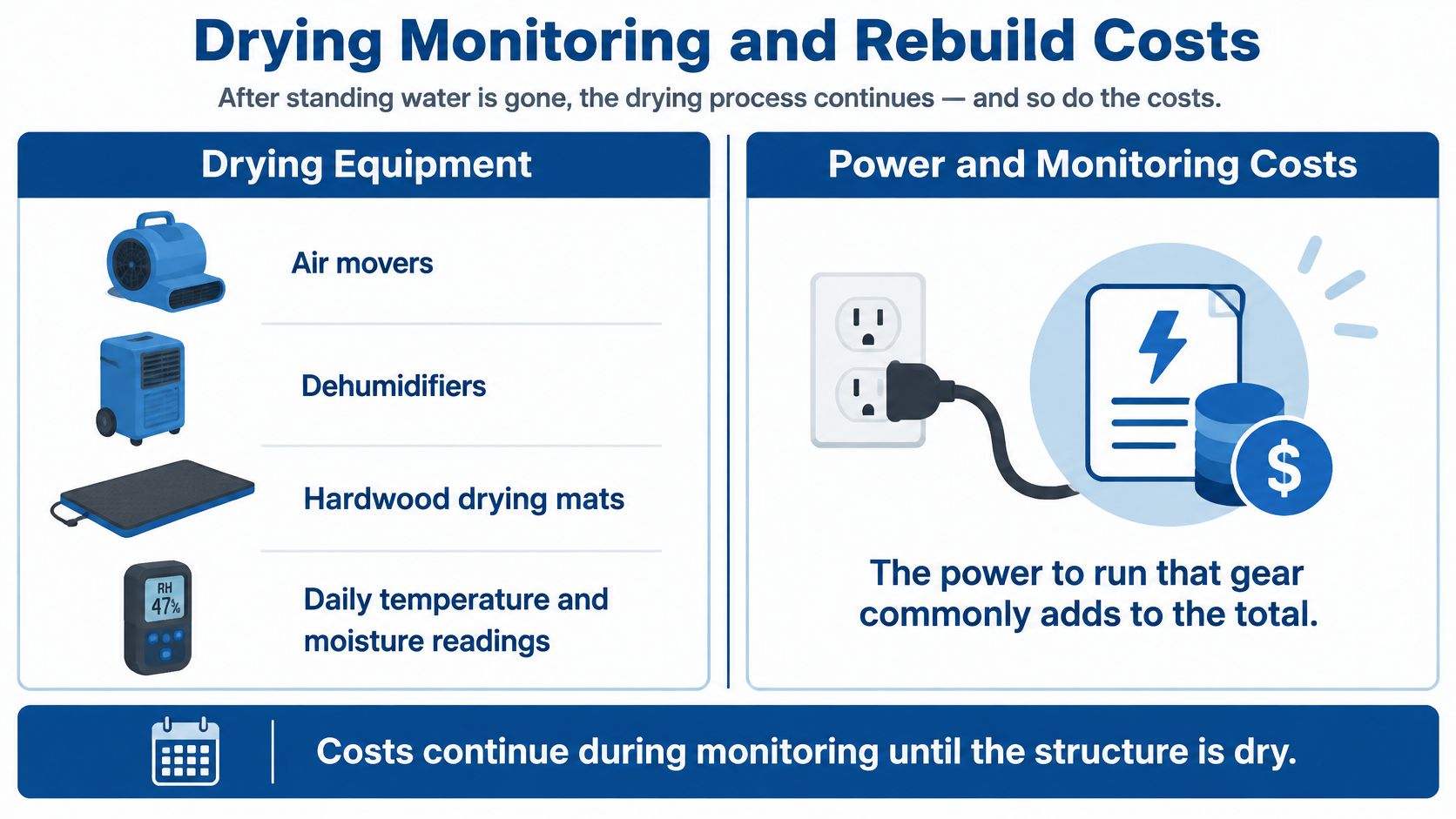
Everything after the standing water disappears is where most of your money goes, and where most corners get cut. Air movers, dehumidifiers, hardwood drying mats, daily temperature and moisture readings, and the electricity to run that equipment commonly add about $1,000 to $3,500 on a house. Wet wall cavities that take several extra days push past that range.
The ANSI/IICRC S500 listing in the ANSI Webstore identifies psychrometry and drying technology, equipment and instruments, microbiology, building-material science, monitoring, and documentation as core restoration considerations. In invoice terms, that means your estimate should account for air movers, dehumidifiers, specialty equipment, periodic monitoring, electricity, equipment repositioning, moisture mapping, and the time needed to hit documented drying goals.
The Two Scenarios Every Estimate Should Show
Demand two scenarios side by side. Scenario one is extraction-only, appropriate only when meters already show materials at dry standard, such as a quick spill on sealed tile over slab. Scenario two is extraction plus monitored structural drying, for the far more common case where flooring, drywall, cabinetry, or concealed spaces still hold moisture. If you're unsure how long scenario two runs, our guide to how long structural drying takes walks through realistic day counts by material.
- Extraction-only: Readings already at dry standard, no equipment left on site, verification documented
- Extraction plus monitored drying: Equipment placed by moisture map, readings logged, equipment removed only when goals are met
A professional record includes temperature and humidity readings, moisture measurements by material, a floor-plan moisture map, and notes on equipment placement and movement. Those records serve two purposes. They prove the structure dried thoroughly, and they provide an adjuster with the documentation needed to pay the drying line without a fight.
Rebuild and the Add-On Services Priced Separately
Drywall, flooring, cabinets, and paint frequently exceed both service lines combined. Use the sample table's rebuild column as your reference rather than expecting a fresh per-room rebuild price on the spot. Microbial prevention and deodorizing are legitimate extras when category 2 or 3 water or persistent odors are present, and they should appear as named lines, not buried in a miscellaneous charge.
Keep one distinction straight. Mold testing identifies whether mold is present and at what levels. It does not remove mold. Remediation is a separate scope with its own price, and any quote that blends testing and removal into one vague mold charge deserves a hard question.
A low extraction quote with no monitoring record is not the low-cost choice. It's an undocumented hope that hidden materials dried on their own.
We fold structural drying, microbial prevention, and reconstruction into one cycle so nothing falls between contractors. RestoTek TX coordinates plumbing repairs with licensed plumbers, ensures the source of water damage is resolved, and begins drying and restoration immediately after repairs, because drying a room that's still leaking wastes every equipment day you pay for. We also provide a single point of contact for the plumbing repair and the restoration, so you're not relaying messages between a plumber and a drying crew while your walls stay wet. When you weigh how much does water extraction cost against a rival's pump-out price, consider that coordination carefully. It's frequently the difference between a three-day dry-out and a second loss in the same wall.
Insurance Coverage for Extraction and Floods
A burst supply line at 2 a.m. gets a different answer from your insurer than creek water through the back door. Learn that split before you call, or you will lose days arguing cause of loss while wet drywall turns.
Sudden Plumbing Losses Versus Excluded Flood
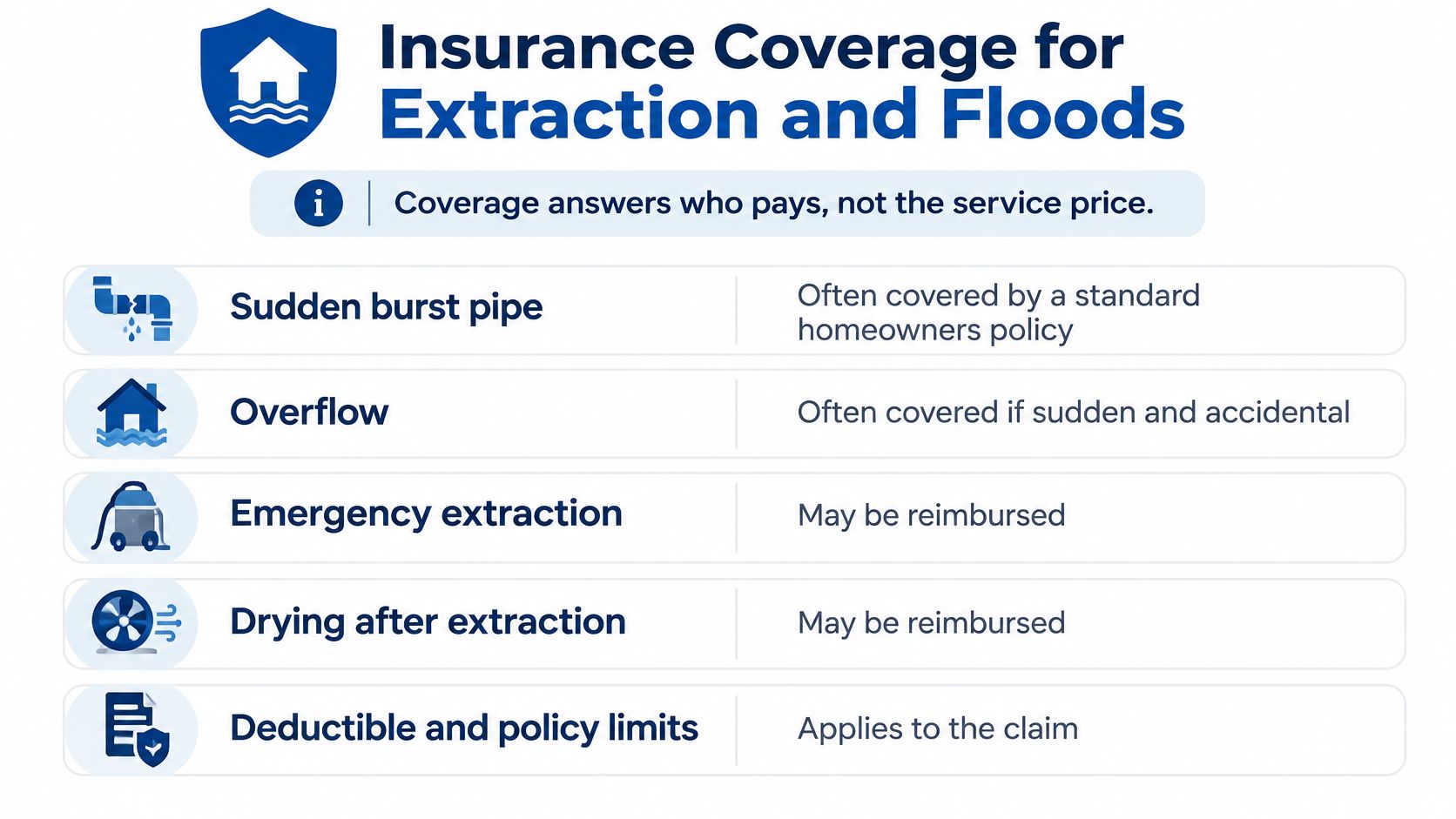
A standard homeowners policy often covers a sudden burst pipe or accidental overflow and may repay reasonable emergency extraction and monitored drying, subject to your deductible and policy terms. The same policy generally excludes flood from rain, creek overflow, and storm surge. An NFIP or other flood policy can cover building and contents up to its limits, but only a small share of households carry one. That coverage gap hits hard in Central Texas. NOAA's Physical Sciences Laboratory reporting on the July 2025 Central Texas floods put economic damages at exceeding $18 billion, with at least 135 fatalities after nearly two feet of rain in the Texas Hill Country.
Do not file street water or creek water as a plumbing claim in Austin or Georgetown. Name stormwater entry, sewer backup, or burst line accurately on the first call. If you want the claims process itself explained step by step, start with our walkthrough of a home insurance water damage claim. A wrong label sends the file to the wrong adjuster. You pay for that mistake in weeks.
Act First and Document for the Decision
Mitigate now. Argue coverage after. Policies expect you to stop further damage instead of waiting for permission, and standing water will not pause for an adjuster schedule. Delay lets the water climb the wall cavity, pushes the job into a higher category, and gives the carrier a reason to dispute everything that spread after day one.
Build a file that survives review:
- Photos before tear-out: Standing water, wet materials, and the failed fixture or line
- A named water source: Burst supply line, sewer backup, stormwater entry, or groundwater intrusion
- Moisture readings: Dated readings by room and material, before and after drying
- Split invoices: Extraction, drying and monitoring, contents, and rebuild on separate lines
- A contents list: Damaged items with photos before disposal
RestoTek TX has experience working alongside insurance claims, and that experience shows up in paperwork discipline more than anywhere else. Mold testing after water damage helps document conditions for insurance purposes, and it stays separate from removal. Testing measures presence and levels. Remediation removes it.
Document as if the claim will be questioned, because the large ones usually are. Photos, readings, and split invoices turn an argument into a review.
Get a No-Cost Local Estimate
You've got the bands, the categories, and the coverage rules. What you need now is a sequence you can execute with water on your floor. Follow these six steps in order.
- Stop the source if it's safe. Shut the fixture valve or the main, and keep power off around standing water. Don't step into water near outlets or a panel to save flooring.
- Photograph everything before anything moves. Capture the water, wet materials, the source, and damaged contents. Two minutes of photos can protect thousands of dollars of claim.
- Request a no-cost on-site estimate. RestoTek TX offers a free estimate, and we work customers through the entire restoration process, including problems such as a line backup or a sink overflow. Our plumbing coordination serves residential and commercial customers across Georgetown, Austin, and Central Texas, with 24/7 response for after-hours losses.
- Require a split written scope. Extraction, drying equipment and monitoring, contents handling, and reconstruction each get their own lines, with the water category and moisture readings named on the document.
- Compare lines, not job totals. A pump-out price against a full dry-out price is a false comparison. Confirm any night or weekend labor surcharge, and what it applies to, before you authorize after-hours work.
- Keep the claim file together. Photos, readings, authorizations, and invoices in one folder from day one, not reconstructed from a camera roll three weeks later.
The Decision Rule to Walk Away With
Authorize extraction quickly once the source is controlled. Every hour of standing water expands the wet footprint and ages the category. Authorize drying and rebuild only for materials that readings show are still wet, and release equipment only when documented goals are met. That rule spends money where moisture is and nowhere else.
One more practical point. A single local contact who coordinates licensed plumbing with the dry-out avoids a second mobilization while your house sits wet waiting on a separate trade. The leak gets fixed, drying starts immediately after, and one person answers for both halves of the job.
So, how much does water extraction cost for your specific loss? Nobody can answer that responsibly from a photo of a puddle. Get the free on-site estimate, get the readings, and get the split scope in writing. Then decide with real numbers instead of a headline rate somebody quoted to win the call.
Standing water in Georgetown, Austin, or anywhere in Central Texas doesn't wait for business hours, and neither do we. Request a free on-site estimate from RestoTek TX and we'll inspect the loss, read the moisture, name the water category, and give you a written scope that splits extraction, drying, and rebuild before you authorize a dollar. Call now, stop the spread tonight, and make every later decision with documented numbers in hand.