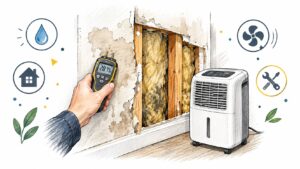
You spot a dark patch spreading across the sheetrock beside a bathroom vanity. The paint is bubbling, the wall feels cool, and a musty smell gets stronger after every humid afternoon. In Georgetown and Austin, that pattern can follow a slow plumbing leak, roof intrusion after a Hill Country storm, or floodwater that moved into the wall cavity before anyone noticed.
The difficult part isn't finding a mold cleaner. It's deciding whether the sheetrock can be cleaned at all. Porous gypsum board often can't be restored once mold has penetrated the paper facing or core, so the safe process starts with moisture control, protection, containment, and an honest assessment of what can be saved.
Assessing the Mold Situation and Protecting Yourself
Don't begin with a spray bottle. Begin by stopping activity in the room and identifying what brought water to the wall. Shut off a nearby supply valve if a plumbing leak is suspected, keep children and pets away, and close the door so normal household traffic doesn't disturb the growth.
Dark discoloration alone doesn't prove that the material is mold, and color doesn't identify a particular species. Look for a combination of irregular growth, raised or fuzzy texture, musty odor, recurring staining, bubbling paint, or a soft wall surface. A flat water stain may remain after a leak, while active growth can spread across the paper surface or appear around trim, outlets, baseboards, and plumbing penetrations.
A small bathroom mark can also be the visible edge of a larger cavity problem. Slow leaks behind a vanity can wet the back of the board, while flash-flood water can wick upward from the floor and migrate into adjacent rooms. On slab-foundation homes around Georgetown, water may travel along framing, insulation, or floor edges before the first visible patch appears.
Take the first safety steps
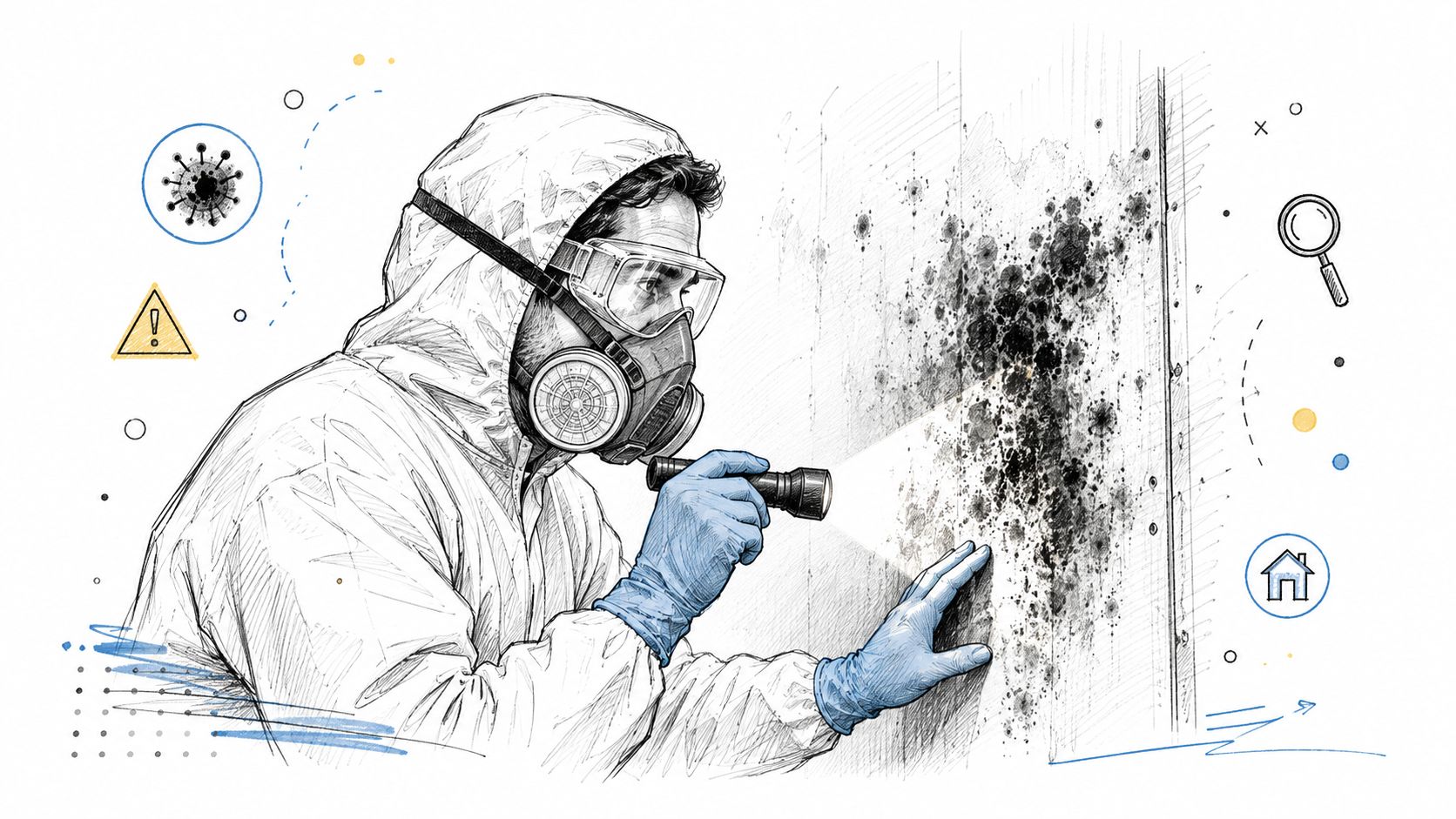
If you need to inspect closely, wear a NIOSH-approved N95, half-face, or full-face respirator, disposable or washable gloves, sealed eye protection, long sleeves, and clothing that can be cleaned separately. CDC guidance specifically recommends a half-face or full-face respirator for work such as ripping out moldy drywall. People with asthma, significant allergies, or weakened immune systems shouldn't perform the removal.
Do not sand, scrape, brush, or dry-sweep the area before containment is ready. Those actions can spread contaminated dust beyond the original wall. If you're uncertain whether the material is mold or how far it extends, arrange a visual inspection and testing rather than cutting exploratory holes throughout the room. A practical starting point is this guide to testing a house for mold.
Practical rule: Treat the wall as contaminated until moisture mapping and a close inspection show otherwise.
Bleach isn't a reliable answer for porous sheetrock. The EPA says drywall may be dried in place only when there is no obvious swelling and the seams remain intact. Moldy surfaces also shouldn't be painted or caulked before cleaning and drying, because a sealed stain isn't the same as a remediated wall.
Finding and Stopping the Moisture Source
Mold removal fails when the water source remains active. Before deciding whether to clean or cut, trace the moisture from the visible mark back to its origin. Check supply lines, shutoff valves, drain assemblies, shower plumbing, window openings, roof penetrations, gutters, and air-conditioning components above the ceiling or inside the attic.
Use a pin or pinless moisture meter to map the wall, not just test the darkest spot. Take readings above, below, and to both sides of the visible growth, then compare them with a clearly dry area made from the same material. A meter helps identify a moisture gradient, but it doesn't replace inspection of the cavity, insulation, framing, or the back of the board.
In an Austin attic, an uninsulated or poorly insulated AC duct can sweat onto framing and ceiling sheetrock. After a Georgetown thunderstorm, inspect roof-to-wall transitions, flashing, attic decking, and exterior penetrations. After a supply-line failure, check the cabinet, baseboard, flooring, and the room on the opposite side of the wall.
Read the wall as a system
Moisture may move farther than the stain suggests. Inspect adjacent rooms, the ceiling below an upper-floor leak, flooring at the base of the wall, and any insulation visible through openings. Look for swollen seams, loose tape, peeling paint, damp trim, and odors that become stronger inside closets or cabinets.
The EPA identifies the wall cavity as the hardest area to dry. If drywall stays in place, the cavity needs ventilation, and drying must continue until the structure is demonstrably dry. A fan pointed at the painted surface may make the front feel dry while insulation and framing remain damp behind it.
Avoid relying on a single universal meter number as a pass or fail. Readings vary by instrument, material, temperature, and calibration. Establish a dry reference in an unaffected section, record the readings and locations, and continue drying until affected materials approach that reference and remain stable. That record is useful for reconstruction decisions and water-loss documentation.
A dry-looking face doesn't prove a dry cavity. Open the wall when its condition can't be verified from the surface.
Setting Up Containment to Prevent Spore Spread
Removing moldy sheetrock without containment turns a localized repair into an indoor cleanup problem. The purpose of containment is to control airflow, keep debris in the work area, and give contaminated tools and waste a defined route out of the home.
For a small bathroom, close the door and seal gaps with poly sheeting and painter's tape. Cover the HVAC supply and return grilles in the work area so the system doesn't carry debris through the house. In an open-plan Georgetown or Austin home, pay attention to connected hallways, return-air paths, ceiling openings, and doors that create drafts.
Build the work zone
Use six-mil polyethylene sheeting where practical, tape seams, and create a flap or zipper access. Zip poles can hold a temporary barrier without damaging finished surfaces. A rented HEPA air scrubber is preferable because it filters airborne particles while the work proceeds. If commercial equipment isn't available, a properly filtered exhaust setup may help, but it must discharge outdoors and must not pull contaminated air through occupied rooms.
Keep the pressure direction moving from clean areas toward the work zone and then outdoors. Seal or isolate openings that could short-circuit that airflow. Don't use a box fan that blows contaminated air across the house or into an attic, crawlspace, or neighboring room.
A small work area may need only a compact enclosure. A room with widespread damage, multiple wall openings, or an open connection to living space needs a larger barrier and a controlled entry path. The negative-pressure system guidance explains why airflow direction matters during home remediation.
Plan decontamination and waste movement
Set clean gloves, respirators, tools, and bags outside the immediate demolition area. Keep a separate surface for contaminated equipment, and wipe or HEPA-vacuum tools before they leave containment. Wear disposable coveralls if available, or remove work clothing inside the controlled area and launder it separately.
Pre-cut heavy plastic bags or use sealed six-mil poly bags for debris. Don't drag loose sheetrock through the home. Bag pieces inside containment, seal the bag, wipe its exterior, and move it along the planned route. If the material came from floodwater or a sewage backup, stop and obtain professional guidance rather than treating it as an ordinary drywall repair.
Deciding Whether to Clean or Replace the Sheetrock
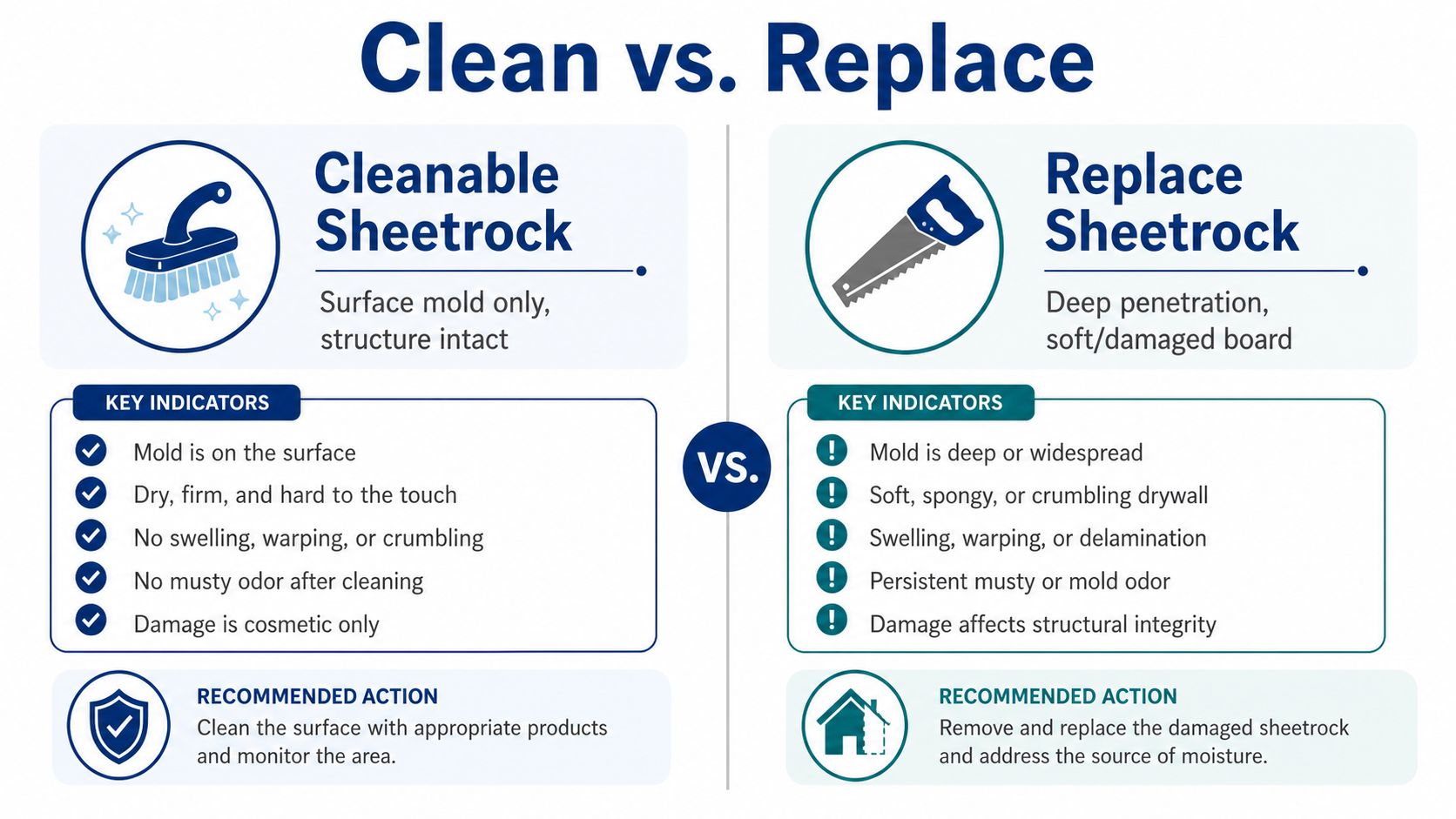
This is the decision that determines whether the repair lasts. Sheetrock, also called gypsum board or wallboard, has a porous paper surface and gypsum core. Once contamination reaches those layers, surface treatment may remove the visible mark without removing the contaminated material.
Federal remediation guidance places wallboard in a higher-cleanup category than hard, non-porous materials. The guidance recommends removing drywall in pieces as large as possible, which reduces the amount of cutting and limits aerosolization during demolition. The EPA's remediation framework and federal mold remediation guidance for buildings support a removal-first approach when porous board is colonized beyond the surface.
Apply the three-question test
Is the growth only on the surface? If the paper is intact, the board is firm, seams haven't swollen, and inspection doesn't suggest growth behind the wall, careful in-place cleaning may be reasonable for a small, contained area.
Has water changed the board? Delamination, bubbling paint, swollen edges, sagging, crumbling gypsum, soft spots, and failed tape point toward removal. A board that has lost its integrity won't become sound because the visible mold has been wiped away.
Can you verify the cavity is clean and dry? If the back of the board, insulation, framing, or wall cavity is affected, cutting out the contaminated section is usually the more dependable choice. Hidden growth, recurring odor, or a stain that returns after cleaning means the visible surface wasn't the entire problem.
Cleanable means surface-contaminated and structurally sound. It doesn't mean merely less ugly after treatment.
For a board that passes all three checks, HEPA vacuuming, damp wiping, and an appropriate antimicrobial treatment can be part of the cleanup. Follow the product label for application and dwell time, and never seal the area with paint until it has been cleaned and dried. For soft, swollen, severely affected, or cavity-contaminated board, professional evaluation is safer than repeated surface treatment. Professional black mold removal can help determine the removal boundary and coordinate drying before reconstruction.
Executing the Removal and Cleanup Process
Once replacement is the right call, remove the board in a controlled way. Keep containment under negative pressure, wear the respirator and eye protection, and shut down air movement that could carry dust into occupied areas.
Start outside the visible damage and mark a rectangular cut that reaches sound, dry material. Score the paper face with a sharp utility knife, then open the section carefully rather than smashing through it. Use a drywall saw only after checking for electrical wiring, plumbing, and other utilities. Large, manageable pieces create less loose debris than repeated small cuts, and federal remediation guidance recommends removing drywall in pieces as large as possible.
Remove, bag, and clean
Place each piece directly into a heavy-duty poly bag inside the work zone. Seal the bag before it leaves containment, wipe the outside, and carry it along the controlled route. Don't place contaminated pieces in an open truck bed or leave them in a hallway while you continue cutting.
After demolition, use a HEPA vacuum on exposed framing, the floor within containment, ledges, and nearby surfaces. Follow vacuuming with damp wiping. Don't dry-sweep, use compressed air, or run an ordinary household vacuum that can exhaust fine particles back into the room.
Clean framing and other salvageable hard surfaces according to the product label. The EPA states that moldy surfaces shouldn't be painted or caulked before they're cleaned and dried. If the cleanup involves hard, non-porous surfaces, CDC guidance limits a bleach mixture to no more than one cup of household bleach per one gallon of water, as stated in its remediation guidance. That solution isn't a substitute for removing moldy porous gypsum board, and bleach shouldn't be mixed with ammonia or other cleaners. See the EPA mold remediation guide for the containment, cleanup, and drying principles professionals follow.
What to do when the board stays
For a surface-only area that passes the decision test, HEPA-vacuum loose material first. Damp-wipe rather than aggressively scrubbing the paper, apply a labeled antimicrobial product, respect its required dwell time, and allow complete drying. Don't sand contaminated paper unless the work is contained and the method is appropriate for the material.
Photograph the source, visible damage, meter locations, containment, removed materials, and exposed framing. Save invoices, equipment records, plumber reports, and disposal documentation. For Georgetown and Austin water losses, a clear timeline and moisture record can make conversations with an insurer more organized, although coverage decisions belong to the policyholder and carrier.
Drying the Cavity and Knowing When to Call a Professional
With the board removed, position air movers to move air across exposed framing and into the cavity, while a dehumidifier removes moisture from the room. Avoid blasting air into an enclosed wall without an exhaust or drying plan. The objective is verified drying of framing, insulation where salvageable, subfloor edges, and adjacent materials, not just a dry surface.
The EPA specifically identifies wall cavities as difficult to dry. Leave the cavity open until readings approach a dry reference for comparable unaffected materials and remain stable. Only then should insulation, vapor-control details where applicable, new sheetrock, joint compound, primer, and paint go back in.
Stop the DIY work when risk increases
Call a qualified remediation professional when mold extends beyond a small, contained area, when growth is inside HVAC ductwork, when the water may be sewage or other contaminated floodwater, or when the wall has structural damage. Persistent coughing, eye irritation, or other symptoms are also reasons to leave the area and seek medical advice rather than continuing demolition.
The IICRC S520 describes mold remediation procedures for residential and commercial buildings, including controls for containment, removal, cleaning, and verification. A professional team can coordinate inspection, moisture mapping, drying, removal, and reconstruction, which is particularly useful after storm-related flooding or hidden plumbing failures.
RestoTek TX serves Georgetown, Austin, and surrounding Central Texas communities with water-loss inspection, extraction, structural drying, mold inspection and remediation, and reconstruction services. Its end-to-end process can keep moisture documentation, remediation work, and rebuilding connected instead of leaving the homeowner to coordinate separate crews.
If black mold has appeared on your sheetrock, RestoTek TX can inspect the moisture source, determine whether the board should be cleaned or removed, and manage drying and reconstruction after the contaminated material is addressed. Visit RestoTek TX to request help for a Georgetown or Austin water-damage and mold situation.