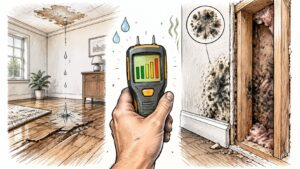
Calling a contractor immediately isn't enough after water damage. A fast conversation can get a crew moving, but an undocumented yes can also be mistaken for permission to remove cabinets, discard belongings, or start repairs you haven't approved.
Good contractor communication separates urgency from authority. You need an incident log, a named decision-maker, and written limits that distinguish emergency mitigation from reconstruction. For homeowners, property managers, and claims coordinators in Austin and Georgetown, that means making each call useful, then preserving the decision where everyone can find it.
What to Send at Each Restoration Stage
A burst supply line rarely has just one audience. The tenant needs access instructions, the owner needs a cost decision, the restoration lead needs work authorization, and the adjuster needs evidence. Sending everyone the same vague message doesn't give each person what they need.
Say you tell a technician to handle the hall bathroom. You mean extract water and set drying equipment. The technician may understand that to include removing a wet vanity. Name the room, the allowed work, and the stopping point before anyone interprets your intentions.
This isn't merely a courtesy issue. Among owners and senior decision-makers at large construction firms worldwide, 31% reported high trust in their contractors in the 2015 KPMG Global Construction Survey, as reported by Construction Dive. For a water loss, a written scope gives people something more dependable than assumptions.
Match the message to the stage
Use a call for urgent coordination, followed by a text or email the same day. Keep the written record specific enough that someone who missed the call can understand the decision.
Who to contact and what needs written approval
| Stage | Who you contact | Send this | Needs written approval |
|---|---|---|---|
| Loss notice the day water is found | Insurer and restoration contractor | Time found, address, rooms wet, known or unknown source, power status, and safety concerns | Coverage confirmation must come from the insurer, not the contractor |
| Emergency mitigation | Restoration lead and property decision-maker | Permission to extract, stabilize, and dry only, with room limits | Tear-out beyond stabilization and contents disposal |
| Drying in progress | Owner or manager, occupants, and adjuster | Moisture readings, equipment by room, and next visit | Extended equipment use with its reason and cost implications stated |
| Scope change | The named person authorized to approve cost | Location, reason, cost or schedule impact, and required signer | Added work before the approval timestamp |
| Reconstruction handoff | Rebuild lead and adjuster | Dry readings, photos, open defects, and material choices | Upgrades and repair of excluded or pre-existing damage |
For the hall bathroom, authorization might include extraction and air movers while excluding cabinet demolition and flooring replacement. If opening materials becomes necessary for stabilization, the crew should identify the proposed opening and seek a specific decision, not assume the original permission covers it.
Keep approval roles separate
The owner or an authorized representative approves the contractor's work. The insurer addresses coverage under the policy. Work authorization isn't coverage confirmation, and copying an adjuster on an email doesn't make the insurer responsible for every charge.
Build those distinctions into your restoration project management record. Before the crew arrives, send the loss-notice message with the discovery time, affected rooms, source status, occupants, pets, and access restrictions.
How to Brief the Crew in the First 72 Hours
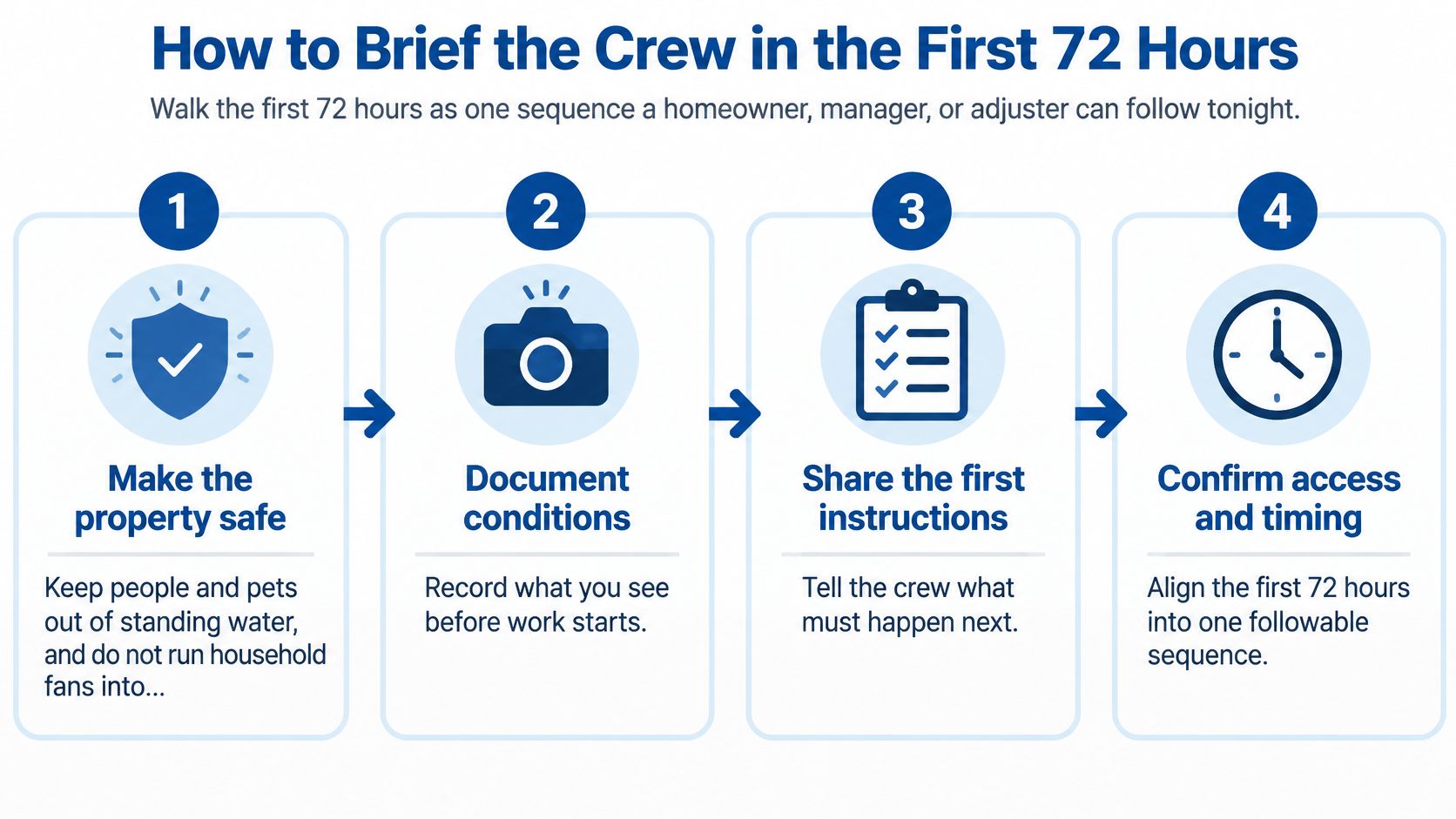
The first 72 hours are a coordination window, not a promise that every property will be dry or ready for repairs. Your immediate job is to protect people, report what happened, and give the crew instructions that don't accidentally authorize the entire rebuild.
Start with safety and the initial calls
Keep people away from hazards. Keep occupants and pets out of standing water. Don't enter water to reach a breaker, plug in equipment, or run household fans toward wet walls when electrical conditions are uncertain. Report sewage, ceiling sagging, unusual odors, and inaccessible areas before the crew enters.
Contact the insurer and restoration contractor. Use the emergency contact route after hours, then send a written recap. For flood policyholders, the FEMA NFIP Claims Handbook advises prompt loss reporting even when coverage is uncertain, photographing and inventorying damaged property, and consulting the adjuster or insurer before signing an agreement with a cleaning, remediation, or maintenance contractor.
Send this as an initial instruction, subject to the contractor's written agreement:
This is [name] at [address]. Water has affected [rooms] since [known time or discovery time]. The source is [stopped, active, or unknown]. I'm requesting extraction, stabilization, and drying only. Send the proposed authorization, the lead's name, and the arrival window.
Identify the approver and field contact. Put the authorized property decision-maker and contractor contact on the same thread. A tenant may coordinate entry without having authority to approve demolition; a manager may need owner approval above the authority granted in the management agreement.
Send: Please confirm that [name] approves scope and cost, and [name] is the contractor contact. Access coordination does not authorize additional work.
Document before instructions multiply
Ask what the crew will record. Request pre-work photographs, affected-room notes, and initial moisture measurements. Don't delay safe emergency action to stage photographs, and don't enter a hazardous room to collect them yourself.
Open the incident log. Use a shared document or a simple spreadsheet with columns for time, person, observation, decision, responsible person, and pending action. Separate what someone observed from what they suspect. Water discovered beside a washing machine doesn't establish that the machine caused it.
Notify the adjuster of what started. Describe the work performed, not the work you assume insurance will cover.
Send, if accurate: Mitigation has started to limit damage. The authorized work is [items and rooms]. No reconstruction agreement has been signed. Photos and moisture notes will follow.
Read every authorization before signing. If a form bundles emergency work, contents disposal, and rebuilding, ask for those permissions to be separated or clearly limited in writing.
- Reconcile the early work. Before the initial coordination window ends, request a summary of completed mitigation, materials still wet, outstanding safety concerns, and the next inspection. Confirm whether reconstruction remains unauthorized.
Practical rule: Replace broad permission with a task and a boundary. A request to save the bathroom isn't approval to redesign it.
Avoid instructions that invite interpretation, including permission to do whatever is necessary or match another room. Give the crew enough authority to perform the agreed emergency work, while preserving a separate decision on repairs and finishes.
Questions to Ask the Restoration Lead
Use the kickoff call to collect answers, not reassurance. Enter the lead's wording into the incident log, then send these confirmation requests.
- Field contact. Please confirm in writing the lead technician's name, direct number, and after-hours contact route.
- Approval authority. Please confirm who may approve scope or price changes and how you'll record that approval.
- Photographs. Please confirm what you'll photograph before extraction, during drying, and at final verification.
- Moisture records. Please confirm the measurement locations, materials tested, and where you'll send the readings.
- Equipment and goals. Please confirm equipment locations, the drying target, and your estimated duration, including what could change it.
- Exclusions. Please confirm which cabinets, flooring, contents, and other materials are outside this visit's scope.
- Changes. Please confirm how you'll report changed conditions, the approval deadline, and what work will wait for a response.
- Subcontractors. Please confirm which cleaning, treatment, plumbing, or rebuild trades may attend and whether they'll follow the same approved scope.
Treat an answer you can't get in writing as unconfirmed. An estimated completion date isn't a guarantee, and a proposed change isn't an approved change.
Photos and Files the Adjuster Can Use
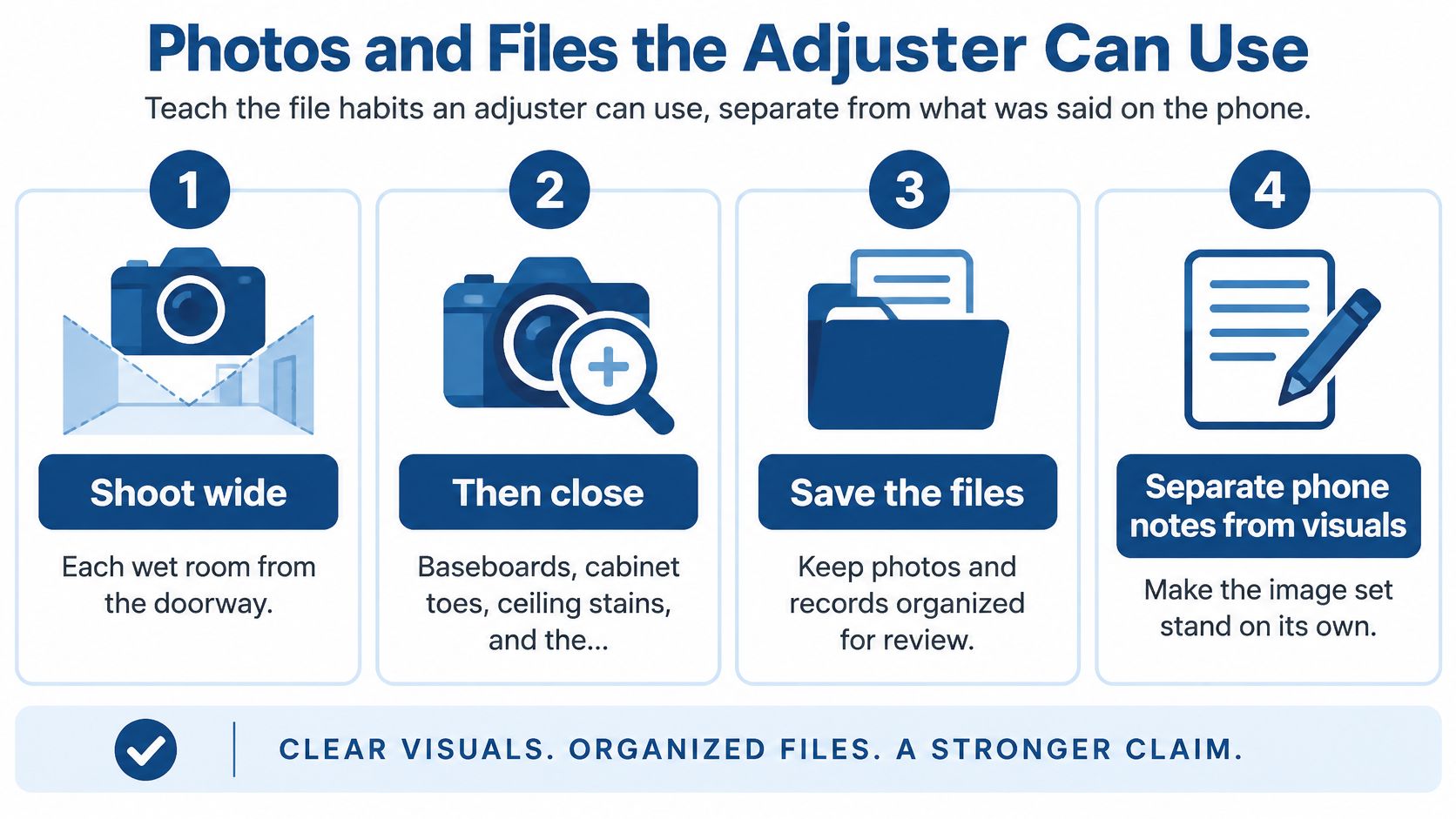
Start with a view from the doorway of each affected room. Then photograph the details: swollen baseboards, cabinet toe kicks, ceiling stains, wet flooring edges, and the suspected source. The wide image establishes location; the close image shows condition.
If you can do so safely, photograph standing water before extraction and repeat the angle afterward. Don't describe a stain as new damage unless you know it is new. Label an uncertain source as suspected rather than turning a guess into a claim fact.
Make every file identifiable
Use a naming pattern such as property-date-room-subject-status. A filename ending in hall-bath-vanity-before-extraction is more useful than a camera-generated string. Preserve the original photographs and their metadata, and save marked-up copies separately.
Ask for moisture records that identify the material, measurement location, date, instrument or scale, and reading. A number without its location and measurement context is difficult to interpret. Request an equipment map that distinguishes dehumidifiers from air movers and shows where each unit operated.
For contents, record individual items or clearly described groups, their room, and visible condition. A note identifying wet children's clothing in a bedroom closet gives the adjuster more to work with than a reference to miscellaneous boxes. Don't retain unsafe items merely for documentation; photograph hazards from a safe position and coordinate handling or disposal.
Choose the authoritative copy
Agree on one shared folder or email record that contains the current scope and approvals. Export documents into formats recipients can open, such as PDFs for signed authorizations and spreadsheets or readable reports for moisture logs. Test access before assuming the adjuster received the files.
Digital records are becoming an explicit owner expectation: 47% of surveyed owners expected to require digital data creation from general contractors, according to the Data-Centric Owner SmartMarket Report. That doesn't mean every participant needs another app. They need consistent filenames, readable exports, and an unmistakable current version.
Use progress documentation to connect evidence to the actual work. Keep superseded estimates in an archive rather than deleting them, but clearly identify which version governs today's decision.
Assemble the adjuster's review pack
Aim to send this pack the day after extraction, marking incomplete records as pending rather than filling gaps with assumptions:
- Photo set. Room overviews, detail shots, source observations, and before-and-after extraction images.
- Contents list. Item descriptions, locations, conditions, and any documented disposal decisions.
- Initial scope. Included work, affected locations, exclusions, and the current estimate.
- Moisture log. Initial and follow-up readings with measurement locations and the stated drying target.
- Written mitigation limit. The authorization showing what the property decision-maker permitted and what remains unapproved.
Include a short cover note identifying missing documents and who will supply them. A clearly labeled incomplete pack is more actionable than an unexplained collection of attachments.
Daily Updates That Close the Loop
A sent message isn't necessarily an understood instruction. In a multi-site construction study published in 2019, 76% of owners said they frequently communicated future construction plans to contractors, while only 19% of contractors agreed, according to Dodge Construction Network. The practical lesson is to ask recipients to confirm their action, not just receipt.
Set an update time with the restoration lead so occupants, managers, and adjusters know when to expect information. Urgent hazards still require immediate contact; the routine update shouldn't become a reason to postpone a safety call.
Tie each update to a decision
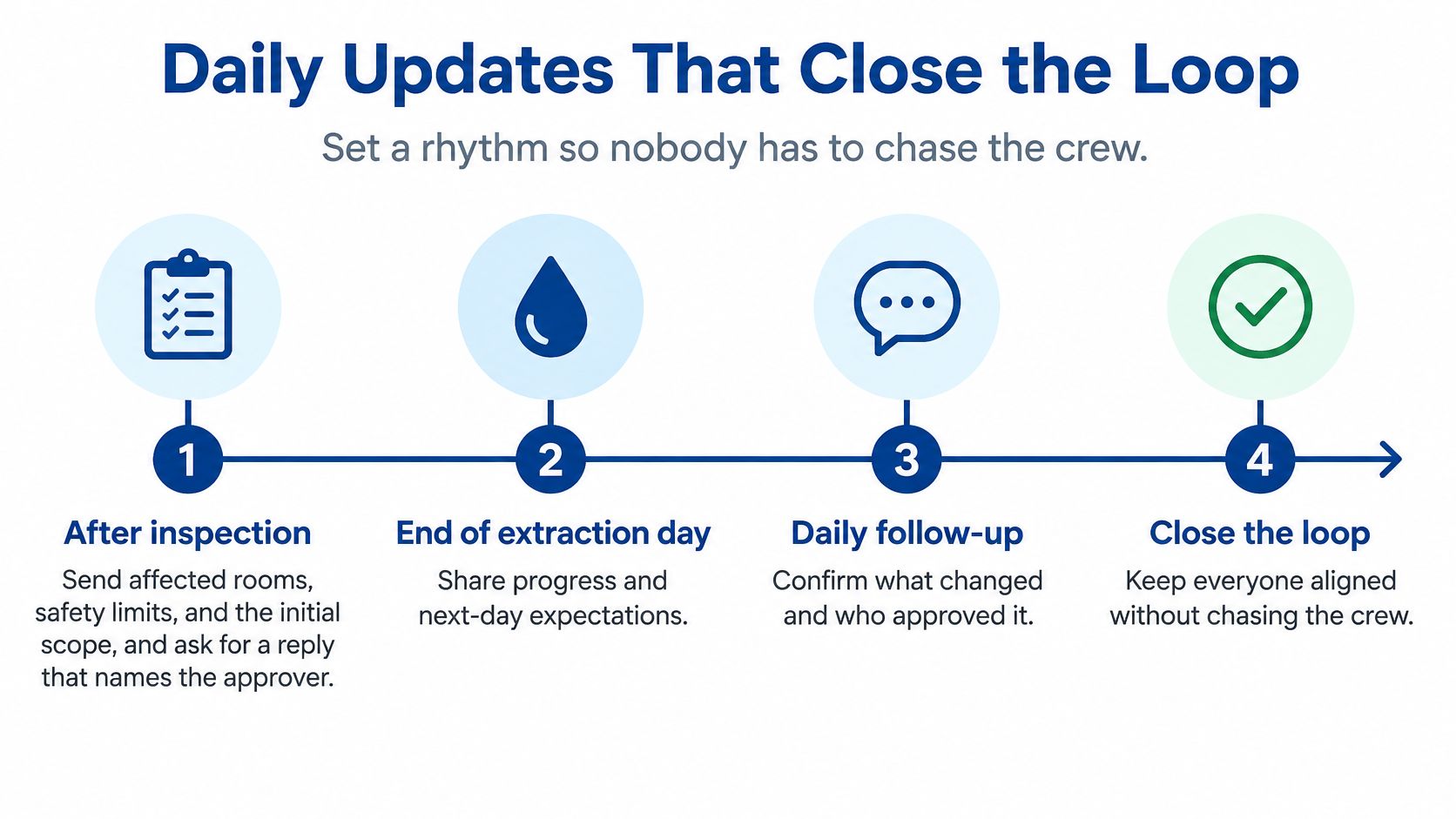
After inspection, the lead should identify affected rooms, access restrictions, and the proposed initial scope. Ask the property representative to confirm the approver's name and any limits on entry or occupied areas. If the source hasn't been stopped, assign responsibility for that task rather than letting everyone assume someone else arranged it.
At the end of extraction day, report where extraction occurred, what remains inaccessible, and which equipment is operating. For an occupied rental or open business, include usable routes, restricted rooms, and instructions for reporting a tripped circuit or equipment interruption. Don't ask occupants to move equipment without the lead's direction.
During drying, describe whether measured locations are moving toward the stated target. Attach the readings rather than substituting a reassuring description. Identify blockers such as unavailable power, a locked room, or a material-removal decision awaiting approval.
A useful reply names the action: [Name] will provide access to the locked storage room before the next visit. An acknowledgment alone doesn't resolve the blocker.
Assign unresolved questions to a person. If the owner must choose between proposed approaches, the contractor should explain the consequences of each, including any expected effect on access, cost, or schedule.
Confirm milestones before the next trade arrives
When the contractor reports that drying is complete, ask for verification against the stated target and identification of any inaccessible or excluded assemblies. Equipment removal and reconstruction readiness should be explicit decisions, not assumptions based on a quieter room.
Before a reconstruction milestone, restate material selections, locations, timing, and any changed cost. A flooring sample approval doesn't automatically authorize a different installation area. Ask the approver to confirm the exact selection and work area, and retain the reply timestamp with the current scope.
Keep routine updates short enough to read on a phone. Link to supporting records, highlight the decision that can't wait, and state what happens if it remains unresolved. Use the reply-by field as an agreed decision window, not as permission to proceed automatically when someone stays silent.
Paste this note into the project thread and replace the brackets:
Property: [Address and claim or job reference]
Date: [Update date, time, and next visit window]
Rooms still wet: [Locations, reading trend, and attached log]
Equipment on site: [Units by room, operating status, and access limits]
Decision needed: [Specific action, named approver, proposed work, and impact]
Reply-by time: [Agreed deadline and requested confirmation of who will do what]
Fixes When Messages and Scope Drift
Silence is a common stall: the contractor needs a decision, the owner thinks the adjuster is handling it, and the adjuster is waiting for documentation. Don't solve that by adding more people to a text thread. Identify who owns the unanswered request.
Agree on escalation windows at kickoff. For example, set a same-day response target for urgent coordination and a next-business-morning target for material selections. These are working agreements, not safety rules; an immediate hazard requires immediate action through the appropriate emergency route.
Match the fix to the breakdown
A construction rework literature review identifies poor communication and coordination as recurring contributors to rework. The corrective move is to restore a shared instruction before crews continue with disputed work.
Communication stalls and the next message
| What you notice | Likely breakdown | Next message |
|---|---|---|
| No reply inside the agreed window | The request has no owner | [Name], please decide [item] by [deadline]. If it waits, [specific activity] remains on hold. |
| Crew opening walls past drying | A verbal comment was treated as a change order | Pause the added opening. Send the location, reason, cost or schedule impact, and authorizer before continuing. |
| Adjuster and contractor cite different rooms | Two versions of the file | Attached is the incident log. Please identify the current scope document and reconcile the room names. |
| Dry-out declared with no readings | Verification was skipped or not shared | Send room-level verification and the equipment-removal plan before we schedule rebuilding. |
| Tenant and owner both directing the crew | Approval authority was never named | Pause conflicting instructions. [Name] is the proposed approver; please confirm that authority in writing. |
A pause should apply to the disputed task, not automatically to all protective work. Ask the lead to distinguish any immediate stabilization needed to prevent further damage from additional demolition or repairs that can await a decision.
Escalate with evidence, not another recap
Resend an unanswered request once with its owner, deadline, and consequence. Then escalate operational issues from the lead technician to the project manager or company owner. Involve the adjuster when scope evidence or claim handling needs resolution, attaching the log rather than expecting another verbal retelling to settle the facts.
If room descriptions conflict, use an annotated floor plan and matching photo labels. If an approval is disputed, collect the authorization, its attachments, and the timestamp. Don't overwrite the disputed record with a cleaner version that hides how the misunderstanding happened.
For questions about the insurance claim process, separate the insurer's coverage position from the contractor's proposed work. Ask each party to identify the unresolved issue within its role.
Before rebuilding, obtain written drying verification, an open-items list, selected materials, and restated exclusions. Property managers should send tenants the approver's name before the next crew visit; adjusters should request the incident log when accounts conflict.
Send this tonight, tailoring the exclusions to the actual job:
Who decides: [Name and phone]. Authorized now: [Specific mitigation items and rooms]. Not authorized: [Additional tear-out, rebuild, and contents disposal] until I approve in writing.
For a water loss in Georgetown, Austin, or surrounding Central Texas communities, RestoTek TX offers inspection, mitigation, structural drying, and reconstruction services. Request an assessment and ask to establish a named project contact, a written mitigation boundary, and a documentation plan before work begins.