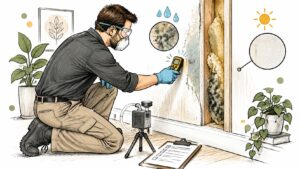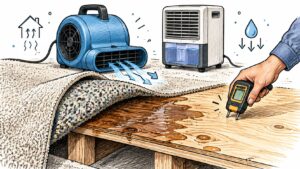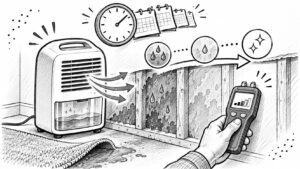
The most repeated advice after a water leak is to order a mold test. Swab the dark patch, mail the sample, and let the report tell you whether the house is safe. That advice gets the sequence backwards, and it asks a laboratory to answer a question a laboratory cannot answer.
What a mold testing professional provides is interpretation of evidence gathered for one defined question. The careful ones write that question down before a sample cassette comes out of the case. Fix the water first, then sample, and only when the sample settles something.
Know the difference and you ask better questions, refuse the useless ones, and read a lab report for what it says rather than what its cover page implies.
When a Mold Testing Professional Is the Right Call
If mold is already visible, the laboratory is usually not the next stop. The U.S. Environmental Protection Agency's page on mold testing and sampling states that visible mold generally makes sampling unnecessary, because the immediate priority is controlling moisture and removing the growth.
Most homeowners call a testing company at exactly that moment. They see a dark ring around a supply line penetration, they want a number, and they pay for a lab report that changes nothing about the work in front of them.
What this trade is good for is the second-order question. The same EPA guidance notes that sampling becomes more technically defensible in four situations: the contamination source is unclear, health concerns require exposure characterization, litigation or insurance documentation is involved, or post-remediation cleanliness has to be evaluated. That is a shorter list than most callers expect. Everything else is metering, looking, and drying, and your money buys more in those three places.
The table below turns the six situations that generate most calls into a decision you can make today.
| Situation | Better first move | Sampling usually useful | Question the visit should answer |
|---|---|---|---|
| Musty odor and no visible growth | Moisture survey, then targeted sampling | Yes, if the source is unclear | Is growth hidden in wet materials |
| Visible mold already present | Control moisture and remove the growth | Usually no | Not a spore-count compliance check |
| Active leak, overflow, or recent flood | Stop the water and dry materials | No until the source is fixed | None until moisture is controlled |
| After professional cleanup | Visual check plus surface sampling | Yes, for verification | Was the cleaned area adequately remediated |
| Buying or selling a home | Inspect history, stains, and moisture | Sometimes, if the concern is specific | Does indoor air differ from outdoors or is damp hidden |
| Symptoms that improve away from home | Medical care plus a building investigation | Sometimes, to characterize exposure | What was in sampled air at that time and place |
Read the last column twice. Not one of those questions resolves into "safe" or "unsafe," and the question most callers ask, whether the house is fine, is absent from the list because no lab report answers it.
Before you book: write a single sentence naming what the visit has to settle. If you cannot write it, you are not ready for sampling, and a careful inspector will say so instead of selling you three cassettes.
Say a supply line failed under a bathroom vanity eight months ago. The drywall looks unremarkable, the cabinet base smells earthy, and the question is whether the toe kick and the wall behind it stayed wet long enough to grow something. That points to a moisture survey with targeted surface samples, not air samples in the hallway.
The symptom row needs a plain caveat. A test can describe what was in the air at one time and place. It cannot diagnose an illness, and a complaint that eases when you leave the building belongs with a doctor who can weigh the whole picture.
What the Visit Measures Instead of a Pass or Fail
A pollen count for your city on one April afternoon describes the air at that monitor at that hour. Nobody treats it as a grade for the whole allergy season, and nobody should treat a single indoor spore count as a grade for a house.
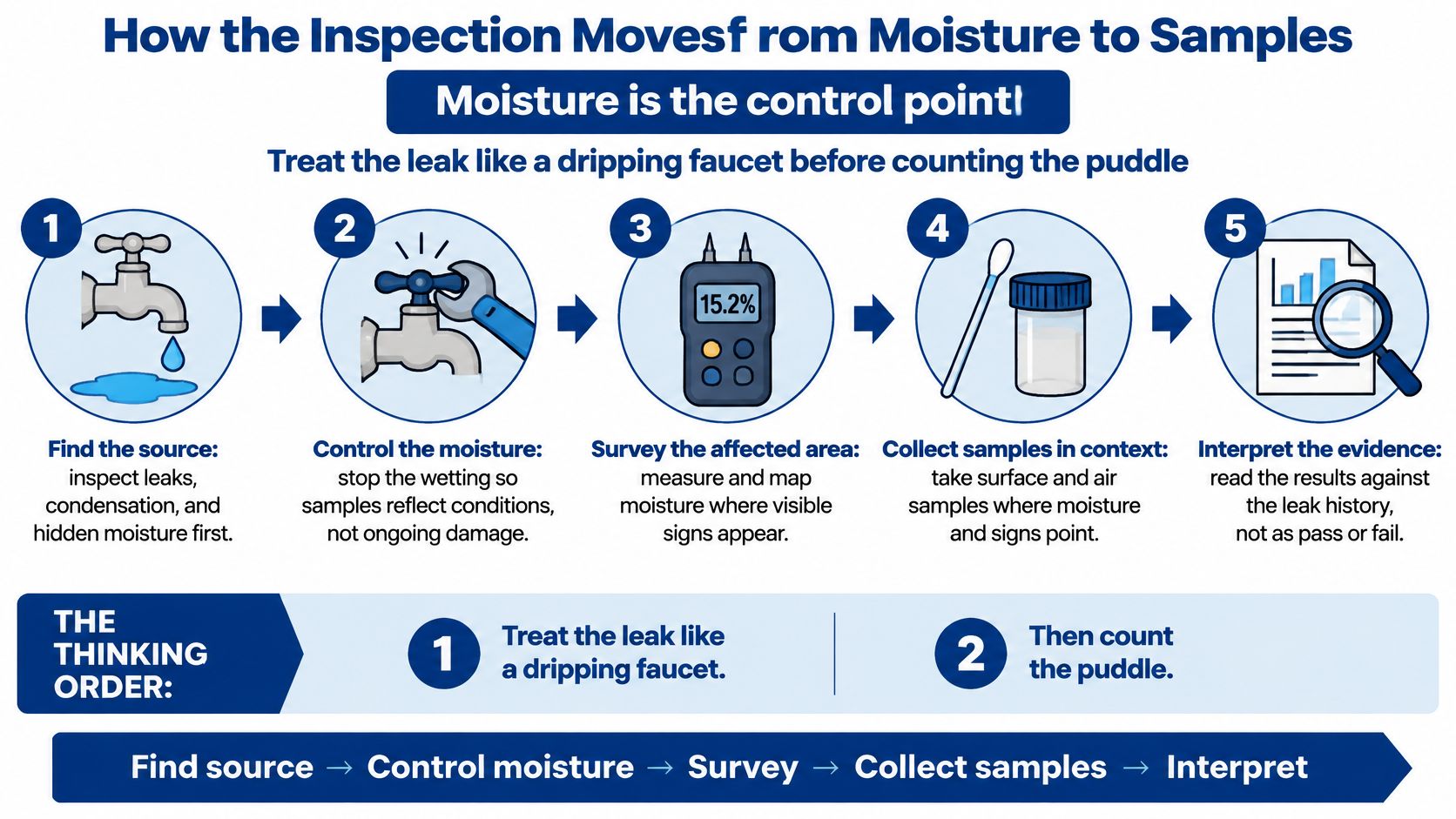
Here is the sequence a properly run visit follows, and how late in the process sampling really arrives.
The work is evidence interpretation, not measurement with a verdict attached. The EPA's brief guide to mold, moisture, and your home explains that no EPA or other federal limits have been established for indoor mold or airborne mold spores, so a test result generally cannot be used to determine whether a building complies with a federal mold standard. There is no line to be above.
What the report should record instead: the building's water history, where water entered and how long materials stayed wet, why each sample was collected, the exact locations, and the limits of what those samples can say. That is a document. It is also the reason to hire a person rather than order a dish in the mail.
A qualified report explains its purpose and its limits. It never presents a spore count as a universal health threshold.
| Sample type | Where it is taken | What it can support |
|---|---|---|
| Air sample | One room at one moment | A time-and-place snapshot; compare with an outdoor reference |
| Surface sample | A specific material surface | Growth on that material and whether a cleaned spot was adequately remediated |
| Bulk sample | A cut piece of building material | Growth tied to that material |
An air cassette samples one room at one moment, so its value climbs when there is a same-day outdoor sample to compare against. Surface and bulk samples tie growth to a material, which is why they are the right tool for checking a cleaned spot after work is finished. Laboratory analysis should follow methods recommended by recognized industrial-hygiene organizations such as AIHA or ACGIH, and choosing among those methods belongs to someone experienced in protocol design, which is the EPA's own reason for routing this work through an experienced professional.
If you want background on how indoor air questions get framed before you book anything, the material on air quality testing covers the comparison logic behind a reference sample.
That is why a solid visit opens with a moisture meter and a written hypothesis, not a cassette on the kitchen counter.
How the Inspection Moves from Moisture to Samples
Treat a water loss like a dripping faucet. You fix the drip before you measure the puddle, because a puddle measured under a running faucet tells you nothing about how much water the room can hold.
Here is the order that follows from it.
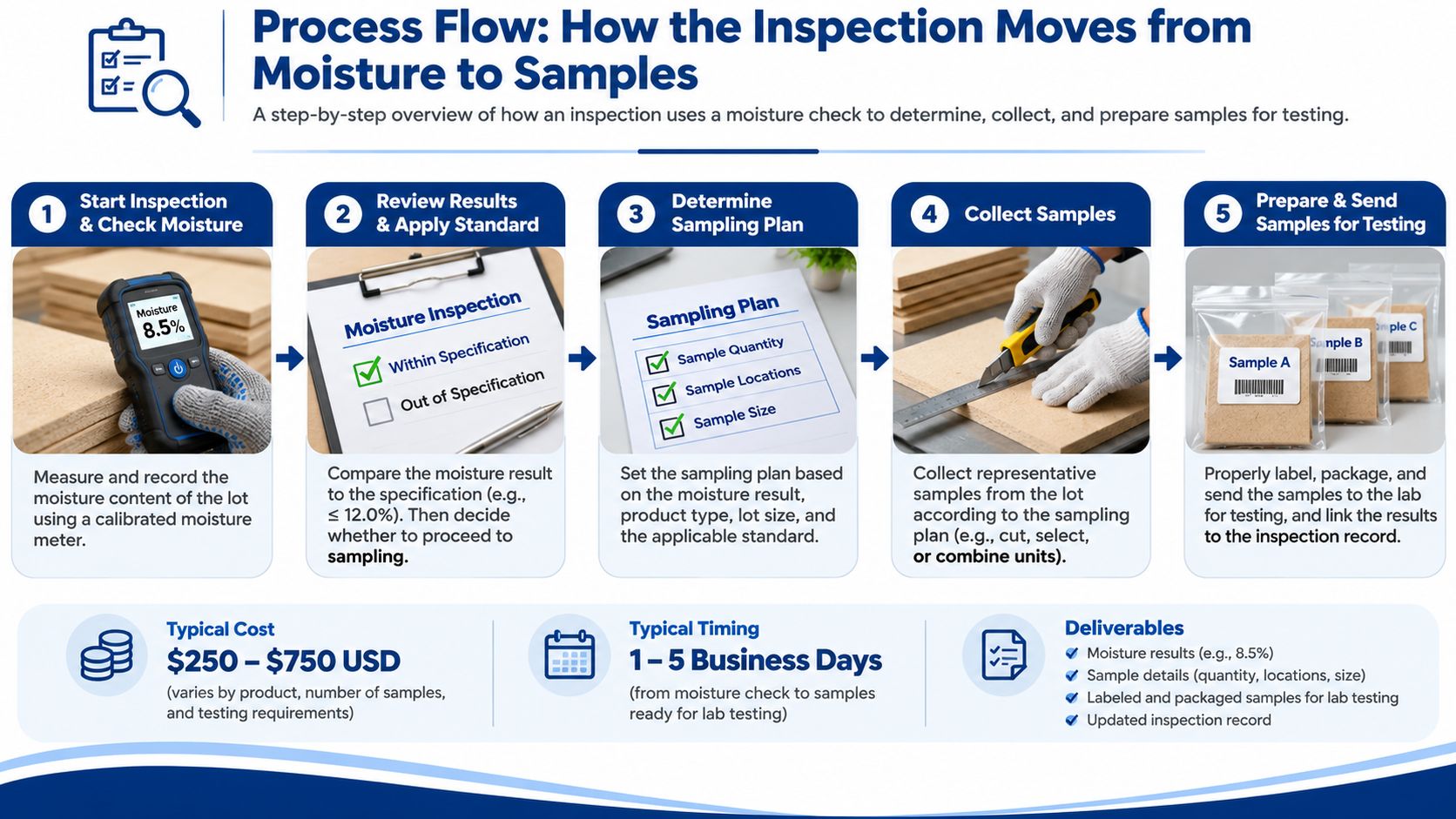
The EPA's mold course chapter on moisture and mold names moisture as the key driver of growth and directs assessment toward existing or potential moisture problems, including those tied to water damage. That is the technical reason the lab comes last, and the practical reason a good inspector spends most of the visit with a meter in hand.
- Write down the water story. Record the source, the date it started, prior floods or plumbing failures, and the one question the visit must answer, because a timeline tells the inspector which cavities stayed wet longest.
- Walk the affected and high-risk areas. Note odor, staining, bubbling paint, and visible growth, since those observations decide where the instruments go next.
- Meter suspect materials against dry controls. Compare a baseboard, cabinet panel, or door casing with an unaffected assembly in the same house, because a reading means little without a baseline from the same building on the same day.
- Evaluate concealed cavities when the evidence justifies it. Pull a baseboard, loosen a toe kick, or cut a small inspection opening when readings, odor, staining, or construction details suggest wetting, because porous materials can hold moisture long after the surface feels dry.
- Write the sampling hypothesis before any cassette or swab. Name the suspected source, the likely pathway, affected locations versus reference locations, the sample type, the lab method, and how the result will be judged, because a sample collected without a hypothesis can be argued away later.
- Match the sample type to the question. Surface or bulk samples identify material-associated growth or verify cleaning, while air samples are a time-and-place snapshot that needs an outdoor reference when comparison is the point.
- Send samples for analysis under recognized methods. Laboratory work should follow methods recommended by organizations such as AIHA or ACGIH, so the result holds up when an adjuster or an attorney reads it.
- Tie every reading to an action. Connect each observation to a specific fix and keep the pre-remediation assessment separate from post-remediation verification, because mixing the two muddies the only document that proves the work was done.
A report built this way keeps readings and photographs side by side. That is what moisture mapping buys you: a walkthrough converted into a record you can hand to an adjuster.
The order matters more than the paperwork. If the source is still active, a laboratory name for the mold stops nothing. It does not dry a cavity or save a cabinet base that is already swelling, and a negative short-term air sample does not prove hidden growth is absent. A report that presents one as proof tells you something about its author.
How to Read Findings That Are Not a Safety Score
Does a clean report mean the house is fine after water damage? No, and the agencies that study buildings say so fairly directly. CDC and NIOSH guidance on mold testing and remediation does not recommend routine mold air sampling for building evaluations and warns that short-term results, particularly negative findings, may not represent actual exposure. Spore counts and culture results cannot be interpreted directly as health-risk measurements.
The American Industrial Hygiene Association adds context that every homeowner should hear before paying for sampling. Airborne mold varies substantially with outdoor conditions and building activity, no precise formula separates normal background from high levels, and one or two indoor samples cannot reliably establish whether indoor fungal diversity differs from outdoors.
So what does a clean report rule out? It may show that sampled air at a particular time contained no detectable or unusual pattern. It does not exclude hidden growth in wall cavities, intermittent release, damp materials, or a moisture source that is still active.
What Five Common Findings Can and Cannot Prove
| Finding | What it can support | What it cannot prove |
|---|---|---|
| Indoor pattern unusual versus a same-day outdoor reference | Indoor amplification worth investigating | A federal health limit or a safe-versus-unsafe label |
| Negative or normal short-term air sample | Sampled air at that moment looked unremarkable | That hidden cavity growth, intermittent release, or remaining damp is absent |
| Surface or bulk sample identifies growth | Mold on that material and a cleanup target | High airborne exposure throughout the building |
| Post-cleanup surface sample looks clear | The sampled spot appears adequately cleaned | That the whole building is dry or mold-free |
| Single spore count and no reference sample | A number from one time and place | That indoor air is elevated above background |
Notice that every row's middle column is a small claim and every right column is the big claim people try to build on top of it. The gap between those two columns is where disputes, panic, and wasted remediation dollars live.
The rule that fixes most confusion: a lab page without moisture data, photographs, and a leak timeline is a list of names, not an assessment of your building.
Three Central Texas Situations
Take a slow supply leak that stained the bottom two inches of baseboard in a hallway. Readings on the baseboard and the drywall below the stain, compared with a dry wall across the hall, decide whether the cavity behind it gets sampled. When the gypsum reads wet against a dry control, the report links that wet material to a drying plan, and the lab result becomes supporting evidence rather than the headline.
Then a buyer who notices an earthy odor in a hall closet after a plumbing failure two owners ago. Nobody can say when growth started or whether it is still active. An indoor sample beside a same-day outdoor reference is the only comparison that carries information, and even then it characterizes air at that hour in that closet.
Now a cleaned closet that fails clearance because the toe kick stayed wet. The visible surfaces were wiped, the cavity was never dried, and the verification sample caught the gap. That case is the argument for ordering verification after the source is fixed rather than on the day the equipment leaves.
Pair the Lab Page With the Building Record
Ask for the report that puts numbers in context. Moisture readings with locations, photographs of what was opened, drying records with daily readings, and repair notes for the leak itself belong in the same binder as the lab results. Read together, they answer the question that started the visit. Read alone, a spore count is a snapshot of air that has already moved on.
Choosing a Professional and Reading the Report
Sample collection works like building evidence, not like a home safety medal. Before anyone opens a cassette or plate, ask what the visit will document. A professional should record the building history, the water source and its timeline, moisture readings compared with dry control areas, the exact question the visit answers, and both sample locations and references. Without that frame, a number is just a speck count floating loose from the building.
Ask who writes the sampling hypothesis and who reviews the laboratory method. Samples should be collected and interpreted by professionals experienced in designing sampling protocols, selecting methods, and reading lab results. A firm that cannot name its method or reviewer is selling a number without a defense behind it.
The IICRC S520 Standard for Professional Mold Remediation is a useful benchmark. It speaks to investigators, indoor environmental professionals, consultants, project managers, property owners, insurance representatives, and regulators, not just remediation contractors. That wider frame keeps assessment tied to containment decisions, documentation, and verification.
Four questions worth asking before you book:
- Which question is being tested? Hidden growth, an indoor-outdoor comparison, and post-remediation verification are three different jobs with three different sample designs.
- Are reference samples planned? An outdoor or unaffected-area sample gives an indoor result context.
- How will findings stay separate from remediation? Verification should rest on the wet materials and drying record, not fold into a sales conversation. Mold testing identifies whether mold is present and at what levels. It does not remove mold. Professional mold remediation is the separate service that removes mold and addresses underlying moisture issues.
- What does the report say it cannot prove? A report with no stated limits is overclaiming.
Walk away from any report that presents a spore count as a universal health threshold or issues a safe-or-unsafe verdict. A lab report can characterize a sample under defined conditions. It cannot declare a house safe or compliant, and no federal standard turns one count into a verdict.
Fix the Moisture or Book a Targeted Test
You can decide this today with two branches.
If water is still entering, materials are wet, or mold is visible, stop the source, extract standing water, dry to a documented dry standard, and remove what cannot be saved. Testing waits. It removes neither the mold nor the leak, and paying for it now just documents a condition you already know about.
If the water event is over and the open question is hidden growth, an indoor-outdoor comparison, insurance documentation, or whether cleanup worked, that is the branch where a professional earns the fee.
What to Bring to That Booking
Bring the one-sentence question you already wrote. Confirm that reference samples are part of the plan and that findings will be reported separately from any remediation work. Ask how results will be explained to you, not just emailed, because the review conversation is where the limits get spelled out.
RestoTek TX provides mold testing and inspection that documents whether mold is present and at what levels, and the process runs from initial inspection and sampling through analysis and a results review. Testing itself does not remove mold; remediation is a separate service that removes growth and addresses the moisture feeding it. If high levels turn up, we can walk you through the next steps, including professional remediation options when they are required.
RestoTek TX handles mold testing and inspection across Georgetown, Austin, and the surrounding Central Texas communities, with moisture readings and a written record that tell you what the results mean and what they cannot prove. If your water event is over and the open question is hidden growth, an indoor-outdoor comparison, or whether a cleanup worked, we will map moisture before anyone samples and explain the findings at a results review. Visit RestoTek TX to request a free estimate for the testing.