A hard Central Texas storm rolls through, and the low corner of your yard turns into a shallow pond. Water gathers beside the foundation, the soil feels saturated underfoot, and the same question comes up: would a sump pump for yard flooding solve this, or would it just move the problem somewhere else?
That distinction matters. A pump can remove water from a defined collection point, but it can't correct a yard that slopes toward the house, stop runoff sheeting across a property, or repair a foundation that lets water through. In Georgetown and Austin, the right fix usually starts with identifying where the water comes from, then choosing the least complicated system that can handle it reliably.
Why Your Yard Keeps Flooding After Every Storm
A homeowner often notices the symptom before the cause. After a downpour, water sits beside the back patio, the grass stays soft for days, and the soil near the foundation begins to wash away. A pump seems like an obvious answer, especially when the same low spot fills during every storm.
But standing water can come from several different sources. Surface runoff moves across the ground from a higher part of the lot, often carrying soil and mulch with it. Groundwater rises through saturated soil and collects in a low area. A localized depression may hold water because the surrounding grade gives it nowhere to drain.
Those patterns look similar from the kitchen window, but they need different repairs.
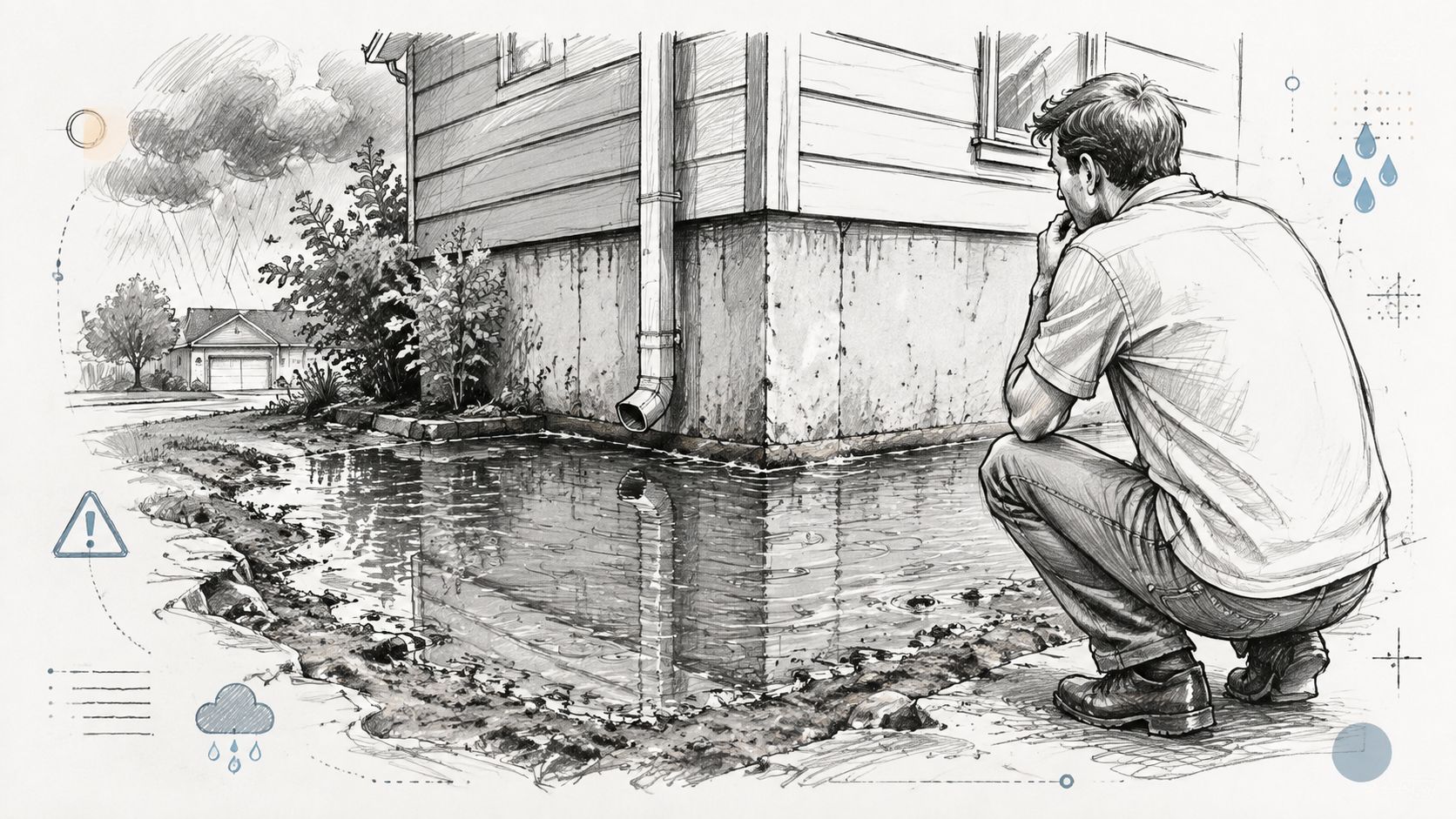
Start with the water path
Watch the yard during rainfall instead of inspecting only after the storm. If water travels in a broad sheet from the street, a neighboring slope, or an upper part of your property, the first remedy is usually grading, a swale, or a collection drain. If it gathers in one predictable basin while nearby areas remain passable, an outdoor pit and pump may be more suitable.
Downspouts deserve special attention. A downspout that releases water beside the foundation can saturate the same soil a yard pump is supposed to protect. Extending the discharge and correcting the surrounding grade may solve the problem without adding a motor, pit, float switch, and electrical connection.
Field rule: Follow the water uphill. The place where water stands is often not the place where the drainage failure begins.
Compacted clay soil can slow infiltration, while edging, retaining walls, patios, and additions can interrupt an older drainage path. A catch basin may collect water that a swale can't handle, while a French drain can intercept shallow groundwater before it reaches the foundation.
Private drainage still needs a site-wide plan
Government guidance from several jurisdictions explains that drainage problems on private property are generally the responsibility of the owner or landlord, while public sewers and public drains belong to the relevant authority or utility. Illinois guidance on private drainage responsibility makes the same practical distinction homeowners encounter elsewhere.
That means a municipal storm system may be functioning as designed while your lot still floods. Keep ditches, swales, drainage gates, retention areas, and runoff paths clear. A sump pump is one layer of protection, not a substitute for a functioning site drainage network.
For broader storm preparation, homeowners can also review this Central Texas summer storm water-damage guide. The key decision remains simple: determine whether water is rising into a collection point or moving across the surface. The first pattern can justify pumping. The second usually calls for changing the water's route.
When a Sump Pump Is the Right Fix and When It Is Not
A sump pump earns its place when water has a defined collection point. An exterior basin in a low area can intercept groundwater or recurring ponding and send it through a controlled discharge line. For example, a basin that collects water in one corner of a flat yard after each storm may be a practical pumping point, especially when the property has little natural fall and gravity drainage cannot move the water to an approved outlet.
It is not a general flood-control device.
Situations that support a pump
A pump is a reasonable candidate when the flooding pattern has these characteristics:
- Defined collection area: Water gathers in a pit, basin, or low point instead of spreading evenly across the property.
- Recurring groundwater pressure: Saturated soil continues feeding the collection point after visible runoff has passed.
- Limited natural fall: The yard lacks enough slope for a gravity drain to carry water where it belongs.
- Safe discharge route: Pumped water can be directed away from the foundation, neighboring property, sidewalk, and unauthorized sewer connections.
Suppose a basin holds a six-inch rise of water and the inflow continues after rain stops. That pattern points to groundwater or a concentrated drainage problem that pumping may address. The basin, pump, discharge pipe, and backup plan still need to work together. A pump can protect a low part of the yard and reduce water reaching the foundation, but only while the collection point and outlet remain functional.
Situations that call for another repair
Surface runoff usually requires a change in the water's route. If water crosses the lawn from higher ground, a pump in the lowest spot may remove some water, yet it will not stop erosion or prevent the next sheet of runoff. Regrading, a swale, a French drain, or a catch basin can intercept or redirect that flow before it reaches the low area. In many yards, correcting the grade is faster and less costly than excavating a basin and maintaining a pump.
Sewer backflow is a separate problem. A sump pump cannot stop contaminated water from pushing backward through a drain. Backwater protection and a plumbing evaluation may be needed.
Water entering through foundation cracks also calls for caution. Hydrostatic pressure can force moisture through cracks, joints, or porous masonry. Pumping nearby water may reduce pressure in some conditions, but it will not seal the opening. Structural evaluation and crack repair may be necessary.
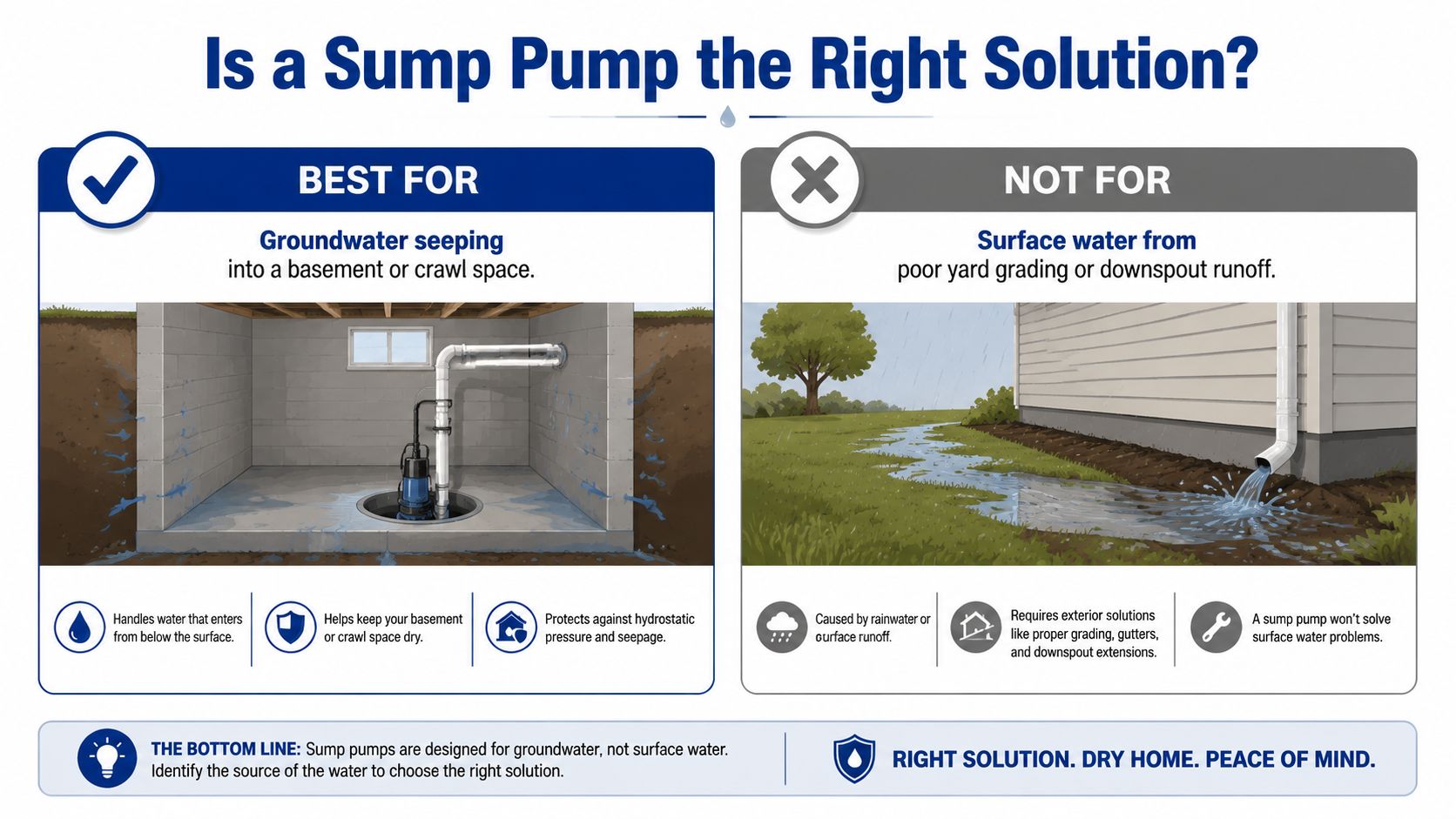
The field test is straightforward: if water collects in a controlled low point and can be discharged safely, pumping may fit; if water arrives as runoff or enters through the structure, fix the route or the building first. FEMA guidance places sump pumps within broader flood mitigation and recommends checking equipment during rainfall, snowmelt, and outages. FEMA sump pump guidance supports using the pump as one layer of protection, not as the only answer.
Sizing Your Sump Pump Using Real Field Measurements
Advertised gallons-per-hour ratings don't tell you what a pump will deliver at your outlet. A pump must overcome total dynamic head, which includes vertical lift, pipe length, elbows, and check-valve resistance. The useful number is the flow at the actual discharge point, not the number printed under ideal test conditions.
Measure inflow before choosing equipment
During a wet period, let the water level in the pit rise for exactly one minute. Measure the change in water level, then use the basin diameter to calculate how many gallons that rise represents. Multiply the measured inflow by a safety factor of about 1.5, as described in this sump pump capacity calculation method.
For a round basin, the gallons-per-inch value depends on diameter. The table below gives a practical reference. The final column shows the flow represented by a six-inch rise over one minute.
| Pit diameter | Gallons per inch | Example, six-inch rise in one minute |
|---|---|---|
| 18 inches | Approximately 1.10 | Approximately 6.6 GPM |
| 24 inches | Approximately 1.96 | Approximately 11.8 GPM |
| 30 inches | Approximately 3.06 | Approximately 18.4 GPM |
| 36 inches | Approximately 4.41 | Approximately 26.5 GPM |
These are geometry-based reference values, not a substitute for measuring your specific pit. Sediment, an irregular basin, or water entering from a connected drain can change the result.
Account for lift and pipe resistance
Suppose a 24-inch pit rises six inches in one minute. The reference volume is approximately 11.8 gallons per minute before the safety factor. Applying the field factor produces a target near 17.7 GPM, before accounting for the discharge system.
Now add eight feet of vertical lift, a long pipe run, elbows, and a check valve. The pump must deliver the target flow at that operating head. Compare the manufacturer's performance curve, not just the horsepower or maximum GPH label. A smaller pump with a useful curve at your actual head can outperform a larger-looking unit selected from a marketing headline.
Horsepower alone isn't a sizing method. Measure first, then select a pump that meets the calculated flow at the measured head.
Permanent pit or temporary flood pump
A permanent exterior basin makes sense when the flooding is predictable and the collection point remains useful between storms. A temporary flood pump can be more flexible for intermittent pooling in a flat yard, but it still needs a stable intake, supervised placement, reliable power, and a lawful discharge destination. Delaware's flood-pump adaptation guide.pdf) distinguishes temporary yard-drainage use from permanent installations and highlights inspection, discharge, and outage planning.
Installing the Pump and Routing Discharge Safely
Place the basin where stormwater already gathers, not where excavation is easiest. For an exterior installation, that usually means the lowest practical part of the yard, near the recurring ponding area but far enough from the foundation for a safe outlet route. Confirm underground utilities and local requirements before digging. Check Georgetown or Austin rules before connecting to public drainage or trenching near a right of way.
Build the collection point correctly
Excavate a stable pit and prepare a clean gravel base that keeps the basin level and prevents settling. Use a basin made for exterior drainage, with a cover that limits leaves, soil, and yard debris from entering. Position the pump so the float moves freely and the intake stays clear of sediment.
A submersible pump also needs a dependable electrical connection protected from wet conditions. Arrange cords and connections so they cannot sit in standing water, become buried, or be damaged by mowing and landscaping equipment.
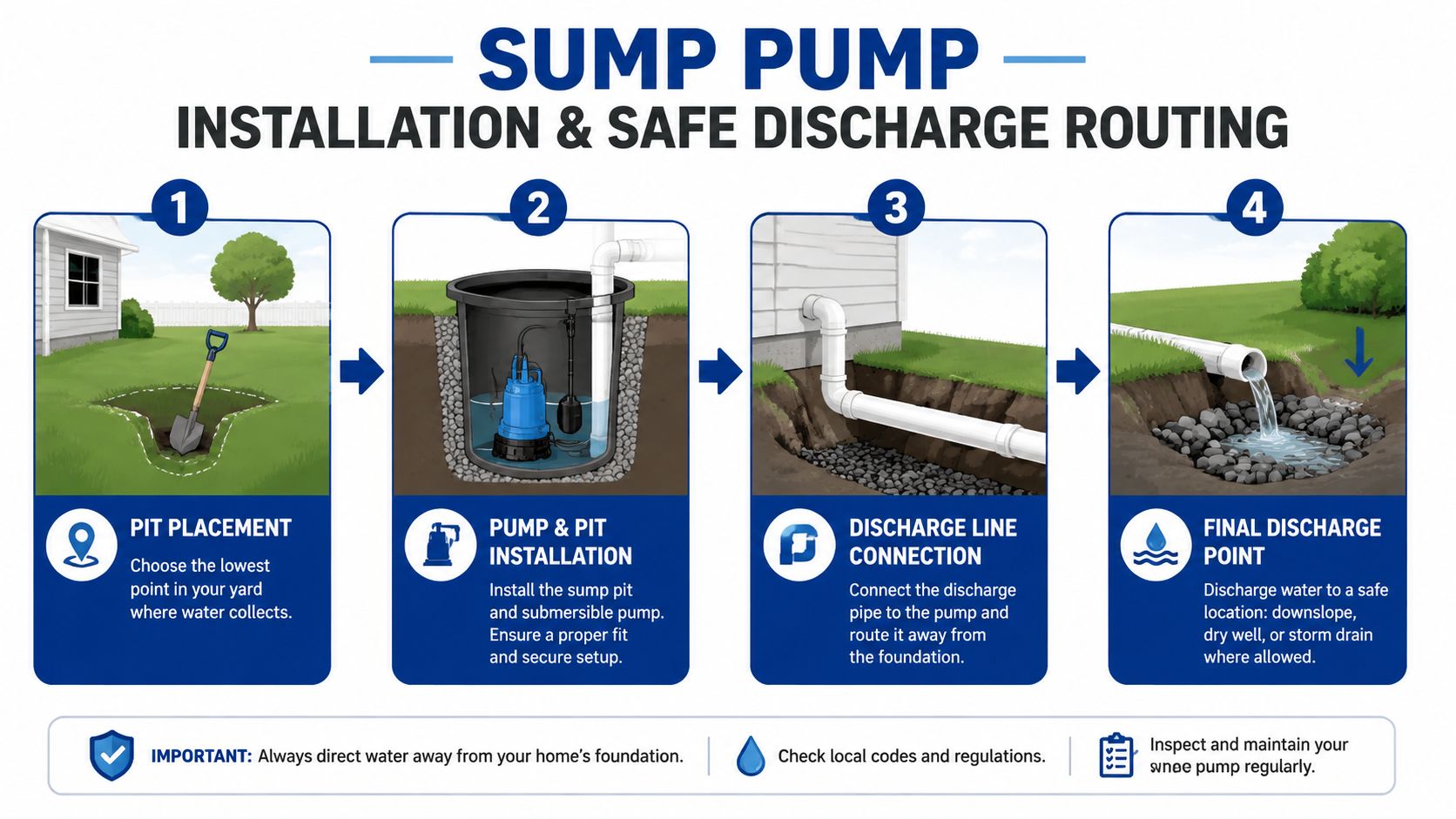
Treat discharge as part of the installation
The pump only moves water. The outlet decides whether that water stays away from the property or creates another drainage problem downhill.
- Use solid pipe for permanent work: Solid PVC or another approved rigid discharge pipe provides a predictable route and resists collapse better than flexible hose.
- Install a check valve: The valve limits backflow into the basin after the pump stops, reducing unnecessary cycling.
- Keep water away from the foundation: Route the outlet roughly 10 feet from the foundation where site conditions and local requirements allow.
- Choose the outlet carefully: Do not discharge onto an adjoining property, a sidewalk where water could create a hazard, or a slope that the flow might undermine.
- Allow the line to empty: Residual water in the pipe can freeze during a cold snap or obstruct the next pump cycle.
Use a suitable downslope area, an approved drainage feature, or another location accepted by local code. Do not assume a storm sewer or sanitary sewer connection is allowed. Municipal approval may be required, and requirements vary by location.
Installation insight: A pump with a clean intake can still fail the homeowner if its discharge line directs water back toward the house.
Storm outages create another weak point. Choose backup power that matches the pump's electrical requirements, then test the transition before severe weather arrives. A backup pump helps only when its intake, discharge route, and power source operate together. In some yards, that work exposes the underlying problem: grading or a swale may control runoff more effectively than a pump, while foundation or retaining-wall damage requires structural repair.
Maintenance and Winterizing to Prevent Failure When It Matters Most
A pump that has sat untouched for months may look ready while the float is stuck, the intake is dirty, or the discharge line is blocked. Exterior systems face leaves, mud, insects, corrosion, and temperature swings, so maintenance needs to include the basin and the route beyond it.
Use a simple inspection calendar
Test the system during a controlled water test. Pour water into the pit and confirm that the float activates the pump, the pump empties the basin, and the float shuts off without hanging on the basin wall or discharge pipe.
Use this checklist as a working routine:
- Test the pump during rainfall: Observe operation when the yard is receiving water, not only when the weather is dry.
- Clean the intake and basin: Remove gravel, leaves, mulch, and sediment that could reach the impeller or restrict flow.
- Inspect for corrosion: Look over the pump body, wiring, fittings, and check valve for rust or damage at least annually.
- Confirm complete discharge: The line should empty fully and shouldn't hold a pocket of water that can freeze or obstruct flow.
- Test backup power: Run the backup system under load at least twice per year and follow the battery manufacturer's replacement schedule.
The RestoTek TX sump pump failure resource also points homeowners toward practical checks such as the float, discharge line, breaker, and backup unit when a system stops working.
Prepare for cold snaps
Central Texas winters are usually mild, but exposed pipe can still hold standing water during an unexpected freeze. Keep the discharge line sloped so water can drain out, protect vulnerable sections from impact, and inspect the outlet after cold weather. Don't bury a line with a low pocket that traps water unless the installation has been designed to prevent blockage.
A covered exterior basin can reduce debris entry and weather exposure, but a cover doesn't replace cleaning. Check the pump after heavy rain, leaf fall, and any landscaping work near the pit.
If the motor runs but the water level doesn't fall, shut it down and inspect the intake, impeller, check valve, and discharge route. Repeated short cycling can indicate backflow, an undersized basin, a float problem, or a restricted line. Those symptoms deserve attention before the next storm, not after water reaches the foundation.
When Yard Flooding Becomes a Restoration Job
A pump can address water in a yard, but it can't dry wet wall cavities, remove contaminated indoor water, or restore materials damaged by repeated moisture. Call for professional help when water enters living areas, flooring or subfloors remain damp, walls show swelling, odors persist, mold appears, or foundation and slab materials show signs of movement or cracking.
A restoration contractor can inspect the source, extract standing water, measure hidden moisture, and establish structural drying with air movement and dehumidification. That assessment matters because moisture can remain inside wall cavities and beneath flooring after the visible surface looks dry. Documentation from the inspection and drying process can also support an insurance claim when coverage applies.
For Georgetown and Austin homeowners, professional water damage restoration in Georgetown becomes the sensible path when flooding has crossed from an exterior drainage nuisance into a building problem. Emergency response is appropriate for active water entry, sewage backup, electrical hazards, or rapidly spreading damage. A scheduled inspection fits recurring dampness, unexplained odors, or a yard problem that keeps affecting the structure.
Before help arrives, keep people away from unsafe water, avoid energizing wet electrical areas, stop the source if you can do so safely, and photograph conditions without delaying extraction. The right sump pump may protect the low spot outside, but restoration addresses the consequences the pump couldn't prevent.
RestoTek TX provides water-damage inspection, extraction, structural drying, microbial prevention, and reconstruction support for flood and water-loss events in Georgetown, Austin, and surrounding Central Texas communities. If yard flooding has reached your home or a sump pump has failed, visit RestoTek TX to request help and discuss the next practical step.