A leak usually doesn't announce itself with a burst pipe and a puddle in the middle of the floor. More often, it starts with a smell you can't place, a ceiling spot that seems a little darker than last week, or paint near a baseboard that feels oddly cool when you touch it.
That uncertainty is what rattles homeowners. You know something's wrong, but you don't know where it started, how far it spread, or whether finding it will mean cutting open half the house. Thermal imaging leak detection helps with that first problem. It gives a trained inspector a non-destructive way to spot unusual temperature patterns that can point to hidden moisture.
In Central Texas, that matters even more. Heavy rain, flashing storm runoff, shifting soil, and hard-to-read wet areas can make a house behave in ways that confuse even careful homeowners. The key is understanding what thermal imaging can do, what it can't do, and why a real inspection always involves more than pointing a camera at a wall.
That Hidden Leak You Can't Find
After a hard rain in Georgetown or Austin, a lot of homeowners notice the same sequence.
First comes the smell. It's faint, a little musty, and strongest in one hallway or bedroom. Then you see a soft stain near a vent, or a strip of baseboard that looks slightly swollen. You wipe it down, turn on a fan, and hope it was nothing.
A few days later, you're still looking at the same spot.
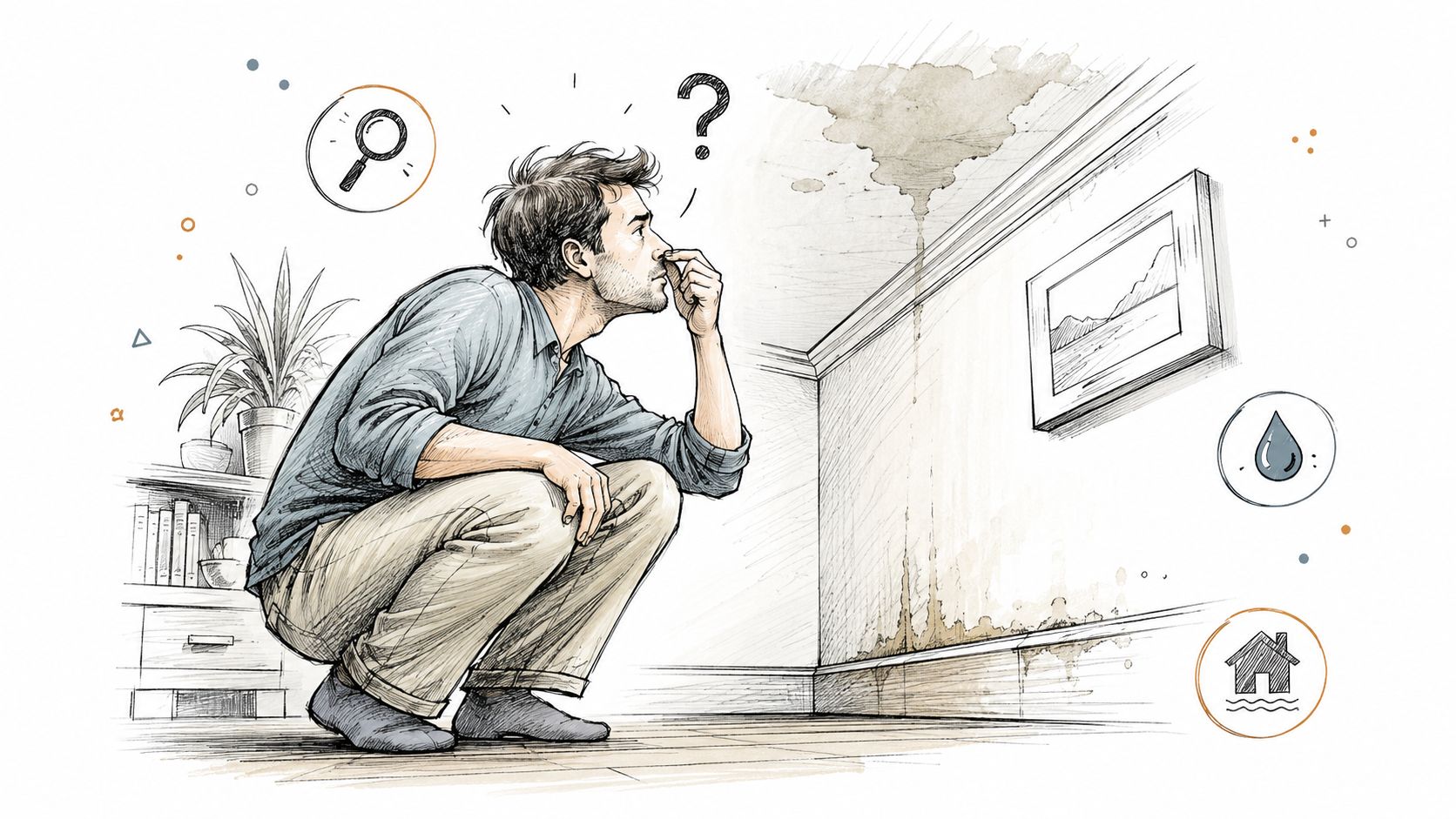
That's where hidden leaks become so frustrating. Water rarely stays directly below the source. It can travel along framing, insulation, roof decking, plumbing runs, or slab edges before it finally leaves a clue you can see. By the time a stain appears, the actual entry point may be somewhere else entirely.
Why homeowners dread the search
The old fear is simple. If no one can see the leak, someone's going to start opening walls until they get lucky.
Thermal imaging changed that process. Instead of guessing, an inspector can scan surfaces for unusual heat patterns and look for areas that behave differently from the dry materials around them. It's a cleaner starting point, especially when the problem is behind drywall, under flooring, or around a ceiling cavity.
Hidden moisture often shows up first as a pattern problem, not a visible water problem.
If you've noticed a suspicious odor, discoloration, or damp trim, it helps to compare what you're seeing with these signs of hidden water damage in a Georgetown TX home.
What this technology gives you
For a worried homeowner, the biggest benefit is peace of mind through direction.
- Less guesswork: The scan helps narrow the search.
- Less damage during inspection: Walls and ceilings don't need to be opened just to begin.
- Faster decisions: You can move from suspicion to a more focused plan.
That doesn't mean the camera is magic. It means you finally have a way to look for clues without tearing the house apart first.
How Infrared Cameras See Hidden Moisture
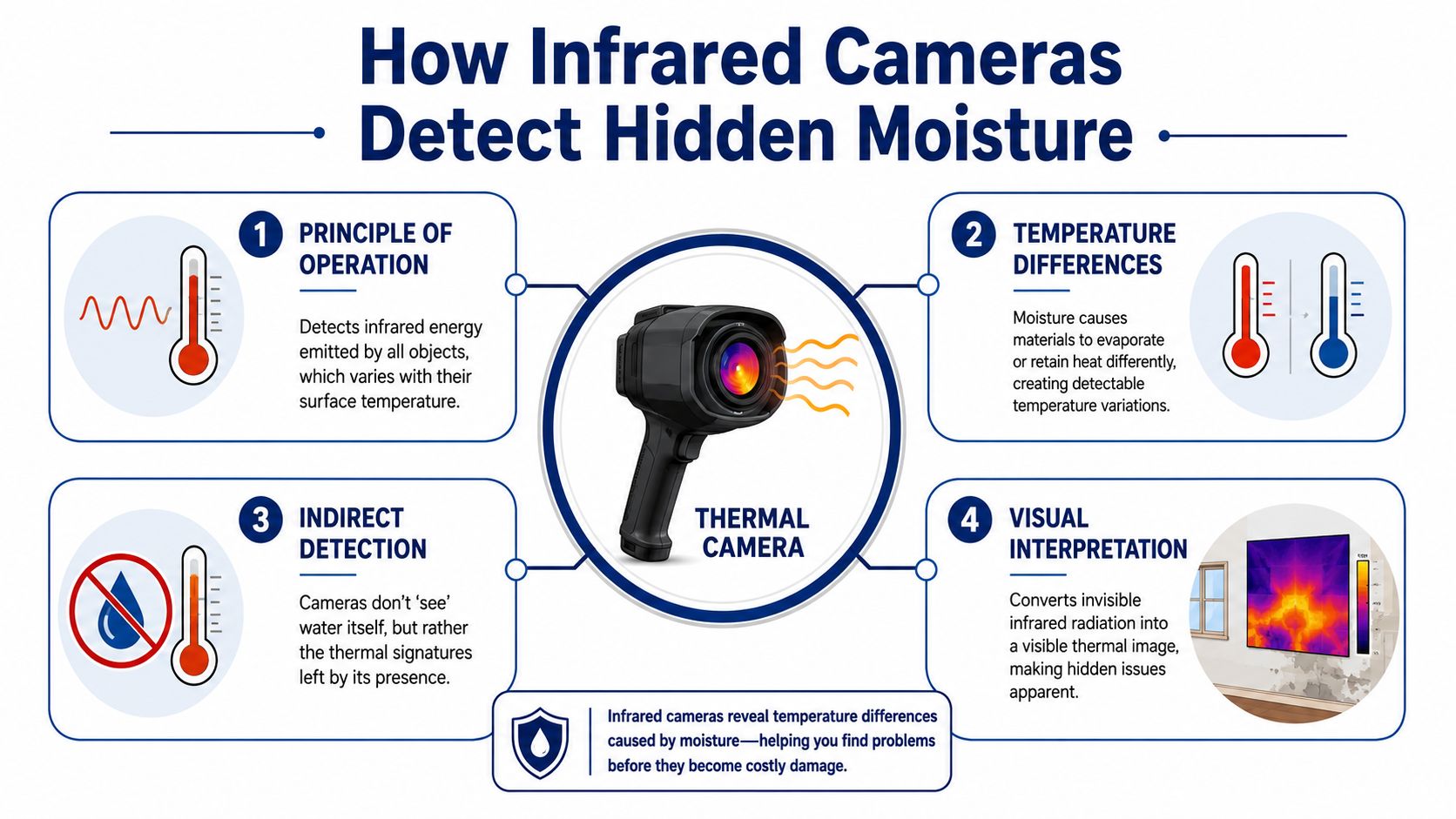
A thermal camera takes a temperature photograph of your home. That's the simplest way to think about it.
It doesn't see through walls the way people imagine in movies. It reads the infrared energy coming off the surface it's pointed at, then converts those temperature differences into a visible image. On screen, areas with different surface temperatures show up as different colors or tones.
It sees temperature, not water
This is the part many people miss. A thermal camera does not detect water directly. It detects the thermal effect that moisture has on building materials.
Wet drywall, wood, and insulation don't heat and cool the same way dry materials do. Sometimes moisture causes an area to stay cooler. In other situations, it changes how that material stores or releases heat. Either way, the camera can pick up that difference if the conditions are right.
That's why thermal imaging leak detection can identify water leaks up to 6–8 weeks before visible signs appear, potentially reducing restoration costs by 45–60%, because it visualizes the temperature anomalies created when wet materials retain or dissipate heat differently from dry surroundings, according to Pixfra's explanation of thermal imaging for water leak detection.
A simple wall example
Say a small plumbing leak is wetting insulation behind a bathroom wall.
From the room, the paint may still look normal. But the damp area behind that paint may cool or release heat differently than the dry studs and drywall nearby. On the thermal image, the inspector may see an irregular shape that stands out from the rest of the wall. That shape is the clue.
It's a little like seeing footprints in grass. You're not seeing the person. You're seeing the effect they left behind.
Why timing matters
Thermal imaging works best when the house gives the camera enough contrast to read. Professionals often pay attention to the time of day, weather, sun exposure, and whether indoor and outdoor temperatures are far enough apart to make suspicious areas stand out.
Some surfaces also reflect heat in misleading ways. A glossy tile wall, a metal register, or direct afternoon sun can create patterns that look important until you inspect them more carefully.
Practical rule: A thermal image is a clue map. It points to where a problem may be, so the inspector can test that area next.
What homeowners should listen for during an explanation
When an inspector walks you through a scan, good explanations usually include these points:
- What surface was scanned: Drywall, ceiling, flooring, or exterior wall.
- What pattern appeared: A cool patch, sharp outline, streak, or isolated spot.
- What might also cause it: Air movement, insulation gaps, reflective material, or actual moisture.
- How they'll confirm it: With a moisture meter or another verification tool.
If you want a plain-language overview of the process itself, this guide on what leak detection is and how it works gives helpful context.
Once you understand that the camera is reading temperature behavior, not water itself, the whole process makes a lot more sense.
Benefits and Limitations of Thermal Imaging
Thermal imaging is one of the most useful tools in leak detection. It's also one of the most misunderstood.
The benefit side is easy to appreciate. An inspector can scan a large area quickly, compare surfaces in real time, and narrow down likely trouble spots without opening materials first. For homeowners, that usually means a faster path to answers and fewer unnecessary holes in walls or ceilings.
The limitation side matters just as much. The image still has to be interpreted correctly.
Where thermal imaging shines
For the right job, thermal imaging leak detection is hard to beat as an early screening tool.
- Non-destructive: It helps inspectors investigate behind finished surfaces without starting demolition.
- Fast coverage: Entire rooms, ceiling lines, and wall sections can be checked efficiently.
- Useful for hidden paths: Moisture around roof leaks, plumbing lines, and wall cavities often leaves a temperature pattern before obvious damage appears.
- Helpful during mitigation: Inspectors can compare affected and unaffected areas and target follow-up testing.
Where people get overconfident
The camera doesn't produce a yes-or-no leak answer by itself. It produces a thermal pattern that has to be read in context.
According to Fluke's guidance on moisture detection with thermal imaging, effective leak detection needs at least a 10°C (18°F) interior-exterior temperature span, and wind, rain, and direct sun can hide real anomalies or create false ones.
That's why two scans of the same wall can look different depending on weather and timing.
Leak detection methods compared
| Method | How It Works | Best For | Limitations |
|---|---|---|---|
| Thermal camera | Reads surface temperature differences and highlights unusual patterns | Screening large areas for possible hidden moisture | Doesn't confirm moisture by itself |
| Moisture meter | Tests material moisture at specific spots | Confirming whether a suspicious area is actually wet | Only checks the exact places tested |
| Visual inspection | Looks for staining, swelling, odor, or material changes | Obvious damage and likely entry areas | Often finds the symptom, not the source |
| Exploratory opening | Removes a small section of material to inspect directly | Cases where confirmation or repair access is needed | Invasive and best used after targeted testing |
The practical takeaway
A homeowner shouldn't expect thermal imaging to work like x-ray vision. A better expectation is this: it helps a trained inspector find the most suspicious areas quickly, then decide what needs to be tested and whether opening materials is necessary.
That's the honest value. It saves guesswork, but it doesn't replace judgment.
What a Professional Inspection Actually Involves
A proper inspection has two separate steps. Detection first. Confirmation second.
That difference is where many DIY articles go off track. They show colorful thermal images and stop there, as if the picture alone settles the issue. It doesn't.
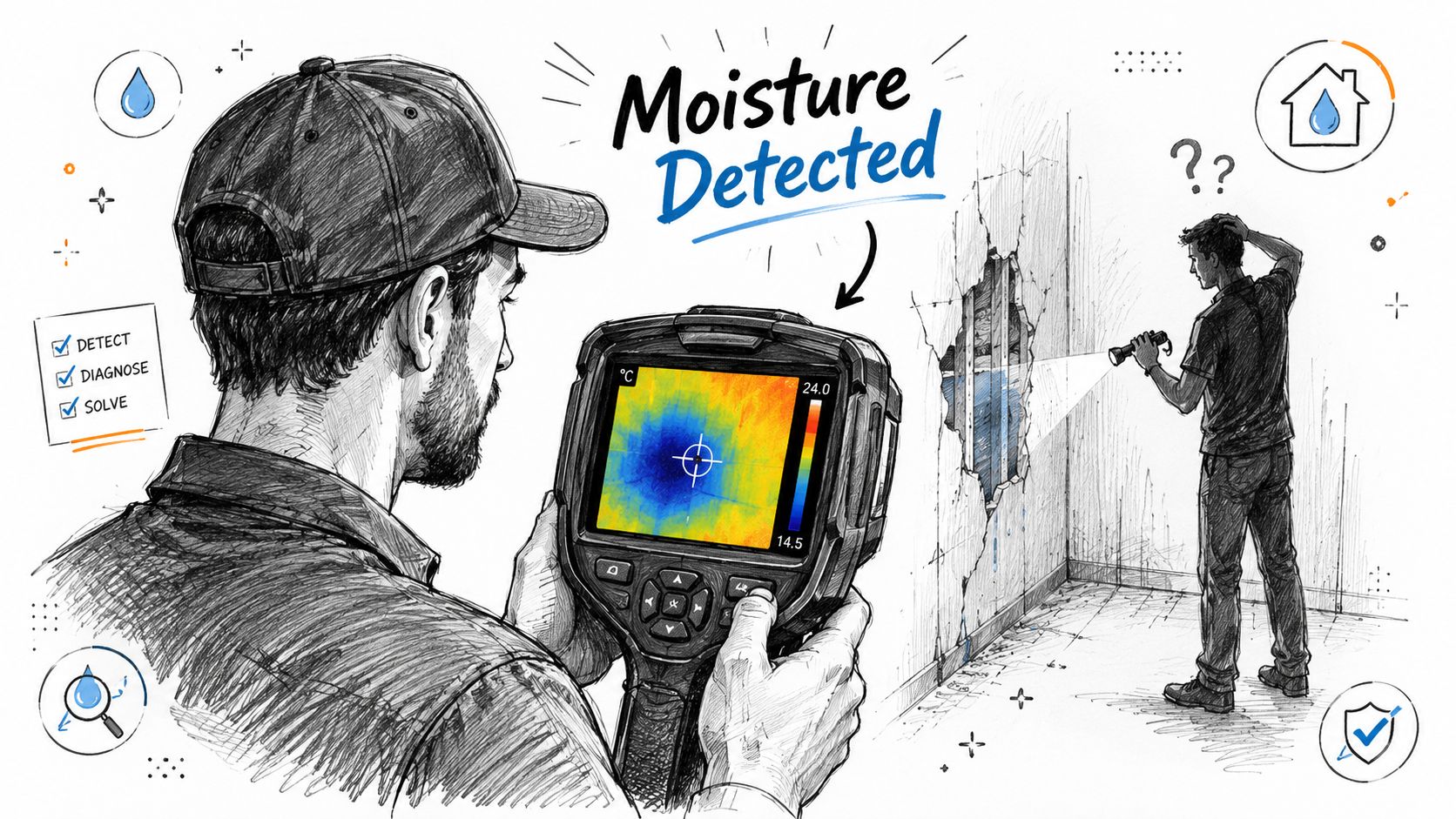
Step one is scanning for anomalies
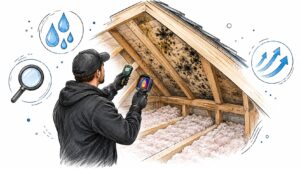
The inspector begins by looking at the structure as a system. Ceilings, walls, floor transitions, window perimeters, plumbing walls, and areas below roof penetrations often get special attention.
The thermal camera helps identify anomalies, meaning places where the surface temperature differs in a way that deserves a closer look. That anomaly could be moisture. It could also be airflow from a gap, a missing insulation pocket, reflective interference, or heat gain from sun exposure.
Step two is confirming moisture
This is the step that separates a professional process from a guess.
A critical distinction is thermal anomaly detection versus confirmed moisture. Without checking the suspicious area with a moisture meter, false positives from airflow or emissivity issues can occur in up to 40% of residential scans, and that can lead to unnecessary repairs, as explained in Thermal Master's discussion of using a thermal camera to find leaks.
The camera finds possibilities. The meter helps establish facts.
A calibrated moisture meter gives the inspector a direct reading at the exact location flagged by the thermal image. That helps answer the homeowner's real questions: Is it wet? How wet? How far has it spread? Is this active, old, or inconclusive?
What the visit often looks like in real life
A solid inspection usually includes a mix of observation, instrument testing, and documentation.
- Initial interview: You explain when you noticed the smell, stain, or dampness, and whether it followed rain, plumbing use, or a specific event.
- Visual review: The inspector looks at probable entry points and damage indicators.
- Thermal scan: Surfaces are scanned for unusual patterns.
- Targeted meter testing: The suspicious locations are checked to verify moisture.
- Scope decisions: If needed, the inspector identifies whether drying, plumbing work, containment, or selective opening is the next move.
In Central Texas, companies such as RestoTek TX use thermal imaging as part of a broader water damage assessment and drying workflow, not as a stand-alone magic answer. That's the right way to use the tool.
Why this matters to homeowners
If someone only shows you a colorful image and says, “There's your leak,” ask what they used to confirm it.
That question protects you from needless demolition. It also protects you from the opposite mistake, which is dismissing a real moisture problem because the image was misunderstood.
Costs Insurance and Special Central Texas Cases
Most homeowners ask the cost question early, and that's reasonable. In practice, thermal imaging is often part of a broader inspection or water damage assessment rather than a separate service that lives on its own.
The value isn't just the scan. It's the information the scan helps produce. If it points the inspector to the right area faster, it can reduce wasted labor, unnecessary wall openings, and confusion about the source of damage.
If you want a local overview of how pricing is usually approached, this page on leak detection service costs is a useful starting point.
How insurance usually fits in
Insurance questions are rarely as simple as “Will they cover thermal imaging?”
What matters more is whether there's a covered cause of loss and whether the inspection supports clear documentation of that loss. If a pipe failure, overflow, or storm-related intrusion is covered under your policy terms, a careful inspection can help show the extent of affected materials and support the restoration scope. Homeowners should still review their own policy and speak with their adjuster for claim-specific answers.
Why Central Texas homes need careful interpretation
Homes in this region have a few quirks that make leak detection more nuanced.
- Clay soil movement: Foundation shift can stress plumbing lines and create subtle leak paths that don't show up where you'd expect.
- Flash-flood patterns: After heavy weather, houses can have complex wet and dry zones that make surface readings harder to interpret.
- Strong sun exposure: Exterior walls and roof-adjacent areas can store heat in ways that confuse a casual scan.
- Mixed causes: A home may have both rain intrusion and an unrelated plumbing issue, which means one symptom can mask another.
In Central Texas, the challenge often isn't spotting that something changed. It's separating storm effects, structural quirks, and real moisture intrusion from one another.
That's why local experience matters. The same thermal pattern can mean very different things depending on recent weather, wall orientation, attic conditions, and how the house was built.
Common Questions About Thermal Leak Detection
A few questions come up in almost every conversation about this technology.
Can a thermal camera see through walls
No. It reads the surface temperature on the wall. If moisture behind the wall changes how that surface behaves thermally, the camera may reveal a pattern that suggests a hidden issue. The camera isn't looking through the drywall. It's reading the effect on the drywall surface.
Is thermal imaging accurate
It can be very accurate when the equipment is advanced and the operator knows how to interpret conditions.
Advanced AI-driven thermal cameras have shown 95.6% leak detection accuracy, using machine learning to recognize subtle temperature patterns that people may miss, according to this paper on AI-driven thermal camera performance.
That said, homeowners should still remember the difference between detection and confirmation. Accuracy improves when the scan is part of a full inspection process rather than a stand-alone guess.
Is it worth it for a small suspected leak
Usually, yes. A small hidden leak can affect insulation, trim, subflooring, cabinetry, or framing long before the damage looks dramatic. Early testing is often less disruptive than waiting until the problem becomes obvious.
If the concern is minor, you gain clarity. If it is active moisture, you've caught it sooner.
What kinds of leaks can this help locate
It's commonly used for hidden plumbing leaks, roof and wall intrusion, moisture in basements or lower-level spaces, and follow-up checks during drying after a water event. The exact approach depends on the building materials and current conditions.
When should I call a professional
Call when you have a pattern you can't explain.
That includes a musty smell after rain, a recurring ceiling stain, swelling baseboards, unexplained dampness, a room that suddenly feels humid, or signs that water may be traveling from somewhere you can't see. It also makes sense to call when you've had a recent overflow, backup, or storm event and want to know whether moisture is still trapped in the structure.

A good inspection should leave you with more than a colorful picture. It should leave you with a clear explanation of what was found, what was confirmed, and what needs to happen next.
If you're dealing with signs of hidden moisture in Georgetown, Austin, or nearby Central Texas communities, RestoTek TX can help you move from suspicion to a documented plan. Their team handles inspection, mitigation, drying, and rebuild coordination, and they offer no-cost estimates for homeowners who need a next step.