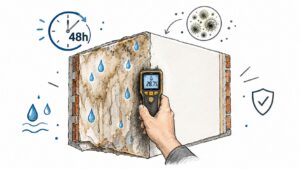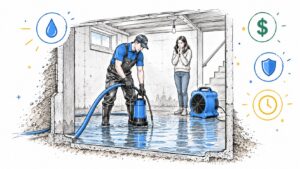
A pipe lets go at three in the morning, or rain pushes through a garage after a Central Texas storm. By the time you find the water, it has already moved under flooring, behind baseboards, and into places a towel can't reach. The surface may look manageable, yet the materials underneath can remain saturated.
That's why water extraction in Austin is more than pumping out visible water. A proper response controls the source, removes bulk water, identifies hidden moisture, and continues with measured structural drying. The decision that matters most is whether the property needs extraction only, or whether wet assemblies must be opened, treated, or rebuilt.
What Water Extraction in Austin Actually Means
A flash-flood surge through a Mueller garage creates an obvious emergency. A failed supply line in a Travis Heights bungalow can be just as serious, even when the water is limited to one room. A slow slab leak is harder still, because laminate or engineered flooring may appear normal while moisture spreads below it.
Professional extraction removes water that can be physically reached. Technicians may use submersible pumps for deeper standing water, truck-mounted or portable extractors for carpet and pad, weighted tools for hard flooring, and moisture meters to locate damp materials beyond the visible wet area. Extraction is the emergency removal stage, not proof that the building is dry.
The first response has a major effect on what can be saved. The verified restoration guidance for Austin-area losses explains that immediate source control and aggressive extraction should be followed by instrumented drying, using moisture meters, thermal imaging, hygrometers, air movement, and dehumidification until readings return to baseline, rather than relying on appearance alone (emergency water damage restoration guidance).
What happens beneath the surface
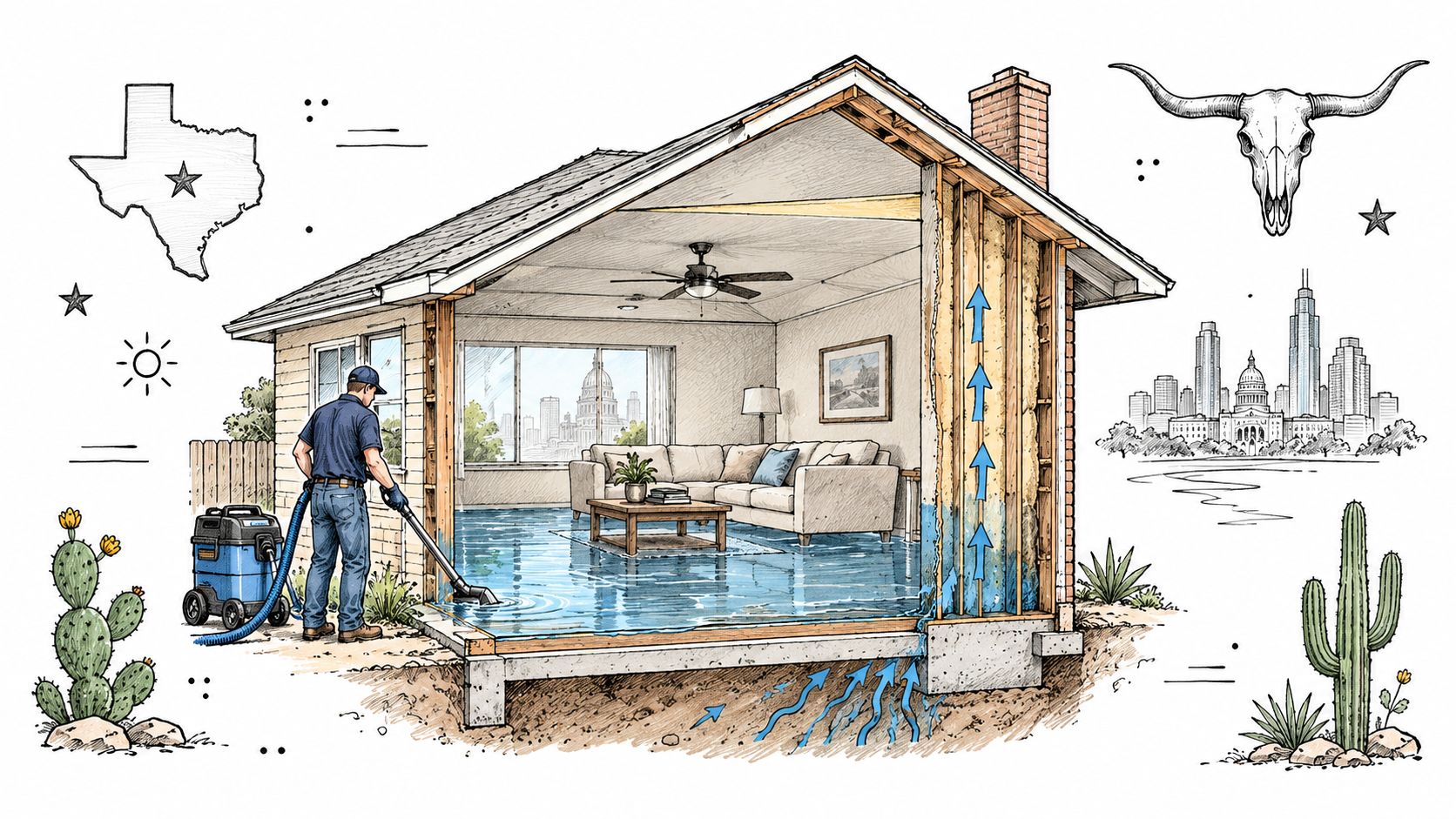
Drywall can wick water upward from a wet floor. Carpet can feel nearly dry while its pad remains saturated. Hardwood, insulation, plaster, concrete, brick, and stone each release moisture differently, so the technician has to test the material rather than assume the room is safe.
A homeowner can mop reachable water and still miss moisture under cabinets, beneath flooring, or inside a wall cavity. That's why a water damage restoration assessment should identify both the source and the full path the water has taken.
Practical rule: If water has reached porous materials, visual inspection alone can't confirm that extraction is complete.
Extraction may be enough when the source was controlled quickly, water stayed on cleanable surfaces, and readings show that the surrounding structure has returned to its normal moisture condition. It isn't enough when moisture remains in cavities, insulation, subfloors, or materials that can't be cleaned and dried reliably.
Extraction Versus Drying and Why the Distinction Matters
After a flash flood pushes water through an Austin garage, a wet vacuum can make the concrete look clean within hours. That visible improvement does not prove the building is dry. Extraction removes bulk liquid water. Structural drying removes moisture held inside materials and the surrounding air. A pump can empty a floor, but it cannot reach a wall cavity or the underside of a subfloor.
The distinction affects the next decision: clean and dry in place, or remove part of the assembly. A supply-line break stopped quickly may leave carpet and hard surfaces that can be extracted and dried. Water trapped beneath flooring, inside insulation, or behind swollen drywall may require controlled demolition because equipment cannot reliably reach every wet layer.
Categories in plain language
- Category 1: Water from a sanitary supply source, such as a broken water line, before contamination changes its condition.
- Category 2: Water with greater contamination, often connected to appliances or indoor sources that affect cleaning and disposal decisions.
- Category 3: Heavily contaminated water, including sewage or exterior floodwater. This requires stronger worker protection, containment, and remediation controls.
A broken washing-machine supply line may begin as Category 1. If water sits, mixes with soil, or contacts contaminated materials, the classification can change. Floodwater entering through a garage during a Central Texas storm should be treated as a contamination event, not ordinary mop-up.
Classes describe drying difficulty
Class 1 involves a limited amount of wet material. Class 2 commonly includes water that has wicked into walls, ceilings, insulation, or subfloors. Class 3 involves more extensive absorption. Class 4 includes low-permeance or saturated materials such as hardwood, plaster, concrete, brick, or stone. The water damage categories and classes guidance explains why class depends on how materials absorb and release water, not only on the puddle's size.
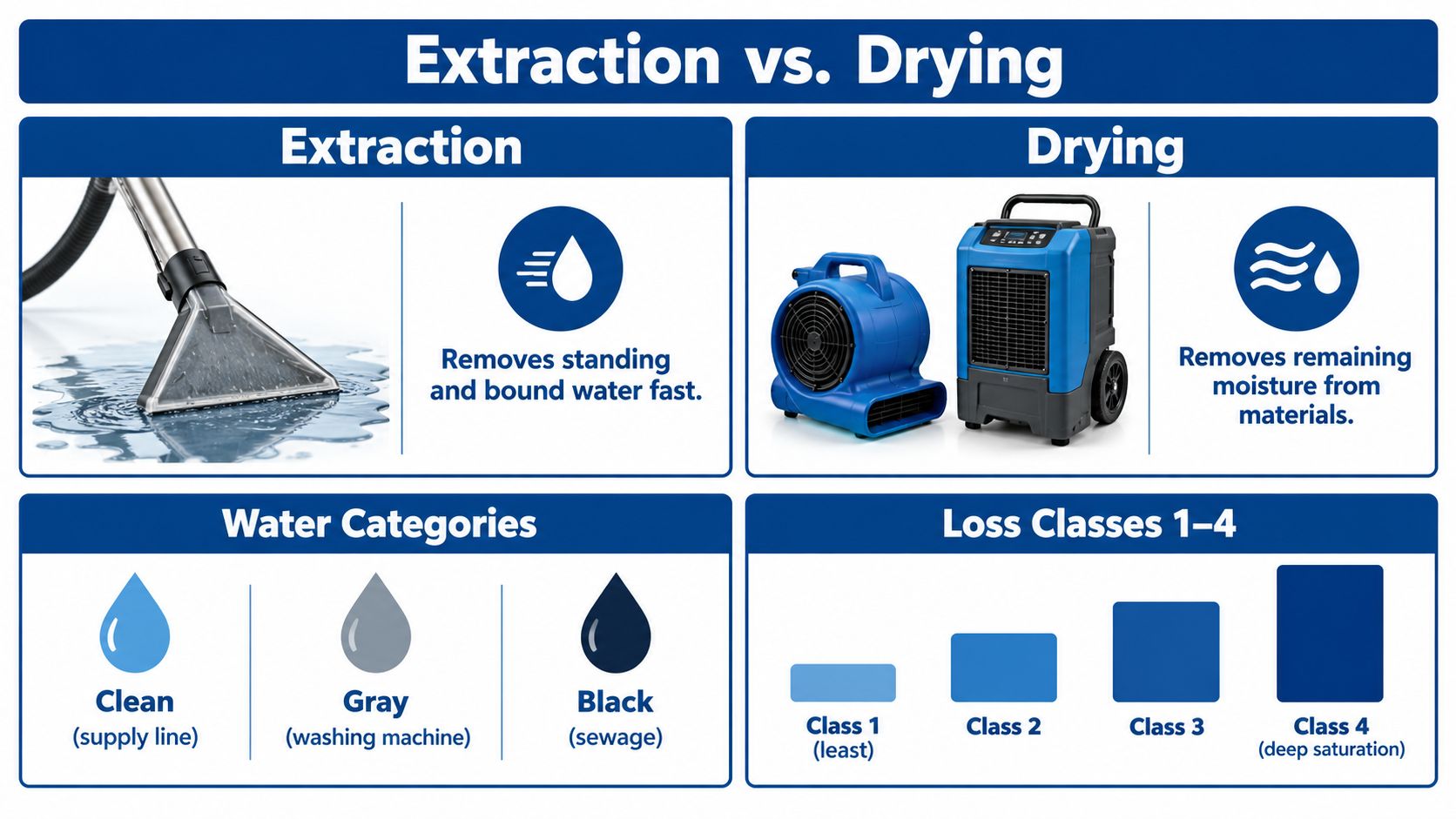
The technician may extract carpet, lift or remove pad, open selected wall sections, and place air movers and dehumidifiers where they can affect the wet assembly. A structural drying guide for Central Texas homes and businesses explains why equipment placement and controlled opening matter. Hygrometers track air conditions, while moisture meters show whether the material itself is drying.
Extraction alone is enough only when testing supports that decision. Without readings and drying records, a dry-looking wall can later show swelling, delamination, warping, or musty odor. Those records also explain to an insurer why removal or additional equipment was needed.
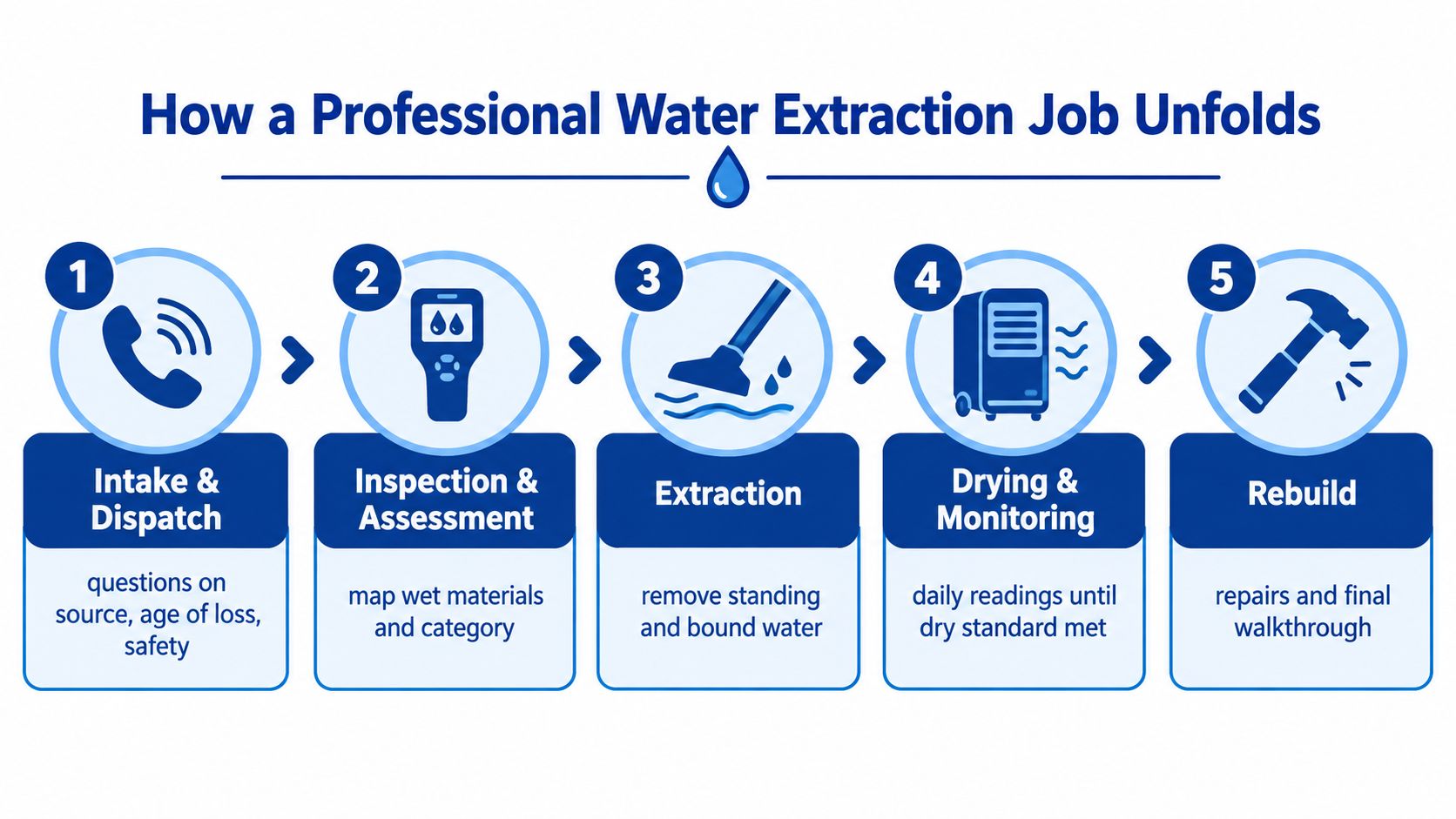
How a Professional Water Extraction Job Unfolds
A professional job should feel organized even when the loss is chaotic. The crew isn't only removing water. It's building a record of what happened, deciding what can be saved, and controlling the conditions that could create further damage.
The first assessment
During intake, the dispatcher should ask where the water came from, when it started, whether the source is still active, and whether electricity is safe in the affected area. Tell the dispatcher if the water came from a toilet, sewer line, appliance, storm, or unknown source. That information influences safety procedures before anyone enters.
At arrival, the technician checks utilities, slip and electrical hazards, structural concerns, and contamination. Category 3 water requires appropriate personal protective equipment and containment. Keep children and pets away, and don't enter standing water near outlets or appliances.
The inspection then maps the loss room by room. Pin and pinless moisture meters help compare wet and unaffected materials, while thermal imaging can reveal temperature patterns associated with concealed moisture. A camera doesn't replace a meter, but together the tools help identify where testing and controlled opening may be needed.
Extraction and controlled removal
Standing water is removed first. Carpet and pad may require separate extraction, and hard flooring may need weighted equipment or specialized methods. The technician should protect contents where possible and photograph conditions before removing materials.
Wet baseboards, damaged drywall, insulation, or carpet pad may not be salvageable, especially when contamination or prolonged saturation prevents reliable cleaning and drying. Don't start demolition before documenting the original condition and checking whether your adjuster needs to inspect it.
Drying, cleaning, and rebuilding
After extraction, air movers increase evaporation and dehumidifiers remove water vapor from the environment. The crew logs moisture readings and adjusts equipment as materials dry. Equipment should stay in place until readings reach the agreed dry standard, not until the floor feels comfortable.
Once drying is verified, technicians clean, sanitize, and deodorize as appropriate to the water category. Reconstruction follows after mitigation, and may include replacing drywall, trim, flooring, insulation, or other removed materials. A qualified water damage restoration technician should explain which phase is underway and what evidence supports the next decision.
Never run household fans through contaminated water. Air movement can spread contamination into clean rooms or HVAC pathways.
Response Times and Central Texas Surge Conditions
A normal weekday call and a region-wide storm response aren't the same operating environment. After heavy rain, flash flooding, or multiple plumbing failures, crews may already be working across Austin, Georgetown, and surrounding Central Texas communities. A promised emergency dispatch means your call has been prioritized, not that extraction has already begun at your property.
Storm severity can also change the order of work. A building with active water entry, unsafe conditions, or a large public impact may require attention before a contained loss. Texas flood planning materials identify $49.06 billion in statewide flood needs and $2.63 billion in flood mitigation projects, while the state flood plan reports that $669 million had been committed through the Flood Infrastructure Fund, a little more than 1% of total need (Texas State Flood Plan). Those figures describe statewide planning, not a specific Austin crew's schedule, but they show why local demand can surge beyond ordinary capacity.
NASA's coverage of July 2025 Texas flooding also describes satellite precipitation and landslide monitoring used for real-time assessment (NASA's Texas flooding coverage). During conditions like these, ask when a crew can arrive, whether a technician can perform an initial safety assessment sooner, and what you should do while waiting.
| Demand Level | Typical Trigger | Call to Arrival | Crew Availability |
|---|---|---|---|
| Routine | Isolated plumbing or appliance loss | Depends on dispatch load and location | A local crew may be scheduled directly |
| Elevated | Widespread rainfall, multiple pipe failures, or localized flooding | May extend beyond the initial estimate | Crews are distributed across active losses |
| Surge | Major storm or regional flooding | Delays are possible, with safety and active-flow losses prioritized | Equipment and technicians may be committed elsewhere |
While waiting, shut off the water source if safe, move dry belongings away from the floor, open cabinet doors, and lift drapes from wet surfaces. Take photos and video before disturbing materials. Don't use a household vacuum for standing water, and don't walk through potentially contaminated water or water near electrical equipment.
Typical Costs and What Drives the Final Number
A wet ceiling below an upstairs bathroom may need a small extraction and targeted drying. A flash flood through a South Austin garage can involve contaminated water, contents handling, wall removal, and reconstruction. The final estimate follows the conditions found, not a single flat price.
The main cost decision is whether materials can be dried in place. Carpet and pad may receive different treatment. Drywall can sometimes stay in place when moisture readings support it, while saturated or contaminated sections may require controlled removal. Engineered wood, hardwood, tile, cabinets, and slab-on-grade assemblies can hold or redirect water where a surface inspection cannot see it.
| Service Component | Typical Austin Range | What Drives Cost Up |
|---|---|---|
| Water extraction | Usually billed by extraction hour or affected area, such as 100 sq ft | Standing-water depth, access, source, and affected area |
| Contents manipulation | Labor-based, with volume affecting the total | Furniture, packed belongings, fragile items, and storage needs |
| Air movers and dehumidifiers | Equipment and runtime are billed separately or together | Larger drying areas, concealed moisture, and longer monitoring |
| Antimicrobial treatment | Priced by affected materials and treatment area | Category 2 or 3 water, porous contents, and containment needs |
| Demolition and reconstruction | Priced by removed materials and replacement scope | Wet drywall, insulation, flooring, cabinets, subfloor, and finish matching |
Extraction may be enough when water is limited, the source is clean, and moisture readings show no hidden spread. It is not enough when water has entered wall cavities, insulation, flooring layers, or cabinet bases. A room can feel dry while trapped moisture continues affecting the structure.
Clean-water losses should generally be extracted and dried within 24–48 hours to limit secondary damage. More contaminated water requires stronger protection and remediation procedures. Faster action can preserve more materials, but no responsible contractor can promise that every surface will be saved.
Insurance often treats sudden, accidental indoor water damage differently from outside flooding, gradual leaks, maintenance issues, and other exclusions. Flood damage may require separate flood coverage. Review the declarations page and contact the insurer before assuming a loss is covered.
Request an itemized scope that separates extraction, drying, monitoring, removal, cleaning, and reconstruction. A low bid that leaves out monitoring or cavity work may look cheaper while leaving part of the loss untreated. Ask what readings support drying in place, which materials will be removed, and what conditions would change the estimate.
Documenting the Loss for a Smoother Insurance Claim
Start documenting before cleanup changes the scene, provided you can do so safely. Use your phone to capture standing water, water lines, affected rooms, damaged contents, the source of the loss, and nearby areas that appear unaffected. Narrate a short video with what happened, when you discovered it, and what you did to stop the source.
Keep the original files and write down the date, approximate discovery time, room, material, and action taken. Photograph appliance labels and serial numbers when they're accessible, but don't risk entering unsafe water or moving heavy equipment.
Records that support the scope
A professional restoration file should connect conditions to actions. Useful records include:
- Moisture maps: Readings by room, material, and location.
- Daily monitoring notes: Moisture and humidity readings that show the drying trend.
- Equipment logs: Equipment type, placement, changes, and removal date.
- Demolition photographs: Images of removed drywall, pad, insulation, or trim before disposal.
- Itemized invoices: Labor, equipment, cleaning, disposal, and reconstruction separated clearly.
The purpose isn't paperwork for its own sake. A moisture map can show why a wall was opened. An equipment log can show that drying continued after the floor looked normal. Photographs can preserve evidence that would otherwise disappear when materials are removed.
Ask the contractor to explain the scope in plain language and identify which work is mitigation versus reconstruction. Industry-standard estimating platforms such as Xactimate can help organize line items, but the estimate still needs to match the actual photos, readings, materials, and work performed.
Documentation rule: Photograph first, preserve the original files, and ask before discarding damaged materials.
An adjuster may not see the property immediately. If demolition happens before the initial water line, damaged pad, or affected contents are recorded, the claim becomes harder to evaluate. Detailed invoices and dated readings give everyone a clearer basis for discussing necessary work.
Why a Local End-to-End Austin Team Makes a Difference
Local capability matters most when demand rises and decisions have to happen quickly. A live dispatcher who understands the service area can gather useful details at two in the morning, confirm whether water is still flowing, and route the request based on location and urgency. A call-center handoff may collect less property-specific information before a technician is assigned.
Central Texas homes also present different drying challenges. A slab-on-grade home, an older pier-and-beam property, a garage with an appliance water heater, and a commercial suite with shared HVAC equipment don't hide moisture in the same way. Local technicians who regularly work across Austin, Georgetown, and nearby communities are more likely to recognize how flooring, wall construction, weather, and access affect the scope.
An end-to-end provider can keep mitigation and reconstruction connected. The same project record can carry the initial photos, moisture map, drying logs, removal decisions, cleaning notes, and rebuild scope. That reduces the risk that one contractor says a material must be removed while the next contractor lacks the evidence or measurements behind that decision.
Look for practical qualifications rather than slogans:
- IICRC training: Shows familiarity with recognized restoration procedures.
- Texas mold remediation credentials: Relevant when mold or microbial growth is part of the scope.
- Insurance and subcontractor documentation: Helps clarify responsibility during repairs.
- Clear billing practices: Itemized work is easier to compare with the claim file.
- Single-point communication: One project manager can explain changes and next steps.
RestoTek TX is a family-operated Central Texas provider led by Joan and Josh Garza. Its stated services cover inspection, water extraction, structural drying, microbial prevention, and reconstruction for properties in Austin, Georgetown, and surrounding communities.
Your First Hour and First Three Days Action Plan
Water damage becomes easier to manage when you separate immediate safety from later decisions. You don't need to determine the entire repair scope in the first few minutes. You need to stop the source, protect people, preserve evidence, and arrange a qualified assessment.
First hour
- Stop the flow. Shut off the fixture, appliance, or main water supply if you can do it safely.
- Protect electricity. Turn off power to affected zones only when you can reach the panel without standing in water.
- Keep people out. Block access for children and pets, especially when water may be contaminated.
- Move small valuables. Relocate documents, electronics, and personal items to a dry area, but don't lift heavy furniture alone.
- Record the condition. Take timestamped photographs and video before cleanup or demolition.
- Call an emergency restoration provider. Give the dispatcher the source, age of the loss, water category if known, and any safety concern.
Don't use a household vacuum for standing water. Don't turn on fans or HVAC equipment when contaminated water may spread through the property, and don't remove walls or flooring before documenting the damage.
First 24 hours
Meet the project manager for the inspection and moisture assessment. Ask which materials can reasonably be dried in place, which require removal, where readings will be taken, and how the results will be reported to your insurer.
Approve a written extraction and drying plan that identifies affected rooms and expected monitoring. Continue your own photo log, notify the insurer, and discuss temporary housing if the property is unsafe, contaminated, or too disruptive to occupy.
Days two and three
Expect monitoring rather than a one-time equipment drop. The crew should revisit affected areas, record moisture and humidity conditions, adjust air movers or dehumidifiers, and explain whether readings are moving toward the agreed dry standard.
Keep copies of updates, invoices, photographs, and removed-material records. A measured process limits secondary damage, gives the adjuster a clearer file, and helps the rebuild begin from a verified scope instead of guesswork.
RestoTek TX provides 24/7 water extraction, structural drying, microbial prevention, and reconstruction support for Austin and Georgetown properties. If water has reached your floors, walls, or contents, visit RestoTek TX to request an assessment and get a documented plan for the next step.