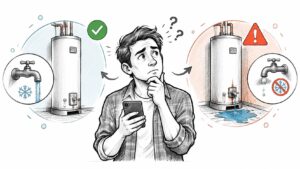
You wake up in a Georgetown home after a cold night and hear water running where no faucet is open. A ceiling stain has spread across the drywall, the floor near an exterior wall feels damp, or the water pressure has suddenly disappeared. Sometimes the failure follows a brief freeze. Other times, it happens during a warm Central Texas afternoon after a valve closes or an aging line finally gives way.
That surprise is what makes burst pipes so disruptive. A pipe can fail inside an attic, behind a wall, beneath a slab, or in a crawl space, then release water where you can't see the original break. In Georgetown and Austin, homeowners must prepare for more than winter weather. Short hard freezes can damage exposed plumbing, while expansive soils, pressure changes, corrosion, construction issues, and heavy seasonal weather can create risk throughout the rest of the year.
Local perspective: A burst pipe is usually the final result of pressure, stress, or weakness building inside the system. Finding the trigger helps you prevent the next failure.
Introduction Why Burst Pipes Catch Georgetown Homeowners Off Guard
A homeowner may think, “It wasn't cold enough to freeze a pipe,” and still face a major water loss. That reaction makes sense because freezing is highly visible in public advice, but it isn't the only way a plumbing system can fail. Research on water distribution systems identifies pressure surges, thermal contraction, soil and traffic loads, ground movement, corrosion, and construction quality as additional sources of pipe stress. Research on pipe-burst mechanisms from IWA Publishing explains why temperature alone doesn't tell the whole story.
A brief freeze can expose plumbing in an uninsulated hose bib, garage wall, attic, or crawl space. A separate failure may begin years earlier, as corrosion thins a metal pipe or poor installation leaves a joint under constant strain. Expansive clay soils can also shift around buried lines, putting stress on slab plumbing and service connections.
The important question isn't only where the water appeared. It's what changed inside the plumbing system before the pipe opened? Water may have frozen and expanded, a valve may have created a pressure surge, or a weakened section may have reached its limit after repeated stress.
This guide starts with the basic physics, then applies it to common Central Texas conditions. You'll learn how to recognize the difference between a freeze-related failure and a non-freeze burst, which warning signs deserve attention, what to do immediately after a break, and how to match prevention to your home's construction and occupancy.
By the end, you should be able to identify vulnerable locations, respond without wasting critical time, and ask better questions of a plumber or restoration professional. That understanding can't eliminate every plumbing emergency, but it can help you reduce exposure and limit damage when something goes wrong.
How Pipes Actually Burst Inside Your Plumbing System
Start with a sealed soda bottle in a freezer. As the water inside turns to ice, it expands. Because the bottle is closed, the growing ice has nowhere to go, so pressure rises against the bottle walls.
Plumbing pipes can behave in a similar way, but the failure pattern often confuses homeowners. Water expands by about 9% when it freezes, and that expansion can create pressure far beyond what a residential pipe can tolerate. Roto-Rooter's explanation of burst-pipe physics notes that the ice blockage often isn't located at the eventual split. The rupture commonly occurs between the ice plug and a closed faucet or valve, where liquid water becomes trapped.
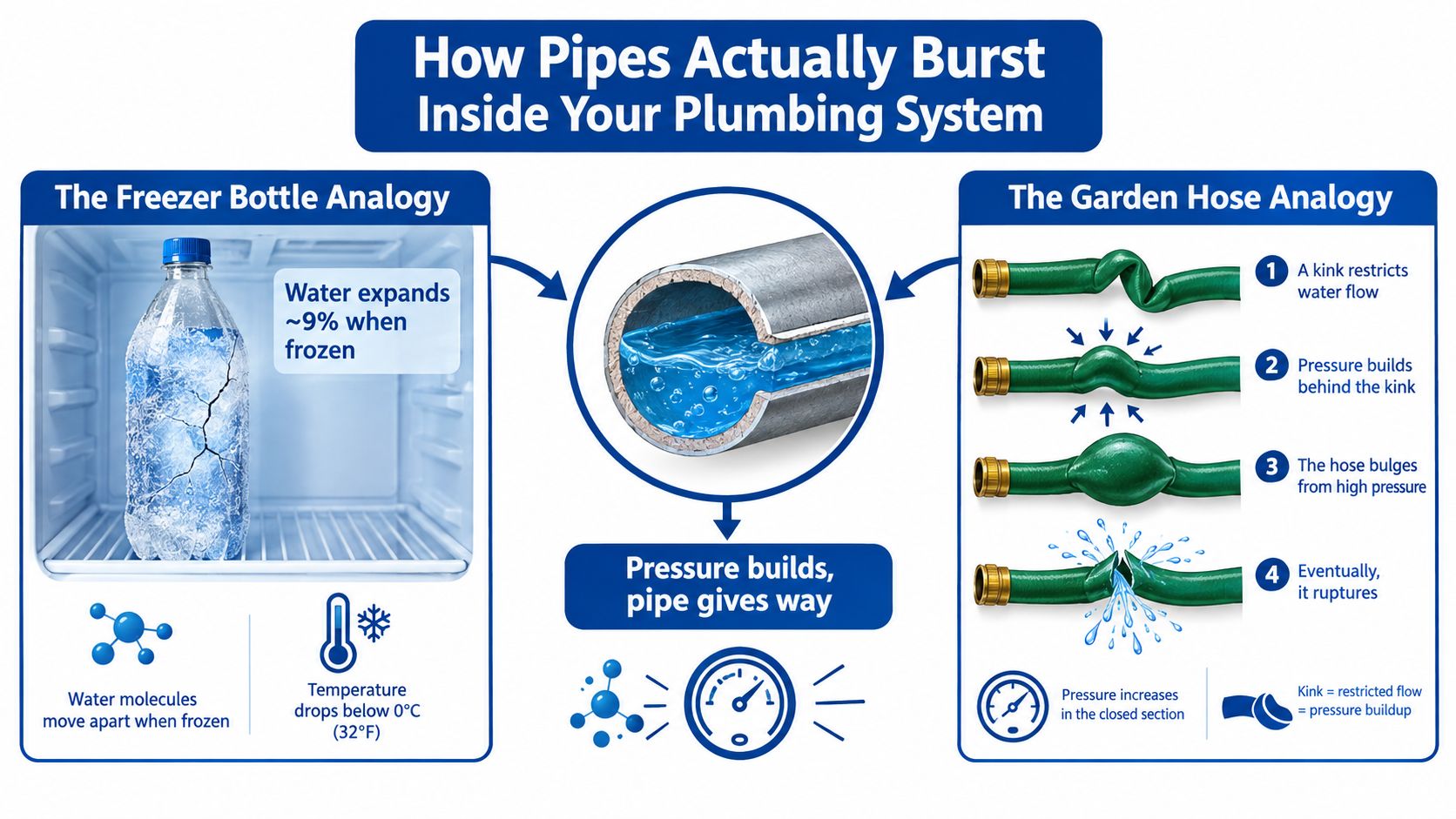
The kinked hose comparison
Think about a garden hose with a kink. Water continues pressing behind the restriction, and the hose may bulge at a weak spot. The kink doesn't necessarily tear first. Pressure finds the section with the least resistance.
A frozen pipe can create the same basic pattern:
- Cold air freezes water in a vulnerable section. The ice forms a plug, particularly where insulation is poor or the pipe sits near an exterior wall.
- The plug restricts movement. Water on the faucet side or valve side remains trapped.
- Expanding ice and trapped liquid increase stress. The water can't compress enough to absorb the force.
- The weakest point opens. That point may be a fitting, joint, corroded wall, or damaged section away from the ice.
Independent industry material reports that freeze-related pressure in a closed plumbing system can exceed 25,000 psi, which explains why both metal and plastic piping can fail during a hard freeze. The key lesson is simple: ice location and break location may be different.
The Most Common Causes of Burst Pipes in Central Texas Homes
Central Texas homes experience several kinds of plumbing stress. Freezing deserves attention, but the right prevention plan also considers the pipe's material, location, pressure environment, and relationship to the soil around the building.
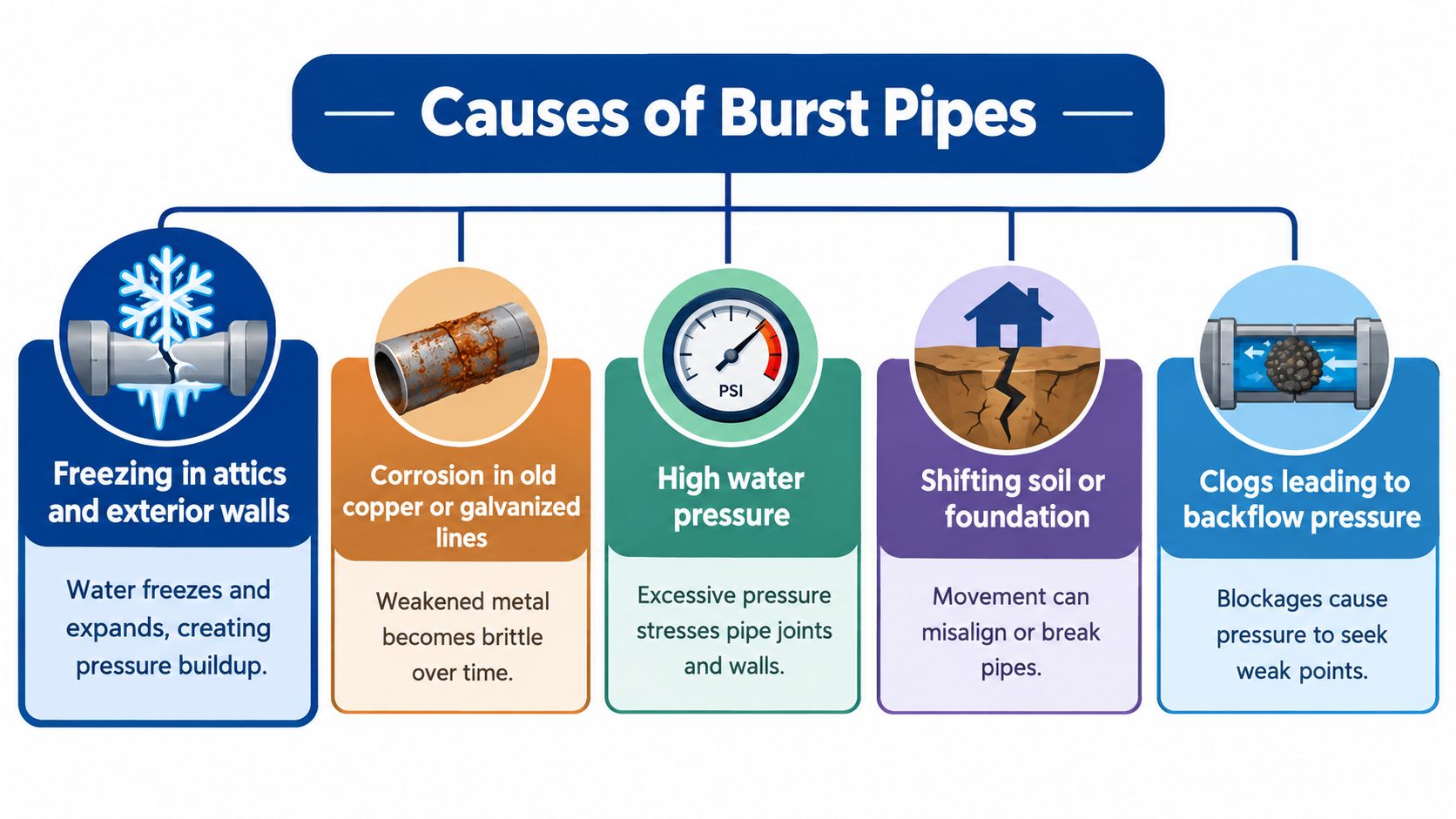
Freezing in exposed plumbing
The most familiar cause affects plumbing that doesn't share the stable temperature of the living space. Attics, crawl spaces, garages, exterior walls, and outdoor hose bibs can cool quickly during a short cold snap. Water sitting in those lines can freeze, creating the pressure pattern described above.
An uninsulated hose bib is an easy example. The exterior fixture may freeze first, while the connected interior pipe remains full of water. If a valve is closed, the trapped section can become the point of failure.
Remember: A brief freeze can be destructive when plumbing sits in the wrong location. Mild overall winters don't make exposed lines safe.
Corrosion and material aging
Older metal piping can lose strength as corrosion attacks the interior or exterior surface. Corrosion may narrow the passage, roughen the wall, or leave a section brittle enough to fail under pressure that a newer pipe would withstand.
A public-utility report discussed in the cited engineering review recorded Singapore burst-pipe rates declining from about 10 leaks per 100 kilometers in 2003 to 4.6 in 2016. The same source describes corrosion as the most common factor identified by experts, alongside weather extremes. The figures come from a 5,500-kilometer system, not Central Texas housing, but they illustrate how maintenance and aging affect burst risk in a large network.
Homeowners dealing with older copper, galvanized, or other aging materials should treat recurring discoloration, pinhole leaks, and repairs in the same area as reasons to request an inspection. Material history matters, especially after renovations that combine older and newer pipe types. For background on a specific piping concern, review what Kitec piping is and why it can be an issue.
High operating pressure and water hammer
Water pressure that stays too high places continuous load on pipe walls, fittings, and appliance connections. A different problem, water hammer, happens when flowing water stops abruptly. A fast-closing valve, pump trip, or check-valve slam can turn flow velocity into a short pressure surge. This technical guide to water hammer explains that these transients can crack joints, fatigue fittings, or rupture weakened pipe walls.
The homeowner may hear a bang when a washing machine shuts off or a faucet closes. One noise doesn't prove a pipe is about to burst, but repeated hammering deserves investigation.
Clogs and restricted flow
A clog doesn't always create the same pressure conditions as a frozen plug, but restrictions can alter flow and send pressure toward weak joints or fittings. Mineral deposits, debris, or a partially blocked line may leave a system working harder than it should.
A pipe beneath a sink, behind a wall, or near a poorly supported connection may fail after repeated stress. Clearing the visible drain won't necessarily address a supply-side pressure problem, so recurring blockages and leaks should receive a complete plumbing assessment.
Soil movement, roots, and installation problems
Buried pipes respond to movement around them. Expansive soils can swell and shrink, while settlement, erosion, drainage changes, or foundation movement can misalign a line. A slab line may experience bending or tension when the surrounding ground shifts.
Tree roots can also interfere with underground lines, particularly at joints or existing cracks. Poor workmanship, inadequate support, incompatible materials, and badly aligned connections add stress before the plumbing system is even put into service. A burst is often a combined-stress failure, not a single dramatic event.
Why Pipes Burst Even When It Is Not Freezing
A summer burst can feel mysterious because the homeowner has ruled out the most familiar trigger. The system may still be carrying stress from pressure changes, aging materials, ground movement, or temperature-related contraction.
Water hammer is the clearest example. Normal water pressure may appear acceptable, but an abrupt valve closure creates a short-lived surge. A long pipe run, high flow velocity, weak fitting, or poorly controlled pump can make that surge more damaging. Repeated events can fatigue a vulnerable section until an ordinary fixture cycle becomes the final trigger.
Temperature also matters outside freezing conditions. Pipes and surrounding materials expand and contract as conditions change. Buried plumbing may face soil cover load, traffic vibration, settlement, or shifting ground. Corrosion reduces the wall thickness that must resist these forces. The pipe doesn't need one extreme event if several moderate stresses act on the same weak point.
Freeze versus non-freeze burst triggers
| Cause Type | Trigger Mechanism | Typical Location | Key Warning Sign |
|---|---|---|---|
| Freeze | Ice formation restricts movement while expanding water raises pressure | Exterior walls, attics, crawl spaces, garages, hose bibs | Reduced flow during cold weather, followed by leakage as conditions change |
| Pressure | Steady high pressure or a short surge strains joints and pipe walls | Fixture connections, long runs, valves, appliance supplies | Banging pipes, pressure fluctuations, repeated fitting leaks |
| Corrosion | Material loss and brittleness reduce the pipe's ability to resist normal loads | Older lines, fittings, joints, concealed cavities | Brown or rusty water, pinhole leaks, recurring repairs |
| Ground movement | Soil settlement, expansion, erosion, or foundation movement bends or misaligns piping | Slab lines, service lines, buried connections | Repeated leaks in one area, unexplained moisture, shifting finishes |
A pipe can also fail at a joint rather than along its straight wall. Fittings concentrate stress, and earlier repairs may leave transitions between materials or sections with different levels of support. That's why a professional inspection should consider the surrounding system instead of treating only the visible opening.
The practical answer to “what causes pipes to burst” is broader than winter preparation. Freezing is one mechanism. Pressure, corrosion, movement, and installation quality create year-round exposure.
Warning Signs and What to Do the Moment a Pipe Bursts
A pipe may announce trouble before it releases a large volume of water. Listen for banging or hammering in walls, watch for fluctuating pressure when fixtures operate, and take unexplained brown or rusty water seriously. Damp drywall, wet flooring, a sudden drop in flow, or a water bill that doesn't match your normal use can also indicate a hidden leak.
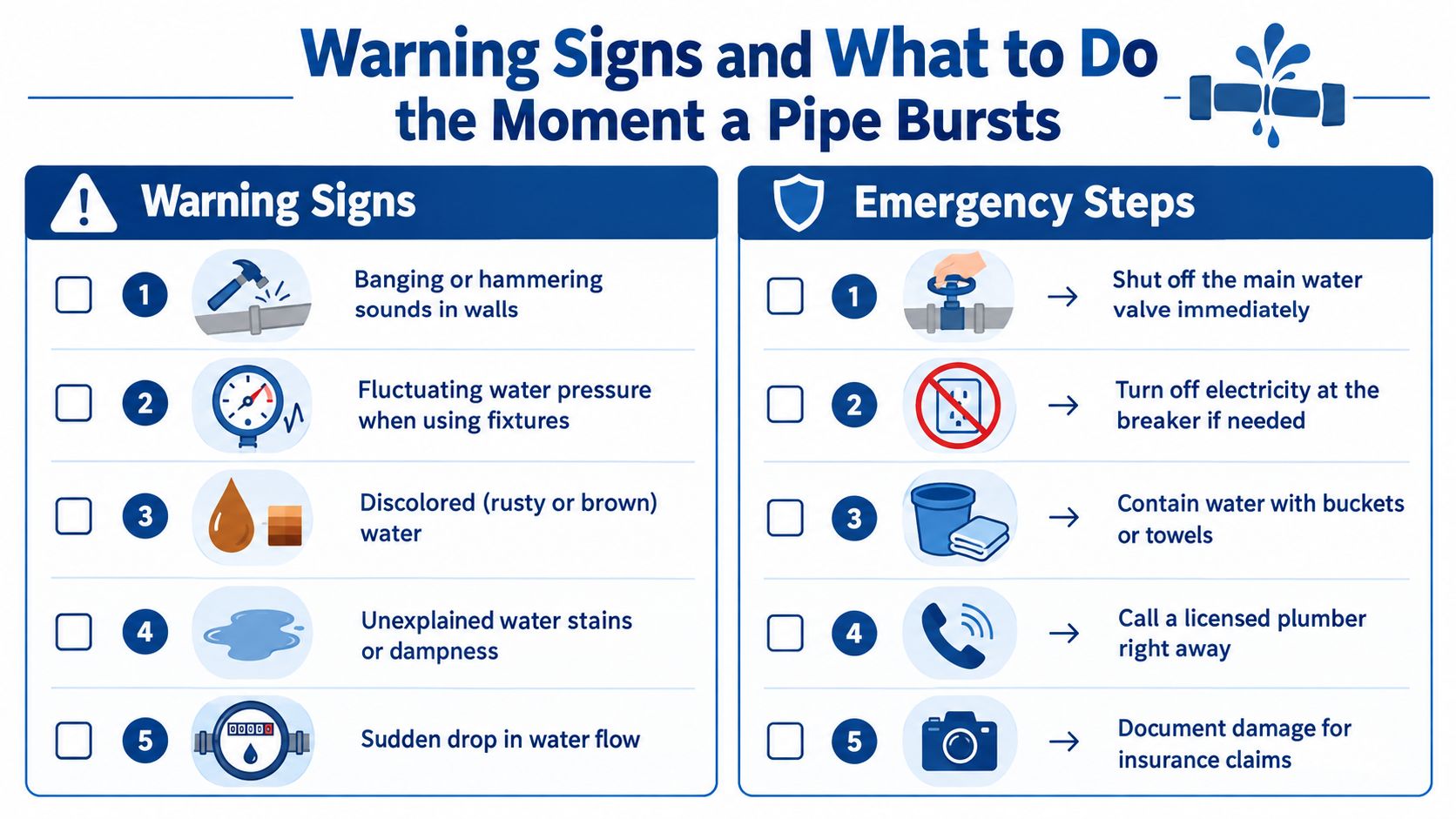
Follow this emergency sequence
- Close the main water valve. Stop incoming water before searching for the exact break. If you can safely isolate a fixture or appliance, close that valve too.
- Protect yourself from electrical hazards. If water has reached outlets, appliances, wiring, or a mechanical room, avoid standing water and switch off the affected circuit from a dry, safe location. Call emergency services if you can't reach the breaker safely.
- Relieve remaining pressure. Open a faucet after the supply is shut off. This helps drain residual water, but don't open fixtures in areas where electrical contact is possible.
- Contain what you can. Use buckets, towels, plastic containers, and furniture protection only when doing so won't put you at risk. Move valuables away from the affected area.
- Document the loss. Photograph the source, standing water, wet materials, and damaged contents before cleanup changes the scene. Keep notes about when you found the problem and what actions you took.
Safety first: Don't use electrical equipment in standing water, and don't enter a soaked ceiling area that may be unstable.
Once the water is controlled, contact a licensed plumber for the source and repair. If walls, floors, cabinets, insulation, or contents are wet, this guide to what to do after a pipe bursts can help you organize the next steps while help is on the way.
RestoTek TX can address water extraction, structural drying, leak detection, and related mitigation after a water-loss event. Fast drying matters because moisture hidden inside cavities can continue affecting materials after the visible water is gone.
Proven Ways to Prevent Burst Pipes Year Round
Prevention works best when each action targets a known failure mechanism. Insulation addresses cold exposure, pressure regulation reduces continuous load, and inspections identify corrosion before a weak wall opens.
Protect exposed lines before cold weather arrives
Insulate plumbing in attics, crawl spaces, exterior walls, garages, and near outdoor fixtures. Seal drafts around penetrations and keep vulnerable areas from receiving direct cold airflow. Foam pipe insulation can help on accessible straight runs, but difficult or concealed plumbing may require a plumber to evaluate routing and protection.
Keep indoor heat consistent when the property is occupied. For a vacant home, second home, or rental, a thermostat, smart leak sensor, and automatic shutoff can provide more useful protection than relying on someone to notice a leak quickly.
Match winter advice to occupancy
There isn't one universal answer to whether you should leave heat on, drip faucets, or shut off and drain the system. The correct choice depends on occupancy, insulation, plumbing layout, and whether someone can respond to an alarm.
Chubb's frozen-pipe guidance emphasizes thermostats, smart leak detection, backup power, and shutting off or draining water in unused buildings. Dripping a faucet may help during an extreme cold snap in an occupied home, but it's not a substitute for protecting exposed lines or winterizing an unattended property.
Control pressure and repeated surges
Ask a plumber to check whether the home needs a pressure regulator. If you hear hammering, a professional can assess valve operation, pipe support, flow conditions, and whether a water hammer arrestor is appropriate. Slower-closing valves and correctly sized surge-control components can reduce transient stress.
Address aging systems and surrounding soil
Have recurring pinhole leaks, rusty water, or corroded fittings evaluated as a system condition rather than treating each leak as an isolated repair. A plumber can help determine whether selective replacement is sensible or whether the material requires broader attention.
Outside, keep drainage from concentrating against the foundation and monitor areas where soil settles, cracks, or repeatedly becomes saturated. Roots and ground movement can affect buried lines, so recurring underground leaks warrant leak detection and a plumbing assessment.
When to Call a Restoration and Plumbing Professional in Georgetown
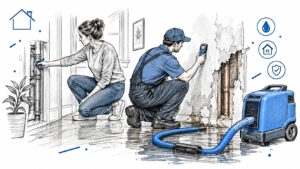
Call a plumber immediately when water continues flowing, the source is hidden, a slab or main line may be involved, or you can't safely isolate the affected section. Call a restoration professional when water has entered drywall, flooring, insulation, cabinetry, ceilings, or concealed cavities.
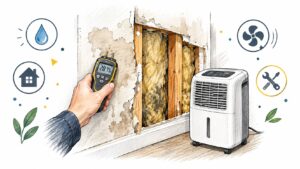
A complete assessment should identify the source, map the affected materials, check for hidden moisture, and establish a drying plan. Extraction removes standing water, but structural drying may require air movement and dehumidification inside materials and building cavities. Professionals can also document conditions and work performed, which helps organize an insurance claim.
Central Texas properties face a mix of freeze exposure, pressure events, corrosion, construction issues, soil movement, and weather-related stress. The water damage restoration service in Georgetown can support inspection, extraction, drying, microbial prevention, and reconstruction after a water loss. RestoTek TX also provides leak detection and plumbing-related services connected to burst or leaking pipes.
DIY cleanup is reasonable only when the area is small, safe, and fully accessible. If moisture has spread behind walls or beneath finished flooring, waiting can leave hidden materials wet even after the surface looks dry.
RestoTek TX provides 24/7 water damage response, extraction, leak detection, structural drying, microbial prevention, and reconstruction support for burst-pipe losses in Georgetown and Austin. If a pipe has failed or you've found unexplained moisture, contact RestoTek TX for practical guidance and a no-cost estimate.