
Most homeowners in the Austin-Georgetown area should expect a basement flooding repair cost of $2,500 to $10,000 for restoration, while severe or contaminated losses can climb past $15,000 to $25,000. The decision you make tonight, extract now or wait, often determines which end of that range you face.
You find two inches of water over the concrete after a Central Texas storm. Wet boxes are floating near the stairs, the sump pump has stopped, and the basement heater is throwing an error. Your phone fills with search results, but none of them answers the practical question: what will this cost, and what should you do first?
For a typical flooded basement, the answer depends less on square footage than on water category, finish level, exposure time, and the work hidden beneath the visible damage. A small unfinished room with clean water may stay near the low thousands. A finished basement with soaked drywall, flooring, contents, or sewage contamination can move quickly into five-figure territory.
You have three decisions to make immediately:
- Extract now or wait: Waiting gives water more time to move into drywall, insulation, framing, and subflooring.
- File a claim or pay out of pocket: Coverage depends on the cause, policy endorsements, and whether the loss is classified as flooding, seepage, backup, or sudden plumbing damage.
- Hire a crew or attempt DIY: A homeowner can handle a small clean-water spill. Standing water near electrical systems, contaminated water, and saturated building materials need professional controls.
This guide gives you the cost bands, invoice line items, insurance documentation, DIY limits, and first-48-hour actions that matter in Georgetown and Austin. For a broader look at local water-loss pricing, compare this guide with home water damage repair cost information.
What You Will Pay After a Basement Floods
The first-night estimate
If water is still standing, budget first for extraction and drying. Cosmetic repairs can wait. A broad consumer estimate puts cleanup and dry-out near $4,000, with many homeowners paying $2,500 to $10,000 before major rebuilding begins, according to HomeAdvisor's flooded-basement cost guide.
That range gives an Austin or Georgetown homeowner a starting point, not a final quote. A failed supply line in a concrete basement may require extraction, drying, and limited sanitation. A finished basement with soaked carpet, drywall, trim, furniture, and stored belongings also needs demolition and reconstruction.
For a smaller loss, set aside $1,500 to $3,000. Moderate flooding commonly reaches $3,000 to $8,000. Severe damage in a finished basement can cost $8,000 to $15,000 or more. Sewer backup cleanup is often $3,500 to $8,000, with severe cases reaching $15,000, according to RestoPros' basement flooding repair cost breakdown.
Tonight's practical rule: Spend the next dollar on safe extraction and drying, not paint, flooring, or other cosmetic work.
What changes the bill
Water type sets the first major decision. Category 1 clean water from a broken supply line is generally simpler to handle than gray water from an appliance or black water from sewage and outdoor flooding. Finished materials raise the bill because carpet, pad, drywall, insulation, engineered flooring, trim, and contents may need removal.
Time also changes the scope. Water trapped inside wall cavities or beneath flooring can remain after the puddles disappear. A box fan in the doorway does not prove the structure is dry.
A cost guide estimates that responding within 24 hours can keep restoration around $1,000 to $4,500, while delays can push totals to $5,000 to $25,000 as mold and structural damage enter the job. Severe black-water or structural losses may exceed $50,000, as reported in iBuyer's water-damage repair cost guide.
For a broader local comparison before approving work, review home water damage repair cost information.
Stop the source if safe. Keep people away from electrical hazards and contaminated water. Photograph every room, preserve damaged materials when practical, and request a written scope before authorizing reconstruction.
How the Restoration Process Builds the Final Bill
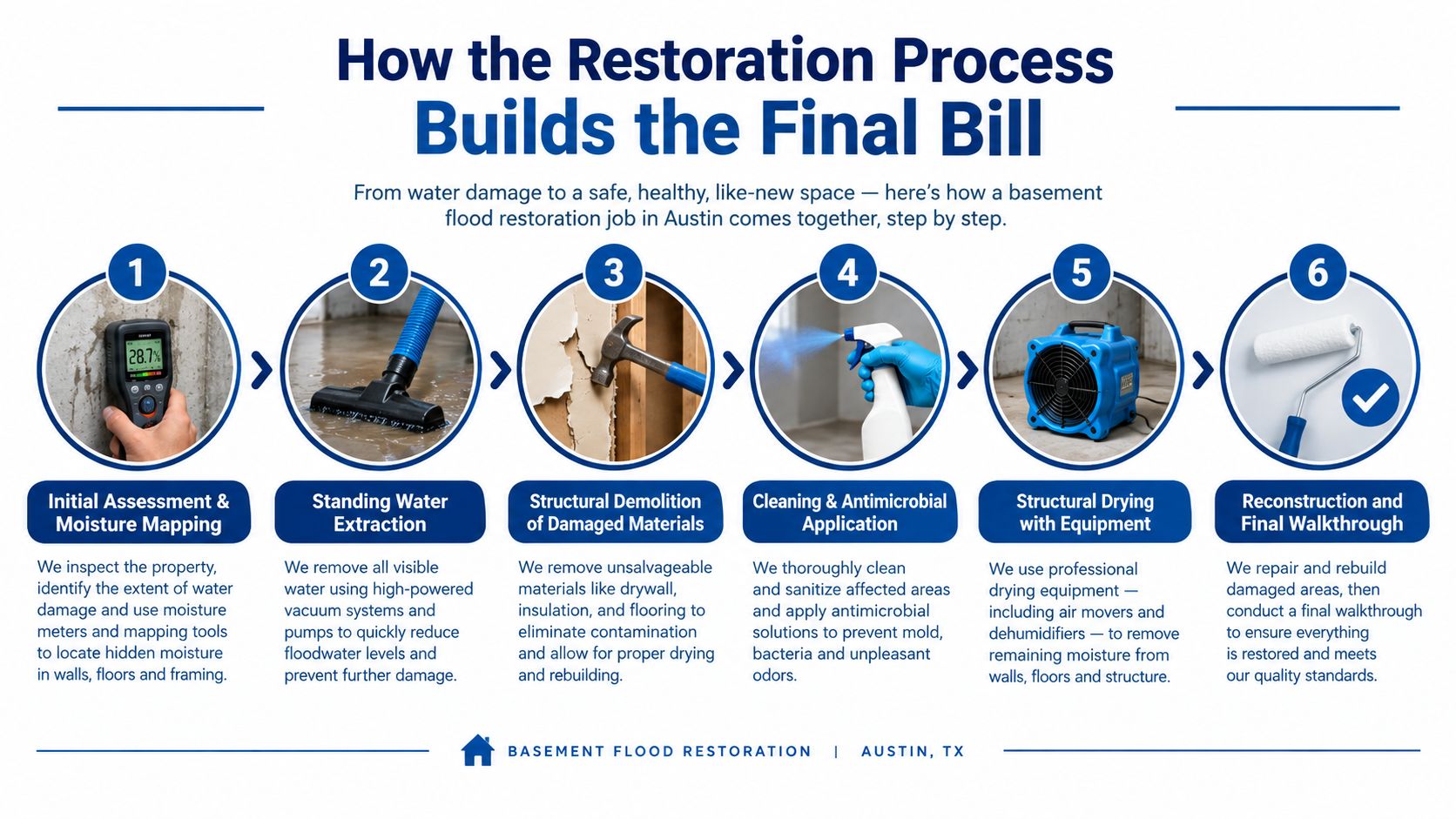
Tonight, your first cost decision is simple: pay for extraction and drying now, or risk paying for demolition, odor control, and mold treatment later. A professional invoice follows the physical path of the damage, from identifying the source through reconstruction.
Assessment and extraction
The first visit should cover safety checks, source identification, moisture mapping, and a written scope. Technicians use moisture meters and, in some cases, infrared imaging to locate wet areas beyond the visible waterline. In a Georgetown or Austin basement, that hidden moisture can sit inside wall cavities or beneath finished flooring.
Standing-water extraction comes next. Crews may use submersible pumps, truck-mounted equipment, or portable extractors based on access and water volume. Set aside $500 to $2,000 for extraction, with contaminated water and larger volumes pushing the figure higher.
Demolition and drying
Wet carpet and pad generally come out when they cannot be safely restored. Crews may cut drywall above the affected area and remove saturated insulation or damaged trim. Demolition and debris hauling commonly run $800 to $2,500 on a moderate job.
Structural drying deserves priority over cosmetic repairs. Commercial dehumidifiers and air movers remove moisture from framing, subfloors, and indoor air while technicians track readings instead of judging dryness by appearance. Equipment and monitoring commonly cost $1,000 to $3,500.
ServiceMaster's restoration cost explanation describes rapid extraction and controlled structural drying because incomplete drying expands secondary damage. Waiting does not remove the cost. It can shift it into swollen subfloors, odor treatment, mold work, or more demolition.
Cleaning and reconstruction
Sanitation and antimicrobial treatment address affected surfaces and odors. Gray- and black-water losses require stricter cleaning, disposal, and worker-safety controls than clean-water jobs.
Reconstruction starts after the structure reaches appropriate dryness. Drywall, insulation, flooring, trim, paint, and framing repairs can add $2,000 to $8,000 or more, depending on what was removed and how much of the basement was finished.
A written invoice separates each phase because each solves a different problem. Extraction stops the immediate loss. Drying protects the structure. Reconstruction makes the room usable again. Saving the invoice, moisture readings, photographs, and removed materials also gives you a clearer record for an insurance claim or an out-of-pocket decision.
Cost Ranges by Severity and Water Type
A useful way to locate your situation is to compare the same hypothetical basement across three damage levels. Consider an 800-square-foot basement in Georgetown or Austin. The square footage alone doesn't determine the bill. The source, contamination, materials, and time in water do.
| Severity Tier | Scenario | Category 1 (Clean) | Category 2 (Gray) | Category 3 (Black/Contaminated) |
|---|---|---|---|---|
| Minor | Supply line burst, caught quickly, mostly unfinished area | $1,500-$4,000 | $3,000-$7,000 | $7,000-$15,000 |
| Moderate | Sump failure, partial finishes, appliance or gray-water involvement | $3,000-$8,000 | $4,000-$10,000 | $8,000-$15,000 or more |
| Severe | Multi-day water, finished surfaces, sewer backup, or outdoor floodwater | $8,000-$15,000 | $10,000-$25,000 | $15,000-$25,000 or more |
The clean-water benchmark of $1,500 to $3,500, gray-water range of $3,000 to $7,000, and black-water range of $7,000 to $15,000 are summarized in Angi's flooded-basement cleanup guidance. Those ranges reflect the added demolition, disposal, sanitation, and safety controls that contamination requires.
Category 1 clean water
A broken supply line or similar clean source usually creates the simplest restoration path. If you catch it quickly, the crew may extract water, dry the concrete and framing, clean affected surfaces, and replace limited finishes.
Category 2 gray water
Water from an appliance, toilet overflow without fecal contamination, or similar source carries more contamination risk. Porous materials may need removal, and sanitation becomes a larger part of the scope.
Category 3 black water
Sewage backup, river water, and outdoor floodwater require the strongest controls. The crew may remove carpet, pad, drywall, insulation, and contents that cannot be safely cleaned. Disposal, containment, sanitation, and reconstruction drive the price toward the top of the table.
An unfinished basement often stays below the cost of an equivalent finished space because concrete and exposed framing leave fewer finishes to replace. A finished basement turns mitigation into a rebuild once water reaches flooring and wall assemblies.
Price Breakdown by Service and Trade
A quote should detail the contractor's work, not just present one unexplained total. Some companies bundle assessment, extraction, and drying. Others itemize each service so an adjuster can compare the scope with policy coverage.
| Service / Trade | Typical Cost Range | When It Applies | Notes |
|---|---|---|---|
| Assessment and moisture mapping | Included or itemized | Every documented loss | Ask for moisture readings and affected-area notes |
| Water extraction and pump-out | $500-$2,000 | Standing water is present | Volume, access, and category affect labor and equipment |
| Structural drying | $1,000-$3,500 | Framing, walls, flooring, or subfloor are wet | Includes air movers, dehumidifiers, and monitoring |
| Demolition and debris hauling | $800-$2,500 | Drywall, pad, insulation, or trim can't be saved | Disposal is more demanding for contaminated material |
| Antimicrobial sanitation | $500-$2,000 | Gray water, black water, or odor concerns | Scope depends on materials retained |
| Mold remediation | Variable, often several thousand dollars | Mold is visible or confirmed | Containment and HEPA air scrubbing may apply |
| Plumbing repair | Variable | Burst line, failed valve, appliance line, or sump issue | Use a properly qualified plumbing trade |
| Electrical reset or repair | Variable | Water reached outlets, panels, appliances, or circuits | Safety comes before drying equipment |
| Reconstruction | $2,000-$8,000 or more | Finishes or structural materials need replacement | Drywall, flooring, paint, trim, and framing drive scope |
Restoration trades versus repair trades
Restoration technicians handle extraction, drying, sanitation, and damage documentation. Licensed or qualified plumbing and electrical professionals address the failed water source and unsafe electrical components. A restoration crew shouldn't conceal a plumbing failure behind new drywall, and a plumber shouldn't declare a basement dry based only on the absence of standing water.
Mold remediation deserves a separate scope when growth is present. Containment, removal, cleaning, and air filtration are different tasks from ordinary water extraction. Don't accept a vague “mold treatment” line without knowing what materials are being removed and how the area will be isolated.
How to read competing quotes
Compare scope before price. One contractor may include demolition and hauling in extraction, while another lists them separately. The cheaper total may omit moisture monitoring, sanitation, contents handling, or reconstruction.
Ask this before signing: “Which materials are you removing, what readings prove the structure is dry, and what work is excluded from this estimate?”
A credible quote identifies the source, affected rooms, water category, equipment plan, demolition limits, drying verification, and reconstruction assumptions. It also distinguishes emergency mitigation from permanent repair.
Hidden Drivers That Push Costs Higher
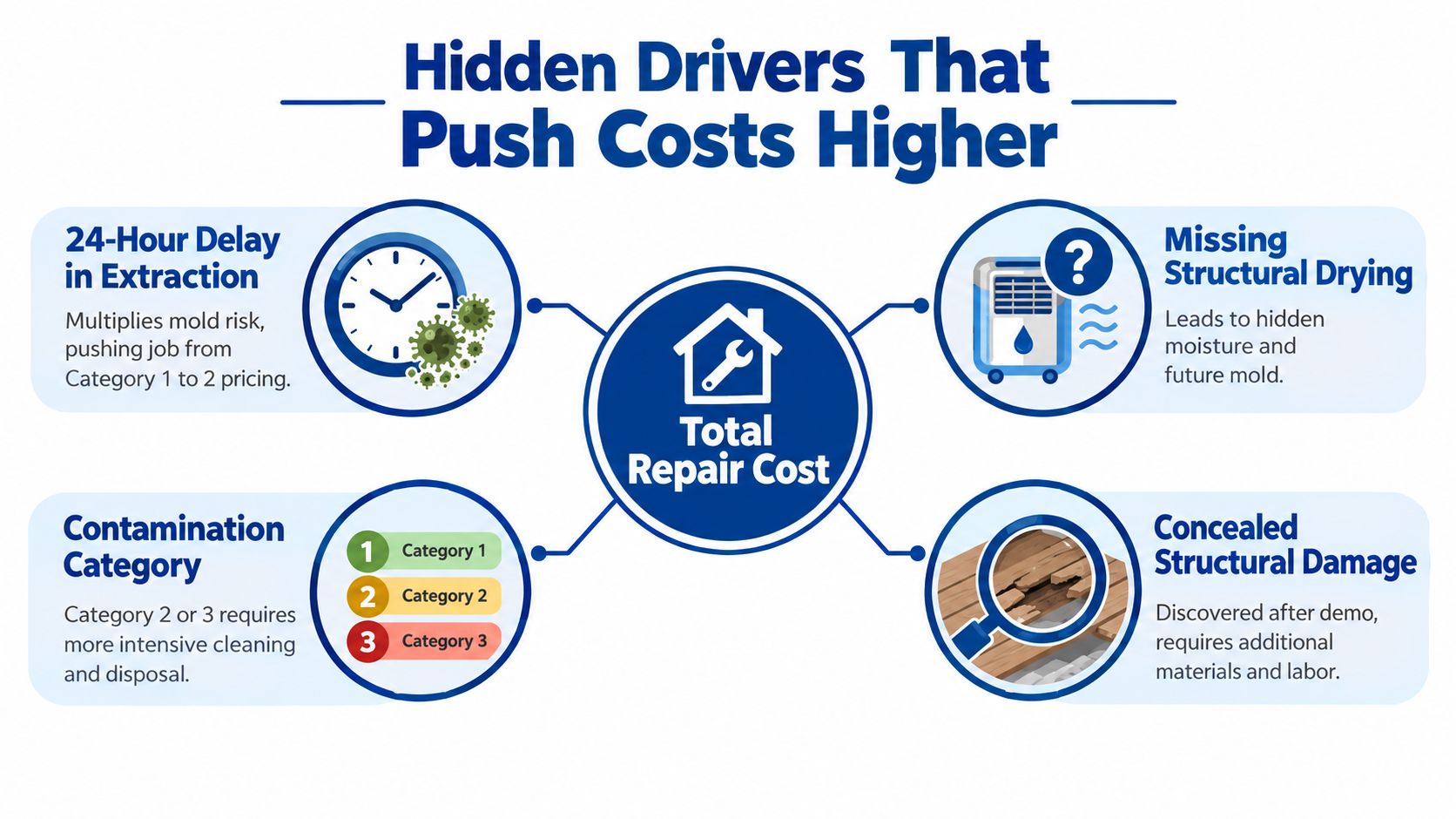
The pump may remove the puddle while the actual work remains. In a Georgetown or Austin basement, moisture can sit behind drywall, under flooring, or inside insulation. Those concealed conditions determine whether you can stop at extraction and drying or must approve demolition, sanitation, and rebuilding.
Delay changes the decision
If the water is clean and the area is safe, extract it now and start drying. Waiting shifts the scope toward additional demolition, odor control, and microbial remediation. It can also expose damage that was hidden at the first visit, turning a limited mitigation job into a larger repair.
Do not wait for the basement to “dry on its own” when drywall, insulation, flooring, or stored contents are wet. The longer those materials hold moisture, the more likely removal becomes.
Inspect the cost amplifiers
- Wall wicking: Drywall and insulation can pull water above the visible line, so removal may extend past the wet-looking area.
- Subfloor saturation: Wood-based subfloors can swell, cup, or lose stability when water remains beneath finished flooring.
- Contents handling: Furniture, boxes, electronics, and stored belongings may require inventory, cleaning, relocation, or disposal.
- HVAC exposure: Water or sewage near a basement air handler or duct system can spread contaminated particles through connected rooms.
- Structural discovery: Framing, foundation interfaces, and concealed cavities may show damage only after materials are opened.
- Coverage classification: Sewer backup and rising water may fall outside standard coverage unless the policy includes the applicable endorsement or flood protection.
Extract now or wait
Waiting is reasonable only for a small, clean spill that is fully removable without affecting building materials. Call a professional crew for standing water, contaminated water, soaked drywall, or water near electrical components. Do not operate equipment in an unsafe area or treat the absence of visible water as proof that the structure is dry.
Ask the contractor to identify these drivers before work begins. The estimate should state what will be removed, dried, cleaned, monitored, and rebuilt. If those items appear only later as change orders, the original price was never a fair comparison.
Insurance, Claims, and What Documentation Matters
Texas homeowners need to separate water damage from flood damage before assuming coverage. Standard homeowners policies commonly address sudden and accidental plumbing losses, such as a burst pipe or appliance discharge, while rising water, groundwater seepage, and many external flood events usually require separate flood coverage.
A sewer backup may also need a specific rider. Gradual seepage, maintenance-related deterioration, and long-standing leaks often create coverage disputes because the insurer may treat them as preventable conditions rather than sudden losses.
| Cause of Loss | Standard HO-3 Policy | Sewer Backup Rider | NFIP Flood Policy |
|---|---|---|---|
| Sudden burst interior pipe | Often covered, subject to policy terms | Usually not the main issue | Usually not the primary response |
| Appliance discharge | Often covered, subject to policy terms | Usually not the main issue | Usually not the primary response |
| Sewer backup | Often excluded without endorsement | May provide relevant coverage | Depends on the flood-loss facts and policy terms |
| Groundwater seepage | Commonly excluded | Usually not designed for seepage | Coverage depends on qualifying flood conditions |
| Rising water from an external flood | Commonly excluded | Usually not sufficient by itself | Intended for qualifying flood damage |
Document before cleanup
Take time-stamped photos and video of the waterline, source, damaged rooms, contents, electrical equipment, and every material you move. Don't throw away damaged items until you've photographed them and recorded what they are, unless they create an immediate health or safety hazard.
Ask the restoration company for:
- A written scope: Rooms, materials, equipment, demolition, sanitation, and reconstruction assumptions.
- Moisture documentation: Readings, affected assemblies, and drying progress.
- An itemized contents list: Include damaged furniture, electronics, stored property, and irreplaceable items.
- Emergency invoices: Keep receipts for pumps, temporary materials, protective equipment, and mitigation.
- A cause description: Record whether the loss came from a pipe, sump pump, appliance, sewer, rain, or rising water.
For practical policy questions and claim preparation, review homeowners insurance coverage for water damage.
What to say on the first call
State the facts you know: when you discovered the water, where it is, what caused it if known, and what you did to prevent further damage. Don't guess about hidden causes, promise that every item is ruined, or authorize permanent reconstruction before the scope is documented.
Mitigation and reconstruction may be handled separately. Submit emergency drying and extraction invoices even if the carrier later disputes coverage for rebuilding. Ask whether the claim is being handled as cash-out or directed repair, and request written explanations for exclusions or denied portions.
Red Flags That Demand a Professional Crew
Tonight's first decision is whether you can remove a small, clean spill safely or need extraction equipment and a drying plan. DIY cleanup fits only a limited surface event that has not reached outlets, appliances, walls, flooring, or other building materials. A towel, shop vacuum, and household fan may handle that situation.
Call a professional restoration crew when the water is deeper, contaminated, or trapped inside the structure. In Georgetown and Austin, a storm, sewer backup, or failed appliance can spread damage beyond what you can see, so waiting to save the service call can create a larger reconstruction bill.
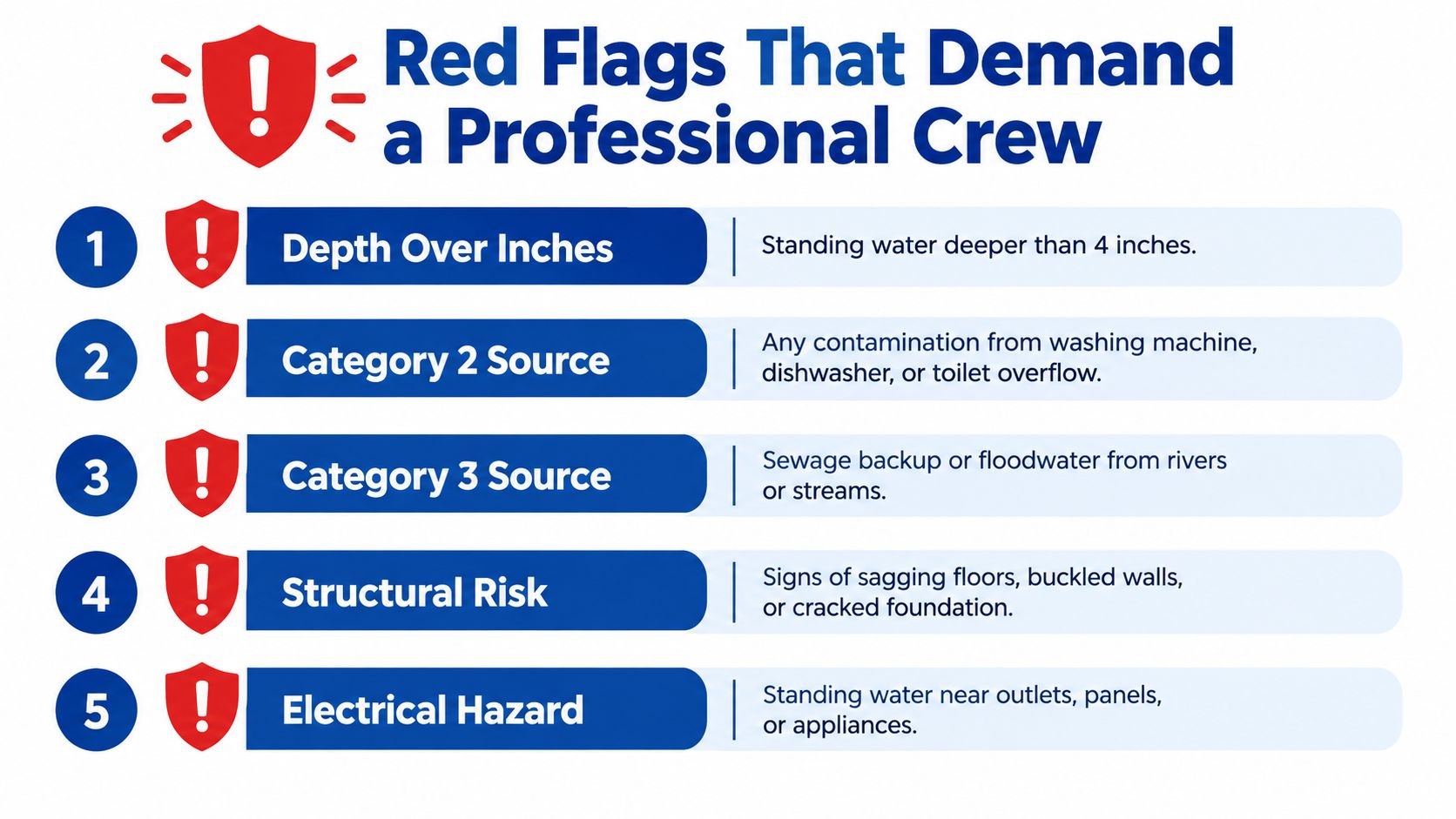
Call for help when any of these conditions exist
- Depth over inches: Standing water deeper than a few inches calls for pumps, safe access, and measured drying.
- Category 2 source: Washing-machine, dishwasher, or toilet overflow water needs more than mopping and ventilation.
- Category 3 source: Sewage, river or stream water, and outdoor floodwater require protective equipment, contamination controls, demolition, and controlled disposal.
- Structural risk: Sagging floors, buckled walls, cracked foundation areas, or swollen subfloors require assessment before anyone enters or places equipment nearby.
- Electrical hazard: Water near outlets, panels, appliances, furnaces, or wiring can cause shock or fire. Stay out until a qualified person isolates the affected power.
Category 3 restoration commonly falls in the $7,000 to $15,000 range and can reach $25,000 or more when demolition, antimicrobial treatment, structural repairs, and reconstruction expand the scope, as reflected in ServiceMaster's restoration cost guidance.
Safety rule: Do not trade a restoration bill for an electrical injury, contaminated-water exposure, or an undocumented structural problem.
Shut off the source if safe, move only safe-to-handle items, and document conditions. Do not operate a wet furnace, plug fans into affected outlets, or disturb sewage-contaminated materials without proper protection.
Your First 48 Hours in Georgetown or Austin
Central Texas storms can deliver heavy rainfall and flash flooding quickly. In Williamson County, expansive clay can hold moisture against foundation walls, while a basement HVAC system can distribute odors or contaminants if floodwater reaches the equipment.
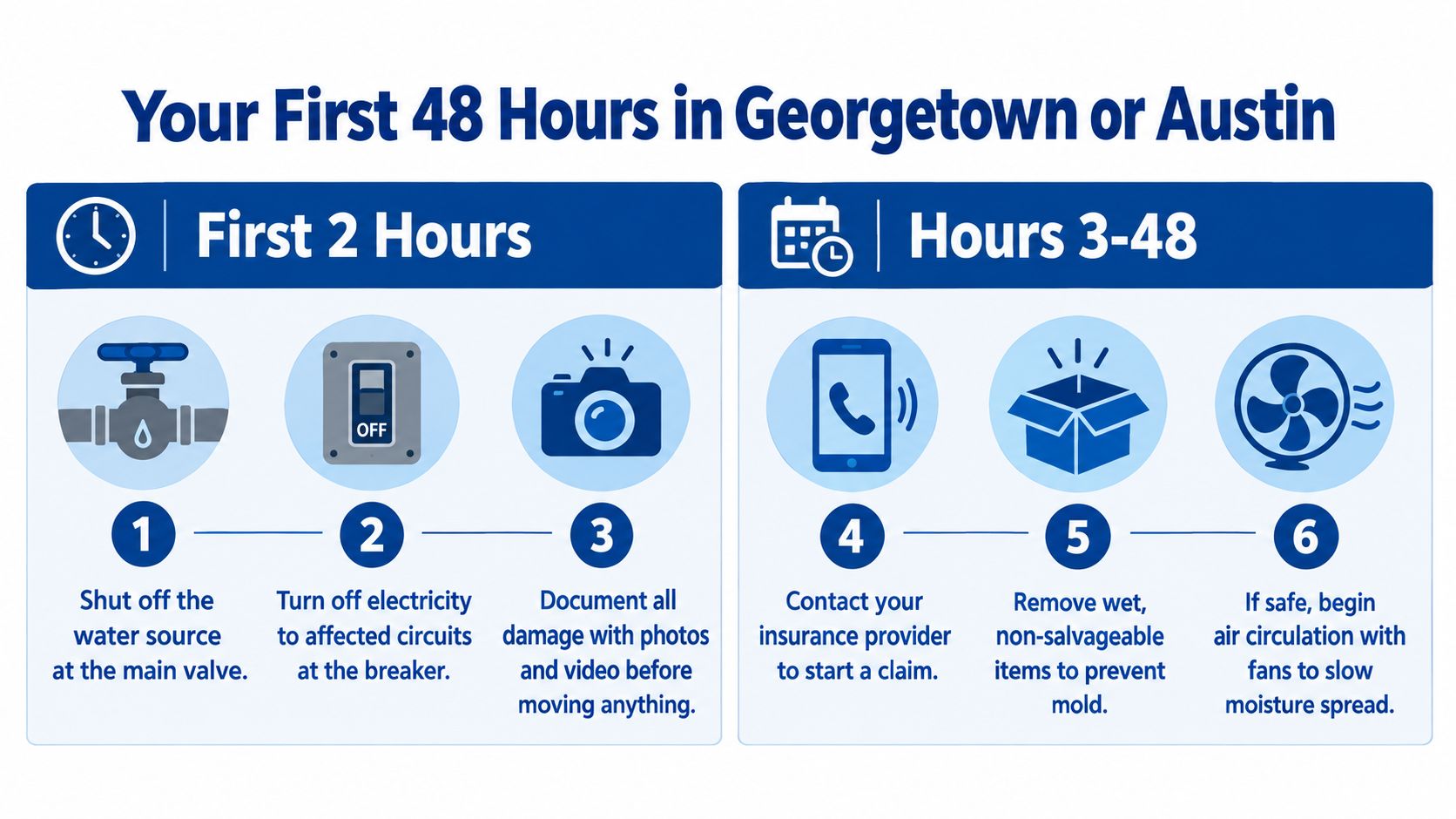
First two hours
- Stop the source: Close the main water valve or shut down the failed appliance if you can do so safely.
- Isolate electricity: Turn off affected circuits at the breaker only if you can reach the panel without entering standing water.
- Document conditions: Photograph and record the waterline, source, contents, finishes, equipment, and visible damage before moving items.
Then call your insurer to open a claim and contact a qualified restoration provider for an assessment and no-cost estimate. RestoTek TX serves Georgetown, Austin, and surrounding Central Texas communities with 24/7 emergency response, according to the company information provided for this article.
Hours three through forty-eight
Keep people and pets away from contaminated water. Remove wet, non-salvageable contents only when it's safe, preserve damaged items for documentation, and don't begin permanent repairs until the loss has been recorded by the adjuster or restoration contractor.
Have these items ready when the crew arrives:
- Photos and video: Include original files with timestamps where available.
- Claim information: Keep the insurance carrier, claim number, adjuster contact, and policy details together.
- Source details: Note when the water started, when you found it, and what failed.
- Priority contents list: Identify documents, photographs, electronics, heirlooms, and other irreplaceable property.
- Access information: Provide utility shutoff locations, basement access instructions, and any known hazards.
Use this first steps after a basement flood checklist while you coordinate extraction, documentation, and insurance communication. The right sequence is simple: make the area safe, document it, stop further damage, and dry the structure before rebuilding.
RestoTek TX provides 24/7 basement flood response in Georgetown, Austin, and surrounding Central Texas communities, including inspection, water extraction, structural drying, microbial prevention, and reconstruction coordination. If your basement is wet tonight, visit RestoTek TX to request help and a no-cost estimate before a limited cleanup turns into a larger repair.