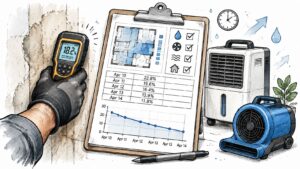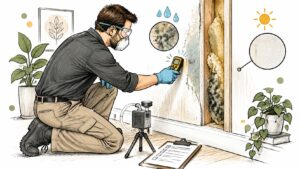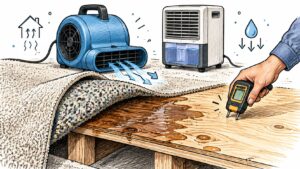
Yes, leak detection works when the tool matches the type of leak and someone acts on what it finds, with homes using external flow monitors reducing indoor water use by 15% in one study summarized by the EPA. It doesn't work as a magic shield, though, because every method has a detection limit, a blind spot, and a dependence on how fast a person responds.
That distinction matters if you're staring at a bill that makes no sense and wondering whether to buy a sensor, run a meter test, or call someone in. The honest answer to does leak detection work depends on what you're trying to find, where it is, and what happens after an alert.
The Moment a Homeowner Starts Asking
A Georgetown homeowner opens a water bill that's climbed for no obvious reason. Nothing's flooding. No faucet's dripping into a sink. Then she walks barefoot down the hallway and notices one patch of floor feels faintly warm.
That small, odd detail is usually when the search starts. A warm spot can mean a hot water line leaking under a slab, moving heat into concrete and flooring day after day. The water itself stays hidden, so waiting for a puddle means waiting for damage you could've caught earlier.
What people are actually worried about
The fear is rarely just wasted water. It's three things at once, a bill that keeps rising, moisture rotting framing or subfloor where you can't see it, and mold growing in a damp wall cavity. Those worries are reasonable, because the EPA estimates the average family can waste about 180 gallons per week, or approximately 9,400 gallons per year, from household leaks, according to EPA WaterSense statistics and facts.
A leak you can't see can still run continuously. The absence of visible water isn't evidence that everything's fine.
Detection is meant to answer a narrower question than homeowners expect. It's not asking whether your home is safe forever. It's asking whether water is moving somewhere it shouldn't, right now, and roughly where.
What Leak Detection Is Trying To Find
| Leak Type | Common Signs | Why It Matters |
|---|---|---|
| Slab leak | Warm floor spot, rising bill, sound of running water | Water spreads under flooring and foundation materials unseen |
| In-wall pinhole leak | Musty odor, soft drywall, recurring stain | Cavities stay damp and invite mold growth |
| Running toilet or fixture leak | Hissing, phantom refills, constant meter movement | Continuous flow wastes water around the clock |
| Roof or envelope leak | Ceiling stain after rain, peeling paint | Intrusion can travel far from the entry point |
That table is why a simple yes or no rarely helps. Each leak type leaves a different kind of trace, and a tool that finds one trace well may miss another entirely. In Central Texas homes, where slab foundations and heavy rain are common, matching the tool to the trace is the whole job.
Four Detection Methods Explained
Think of detection methods as four different senses. Each one picks up a different clue, sound, temperature, moisture, or flow. Once you know which clue you're chasing, the right tool usually becomes obvious.

Listening for escaping water
Acoustic detection uses sensitive microphones, ground listening devices, or correlators to pick up the hiss and vibration of pressurized water escaping a pipe. It's like hearing a whisper in a quiet room, since the leak makes a distinct sound against an otherwise silent line. Technicians compare readings at multiple points to triangulate where that sound is strongest.
Thermal imaging works differently. A camera shows temperature differences across a surface, so a hot water slab leak appears as a warm bloom and evaporating moisture often appears cooler than surrounding dry material. It's like finding the one cold tile in a sunlit bathroom. You can read more about how this works in practice in this guide to thermal imaging leak detection.
Confirming moisture and measuring flow
- Moisture meters and borescopes: A meter reads moisture content in drywall, wood, or flooring at a specific spot, while a borescope camera looks inside a wall cavity through a small opening. These tools confirm what's wet rather than guessing from the surface.
- Flow and pressure monitoring: A monitor at the meter or on a fixture tracks whether water moves when nothing should be running. It can't point to a room, but it can tell you the home is losing water somewhere.
Here's the mental model to keep. Acoustic tools locate pressurized pipe leaks, thermal cameras map temperature clues, moisture tools confirm wet materials, and flow monitors tell you a problem exists even when they can't say where. Professionals rarely rely on one method alone. They use one tool to suspect, another to confirm, and that sequence is what makes the finding trustworthy rather than a hunch.
How Accurate Each Method Really Is
No method is accurate in the abstract. Accuracy depends on pipe material, water pressure, background noise, and whether the person holding the tool knows how to read it. A strong result from one method, confirmed by a second, is worth far more than a single confident reading.
Acoustic methods perform best on pressurized leaks in quiet conditions. Their signal weakens badly in common situations, though. A technical review notes that acoustic signal strength falls for low-pressure or small leaks and degrades with plastic pipes, large diameters, clay or grass soils, pipes buried below the water table, and high background noise, as described in a 2024 review of water leak detection technologies.
That same body of research shows technology is improving, since a neural network system analyzing acoustic recordings from an Adelaide smart water network distinguished leaks from background noise with accuracy above 90%. Treat that as a benchmark under specific conditions, not a promise for your street. The model was trained on that network's data, and your home's pipes, soil, and noise environment are different.
Where each method gets fooled
Thermal cameras spot anomalies well, especially hot water lines under slabs, but sunlight heating a floor, HVAC airflow, or recently used hot water can create misleading patterns. The camera shows temperature, not water, so interpretation is the skill. Moisture meters give direct readings, yet only at the exact spot tested, so a dry reading two feet from a leak proves nothing about the wet area nearby.
Flow monitors have the opposite profile. They're excellent at catching continuous, whole-home losses, including slow leaks you'd never hear. Their weakness is location, since they tell you water is moving, not which pipe, wall, or fixture is responsible.
Detection Methods At A Glance
| Method | Best At Finding | Main Limitation |
|---|---|---|
| Acoustic | Pressurized pipe leaks, including underground lines | Weak signal with plastic pipe, low pressure, or high noise |
| Thermal imaging | Slab leaks, hidden moisture patterns, roof intrusion paths | Shows temperature, not water, so results need interpretation |
| Moisture meter and borescope | Confirming wet drywall, wood, and wall cavities | Only measures the exact spot the technician can reach |
| Flow monitoring | Continuous running water anywhere in the home | Detects the loss but doesn't locate its source |
Keep this comparison handy when you talk to a provider. If someone promises one tool will find everything, that claim itself is the warning sign.
Where Consumer Sensors Quietly Fail
A smart sensor feels like protection. You stick it near a water heater, connect the app, and assume the home is covered. That assumption is where people get hurt, because consumer devices vary enormously in what they can sense.
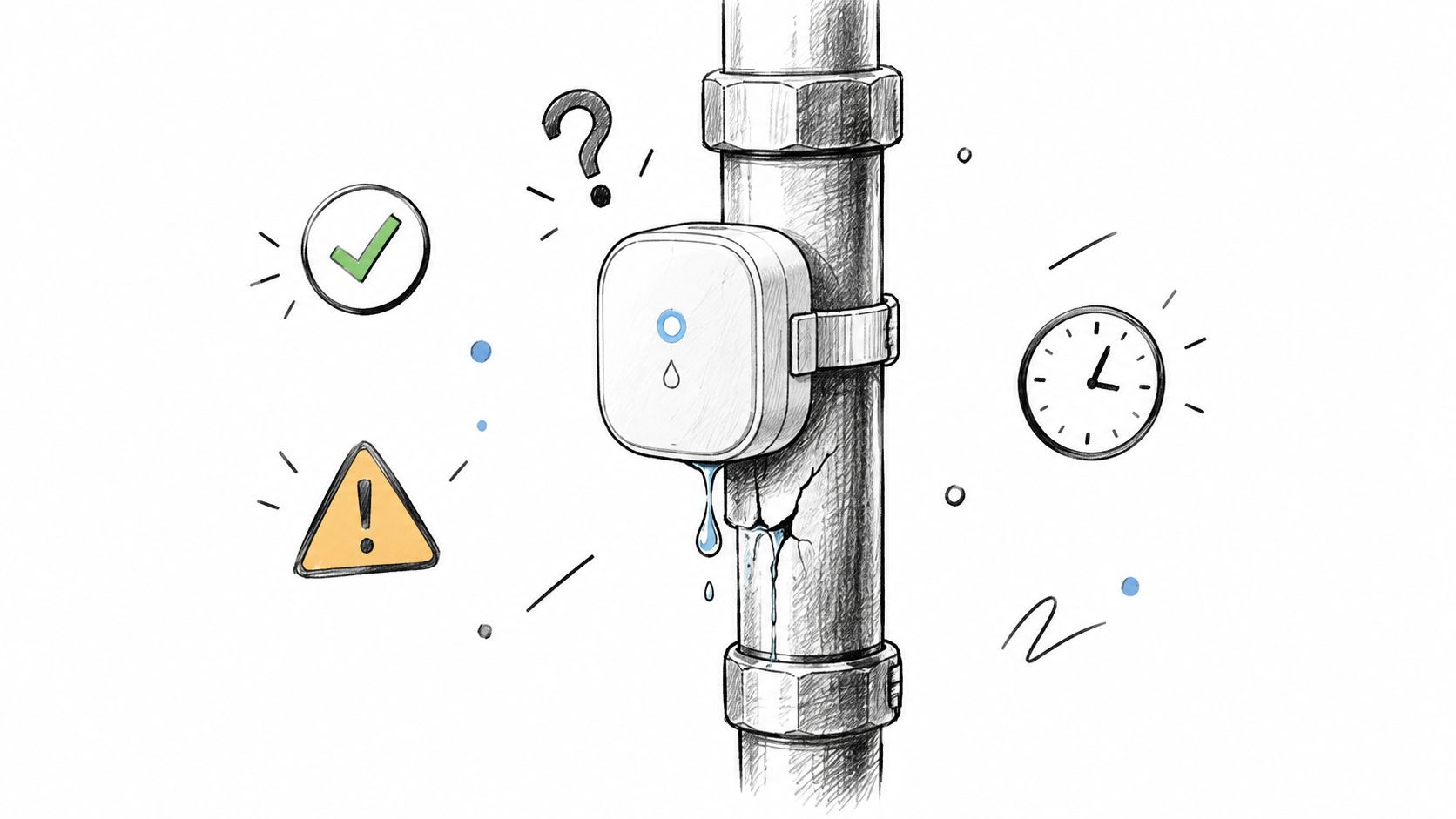
Independent EPA testing found that some systems detected simulated pipeline leaks as small as 0.06 gallons per minute, while another system could locate leaks only above 0.6 gallons per minute, according to EPA testing of leak detection systems. That's a tenfold gap between products sitting in similar packaging. A slow pinhole leak inside a wall can run well below the higher threshold for a long time, soaking insulation and framing while the sensor stays silent.
The same testing found another quiet failure. Systems struggled to distinguish two nearby leaks and generally reported only the larger one in a cluster. So a homeowner can fix the leak that triggered the alert, feel relieved, and leave a second, smaller leak running untouched.
Placement is the other blind spot
- Point sensors: These only react when water physically reaches them, so a sensor by the washing machine won't notice a slab leak across the house.
- Whole-home flow devices: These watch total flow, but a very slow leak may fall inside the normal variation the device is trained to ignore.
- Any sensor: It can't tell you how wet the wall cavity already is, which is why understanding how to read moisture meter results matters after any alert.
Practical rule: Treat a sensor alert as a reason to investigate, and treat the absence of an alert as no information at all.
That skepticism isn't anti-technology. Sensors catch burst lines and appliance failures early, and that's valuable. The mistake is expecting a device built for high-flow events to catch a slow, hidden seep it was never designed to see.
Why Detection Only Works When Response Works
A notification on your phone doesn't stop water. It starts a chain, and savings only appear if every link holds. The sensor or meter detects abnormal flow, the alert reaches a person, that person investigates, and a plumber or restoration team confirms and repairs the source.
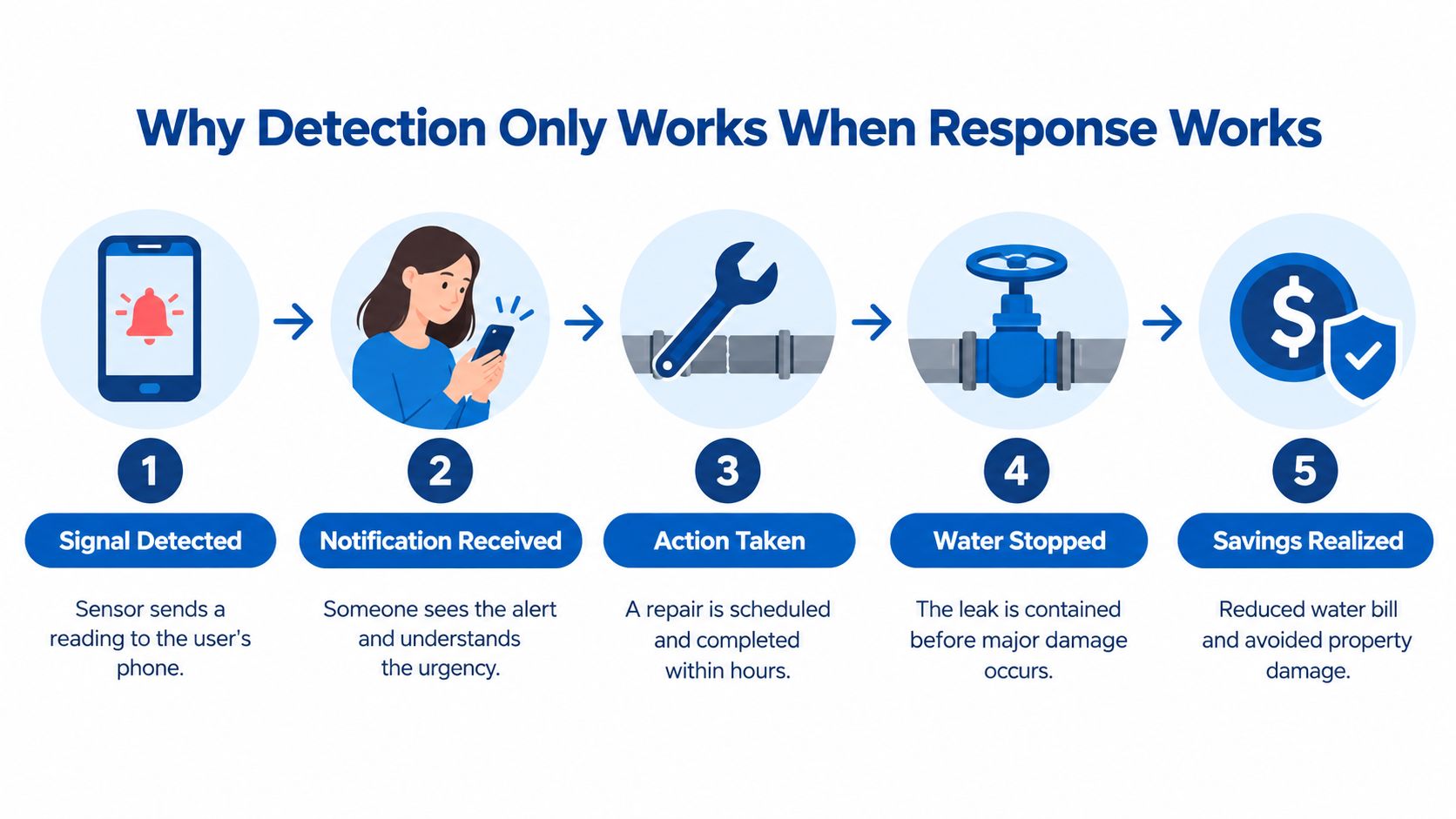
The evidence supports that framing. An EPA guide describes a senior housing community where more than 1,000 in-line monitoring devices at toilets helped identify leaks, and repairs reduced water use by 25%, saving more than 1 million gallons and approximately $10,000, as documented in the EPA leak detection and flow monitoring guide. Notice the sequence in that example. Monitors found the problem, but people repaired toilets, and the repairs produced the savings.
In Goodyear, Arizona, participating homes saved an average of 38 gallons per household per day after installation. Again, the device alone saved nothing. Occupants and managers acted on what it reported.
Where the chain breaks
Each link has a failure mode. Interference can produce both false positives and false negatives, as noted in EPA documentation on leak detection interference. Beyond interference, alerts die for ordinary reasons.
- Connectivity loss: A Wi-Fi outage or dead battery means the alert never leaves the device.
- Alert fatigue: Repeated false alarms train people to swipe notifications away without reading them.
- Nobody available: A vacation, a vacant rental, or a property manager covering too many units delays investigation by days.
- No plan: The person who sees the alert doesn't know which valve to close or who to call, which is why reviewing emergency response steps before you need them is worth doing now.
Automatic shutoff systems shorten the chain by closing a valve without waiting for a human, and professionally monitored systems add a person whose job is to respond. Both cost more than a passive sensor because you're paying for the response half, not just the detection half. When you compare options, ask who acts at 2 a.m., not just how sensitive the sensor is.
When a Professional Should Take Over
Some signals mean you should stop investigating on your own. Not because you've failed, but because the next step requires acoustic correlators, thermal cameras, and moisture mapping used together, plus the judgment to interpret conflicting readings.
Signals that justify a call
- Meter moving with everything off: Water is going somewhere, and you can't see where.
- Warm spots on floors: This points toward a hot water line leaking under the slab.
- Stains that return after cleaning: Moisture is still feeding the spot from behind the surface.
- Musty odor with no visible source: A hidden cavity is likely staying damp.
- Recurring mold in the same area: Cleaning treats the symptom while the moisture source remains.
- Unexplained bill spikes: Continuous loss is happening whether or not you've found it yet.
Any leak that's run long enough to saturate drywall or subfloor also belongs in this category. At that point the question isn't only where the water comes from. It's how far it has spread, which materials are compromised, and what's growing in spaces you can't open casually.
Understand the handoff, because it prevents a common and expensive mistake. A plumber confirms and stops the source. Then a restoration team handles extraction, structural drying, and microbial prevention so materials return to dry standards. Stopping the drip and walking away leaves wet framing and flooring to deteriorate on their own schedule.
Repairing the pipe ends the leak. It doesn't end the damage the leak already caused.
Providers like RestoTek TX handle that second half for Georgetown and Austin properties, combining instrument based leak detection with drying and reconstruction under one provider. Whoever you call, ask whether they provide moisture mapping after the repair, not just the repair itself. A team that measures dryness before closing walls is a team solving the whole problem rather than the visible third of it.
A Practical Decision Framework
You don't need to buy anything this week. You need information, and you can gather most of it with a flashlight, your meter, and your latest bill.
Your checklist
- Locate your meter and shutoff valve: Know where both are before you need them urgently.
- Run a no-use meter test: Record the meter, avoid all water use, then check whether the reading changed, since any movement suggests a leak.
- Walk the home: Listen for running water, hissing toilets, or a water heater firing when nothing's been used.
- Scan surfaces: Check ceilings for stains, floors for warm or spongy spots, and cabinets for musty smells.
- Compare bills: Look at usage across recent months, not just the dollar total, since rates can hide a usage jump.
If any signal is positive, the next step is a professional inspection, not another month of watching. Fixing easily corrected household leaks can reduce a water bill by about 10%, and the same early action is what keeps a hidden leak from becoming a structural repair.
When you call a provider, ask three questions. What method will you use for my type of suspected leak? What's your detection threshold, and what could you miss? Will you provide moisture mapping and drying after the source is fixed? Clear answers tell you the team handles the full chain, from finding the water to proving the home is dry.
If your meter test, a warm floor, or a sensor alert suggests water is moving where it shouldn't, RestoTek TX provides non-invasive leak detection, moisture mapping, extraction, and structural drying for homes and properties across Georgetown and Austin. Visit RestoTek TX to request an inspection and get a clear plan for finding the source and drying what's already wet.