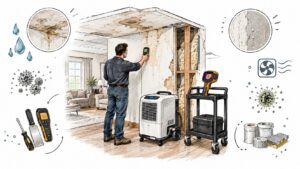
You step into the living room after a midnight storm and hear the carpet squish beneath your shoes. A ceiling stain has spread above the kitchen table, the air conditioner is off, and somewhere behind the wall, insulation or framing may already be holding water. In Georgetown and Austin, that situation demands more than a towel and a box fan. Moisture damage repair starts with safety, source control, and proof that the structure is dry.
When Water Finds Its Way Into Your Home
Central Texas weather makes a wet home harder to manage than it first appears. Summer air can already carry substantial moisture, and a closed house without active air conditioning gives that moisture fewer places to go. Mold can begin growing on damp building materials within 24 to 48 hours when wet areas aren't dried quickly, a timing benchmark referenced in moisture damage guidance for water losses. Drywall, carpet, wood framing, and insulation are especially vulnerable because they absorb water instead of allowing it to run off.
The water source changes the response. A failed supply line may introduce relatively clean water, while an appliance discharge or roof leak can carry contaminants picked up along its path. Sewage backups and floodwater require the highest level of caution because they can contain biological hazards and may make porous contents unsafe to handle or save. The category affects protective equipment, containment, disposal, cleaning, and whether a homeowner should enter the area at all.
The first hour sets the direction
Start with safety, not cleanup. Smell for gas, look for a sagging ceiling, and keep away from standing water until the electrical risk has been evaluated. If water is near outlets, appliances, or the breaker panel, don't step into it to reach a switch. Keep children and pets out of the affected space, and treat any suspected sewage or floodwater as contaminated.
Once the area is safe, stop the source. Close the main water shutoff if a supply line is still running, isolate a fixture if its valve works, and stop using an overflowing appliance. After a storm has passed and conditions are safe, a temporary roof covering can limit additional intrusion, but roof work itself belongs to someone equipped for the hazard. A stopped leak beats a larger drying machine every time. Equipment can't keep up with an active source.
Document what you find before moving contents or tearing anything out. Take time-stamped photos from wide and close angles, record when you discovered the loss, and write down what happened while the sequence is fresh. Save a failed hose, fitting, valve, or other part if it can be stored safely. Evidence becomes harder to interpret after cleanup, and insurance questions often focus on the source, timing, and actions taken.
Practical rule: Don't let visible dryness convince you the job is finished. Water often travels below flooring, behind baseboards, and along framing.
Call a restoration company when water has reached walls, ceilings, insulation, cabinets, subfloors, or multiple rooms. On the first call, provide the address, water source, affected areas, whether the source is stopped, whether electricity is involved, and whether sewage or floodwater may be present. Mention the time of discovery and send photos if requested. That information helps the crew bring extraction equipment, containment materials, meters, and the appropriate protective gear instead of losing time on arrival.
How Professionals Read Moisture You Cannot See
Surface appearance tells only part of the story. A trained technician uses instruments to locate wet materials, trace migration, and compare affected areas with an unaffected reference area in the same structure. That comparison matters in Austin's humid baseline conditions, where a reading that looks low in isolation may still differ significantly from nearby dry materials.
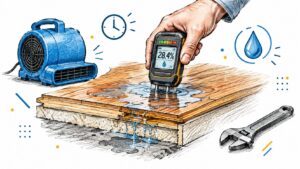
Pin-type meters measure moisture at the probe tips, which makes them useful for checking wood framing, trim, and drywall at specific points. Pinless meters scan a broader surface without leaving probe holes, helping technicians map the edges of a wet zone. Neither tool replaces judgment. A pin meter can miss moisture a short distance away, while a pinless meter can respond to materials, fasteners, and construction layers.
Thermal cameras are valuable for locating temperature differences created by evaporation or wet assemblies, but an infrared image doesn't prove that water is present. The technician confirms suspicious areas with a moisture meter and, when necessary, limited exploratory work. A wall can feel dry at the paint surface while its cavity or framing remains damp.

Why the air matters
Psychrometrics is the practical science of how temperature, humidity, and moisture movement interact. Air movers push evaporated moisture away from wet surfaces, while dehumidifiers remove that moisture from the room. Heat can support evaporation, but heat alone may spread moisture through the building if the air isn't controlled.
Technicians should record repeated readings at fixed points with the same meter and location each day. Moisture mapping for affected structures gives the crew a visual record of where water traveled and whether the drying plan is working. The target isn't a generic number pulled from a chart. It is the original moisture condition or a comparable unaffected area, interpreted by material.
Structural Drying That Reaches Dry Standard
Structural drying is a coordinated process. Extraction removes bulk water, air movement supports evaporation, and dehumidification removes moisture from the air. If one part is missing, progress can stall. Strong air movement without humidity control may redistribute moisture, while a dehumidifier without enough circulation can leave assemblies drying unevenly.
Technicians first remove standing water with equipment suited to the loss. Weighted extraction tools pull water from carpet and pad, while truck-mounted systems handle larger volumes and longer hose runs. Air movers are positioned to move dry air across wet surfaces, and dehumidifiers process the moisture-laden air. Cabinets, wall cavities, and flooring often need a more targeted setup than an open room.
Drying goals must match the material
The IICRC standards overview describes returning affected materials to their pre-loss condition or matching comparable unaffected materials. It also emphasizes repeated instrumented verification and psychrometric control. The IICRC S500 approach commonly uses heated-environment working conditions of about 30 to 50 percent relative humidity, while technicians still account for the building, materials, and outdoor weather instead of chasing one number.
Wood framing is often checked around 12 to 16 percent moisture content, interpreted against unaffected wood. Drywall, subfloors, hardwood, and masonry require material-specific comparisons. A single endpoint can mislead when materials respond differently.
| Material | Target moisture content | Why it matters |
|---|---|---|
| Wood framing | Often around 12 to 16 percent, interpreted against unaffected wood | Moisture can remain inside framing after the surface feels dry |
| Drywall | Compare with unaffected drywall in the same structure | Gypsum and paper facings respond differently from solid wood |
| Subfloors | Compare with unaffected subfloor material | Remaining moisture can cause swelling, odors, or finish failure |
| Hardwood | Compare with unaffected hardwood and account for installation | Dry boards at the surface may still hold moisture below |
| Masonry | Use material-specific comparison | Masonry can retain moisture and release it slowly |
Daily readings should use fixed monitoring points and the same instrument whenever possible. Crews also record indoor and outdoor grains-per-pound values because drying depends on vapor pressure and ambient conditions, not only how a wall feels. Structural drying guidance for Central Texas properties explains why equipment should stay in place until documented goals are met.
In Georgetown, storm humidity can slow evaporation, particularly when uncontrolled outdoor air enters the building. Austin and Georgetown flash-flood losses may also involve water reaching flooring, trim, and wall assemblies faster than a homeowner can assess them. Removing equipment because carpet feels dry is a common DIY mistake. Trapped moisture may later appear as cupped flooring, swollen trim, or musty odor. The drying curve and final readings matter more than the calendar.
Mold Prevention, Testing, and When Remediation Expands
Mold prevention starts while the structure is wet. The 24-to-48-hour window established earlier matters because delayed drying can let damp building materials support mold growth. In Georgetown and Austin, flash-flood losses and humid spring weather can extend that risk when outdoor air enters the building. Fast extraction, controlled air movement, dehumidification, and removal of materials that cannot be dried address the cause more effectively than a later chemical treatment.
Antimicrobial products may help manage affected surfaces, but they do not replace removal of colonized porous materials. Spraying a musty wall without opening and drying the assembly leaves moisture and contamination behind. Deodorization follows the same sequence. Odor treatment is more reliable after technicians remove contamination and correct the conditions producing the smell.
Testing should answer a decision
Mold testing earns its cost when the result changes the work plan. Pre-remediation sampling can document why a larger containment or demolition plan is justified. Clearance sampling after remediation can help confirm that conditions have returned to an appropriate baseline. Routine air testing during a straightforward clean-water loss often does not change the drying or removal scope.
Austin-area outdoor spore levels can rise after spring storms, so an outdoor reference sample may help interpret indoor results. A responsible provider should state the question before collecting samples, explain how the result will affect the scope, and identify its limits. Homeowners should question testing that appears designed only to justify a larger project.
The practical decision depends on the evidence. Promptly dried materials that remain structurally sound and show no microbial amplification may need only targeted mitigation. Visible growth, persistent odor, prolonged saturation, or contaminated water can require containment, removal, cleaning, and verification. The project expands when the condition cannot be controlled through drying and surface treatment alone.
Leak Detection and the Paper Trail That Protects You
The first leak may not be the only failure. A ceiling stain can come from a roof penetration, plumbing line, HVAC condensate problem, or moisture that has traveled from another room. A restoration crew that dries the visible area without investigating the migration path risks leaving the original cause active.
Thermal imaging can reveal temperature anomalies behind walls, and moisture meters can trace how far water moved through floors and partitions. A borescope can inspect a cavity through a small access point rather than opening an entire wall. These tools don't replace plumbing or building-envelope diagnosis, but they help technicians decide where to look before demolition expands.
Central Texas homes may present slab-leak concerns, aging supply connections, and HVAC condensate pan overflows. The correct response depends on the building and the observed evidence, so a recurring stain deserves investigation instead of another coat of paint. If water keeps returning, the drying equipment isn't the root-cause solution.
Records matter after the equipment leaves
A professional file should connect the source, affected materials, actions, and final condition. Keep:
- Time-stamped photographs: Show the original loss, contents, demolition, equipment placement, and completed work.
- Daily moisture readings: Record fixed locations, readings, instrument identification, and comparison materials.
- Psychrometric records: Document indoor and outdoor conditions that explain the drying environment.
- Written scope: Tie proposed work to observed damage rather than vague room descriptions.
- Failed components: Preserve relevant parts when safe and appropriate for claim review.
A detailed progress documentation process gives homeowners a record that remains useful when an adjuster asks what was done and why. It also helps identify changes in scope before they become disputes.
A room full of fans isn't proof of professional drying. The readings, map, source diagnosis, and completion record are what tell the story.
When Reconstruction Becomes Part of the Repair
Some losses finish with extraction, drying, cleaning, and paint. Others require selective demolition and reconstruction because the materials have swollen, delaminated, contaminated, or lost their intended performance. The right response depends on what the inspection and drying records show, not on how quickly a room can be made to look normal.
A solid wood component may be a candidate for drying in place when its structure remains sound. MDF baseboards commonly swell after saturation and may not return to a usable profile. A subfloor with delamination can telegraph movement through tile grout after the surface has been covered. Wet insulation, damaged drywall, cabinetry, and finish flooring may require removal when they can't be cleaned and dried reliably.
Match the response to the loss
A small, isolated spill on a nonporous surface may be manageable with safe cleanup and controlled ventilation. A homeowner should stop the DIY approach when water reaches wall cavities, electrical systems, insulation, multiple rooms, or structural layers. Sewage and floodwater call for trained handling, protective equipment, and appropriate disposal.
A restoration company fits losses that need extraction, moisture mapping, controlled drying, microbial prevention, or claim documentation. A general contractor becomes important when the project includes substantial rebuilding, cabinetry, electrical, plumbing, flooring, or finish coordination. Some companies provide both phases, while others hand reconstruction to a separate builder. Either arrangement can work if the transition preserves the drying records.
Skipping verification creates avoidable risk. New drywall, flooring, cabinets, and paint should not cover materials that haven't reached their documented drying goal. The S500 reference history shows how water damage restoration developed into a standardized discipline focused on inspection, mitigation, drying, and verification rather than appearance alone.
For Georgetown and Austin homeowners, storm-related claims can involve several trades and a long paper trail. Keep the drying completion report with the reconstruction documents. It protects the work by showing that new materials were installed onto a properly evaluated substrate.
Your Moisture Damage Repair Checklist Before the Next Storm
A useful checklist has to work during a stressful event, not just describe restoration in theory. Keep these actions in a utility closet, save the emergency contacts in your phone, and give household members a clear rule about standing water and electrical hazards.
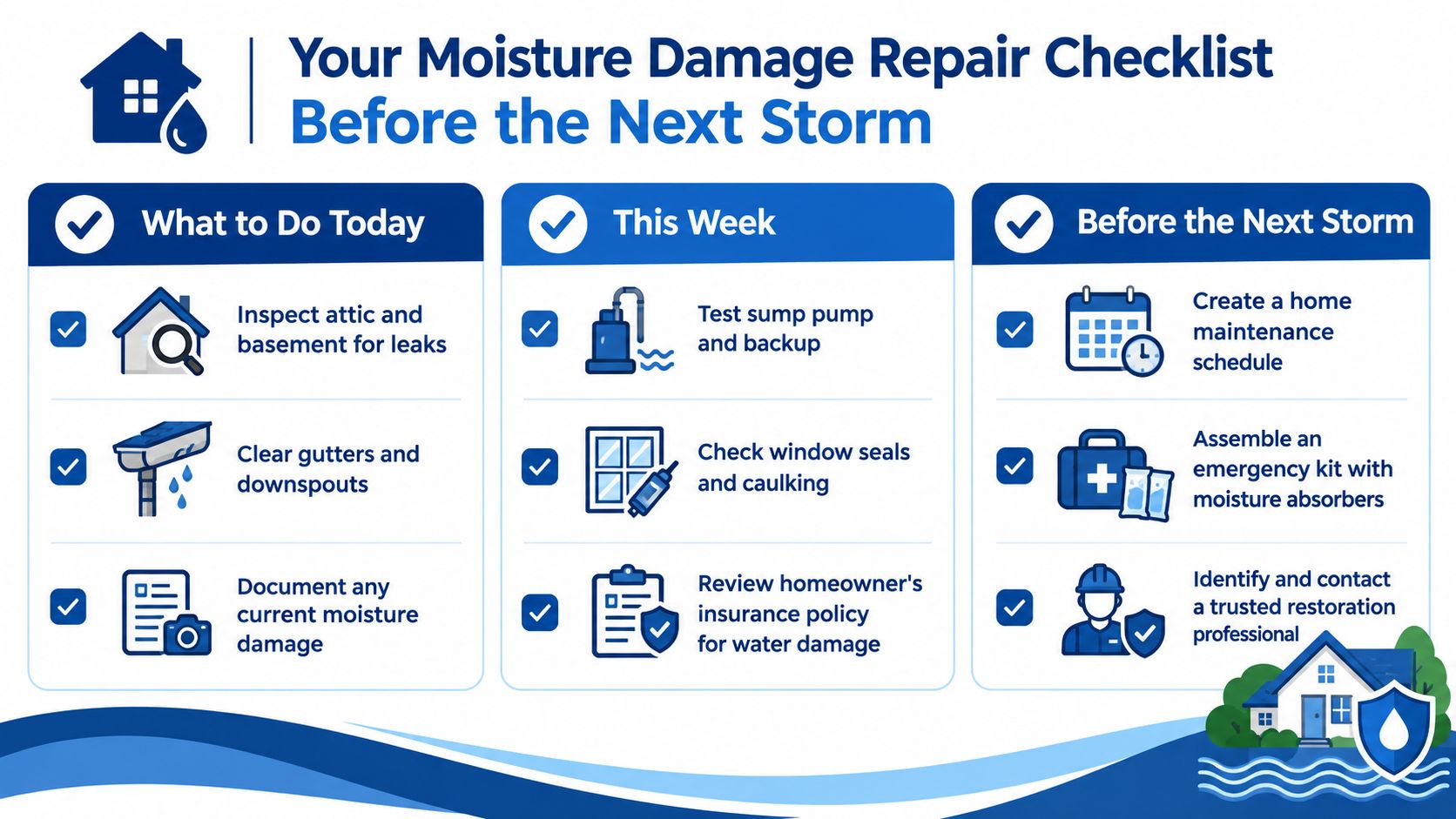
What to do today
If water is entering now, protect people first and stop the source only when it can be done safely. Photograph the affected rooms, contents, ceiling stains, flooring, and failed components before cleanup changes the evidence. Contact a 24/7 response line when the loss involves hidden cavities, contaminated water, structural materials, or more than a small isolated area.
Ask the responding technician how the team will establish a dry standard, where readings will be taken, and how completion will be documented. A credible plan should include moisture mapping, equipment management, repeated readings, and comparison with unaffected materials.
What to do this week
During active drying, keep the monitoring record available. Daily readings should identify the locations checked and show whether the materials are moving toward their target. Check dehumidifier filters and drainage arrangements as instructed, and update the contents inventory as items are moved, cleaned, discarded, or stored.
Use the week to review your insurance policy and record questions for the carrier. Coverage depends on policy language and the event, so don't assume a visible leak automatically determines the claim outcome. Keep every estimate, photograph, invoice, reading log, and change authorization together.
Before the next storm
Inspect grading, gutters, downspouts, roof penetrations, window seals, attic ventilation, HVAC drain pans, and water-heater protection. In Georgetown's heat and storm cycles, small maintenance failures can become interior losses when rain arrives faster than the building can shed it.
Before hiring help, ask whether the provider can supply IICRC-based procedures, psychrometric drying logs, moisture maps, and a final report. RestoTek TX provides inspection, extraction, structural drying, microbial prevention, leak detection, and reconstruction services for Georgetown, Austin, and surrounding Central Texas communities.
If your Georgetown or Austin property has wet flooring, a spreading stain, hidden moisture, or storm-related flooding, contact RestoTek TX for inspection, extraction, documented structural drying, and repair guidance. Ask for a moisture map and drying records so you know the work is complete before reconstruction begins.